WELCOME
P.SREELATHA
TAM/14-24
SIGNAL RANSDUCTION &
PERCEPTION OF AUXIN :
CELL ELONGATION
Physiological effect of auxin : cell elongation
 Auxin promote growth in stems and
coleoptiles ,inhibiting growth in roots
 These are synthesized in shoot apex ad transported
basipitally to lower tissues.
 The outer tissues of dicot stems are the target of auxin
action.
 The minimum lag time for auxin – induced growth is ten
minutes.
 In avena coleoptile an soybean hypocotyle reach the
maximum growth rate after 30 – 60 minutes of
treatments.
 This maximum represents five to ten folds increases over
the basal rate.
Auxin rapidly increases the extensaibility of the cell
wall
 Plant cell expands in three steps:
1) Osmotic uptake of water across the plasma membrane is
driven by the gradient in water potntial.
2) Turgor pressure builds up because of rigidity of the cell
wall.
3)Biochemical wall loosening occurs,allowing the cell to
expand in response to turgor pressure.
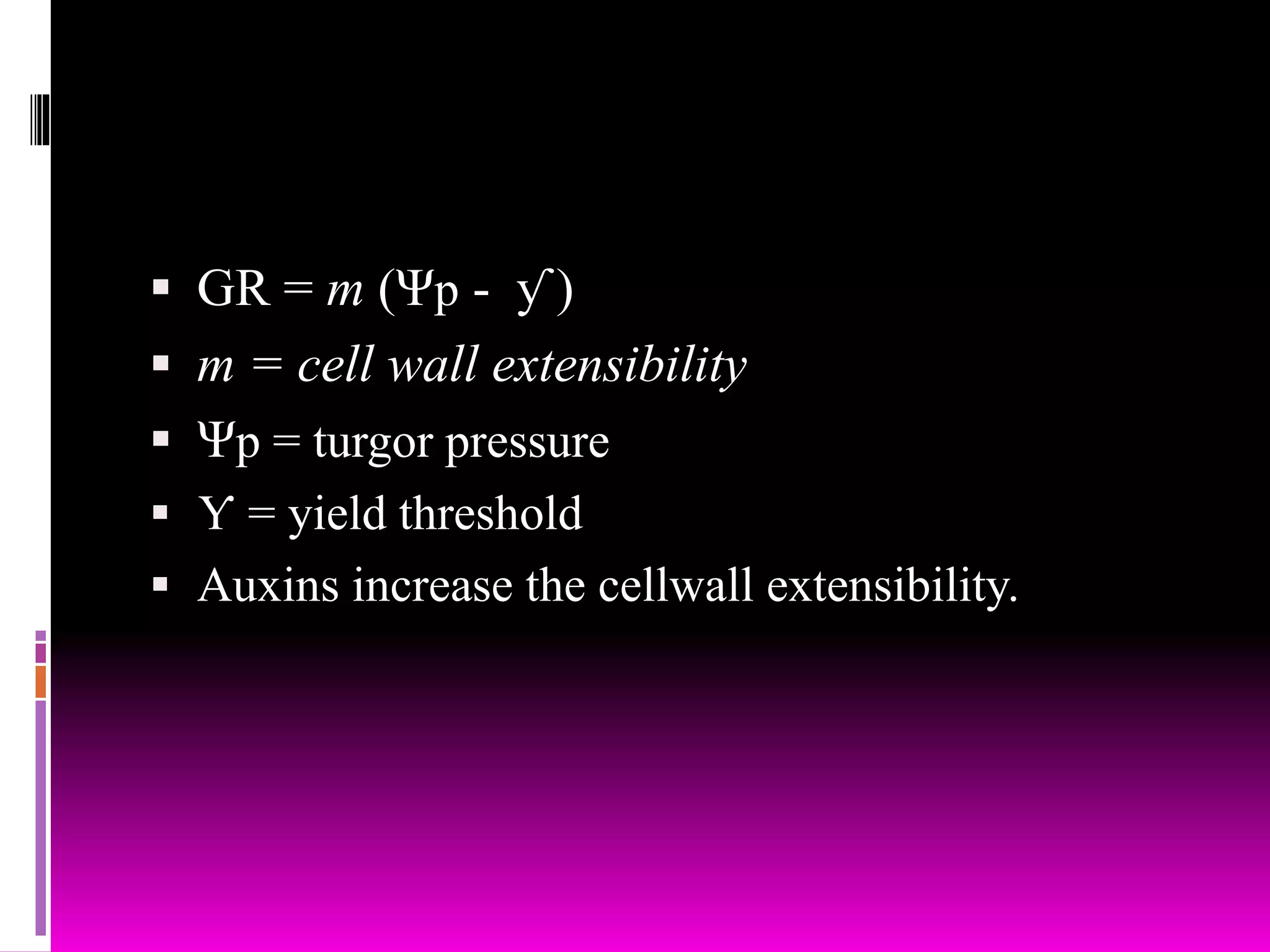
 GR = m (Ψp - ƴ )
 m = cell wall extensibility
 Ψp = turgor pressure
 Ƴ = yield threshold
 Auxins increase the cellwall extensibility.
Auxin induced proton extrusion acidifies the
cellwall and increases the cell extension
 According to acid growth hypothesis hydrogen ion act as
a intermediate between the auxin and cellwall loosening
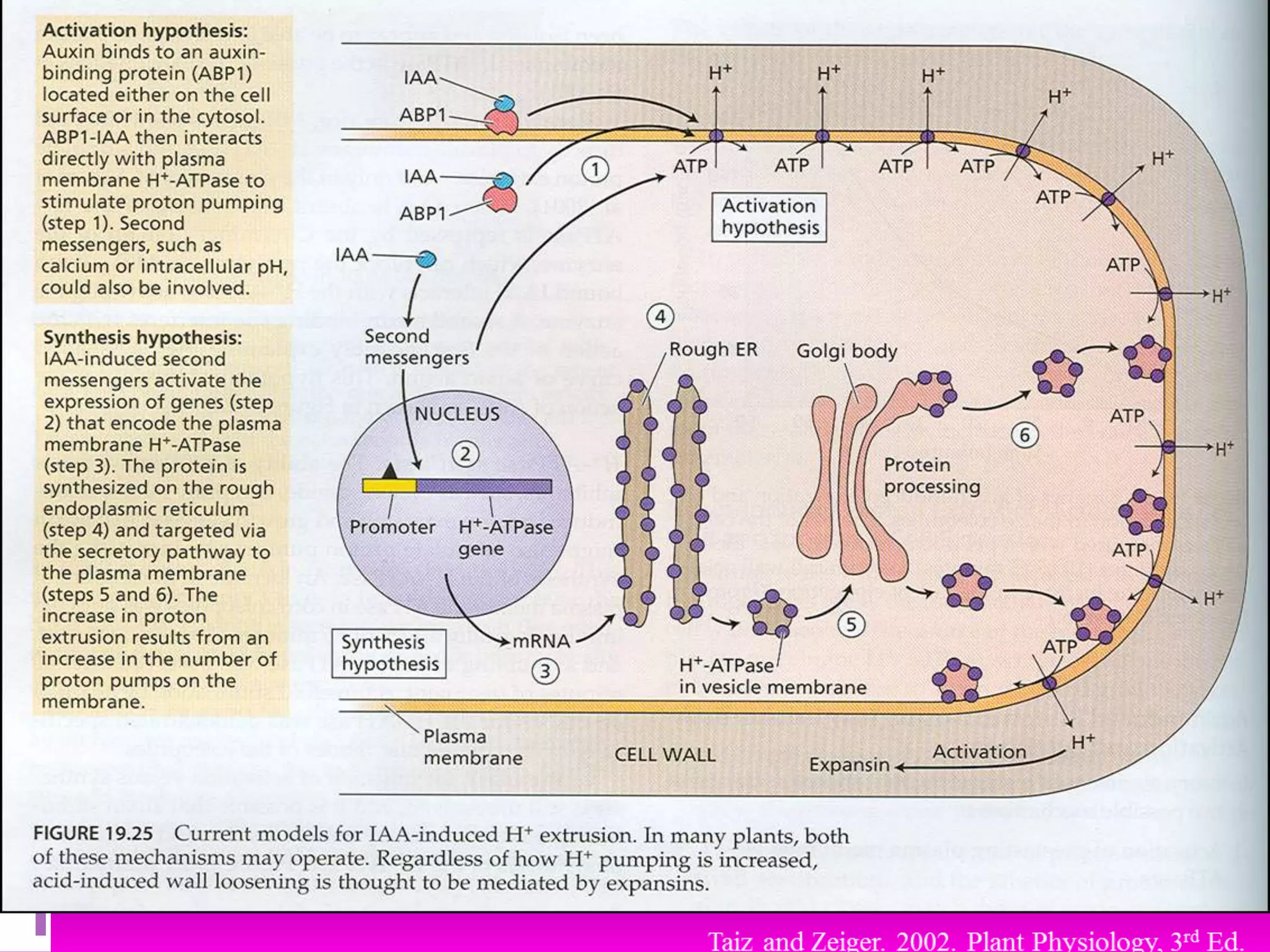
 Source of hydrogen ion is the H+ -ATPase in the plasma
membrane. Whose activity is increase in response to
auxin.
 The acid growth hypothesis allows five main predictions
 1)acid buffers alone should promote short term growth
provided the cuticle has been abraded to allow the
protons access to the cell wall.
2) Auxin should increase the rate of proton extrusion
and kinetics of proton extrusion should closely
match those of auxin induced growth
3) Nutral buffer buffer should inhibit the auxin
induced growth
4) Compuonds that that promote proton extrusion
should stimulate growth
5) Cell wall should contain wall loosening factor with
an acidic ph optimum
Signal transduction pathways
 ABP1 Functions as an auxin receptor
 Calcium and intracellular pH possible signaling
intermediates
 Auxin increases the level of free calcium in the cell.
 Changes in cytoplasmic pH serves as a second messenger
 In plants auxin induces a decrease in cytosolic pH of
about 0.2 times within 4 min of application
 Cytosolic pH is 7.4 ph optimum of plasma membrane H+
ATP ase is 6.5 decreases in cytosolic pH of 0.2 units could
cause a marked increase in the activity of pasma
membrane H+ATP ase
 Decrease in cytosolic pH might also account for auxin
induced increase in free intra cellular calcium by
promoting the dissociation of bound forms
 MAP kinase that play a role in signal transduction by
phosphorylating protiens
 Auxin appears to exert its effect on the cell cycle
primarmarily by stimulating the synthesis of the major
cyclin – dependent protien kinase (CDK):Cdc2(cell
division cycle 2)
 Auxin induced gene fall in to two classes :early and late
 One of the important functions of the signal transduction
pathways iniated when auxin bind to its receptor is the
activation of a select group of transcription factors
 The activated transcription factors enter the nucleus and
promote the expression of specific genes
 Genes whose expression is stimulated by the activation
of pre existing transcription factors are called primary
response genes or early genes
 Early genes expression cannot be blocked by inhibitors
of protein synthesis such as cyclo heximide
 Expression of early genes is very short time ranging
from few minutes to several hours
Primary response genes
1) Some of the early genes encode proteins that regulate
the transcription of secondary response genes
 Because that required for the long term response to the
hormones
 Because late genes requires de novo protein synthesis,
their expression is blocked by protein synthesis
inhibitors
2) other early genes involved in intercellular
communication , or cell to cell signaling
3) another group of early genes is involved in adaptation
to stress
 Five major classes of early auxin responsive genes
have been identified
 Genes involved in auxin regulated growth and
development
1)the Aux/IAA gene family
2)the SAUR gene family
3)the GH3 gene family
 stresess response genes :
4) Genes encoding glutathione s transferase
5) Genes encoding 1 amino cyclopropine 1carboxylic
acid synthase
AUX/IAA gene family:
 These genes encode short lived transcription factors that
function as repressors or activators of the expression of
late auxin inducible genes
 The expression of most of the AUX/IAA family of
genesis stimulated by auxin within 5 to 60 min of
hormone addition
SAUR gene family:
 Auxin stimulate the expression of SAUR genes within 5
to 10 min of treatment.
 Response is insensitive to cycloheximide.
 These are the convenient probe for lateral transport of
auxin during photo and gravitropism.
 GH3 Gene family:
 These genes are found in soybean and arabidopsis
 These are stimulated by within 5 to 10 min
 Mutations in arabidopsis GH3 like genes resulted in
dwarfism and appear function in light regulated auxin
responses
 Because GH3 expression is a good reflection of the
presence of endogenous auxin
 Synthetic GH3 based receptor gene is DR5
 Early genes for stress adoptations:
 Several genes encoding glutathione – s – transferase
 A class of proteins stimulated by various stress
conditions are induced by elevated auxin conc

Auxin signal transduction and perception

  • 1.
  • 2.
  • 3.
    Physiological effect ofauxin : cell elongation  Auxin promote growth in stems and coleoptiles ,inhibiting growth in roots  These are synthesized in shoot apex ad transported basipitally to lower tissues.  The outer tissues of dicot stems are the target of auxin action.  The minimum lag time for auxin – induced growth is ten minutes.  In avena coleoptile an soybean hypocotyle reach the maximum growth rate after 30 – 60 minutes of treatments.  This maximum represents five to ten folds increases over the basal rate.
  • 4.
    Auxin rapidly increasesthe extensaibility of the cell wall  Plant cell expands in three steps: 1) Osmotic uptake of water across the plasma membrane is driven by the gradient in water potntial. 2) Turgor pressure builds up because of rigidity of the cell wall. 3)Biochemical wall loosening occurs,allowing the cell to expand in response to turgor pressure.
  • 5.
     GR =m (Ψp - ƴ )  m = cell wall extensibility  Ψp = turgor pressure  Ƴ = yield threshold  Auxins increase the cellwall extensibility.
  • 6.
    Auxin induced protonextrusion acidifies the cellwall and increases the cell extension  According to acid growth hypothesis hydrogen ion act as a intermediate between the auxin and cellwall loosening  Source of hydrogen ion is the H+ -ATPase in the plasma membrane. Whose activity is increase in response to auxin.  The acid growth hypothesis allows five main predictions  1)acid buffers alone should promote short term growth provided the cuticle has been abraded to allow the protons access to the cell wall.
  • 7.
    2) Auxin shouldincrease the rate of proton extrusion and kinetics of proton extrusion should closely match those of auxin induced growth 3) Nutral buffer buffer should inhibit the auxin induced growth 4) Compuonds that that promote proton extrusion should stimulate growth 5) Cell wall should contain wall loosening factor with an acidic ph optimum
  • 9.
    Signal transduction pathways ABP1 Functions as an auxin receptor  Calcium and intracellular pH possible signaling intermediates  Auxin increases the level of free calcium in the cell.  Changes in cytoplasmic pH serves as a second messenger  In plants auxin induces a decrease in cytosolic pH of about 0.2 times within 4 min of application  Cytosolic pH is 7.4 ph optimum of plasma membrane H+ ATP ase is 6.5 decreases in cytosolic pH of 0.2 units could cause a marked increase in the activity of pasma membrane H+ATP ase
  • 10.
     Decrease incytosolic pH might also account for auxin induced increase in free intra cellular calcium by promoting the dissociation of bound forms  MAP kinase that play a role in signal transduction by phosphorylating protiens  Auxin appears to exert its effect on the cell cycle primarmarily by stimulating the synthesis of the major cyclin – dependent protien kinase (CDK):Cdc2(cell division cycle 2)
  • 11.
     Auxin inducedgene fall in to two classes :early and late  One of the important functions of the signal transduction pathways iniated when auxin bind to its receptor is the activation of a select group of transcription factors  The activated transcription factors enter the nucleus and promote the expression of specific genes  Genes whose expression is stimulated by the activation of pre existing transcription factors are called primary response genes or early genes  Early genes expression cannot be blocked by inhibitors of protein synthesis such as cyclo heximide  Expression of early genes is very short time ranging from few minutes to several hours
  • 12.
    Primary response genes 1)Some of the early genes encode proteins that regulate the transcription of secondary response genes  Because that required for the long term response to the hormones  Because late genes requires de novo protein synthesis, their expression is blocked by protein synthesis inhibitors 2) other early genes involved in intercellular communication , or cell to cell signaling 3) another group of early genes is involved in adaptation to stress
  • 13.
     Five majorclasses of early auxin responsive genes have been identified  Genes involved in auxin regulated growth and development 1)the Aux/IAA gene family 2)the SAUR gene family 3)the GH3 gene family  stresess response genes : 4) Genes encoding glutathione s transferase 5) Genes encoding 1 amino cyclopropine 1carboxylic acid synthase
  • 14.
    AUX/IAA gene family: These genes encode short lived transcription factors that function as repressors or activators of the expression of late auxin inducible genes  The expression of most of the AUX/IAA family of genesis stimulated by auxin within 5 to 60 min of hormone addition SAUR gene family:  Auxin stimulate the expression of SAUR genes within 5 to 10 min of treatment.  Response is insensitive to cycloheximide.  These are the convenient probe for lateral transport of auxin during photo and gravitropism.
  • 15.
     GH3 Genefamily:  These genes are found in soybean and arabidopsis  These are stimulated by within 5 to 10 min  Mutations in arabidopsis GH3 like genes resulted in dwarfism and appear function in light regulated auxin responses  Because GH3 expression is a good reflection of the presence of endogenous auxin  Synthetic GH3 based receptor gene is DR5
  • 16.
     Early genesfor stress adoptations:  Several genes encoding glutathione – s – transferase  A class of proteins stimulated by various stress conditions are induced by elevated auxin conc