Descent with Modification: A
Darwinian View of Life
PowerPoint Lectures for
Biology, Seventh Edition
Neil Campbell and Jane Reece

Lectures by Chris Romero
Copyright © 2005 Pearson Education, Inc. publishing as Benjamin Cummings
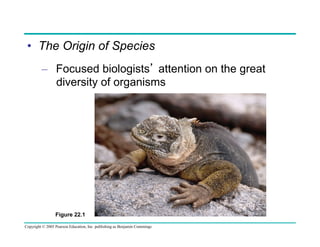
•  The Origin of Species
–  Focused biologists’ attention on the great
diversity of organisms

Figure 22.1
Copyright © 2005 Pearson Education, Inc. publishing as Benjamin Cummings
•  Darwin made two major points in his book
–  He presented evidence that the many species
of organisms presently inhabiting the Earth are
descendants of ancestral species
–  He proposed a mechanism for the evolutionary
process, natural selection

Copyright © 2005 Pearson Education, Inc. publishing as Benjamin Cummings
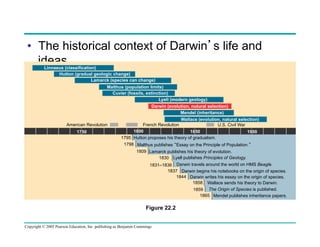
•  The historical context of Darwin’s life and
ideas
Linnaeus (classification)
Hutton (gradual geologic change)
Lamarck (species can change)

Malthus (population limits)
Cuvier (fossils, extinction)
Lyell (modern geology)
Darwin (evolution, nutural selection)
Mendel (inheritance)
American Revolution
1750

Wallace (evolution, natural selection)
French Revolution
U.S. Civil War
1800
1850
1900
1795 Hutton proposes his theory of gradualism.
1798 Malthus publishes “Essay on the Principle of Population.”
1809 Lamarck publishes his theory of evolution.
1830 Lyell publishes Principles of Geology.
1831–1836 Darwin travels around the world on HMS Beagle.
1837 Darwin begins his notebooks on the origin of species.
1844 Darwin writes his essay on the origin of species.
1858 Wallace sends his theory to Darwin.
1859 The Origin of Species is published.
1865 Mendel publishes inheritance papers.

Figure 22.2
Copyright © 2005 Pearson Education, Inc. publishing as Benjamin Cummings
Resistance to the Idea of Evolution
•  The Origin of Species
–  Shook the deepest roots of Western culture
–  Challenged a worldview that had been
prevalent for centuries

Copyright © 2005 Pearson Education, Inc. publishing as Benjamin Cummings
The Scale of Nature and Classification of Species
•  The Greek philosopher Aristotle
–  Viewed species as fixed and unchanging

•  The Old Testament of the Bible
–  Holds that species were individually designed
by God and therefore perfect

Copyright © 2005 Pearson Education, Inc. publishing as Benjamin Cummings
•  Carolus Linnaeus
–  Interpreted organismal adaptations as
evidence that the Creator had designed each
species for a specific purpose
–  Was a founder of taxonomy, classifying life’s
diversity “for the greater glory of God”

Copyright © 2005 Pearson Education, Inc. publishing as Benjamin Cummings
Theories of Gradualism
•  Gradualism
–  Is the idea that profound change can take
place through the cumulative effect of slow but
continuous processes

Copyright © 2005 Pearson Education, Inc. publishing as Benjamin Cummings
•  Geologists Hutton and Lyell
–  Perceived that changes in Earth’s surface can
result from slow continuous actions still
operating today
–  Exerted a strong influence on Darwin’s
thinking

Copyright © 2005 Pearson Education, Inc. publishing as Benjamin Cummings
Lamarck’s Theory of Evolution
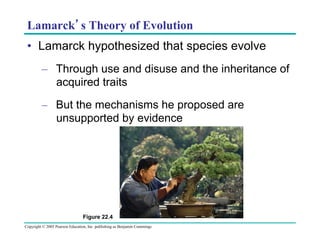
•  Lamarck hypothesized that species evolve
–  Through use and disuse and the inheritance of
acquired traits
–  But the mechanisms he proposed are
unsupported by evidence

Figure 22.4
Copyright © 2005 Pearson Education, Inc. publishing as Benjamin Cummings
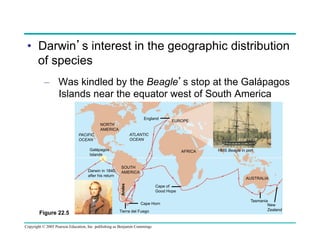
•  Darwin’s interest in the geographic distribution
of species
–  Was kindled by the Beagle’s stop at the Galápagos
Islands near the equator west of South America
England
NORTH
AMERICA

EUROPE

ATLANTIC
OCEAN

PACIFIC
OCEAN
Galápagos
Islands

AUSTRALIA
Cape of
Good Hope
Cape Horn

Figure 22.5

HMS Beagle in port

SOUTH
AMERICA
Andes

Darwin in 1840,
after his return

AFRICA

Tierra del Fuego

Copyright © 2005 Pearson Education, Inc. publishing as Benjamin Cummings

Tasmania
New
Zealand
The Origin of Species
•  Darwin developed two main ideas
–  Evolution explains life’s unity and diversity
–  Natural selection is a cause of adaptive
evolution

Copyright © 2005 Pearson Education, Inc. publishing as Benjamin Cummings
Descent with Modification
•  The phrase descent with modification
–  Summarized Darwin’s perception of the unity
of life
–  States that all organisms are related through
descent from an ancestor that lived in the
remote past

Copyright © 2005 Pearson Education, Inc. publishing as Benjamin Cummings
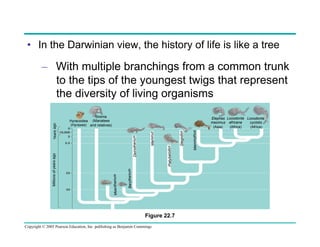
•  In the Darwinian view, the history of life is like a tree

Sirenia
Hyracoidea (Manatees
(Hyraxes) and relatives)

Figure 22.7
Copyright © 2005 Pearson Education, Inc. publishing as Benjamin Cummings

Mammuthus

Stegodon

Platybelodon

Mammut

Barytherium

Deinotherium

Elephas Loxodonta Loxodonta
maximus africana
cyclotis
(Africa)
(Asia)
(Africa)

Moeritherium

Millions of years ago

Years ago

–  With multiple branchings from a common trunk
to the tips of the youngest twigs that represent
the diversity of living organisms
Natural Selection and Adaptation
•  Evolutionary biologist Ernst Mayr
–  Has dissected the logic of Darwin’s theory into
three inferences based on five observations

Copyright © 2005 Pearson Education, Inc. publishing as Benjamin Cummings
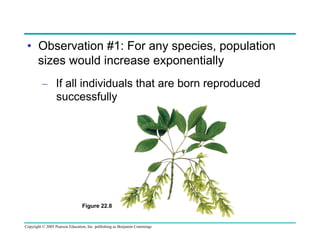
•  Observation #1: For any species, population
sizes would increase exponentially
–  If all individuals that are born reproduced
successfully

Figure 22.8

Copyright © 2005 Pearson Education, Inc. publishing as Benjamin Cummings
•  Observation #2: Nonetheless, populations tend
to be stable in size
–  Except for seasonal fluctuations

•  Observation #3: Resources are limited
•  Inference #1: Production of more individuals
than the environment can support
–  Leads to a struggle for existence among
individuals of a population, with only a fraction
of their offspring surviving
Copyright © 2005 Pearson Education, Inc. publishing as Benjamin Cummings
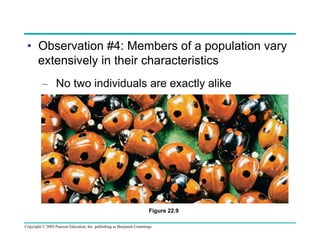
•  Observation #4: Members of a population vary
extensively in their characteristics
–  No two individuals are exactly alike

Figure 22.9
Copyright © 2005 Pearson Education, Inc. publishing as Benjamin Cummings
•  Observation #5: Much of this variation is
heritable
•  Inference #2: Survival depends in part on
inherited traits
–  Individuals whose inherited traits give them a
high probability of surviving and reproducing
are likely to leave more offspring than other
individuals

Copyright © 2005 Pearson Education, Inc. publishing as Benjamin Cummings
•  Inference #3: This unequal ability of individuals
to survive and reproduce
–  Will lead to a gradual change in a population,
with favorable characteristics accumulating
over generations

Copyright © 2005 Pearson Education, Inc. publishing as Benjamin Cummings
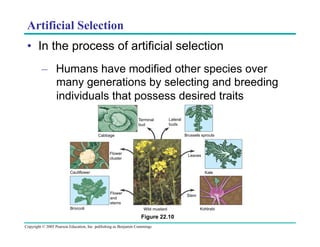
Artificial Selection
•  In the process of artificial selection
–  Humans have modified other species over
many generations by selecting and breeding
individuals that possess desired traits
Terminal
bud

Lateral
buds
Brussels sprouts

Cabbage

Flower
cluster

Leaves

Cauliflower

Kale

Flower
and
stems
Broccoli

Stem
Wild mustard

Figure 22.10
Copyright © 2005 Pearson Education, Inc. publishing as Benjamin Cummings

Kohlrabi
Summary of Natural Selection
•  Natural selection is differential success in
reproduction
–  That results from the interaction between
individuals that vary in heritable traits and their
environment

Copyright © 2005 Pearson Education, Inc. publishing as Benjamin Cummings
•  If an environment changes over time
–  Natural selection may result in adaptation to
these new conditions

Copyright © 2005 Pearson Education, Inc. publishing as Benjamin Cummings
The Evolution of Drug-Resistant HIV	

•  In humans, the use of drugs
–  Selects for pathogens that through chance
mutations are resistant to the drugs’ effects

•  Natural selection is a cause of adaptive
evolution

Copyright © 2005 Pearson Education, Inc. publishing as Benjamin Cummings
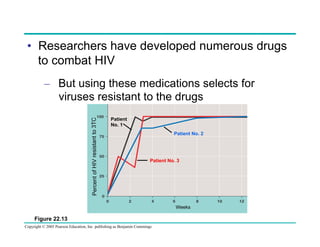
•  Researchers have developed numerous drugs
to combat HIV

Percent of HIV resistant to 3TC

–  But using these medications selects for
viruses resistant to the drugs
Patient
No. 1
Patient No. 2

Patient No. 3

Weeks

Figure 22.13
Copyright © 2005 Pearson Education, Inc. publishing as Benjamin Cummings
Molecular Homologies
•  Biologists also observe homologies among
organisms at the molecular level
–  Such as genes that are shared among
organisms inherited from a common ancestor

Copyright © 2005 Pearson Education, Inc. publishing as Benjamin Cummings
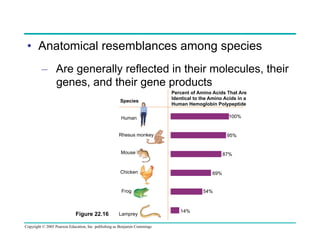
•  Anatomical resemblances among species
–  Are generally reflected in their molecules, their
genes, and their gene products
Species

Percent of Amino Acids That Are
Identical to the Amino Acids in a
Human Hemoglobin Polypeptide
100%

Human
Rhesus monkey

95%

Mouse

87%

Chicken

69%

Frog

Figure 22.16

Lamprey

Copyright © 2005 Pearson Education, Inc. publishing as Benjamin Cummings

54%

14%
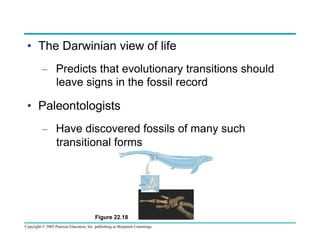
•  The Darwinian view of life
–  Predicts that evolutionary transitions should
leave signs in the fossil record

•  Paleontologists
–  Have discovered fossils of many such
transitional forms

Figure 22.18
Copyright © 2005 Pearson Education, Inc. publishing as Benjamin Cummings
What Is Theoretical about the Darwinian View of Life?

•  In science, a theory
–  Accounts for many observations and data and
attempts to explain and integrate a great
variety of phenomena

Copyright © 2005 Pearson Education, Inc. publishing as Benjamin Cummings
•  New information has revised our understanding
of the tree of life
•  Molecular Data
–  Have provided new insights in recent decades
regarding the deepest branches of the tree of
life

Copyright © 2005 Pearson Education, Inc. publishing as Benjamin Cummings
Previous Taxonomic Systems
•  Early classification systems had two kingdoms
–  Plants and animals

Copyright © 2005 Pearson Education, Inc. publishing as Benjamin Cummings
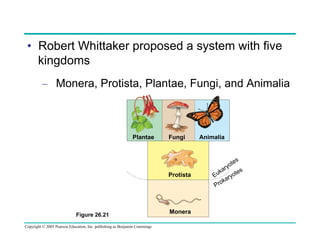
•  Robert Whittaker proposed a system with five
kingdoms
–  Monera, Protista, Plantae, Fungi, and Animalia

Plantae

Fungi

Protista

Figure 26.21
Copyright © 2005 Pearson Education, Inc. publishing as Benjamin Cummings

Monera

Animalia
Reconstructing the Tree of Life: A Work in Progress

•  A three domain system
–  Has replaced the five kingdom system
–  Includes the domains Archaea, Bacteria, and
Eukarya

•  Each domain
–  Has been split by taxonomists into many
kingdoms

Copyright © 2005 Pearson Education, Inc. publishing as Benjamin Cummings
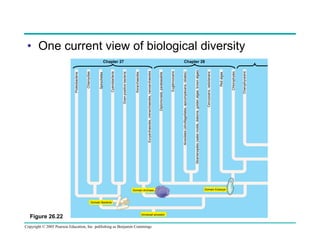
Figure 26.22

Copyright © 2005 Pearson Education, Inc. publishing as Benjamin Cummings
Domain Archaea

Domain Bacteria

Universal ancestor
Domain Eukarya

Charophyceans

Chlorophytes

Red algae

Cercozoans, radiolarians

Stramenopiles (water molds, diatoms, golden algae, brown algae)

Chapter 27

Alveolates (dinoflagellates, apicomplexans, ciliates)

Euglenozoans

Diplomonads, parabasalids

Euryarchaeotes, crenarchaeotes, nanoarchaeotes

Korarchaeotes

Gram-positive bacteria

Cyanobacteria

Spirochetes

Chlamydias

Proteobacteria

•  One current view of biological diversity
Chapter 28
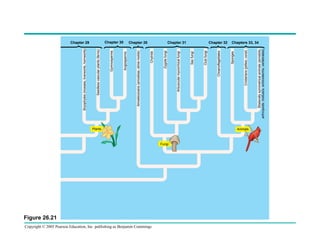
Figure 26.21

Copyright © 2005 Pearson Education, Inc. publishing as Benjamin Cummings
Plants

Fungi
Animals

Bilaterally symmetrical animals (annelids,
arthropods, molluscs, echinoderms, vertebrates)

Cnidarians (jellies, coral)

Chapter 32
Sponges

Chapter 31
Choanoflagellates

Club fungi

Sac fungi

Chapter 28
Arbuscular mycorrhizal fungi

Zygote fungi

Chytrids

Chapter 30
Amoebozoans (amoebas, slime molds)

Angiosperms

Gymnosperms

Seedless vascular plants (ferns)

Bryophytes (mosses, liverworts, hornworts)

Chapter 29
Chapters 33, 34
•  Concept 25.2: Phylogenetic systematics
connects classification with evolutionary history
•  Taxonomy
–  Is the ordered division of organisms into
categories based on a set of characteristics
used to assess similarities and differences

Copyright © 2005 Pearson Education, Inc. publishing as Benjamin Cummings
Binomial Nomenclature
•  Binomial nomenclature
–  Is the two-part format of the scientific name of
an organism
–  Was developed by Carolus Linnaeus

Copyright © 2005 Pearson Education, Inc. publishing as Benjamin Cummings
•  The binomial name of an organism or scientific
epithet
–  Is latinized
–  Is the genus and species

Copyright © 2005 Pearson Education, Inc. publishing as Benjamin Cummings
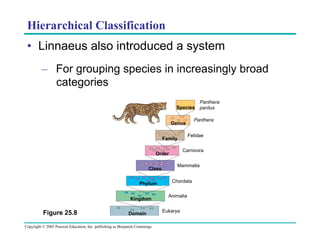
Hierarchical Classification
•  Linnaeus also introduced a system
–  For grouping species in increasingly broad
categories
Panthera
Species pardus
Panthera

Genus

Felidae

Family

Carnivora

Order
Class
Phylum
Kingdom

Figure 25.8

Domain

Copyright © 2005 Pearson Education, Inc. publishing as Benjamin Cummings

Mammalia
Chordata
Animalia
Eukarya
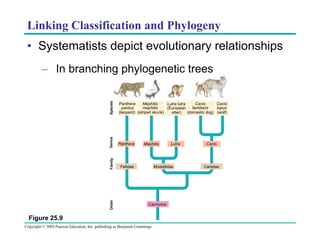
Linking Classification and Phylogeny
•  Systematists depict evolutionary relationships

Species

Panthera

Order

Family

Panthera
Mephitis
Canis
Canis
Lutra lutra
pardus
mephitis
familiaris
lupus
(European
(leopard) (striped skunk)
otter) (domestic dog) (wolf)

Genus

–  In branching phylogenetic trees

Mephitis

Felidae

Lutra

Mustelidae

Carnivora

Figure 25.9
Copyright © 2005 Pearson Education, Inc. publishing as Benjamin Cummings

Canis

Canidae
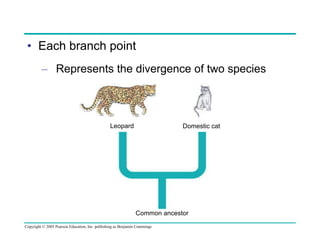
•  Each branch point
–  Represents the divergence of two species

Leopard

Domestic cat

Common ancestor
Copyright © 2005 Pearson Education, Inc. publishing as Benjamin Cummings
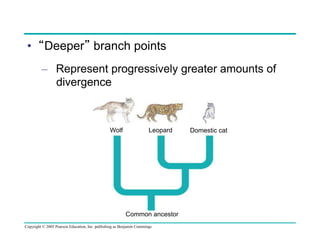
•  “Deeper” branch points
–  Represent progressively greater amounts of
divergence

Wolf

Leopard

Common ancestor
Copyright © 2005 Pearson Education, Inc. publishing as Benjamin Cummings

Domestic cat
•  Concept 25.3: Phylogenetic systematics informs the
construction of phylogenetic trees based on shared
characteristics
•  A cladogram
–  Is a depiction of patterns of shared characteristics
among taxa

•  A clade within a cladogram
–  Is defined as a group of species that includes an
ancestral species and all its descendants

•  Cladistics
–  Is the study of resemblances among clades
Copyright © 2005 Pearson Education, Inc. publishing as Benjamin Cummings
Cladistics
•  Clades
–  Can be nested within larger clades, but not all
groupings or organisms qualify as clades

Copyright © 2005 Pearson Education, Inc. publishing as Benjamin Cummings
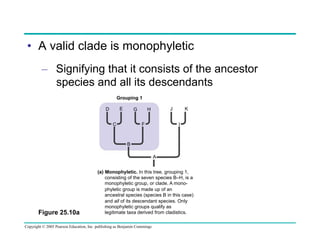
•  A valid clade is monophyletic
–  Signifying that it consists of the ancestor
species and all its descendants
Grouping 1
E

D

J

H

G
F

C

K
I

B
A

Figure 25.10a

(a) Monophyletic. In this tree, grouping 1,
consisting of the seven species B–H, is a
monophyletic group, or clade. A monophyletic group is made up of an
ancestral species (species B in this case)
and all of its descendant species. Only
monophyletic groups qualify as
legitimate taxa derived from cladistics.

Copyright © 2005 Pearson Education, Inc. publishing as Benjamin Cummings
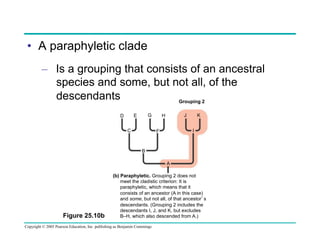
•  A paraphyletic clade
–  Is a grouping that consists of an ancestral
species and some, but not all, of the
descendants
Grouping 2
G

E

D
C

J

H

K
I

F

B
A

Figure 25.10b

(b) Paraphyletic. Grouping 2 does not
meet the cladistic criterion: It is
paraphyletic, which means that it
consists of an ancestor (A in this case)
and some, but not all, of that ancestor’s
descendants. (Grouping 2 includes the
descendants I, J, and K, but excludes
B–H, which also descended from A.)

Copyright © 2005 Pearson Education, Inc. publishing as Benjamin Cummings
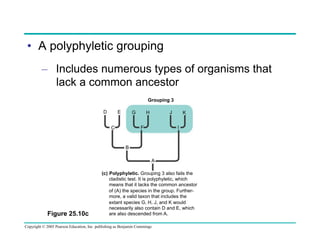
•  A polyphyletic grouping
–  Includes numerous types of organisms that
lack a common ancestor
Grouping 3
D

E

G

J

H

I

F

C

K

B
A

Figure 25.10c

(c) Polyphyletic. Grouping 3 also fails the
cladistic test. It is polyphyletic, which
means that it lacks the common ancestor
of (A) the species in the group. Furthermore, a valid taxon that includes the
extant species G, H, J, and K would
necessarily also contain D and E, which
are also descended from A.

Copyright © 2005 Pearson Education, Inc. publishing as Benjamin Cummings
Shared Primitive and Shared Derived Characteristics

•  In cladistic analysis
–  Clades are defined by their evolutionary
novelties

Copyright © 2005 Pearson Education, Inc. publishing as Benjamin Cummings
•  A shared primitive character
–  Is a homologous structure that predates the
branching of a particular clade from other
members of that clade
–  Is shared beyond the taxon we are trying to
define

Copyright © 2005 Pearson Education, Inc. publishing as Benjamin Cummings
•  A shared derived character
–  Is an evolutionary novelty unique to a particular
clade

Copyright © 2005 Pearson Education, Inc. publishing as Benjamin Cummings
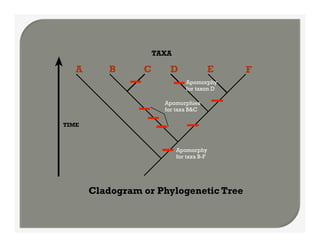
TAXA

A

B

C

D

E
Apomorphy
for taxon D

Apomorphies
for taxa B&C
TIME

Apomorphy
for taxa B-F

Cladogram or Phylogenetic Tree

F
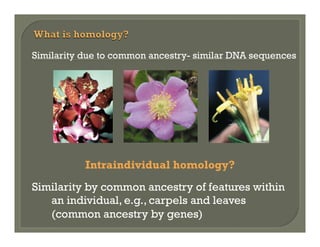
Similarity due to common ancestry- similar DNA sequences

Intraindividual homology?
Similarity by common ancestry of features within
an individual, e.g., carpels and leaves
(common ancestry by genes)
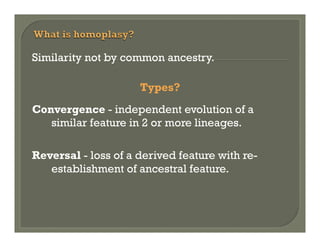
Similarity not by common ancestry.
Types?
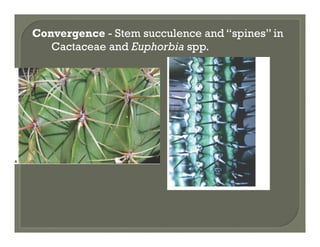
Convergence - independent evolution of a
similar feature in 2 or more lineages.
Reversal - loss of a derived feature with reestablishment of ancestral feature.
Convergence - Stem succulence and “spines” in
Cactaceae and Euphorbia spp.
Evolution and systematics.ppt

Evolution and systematics.ppt

  • 1.
    Descent with Modification:A Darwinian View of Life PowerPoint Lectures for Biology, Seventh Edition Neil Campbell and Jane Reece Lectures by Chris Romero Copyright © 2005 Pearson Education, Inc. publishing as Benjamin Cummings
  • 2.
    •  The Originof Species –  Focused biologists’ attention on the great diversity of organisms Figure 22.1 Copyright © 2005 Pearson Education, Inc. publishing as Benjamin Cummings
  • 3.
    •  Darwin madetwo major points in his book –  He presented evidence that the many species of organisms presently inhabiting the Earth are descendants of ancestral species –  He proposed a mechanism for the evolutionary process, natural selection Copyright © 2005 Pearson Education, Inc. publishing as Benjamin Cummings
  • 4.
    •  The historicalcontext of Darwin’s life and ideas Linnaeus (classification) Hutton (gradual geologic change) Lamarck (species can change) Malthus (population limits) Cuvier (fossils, extinction) Lyell (modern geology) Darwin (evolution, nutural selection) Mendel (inheritance) American Revolution 1750 Wallace (evolution, natural selection) French Revolution U.S. Civil War 1800 1850 1900 1795 Hutton proposes his theory of gradualism. 1798 Malthus publishes “Essay on the Principle of Population.” 1809 Lamarck publishes his theory of evolution. 1830 Lyell publishes Principles of Geology. 1831–1836 Darwin travels around the world on HMS Beagle. 1837 Darwin begins his notebooks on the origin of species. 1844 Darwin writes his essay on the origin of species. 1858 Wallace sends his theory to Darwin. 1859 The Origin of Species is published. 1865 Mendel publishes inheritance papers. Figure 22.2 Copyright © 2005 Pearson Education, Inc. publishing as Benjamin Cummings
  • 5.
    Resistance to theIdea of Evolution •  The Origin of Species –  Shook the deepest roots of Western culture –  Challenged a worldview that had been prevalent for centuries Copyright © 2005 Pearson Education, Inc. publishing as Benjamin Cummings
  • 6.
    The Scale ofNature and Classification of Species •  The Greek philosopher Aristotle –  Viewed species as fixed and unchanging •  The Old Testament of the Bible –  Holds that species were individually designed by God and therefore perfect Copyright © 2005 Pearson Education, Inc. publishing as Benjamin Cummings
  • 7.
    •  Carolus Linnaeus – Interpreted organismal adaptations as evidence that the Creator had designed each species for a specific purpose –  Was a founder of taxonomy, classifying life’s diversity “for the greater glory of God” Copyright © 2005 Pearson Education, Inc. publishing as Benjamin Cummings
  • 8.
    Theories of Gradualism • Gradualism –  Is the idea that profound change can take place through the cumulative effect of slow but continuous processes Copyright © 2005 Pearson Education, Inc. publishing as Benjamin Cummings
  • 9.
    •  Geologists Huttonand Lyell –  Perceived that changes in Earth’s surface can result from slow continuous actions still operating today –  Exerted a strong influence on Darwin’s thinking Copyright © 2005 Pearson Education, Inc. publishing as Benjamin Cummings
  • 10.
    Lamarck’s Theory ofEvolution •  Lamarck hypothesized that species evolve –  Through use and disuse and the inheritance of acquired traits –  But the mechanisms he proposed are unsupported by evidence Figure 22.4 Copyright © 2005 Pearson Education, Inc. publishing as Benjamin Cummings
  • 11.
    •  Darwin’s interestin the geographic distribution of species –  Was kindled by the Beagle’s stop at the Galápagos Islands near the equator west of South America England NORTH AMERICA EUROPE ATLANTIC OCEAN PACIFIC OCEAN Galápagos Islands AUSTRALIA Cape of Good Hope Cape Horn Figure 22.5 HMS Beagle in port SOUTH AMERICA Andes Darwin in 1840, after his return AFRICA Tierra del Fuego Copyright © 2005 Pearson Education, Inc. publishing as Benjamin Cummings Tasmania New Zealand
  • 12.
    The Origin ofSpecies •  Darwin developed two main ideas –  Evolution explains life’s unity and diversity –  Natural selection is a cause of adaptive evolution Copyright © 2005 Pearson Education, Inc. publishing as Benjamin Cummings
  • 13.
    Descent with Modification • The phrase descent with modification –  Summarized Darwin’s perception of the unity of life –  States that all organisms are related through descent from an ancestor that lived in the remote past Copyright © 2005 Pearson Education, Inc. publishing as Benjamin Cummings
  • 14.
    •  In theDarwinian view, the history of life is like a tree Sirenia Hyracoidea (Manatees (Hyraxes) and relatives) Figure 22.7 Copyright © 2005 Pearson Education, Inc. publishing as Benjamin Cummings Mammuthus Stegodon Platybelodon Mammut Barytherium Deinotherium Elephas Loxodonta Loxodonta maximus africana cyclotis (Africa) (Asia) (Africa) Moeritherium Millions of years ago Years ago –  With multiple branchings from a common trunk to the tips of the youngest twigs that represent the diversity of living organisms
  • 15.
    Natural Selection andAdaptation •  Evolutionary biologist Ernst Mayr –  Has dissected the logic of Darwin’s theory into three inferences based on five observations Copyright © 2005 Pearson Education, Inc. publishing as Benjamin Cummings
  • 16.
    •  Observation #1:For any species, population sizes would increase exponentially –  If all individuals that are born reproduced successfully Figure 22.8 Copyright © 2005 Pearson Education, Inc. publishing as Benjamin Cummings
  • 17.
    •  Observation #2:Nonetheless, populations tend to be stable in size –  Except for seasonal fluctuations •  Observation #3: Resources are limited •  Inference #1: Production of more individuals than the environment can support –  Leads to a struggle for existence among individuals of a population, with only a fraction of their offspring surviving Copyright © 2005 Pearson Education, Inc. publishing as Benjamin Cummings
  • 18.
    •  Observation #4:Members of a population vary extensively in their characteristics –  No two individuals are exactly alike Figure 22.9 Copyright © 2005 Pearson Education, Inc. publishing as Benjamin Cummings
  • 19.
    •  Observation #5:Much of this variation is heritable •  Inference #2: Survival depends in part on inherited traits –  Individuals whose inherited traits give them a high probability of surviving and reproducing are likely to leave more offspring than other individuals Copyright © 2005 Pearson Education, Inc. publishing as Benjamin Cummings
  • 20.
    •  Inference #3:This unequal ability of individuals to survive and reproduce –  Will lead to a gradual change in a population, with favorable characteristics accumulating over generations Copyright © 2005 Pearson Education, Inc. publishing as Benjamin Cummings
  • 21.
    Artificial Selection •  Inthe process of artificial selection –  Humans have modified other species over many generations by selecting and breeding individuals that possess desired traits Terminal bud Lateral buds Brussels sprouts Cabbage Flower cluster Leaves Cauliflower Kale Flower and stems Broccoli Stem Wild mustard Figure 22.10 Copyright © 2005 Pearson Education, Inc. publishing as Benjamin Cummings Kohlrabi
  • 22.
    Summary of NaturalSelection •  Natural selection is differential success in reproduction –  That results from the interaction between individuals that vary in heritable traits and their environment Copyright © 2005 Pearson Education, Inc. publishing as Benjamin Cummings
  • 23.
    •  If anenvironment changes over time –  Natural selection may result in adaptation to these new conditions Copyright © 2005 Pearson Education, Inc. publishing as Benjamin Cummings
  • 24.
    The Evolution ofDrug-Resistant HIV •  In humans, the use of drugs –  Selects for pathogens that through chance mutations are resistant to the drugs’ effects •  Natural selection is a cause of adaptive evolution Copyright © 2005 Pearson Education, Inc. publishing as Benjamin Cummings
  • 25.
    •  Researchers havedeveloped numerous drugs to combat HIV Percent of HIV resistant to 3TC –  But using these medications selects for viruses resistant to the drugs Patient No. 1 Patient No. 2 Patient No. 3 Weeks Figure 22.13 Copyright © 2005 Pearson Education, Inc. publishing as Benjamin Cummings
  • 26.
    Molecular Homologies •  Biologistsalso observe homologies among organisms at the molecular level –  Such as genes that are shared among organisms inherited from a common ancestor Copyright © 2005 Pearson Education, Inc. publishing as Benjamin Cummings
  • 27.
    •  Anatomical resemblancesamong species –  Are generally reflected in their molecules, their genes, and their gene products Species Percent of Amino Acids That Are Identical to the Amino Acids in a Human Hemoglobin Polypeptide 100% Human Rhesus monkey 95% Mouse 87% Chicken 69% Frog Figure 22.16 Lamprey Copyright © 2005 Pearson Education, Inc. publishing as Benjamin Cummings 54% 14%
  • 28.
    •  The Darwinianview of life –  Predicts that evolutionary transitions should leave signs in the fossil record •  Paleontologists –  Have discovered fossils of many such transitional forms Figure 22.18 Copyright © 2005 Pearson Education, Inc. publishing as Benjamin Cummings
  • 29.
    What Is Theoreticalabout the Darwinian View of Life? •  In science, a theory –  Accounts for many observations and data and attempts to explain and integrate a great variety of phenomena Copyright © 2005 Pearson Education, Inc. publishing as Benjamin Cummings
  • 30.
    •  New informationhas revised our understanding of the tree of life •  Molecular Data –  Have provided new insights in recent decades regarding the deepest branches of the tree of life Copyright © 2005 Pearson Education, Inc. publishing as Benjamin Cummings
  • 31.
    Previous Taxonomic Systems • Early classification systems had two kingdoms –  Plants and animals Copyright © 2005 Pearson Education, Inc. publishing as Benjamin Cummings
  • 32.
    •  Robert Whittakerproposed a system with five kingdoms –  Monera, Protista, Plantae, Fungi, and Animalia Plantae Fungi Protista Figure 26.21 Copyright © 2005 Pearson Education, Inc. publishing as Benjamin Cummings Monera Animalia
  • 33.
    Reconstructing the Treeof Life: A Work in Progress •  A three domain system –  Has replaced the five kingdom system –  Includes the domains Archaea, Bacteria, and Eukarya •  Each domain –  Has been split by taxonomists into many kingdoms Copyright © 2005 Pearson Education, Inc. publishing as Benjamin Cummings
  • 34.
    Figure 26.22 Copyright ©2005 Pearson Education, Inc. publishing as Benjamin Cummings Domain Archaea Domain Bacteria Universal ancestor Domain Eukarya Charophyceans Chlorophytes Red algae Cercozoans, radiolarians Stramenopiles (water molds, diatoms, golden algae, brown algae) Chapter 27 Alveolates (dinoflagellates, apicomplexans, ciliates) Euglenozoans Diplomonads, parabasalids Euryarchaeotes, crenarchaeotes, nanoarchaeotes Korarchaeotes Gram-positive bacteria Cyanobacteria Spirochetes Chlamydias Proteobacteria •  One current view of biological diversity Chapter 28
  • 35.
    Figure 26.21 Copyright ©2005 Pearson Education, Inc. publishing as Benjamin Cummings Plants Fungi Animals Bilaterally symmetrical animals (annelids, arthropods, molluscs, echinoderms, vertebrates) Cnidarians (jellies, coral) Chapter 32 Sponges Chapter 31 Choanoflagellates Club fungi Sac fungi Chapter 28 Arbuscular mycorrhizal fungi Zygote fungi Chytrids Chapter 30 Amoebozoans (amoebas, slime molds) Angiosperms Gymnosperms Seedless vascular plants (ferns) Bryophytes (mosses, liverworts, hornworts) Chapter 29 Chapters 33, 34
  • 36.
    •  Concept 25.2:Phylogenetic systematics connects classification with evolutionary history •  Taxonomy –  Is the ordered division of organisms into categories based on a set of characteristics used to assess similarities and differences Copyright © 2005 Pearson Education, Inc. publishing as Benjamin Cummings
  • 37.
    Binomial Nomenclature •  Binomialnomenclature –  Is the two-part format of the scientific name of an organism –  Was developed by Carolus Linnaeus Copyright © 2005 Pearson Education, Inc. publishing as Benjamin Cummings
  • 38.
    •  The binomialname of an organism or scientific epithet –  Is latinized –  Is the genus and species Copyright © 2005 Pearson Education, Inc. publishing as Benjamin Cummings
  • 39.
    Hierarchical Classification •  Linnaeusalso introduced a system –  For grouping species in increasingly broad categories Panthera Species pardus Panthera Genus Felidae Family Carnivora Order Class Phylum Kingdom Figure 25.8 Domain Copyright © 2005 Pearson Education, Inc. publishing as Benjamin Cummings Mammalia Chordata Animalia Eukarya
  • 40.
    Linking Classification andPhylogeny •  Systematists depict evolutionary relationships Species Panthera Order Family Panthera Mephitis Canis Canis Lutra lutra pardus mephitis familiaris lupus (European (leopard) (striped skunk) otter) (domestic dog) (wolf) Genus –  In branching phylogenetic trees Mephitis Felidae Lutra Mustelidae Carnivora Figure 25.9 Copyright © 2005 Pearson Education, Inc. publishing as Benjamin Cummings Canis Canidae
  • 41.
    •  Each branchpoint –  Represents the divergence of two species Leopard Domestic cat Common ancestor Copyright © 2005 Pearson Education, Inc. publishing as Benjamin Cummings
  • 42.
    •  “Deeper” branchpoints –  Represent progressively greater amounts of divergence Wolf Leopard Common ancestor Copyright © 2005 Pearson Education, Inc. publishing as Benjamin Cummings Domestic cat
  • 43.
    •  Concept 25.3:Phylogenetic systematics informs the construction of phylogenetic trees based on shared characteristics •  A cladogram –  Is a depiction of patterns of shared characteristics among taxa •  A clade within a cladogram –  Is defined as a group of species that includes an ancestral species and all its descendants •  Cladistics –  Is the study of resemblances among clades Copyright © 2005 Pearson Education, Inc. publishing as Benjamin Cummings
  • 44.
    Cladistics •  Clades –  Canbe nested within larger clades, but not all groupings or organisms qualify as clades Copyright © 2005 Pearson Education, Inc. publishing as Benjamin Cummings
  • 45.
    •  A validclade is monophyletic –  Signifying that it consists of the ancestor species and all its descendants Grouping 1 E D J H G F C K I B A Figure 25.10a (a) Monophyletic. In this tree, grouping 1, consisting of the seven species B–H, is a monophyletic group, or clade. A monophyletic group is made up of an ancestral species (species B in this case) and all of its descendant species. Only monophyletic groups qualify as legitimate taxa derived from cladistics. Copyright © 2005 Pearson Education, Inc. publishing as Benjamin Cummings
  • 46.
    •  A paraphyleticclade –  Is a grouping that consists of an ancestral species and some, but not all, of the descendants Grouping 2 G E D C J H K I F B A Figure 25.10b (b) Paraphyletic. Grouping 2 does not meet the cladistic criterion: It is paraphyletic, which means that it consists of an ancestor (A in this case) and some, but not all, of that ancestor’s descendants. (Grouping 2 includes the descendants I, J, and K, but excludes B–H, which also descended from A.) Copyright © 2005 Pearson Education, Inc. publishing as Benjamin Cummings
  • 47.
    •  A polyphyleticgrouping –  Includes numerous types of organisms that lack a common ancestor Grouping 3 D E G J H I F C K B A Figure 25.10c (c) Polyphyletic. Grouping 3 also fails the cladistic test. It is polyphyletic, which means that it lacks the common ancestor of (A) the species in the group. Furthermore, a valid taxon that includes the extant species G, H, J, and K would necessarily also contain D and E, which are also descended from A. Copyright © 2005 Pearson Education, Inc. publishing as Benjamin Cummings
  • 48.
    Shared Primitive andShared Derived Characteristics •  In cladistic analysis –  Clades are defined by their evolutionary novelties Copyright © 2005 Pearson Education, Inc. publishing as Benjamin Cummings
  • 49.
    •  A sharedprimitive character –  Is a homologous structure that predates the branching of a particular clade from other members of that clade –  Is shared beyond the taxon we are trying to define Copyright © 2005 Pearson Education, Inc. publishing as Benjamin Cummings
  • 50.
    •  A sharedderived character –  Is an evolutionary novelty unique to a particular clade Copyright © 2005 Pearson Education, Inc. publishing as Benjamin Cummings
  • 51.
    TAXA A B C D E Apomorphy for taxon D Apomorphies fortaxa B&C TIME Apomorphy for taxa B-F Cladogram or Phylogenetic Tree F
  • 52.
    Similarity due tocommon ancestry- similar DNA sequences Intraindividual homology? Similarity by common ancestry of features within an individual, e.g., carpels and leaves (common ancestry by genes)
  • 53.
    Similarity not bycommon ancestry. Types? Convergence - independent evolution of a similar feature in 2 or more lineages. Reversal - loss of a derived feature with reestablishment of ancestral feature.
  • 54.
    Convergence - Stemsucculence and “spines” in Cactaceae and Euphorbia spp.