• All cells of a plant develops
from the zygote.
• Zygote produces a number
of cells which organize into
tissues and organs.
• Development is the sum of
two processes: growth and
differentiation.
• During the process of
development, a complex
body organisation is
formed that produces
roots, leaves, branches,
flowers, fruits, and seeds,
and eventually they die.
• Growth may be defined as an irreversible permanent
increase in size in size, volume or mass of a cell or
organ or whole organism.
• Growth is one of the fundamental characteristics of a
living being.
• It is accompanied by metabolic processes i.e. anabolic
and catabolic process, that occur at the expense of
energy.
• Example:- expansion of a leaf, elongation of stem etc.
GROWTH
Characteristics of Growth
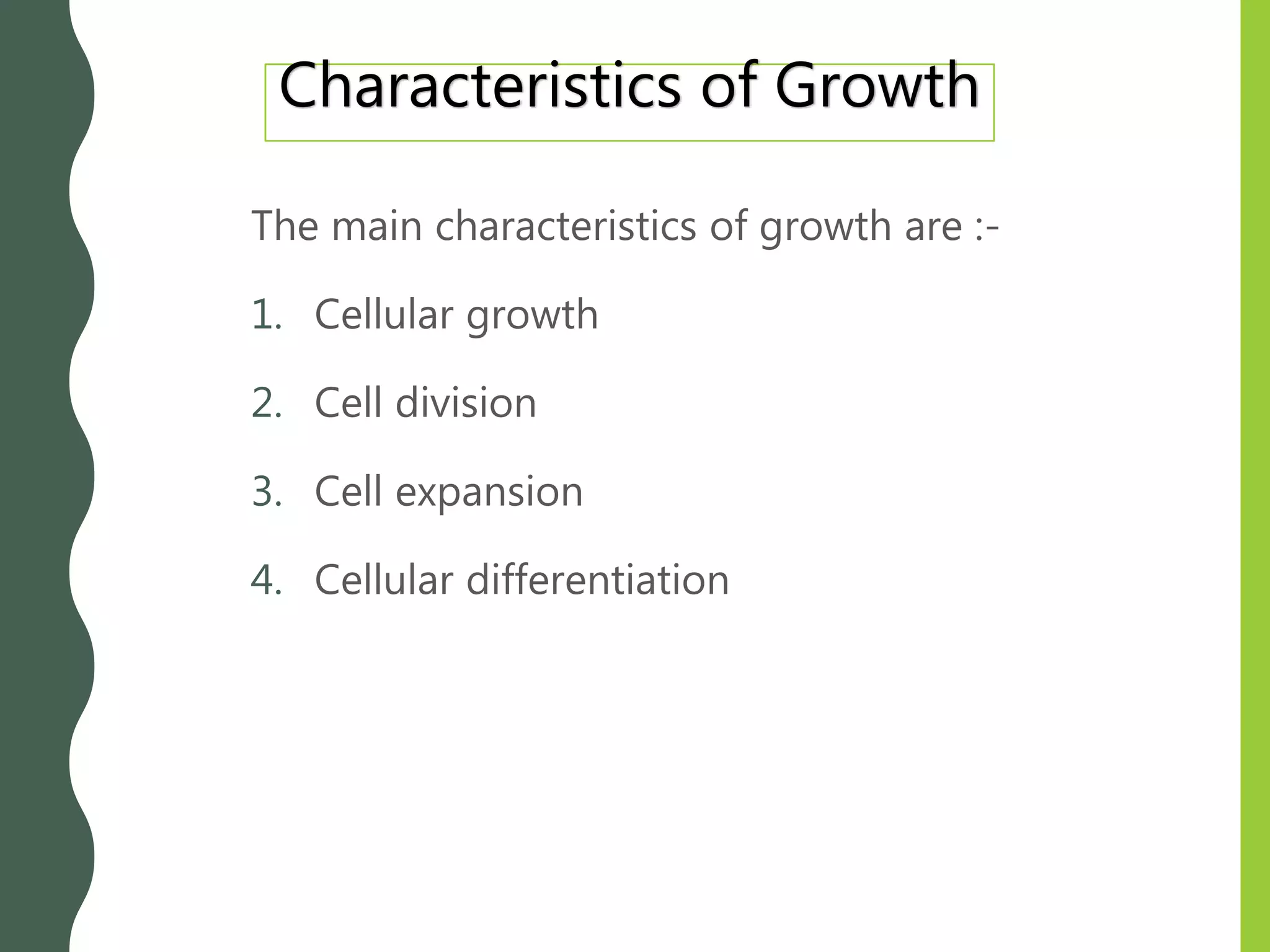
The main characteristics of growth are :-
1. Cellular growth
2. Cell division
3. Cell expansion
4. Cellular differentiation
• Growth rate can be defined as increased growth per unit
time.
• The rate of growth can be expressed mathematically.
• Types of Growth Rate
Growth Rates
Growth Rate
Arithmetic
growth
Geometric
growth
• Arithmetic growth -
• After mitotic cell division, only
one daughter cell continues to
divide while others
differentiate or mature.
• Example − root elongating at a
constant rate.
• Mathematically, it is expressed
as
Lt = L0 + rt
Lt = length at time ‘t’
L0 = length at time ‘zero’
r = growth rate / elongation
per unit time
Constant linear growth, a plot
of length L against time t
• Geometric Growth - Initial growth is slow (lag phase), followed by a
rapid increase in growth (log/exponential phase), and followed by a
phase where growth slows down (stationary phase).
• Example − all cells, tissues and organs show this type of growth
• If one plots the parameter of growth against time, it would be a
typical sigmoid or S-curve.
• The exponential growth can be expressed
as :
W1 = W0 ert
W1 = final size (weight, height, number
etc.)
W0 = initial size at the beginning of the
period
r = growth rate
t = time of growth
e = base of natural logarithms
• Cellular differentiation is the
process by which a less
specialized cell becomes a
more specialized cell type.
• Cells derived from
meristems and cambium
differentiate and mature to
perform specific functions
which is termed as
differentiation.
• Cells undergo structural changes during
differentiation.
• Changes take place both in their cell walls and
protoplasm.
• Example :- Cells lose their protoplasm during the
formation of tracheary elements.
• Plants develop a strong, elastic, lignocellulosic
secondary cell walls, to carry water to long distances
even under extreme tension.
• Dedifferentiation is an important biological phenomenon whereby
cells regress from a specialized function to a simpler state
reminiscent of stem cells.
• An undividable differentiated cell sometimes regains the power of
division. This process is called dedifferentiation.
• Dedifferentiation is a common process in plants during secondary
growth and in wound healing mechanisms.
• A dedifferentiated cell
can divide and
produce new cells.
• New cells produced
again loose the power
of division and
become a part of
permanent tissue
which is called
“redifferentiation’.
• Example:- Formation
of tumour cells.
• Development is a term that includes all changes that an organism
goes through during its life cycle from germination of the seed to
senescence.
Sequence of the developmental process in a plant cell
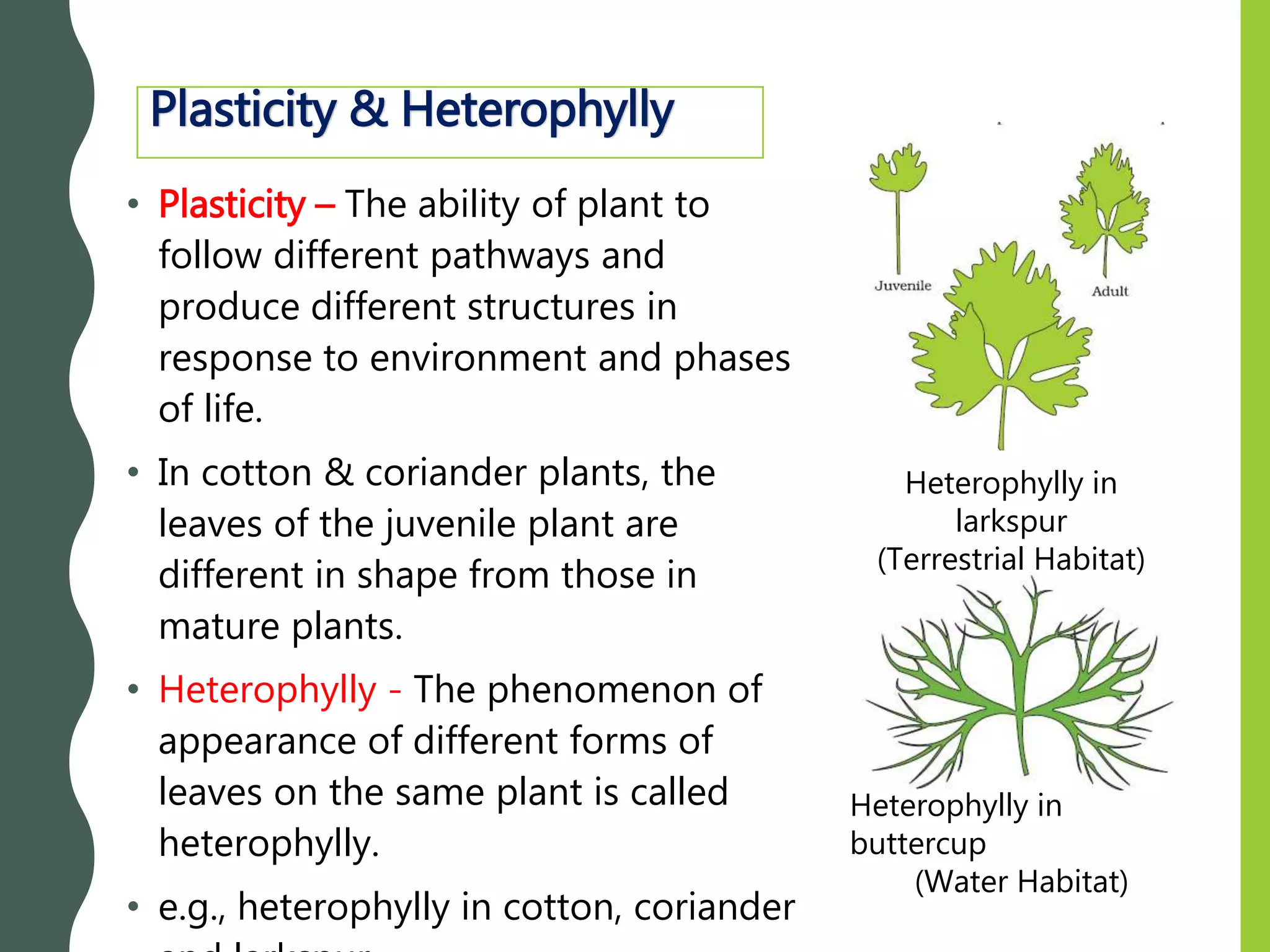
• Plasticity – The ability of plant to
follow different pathways and
produce different structures in
response to environment and phases
of life.
• In cotton & coriander plants, the
leaves of the juvenile plant are
different in shape from those in
mature plants.
• Heterophylly - The phenomenon of
appearance of different forms of
leaves on the same plant is called
heterophylly.
• e.g., heterophylly in cotton, coriander
Heterophylly in
buttercup
(Water Habitat)
Heterophylly in
larkspur
(Terrestrial Habitat)
Plasticity & Heterophylly
• Plant growth regulators (Phytohormones) are chemical
substances that influence the growth
and differentiation of plant cells, tissues and organs.
• Plant growth regulators function as chemical
messengers for intercellular communication .
• They work together coordinating the growth and
development of cells.
• They could be indole compounds (indole-3-acetic acid,
IAA); adenine derivatives (N6-furfurylamino purine,
kinetin), derivatives of carotenoids (abscisic acid, ABA);
terpenes (gibberellic acid, GA3) or gases (ethylene,
C2H4).
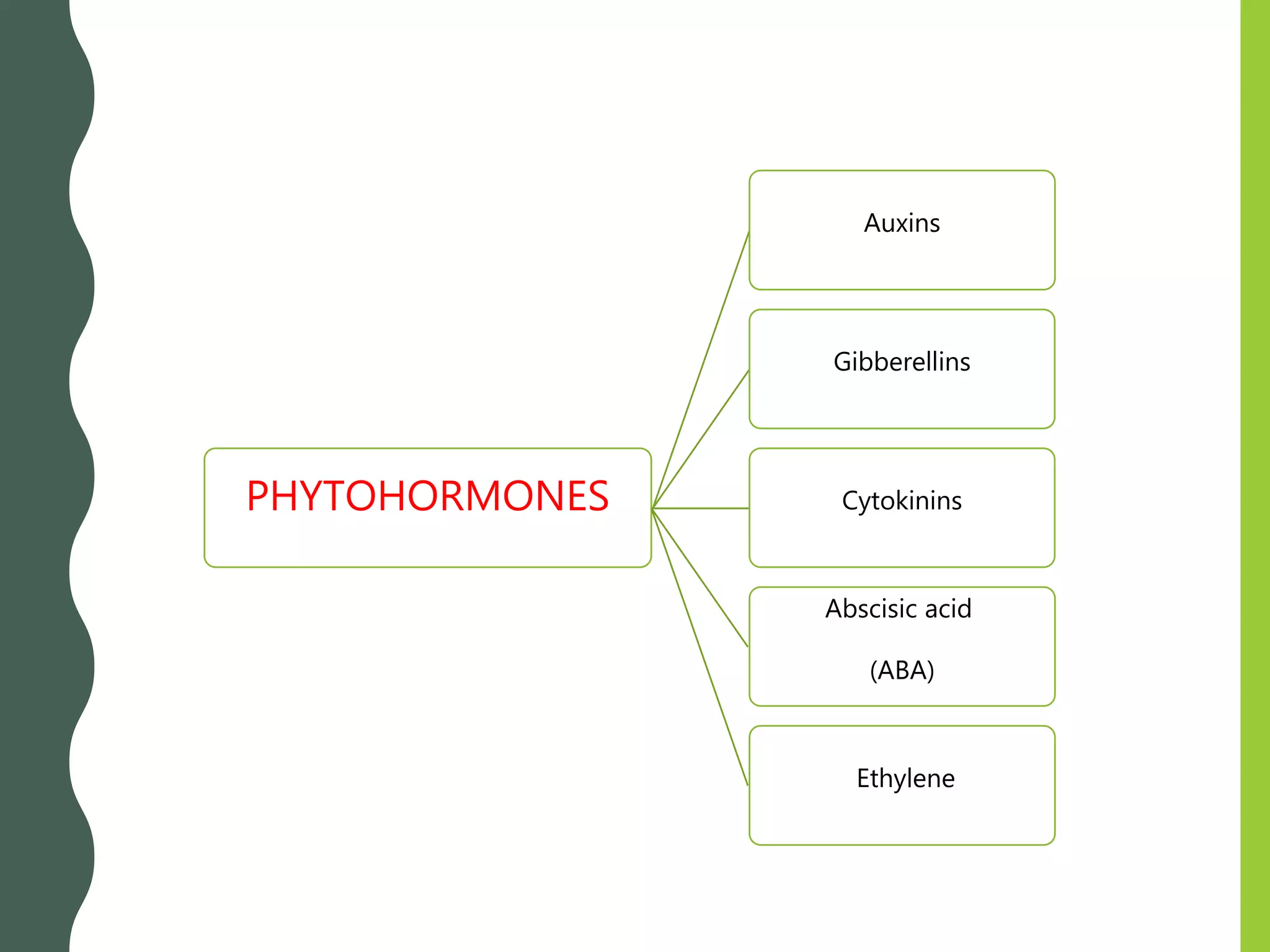
PHYTOHORMONES
Auxins
Gibberellins
Cytokinins
Abscisic acid
(ABA)
Ethylene
PGRs
Growth
Promoters
Auxins,
Gibberellins,
Cytokinins
Growth
Inhibitors
Abscisic Acid,
Ethylene
• Auxins were discovered by Charles Darwin and Francis
Darwin.
• F.W. Went isolated auxins from the tips of coleoptiles
of oat seedlings.
• Went developed Avena curvature test for bioassay of
auxins.
Synthetic Auxins
• IAA - Indole Acetic Acid
• IBA – Indole Butyric Acid
• NAA - Naphthalene Acetic Acid
• 2, 4-D - 2, 4-dichlorophenoxyacetic
• promote apical dominance
• initiate rooting in stem cuttings
• promote flowering e.g. in pineapples
• prevent fruit and leaf drop at early stages
• promote the abscission of older mature leaves and
fruits
• induce parthenocarpy, e.g., in tomatoes
• used as herbicides
• controls xylem differentiation and helps in cell
division
• E. Kurosawa, a Japanese scientist, identified gibbereilins present in
a fungal pathogen Gibberella fujikuroi.
• Gibbereilins were isolated from infected rice seedlings when
treated with sterile filtrates of fungus.
• Physiological Effects of Gibberelins
• Elongation of intact stems
• Dwarf shoots
• Bolting in rosette plants (e.g., Henbane, Cabbage)
• Overcome the natural dormancy of buds, tubers, seeds etc.
• Seed Germination
• Induce parthenocarpy or development of seedless fruits
• Promote flowering in long day plants
• Vernalization
• Skoog and Miller discovered cytokinins.
• Skoog and Miller crystallised the cytokinesis promoting
active substance named it kinetin from corn-kernels
and coconut milk.
Physiological Effects of Cytokinins
• induce cell-division
• delay the senescence of leaves and other organs
• promotes lateral bud
• increases cell expansion in dicot cotyledons and in
leaves
• promotes chloroplast development and chlorophyll
synthesis
• Cousins confirmed the release of a volatile substance from
ripened oranges that hastened the ripening of stored
unripened bananas.
• The volatile substance was identified as ethylene.
Physiological Effects of Cytokinins
• promotes senescence and abscission
• inhibits elongation of stems and roots
• Induce fruit ripening
• breaks seed and bud dormancy
• initiates germination in peanut seeds
• sprouting of potato tubers
• promotes root growth and root hair formation
• initiate flowering and for synchronising fruit-set in
pineapples
• 1963, Frederick T. Addicott and his co-workers identified
Abscisic acid.
• ABA was isolated from several abscission-accelerating
substances from cotton plants.
• ABA is called stress hormone.
Physiological Effects of Cytokinins
• acts as a general plant growth inhibitor
• induces seed and bud dormancy
• inhibits seed germination
• stimulates the closure of stomata
• plays an important role in seed development, maturation
and dormancy
• Photoperiodism is a response of plants to the relative lengths of
light and dark periods.
• Some plants require periodic exposure to light to induce flowering.
• Duration of dark period is equally important for flowering.
Long Day Plants − Plants that require exposure to light for a period
exceeding critical duration to induce flowering.
Example: Pea (Pisum sativum), Barley (Hordeum vulgare),
Wheat (Triticum aestivum)
Short Day Plants − Plants that require exposure to light for a period
less than this critical period to induce flowering.
Example: Rice, Jowar, Cotton
Day Neutral Plants − Plants where there is no correlation between
exposure to light duration and induction of flowering.
Example: cucumber, rose, and tomato
• Vernalisation is the phenomenon of induction of
flowering in plants by exposure to low temperature.
• It prevents precocious reproductive development late
in the growing season, and enables the plant to have
sufficient time to reach maturity.
• Example − Biennial plants
• These are monocarpic plants that flower and then die
in second season.
• Examples :- sugar beet, cabbage, carrot, etc.

Chapter 15. Plant Growth and Development

  • 2.
    • All cellsof a plant develops from the zygote. • Zygote produces a number of cells which organize into tissues and organs. • Development is the sum of two processes: growth and differentiation. • During the process of development, a complex body organisation is formed that produces roots, leaves, branches, flowers, fruits, and seeds, and eventually they die.
  • 3.
    • Growth maybe defined as an irreversible permanent increase in size in size, volume or mass of a cell or organ or whole organism. • Growth is one of the fundamental characteristics of a living being. • It is accompanied by metabolic processes i.e. anabolic and catabolic process, that occur at the expense of energy. • Example:- expansion of a leaf, elongation of stem etc. GROWTH
  • 4.
    Characteristics of Growth Themain characteristics of growth are :- 1. Cellular growth 2. Cell division 3. Cell expansion 4. Cellular differentiation
  • 5.
    • Growth ratecan be defined as increased growth per unit time. • The rate of growth can be expressed mathematically. • Types of Growth Rate Growth Rates Growth Rate Arithmetic growth Geometric growth
  • 6.
    • Arithmetic growth- • After mitotic cell division, only one daughter cell continues to divide while others differentiate or mature. • Example − root elongating at a constant rate. • Mathematically, it is expressed as Lt = L0 + rt Lt = length at time ‘t’ L0 = length at time ‘zero’ r = growth rate / elongation per unit time Constant linear growth, a plot of length L against time t
  • 7.
    • Geometric Growth- Initial growth is slow (lag phase), followed by a rapid increase in growth (log/exponential phase), and followed by a phase where growth slows down (stationary phase). • Example − all cells, tissues and organs show this type of growth • If one plots the parameter of growth against time, it would be a typical sigmoid or S-curve. • The exponential growth can be expressed as : W1 = W0 ert W1 = final size (weight, height, number etc.) W0 = initial size at the beginning of the period r = growth rate t = time of growth e = base of natural logarithms
  • 8.
    • Cellular differentiationis the process by which a less specialized cell becomes a more specialized cell type. • Cells derived from meristems and cambium differentiate and mature to perform specific functions which is termed as differentiation.
  • 9.
    • Cells undergostructural changes during differentiation. • Changes take place both in their cell walls and protoplasm. • Example :- Cells lose their protoplasm during the formation of tracheary elements. • Plants develop a strong, elastic, lignocellulosic secondary cell walls, to carry water to long distances even under extreme tension.
  • 10.
    • Dedifferentiation isan important biological phenomenon whereby cells regress from a specialized function to a simpler state reminiscent of stem cells. • An undividable differentiated cell sometimes regains the power of division. This process is called dedifferentiation. • Dedifferentiation is a common process in plants during secondary growth and in wound healing mechanisms.
  • 11.
    • A dedifferentiatedcell can divide and produce new cells. • New cells produced again loose the power of division and become a part of permanent tissue which is called “redifferentiation’. • Example:- Formation of tumour cells.
  • 12.
    • Development isa term that includes all changes that an organism goes through during its life cycle from germination of the seed to senescence. Sequence of the developmental process in a plant cell
  • 13.
    • Plasticity –The ability of plant to follow different pathways and produce different structures in response to environment and phases of life. • In cotton & coriander plants, the leaves of the juvenile plant are different in shape from those in mature plants. • Heterophylly - The phenomenon of appearance of different forms of leaves on the same plant is called heterophylly. • e.g., heterophylly in cotton, coriander Heterophylly in buttercup (Water Habitat) Heterophylly in larkspur (Terrestrial Habitat) Plasticity & Heterophylly
  • 14.
    • Plant growthregulators (Phytohormones) are chemical substances that influence the growth and differentiation of plant cells, tissues and organs. • Plant growth regulators function as chemical messengers for intercellular communication . • They work together coordinating the growth and development of cells. • They could be indole compounds (indole-3-acetic acid, IAA); adenine derivatives (N6-furfurylamino purine, kinetin), derivatives of carotenoids (abscisic acid, ABA); terpenes (gibberellic acid, GA3) or gases (ethylene, C2H4).
  • 15.
  • 16.
  • 17.
    • Auxins werediscovered by Charles Darwin and Francis Darwin. • F.W. Went isolated auxins from the tips of coleoptiles of oat seedlings. • Went developed Avena curvature test for bioassay of auxins. Synthetic Auxins • IAA - Indole Acetic Acid • IBA – Indole Butyric Acid • NAA - Naphthalene Acetic Acid • 2, 4-D - 2, 4-dichlorophenoxyacetic
  • 18.
    • promote apicaldominance • initiate rooting in stem cuttings • promote flowering e.g. in pineapples • prevent fruit and leaf drop at early stages • promote the abscission of older mature leaves and fruits • induce parthenocarpy, e.g., in tomatoes • used as herbicides • controls xylem differentiation and helps in cell division
  • 19.
    • E. Kurosawa,a Japanese scientist, identified gibbereilins present in a fungal pathogen Gibberella fujikuroi. • Gibbereilins were isolated from infected rice seedlings when treated with sterile filtrates of fungus. • Physiological Effects of Gibberelins • Elongation of intact stems • Dwarf shoots • Bolting in rosette plants (e.g., Henbane, Cabbage) • Overcome the natural dormancy of buds, tubers, seeds etc. • Seed Germination • Induce parthenocarpy or development of seedless fruits • Promote flowering in long day plants • Vernalization
  • 20.
    • Skoog andMiller discovered cytokinins. • Skoog and Miller crystallised the cytokinesis promoting active substance named it kinetin from corn-kernels and coconut milk. Physiological Effects of Cytokinins • induce cell-division • delay the senescence of leaves and other organs • promotes lateral bud • increases cell expansion in dicot cotyledons and in leaves • promotes chloroplast development and chlorophyll synthesis
  • 21.
    • Cousins confirmedthe release of a volatile substance from ripened oranges that hastened the ripening of stored unripened bananas. • The volatile substance was identified as ethylene. Physiological Effects of Cytokinins • promotes senescence and abscission • inhibits elongation of stems and roots • Induce fruit ripening • breaks seed and bud dormancy • initiates germination in peanut seeds • sprouting of potato tubers • promotes root growth and root hair formation • initiate flowering and for synchronising fruit-set in pineapples
  • 22.
    • 1963, FrederickT. Addicott and his co-workers identified Abscisic acid. • ABA was isolated from several abscission-accelerating substances from cotton plants. • ABA is called stress hormone. Physiological Effects of Cytokinins • acts as a general plant growth inhibitor • induces seed and bud dormancy • inhibits seed germination • stimulates the closure of stomata • plays an important role in seed development, maturation and dormancy
  • 23.
    • Photoperiodism isa response of plants to the relative lengths of light and dark periods. • Some plants require periodic exposure to light to induce flowering. • Duration of dark period is equally important for flowering. Long Day Plants − Plants that require exposure to light for a period exceeding critical duration to induce flowering. Example: Pea (Pisum sativum), Barley (Hordeum vulgare), Wheat (Triticum aestivum) Short Day Plants − Plants that require exposure to light for a period less than this critical period to induce flowering. Example: Rice, Jowar, Cotton Day Neutral Plants − Plants where there is no correlation between exposure to light duration and induction of flowering. Example: cucumber, rose, and tomato
  • 24.
    • Vernalisation isthe phenomenon of induction of flowering in plants by exposure to low temperature. • It prevents precocious reproductive development late in the growing season, and enables the plant to have sufficient time to reach maturity. • Example − Biennial plants • These are monocarpic plants that flower and then die in second season. • Examples :- sugar beet, cabbage, carrot, etc.