10/14/13	
  

Diversity And Classification of
Flowering Plants:
Eudicots: Asterids

Michael G. Simpson

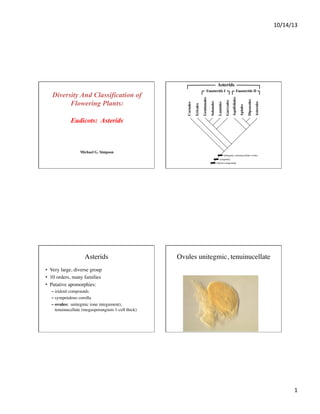
Asterids	


Ovules unitegmic, tenuinucellate	


•  Very large, diverse group	

•  10 orders, many families	

•  Putative apomorphies:	

–  iridoid compounds	

–  sympetalous corolla	

–  ovules: unitegmic (one integument),
tenuinucellate (megasporangium 1-cell thick)	


1	
  
10/14/13	
  

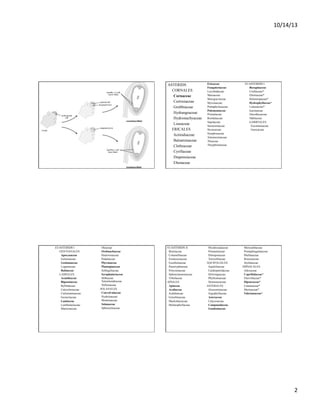
ASTERIDS
CORNALES
Cornaceae
Curtissiaceae
Grubbiaceae
Hydrangeaceae
Hydrostachyaceae
Loasaceae
ERICALES
Actinidiaceae
Balsaminaceae
Clethraceae
Cyrillaceae
Diapensiaceae
Ebenaceae


EUASTERIDS I
GENTIANALES
Apocynaceae
Gelsmiaceae
Gentianaceae
Loganiaceae
Rubiaceae
LAMIALES
Acanthaceae
Bignoniaceae
Byblidaceae
Calceolariaceae
Carlemanniaceae
Gesneriaceae
Lamiaceae
Lentibulariaceae
Martyniaceae


Oleaceae
Orobanchaceae
Paulowniaceae
Pedaliaceae
Phyrmaceae
Plantaginaceae
Schlegeliaceae
Scrophulariaceae
Stilbaceae
Tetrachondraceae
Verbenaceae
SOLANALES
Convolvulaceae
Hydroleaceae
Montiniaceae
Solanaceae
Sphenocleaceae

Ericaceae
Fouquieriaceae
Lecythidaceae
Maesaceae
Marcgraviaceae
Myrsinaceae
Pentaphylacaceae
Polemoniaceae
Primulaceae
Roridulaceae
Sapotaceae
Sarraceniaceae
Styracaceae
Symplocaceae
Tetrameristaceae
Theaceae
Theophrastaceae

EUASTERIDS II
Bruniaceae
Columelliaceae
Eremosynaceae
Escalloniaceae
Paracryphiaceae
Polyosmaceae
Sphenostemonaceae
Tribelaceae
APIALES
Apiaceae
Araliaceae
Aralidiaceae
Griseliniaceae
Mackinlayaceae
Melanophyllaceae

Myodocarpaceae
Pennantiaceae
Pittosporaceae
Torricelliaceae
AQUIFOLIALES
Aquifoliaceae
Cardiopteridaceae
Helwingiaceae
Phyllonmaceae
Stemonuraceae
ASTERALES
Alseuosmiaceae
Argophyllaceae
Asteraceae
Calyceraceae
Campanulaceae
Goodeniaceae


EUASTERIDS I
Boraginaceae
Cordiaceae*
Ehretiaceae*
Heliotropaceae*
Hydrophyllaceae*
Lennoaceae*
Icacinaceae
Oncothecaceae
Vahliaceae
GARRYALES
Eucommiaceae
Garryaceae

Menyanthaceae
Pentaphragmataceae
Phellinaceae
Rousseaceae
Stylidiaceae
DIPSACALES
Adoxaceae
Caprifoliaceae*
Diervillaceae*
Dipsacaceae*
Linnaeaceae*
Morinaceae*
Valerianaceae*

2	
  
10/14/13	
  

Apocynaceae, s.l. - Dogbane/Milkweed family (Greek
for "away from dog," in reference to past use of some taxa as a dog
poison). 411 genera / 4,650 species.

The Apocynaceae, s.l.
•  5-merous perianth/androecium,
•  the gynoecium usually with 2 carpels,
•  ovaries distinct in some taxa with styles connate
(in Asclepiadoids androecium adnate to single stigma
forming a gynostegium and pollen fused to form pollinia,
each half derived from an adjacent anther),
K (5) C (5) A 5 or (5) G (2) [(-8)], superior, rarely halfinferior.


3	
  
10/14/13	
  

• 
• 
• 
• 

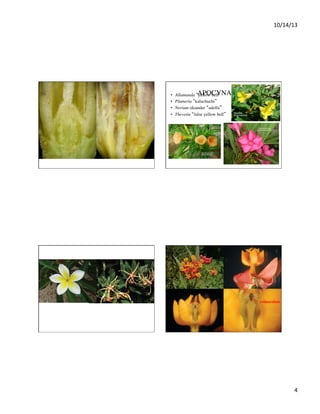
APOCYNACEAE	

Allamanda “yellow bell”	

Plumeria “kalachuchi”	

Nerium oleander “adelfa”	

Thevetia “false yellow bell”	


retinaculum


4	
  
10/14/13	


pollinium

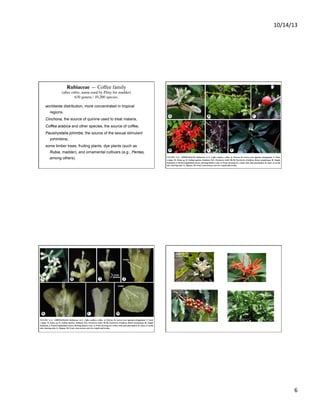
Rubiaceae — Coffee family 
(after rubia, name used by Pliny for madder)
630 genera / 10,200 species.


Leaves simple, entire, usually decussate leaves
connate stipules, the stipules often with mucilagesecreting colleters
2 ovaries, 
2 styles, 
1 stigma


usually a cyme,
Flowers bisexual, the perianth dichlamydeous, perianth
and androecium often 4 –5-merous (calyx absent in
some),
ovary usually inferior
ovules with a funicular obturator,
K (4-5) [0] C (4-5) [(3,8-10)] A 4-5 [3,8-10] G (2)
[(3-5+)], usually inferior, rarely superior.	


5	
  
10/14/13	
  

Rubiaceae — Coffee family 
(after rubia, name used by Pliny for madder)
630 genera / 10,200 species.
	

worldwide distribution, more concentrated in tropical
regions.
Cinchona, the source of quinine used to treat malaria,
Coffea arabica and other species, the source of coffee,
Pausinystalia johimbe, the source of the sexual stimulant
yohimbine,
some timber trees, fruiting plants, dye plants (such as
Rubia, madder), and ornamental cultivars (e.g., Pentas,
among others).	


6	
  
10/14/13	
  

Lamiaceae (=Labiatae) - Mint family
(Lamium, gullet, after the shape of the corolla tube or old Latin name
used by Pliny). 251 genera / 6,700 species.
often aromatic with ethereal oils
with usually 4-sided stems, opposite [or whorled] leaves
verticillaster or thyrse inflorescence [flowers solitary and axillary
in some], and zygomorphic [rarely actinomorphic],
usually bilabiate flowers
deeply 4-lobed ovary (by formation of false septa) and
gynobasic style
K (5) C (5) [(4)] A 4 or 2 [+2 staminodes] G (2), superior,
hypanthium absent.

Mentha, mint;
Ocimum, basil;
Rosmarinus, rosemary;
Salvia, sage;
Thymus, thyme

Leaves opposite; stems 4-sided	


7	
  
10/14/13	
  

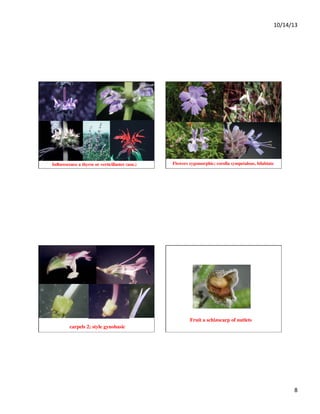
Inflorescence a thyrse or verticillaster (usu.)	


Flowers zygomorphic; corolla sympetalous, bilabiate	


Fruit a schizocarp of nutlets	

carpels 2; style gynobasic	


8	
  
10/14/13	
  

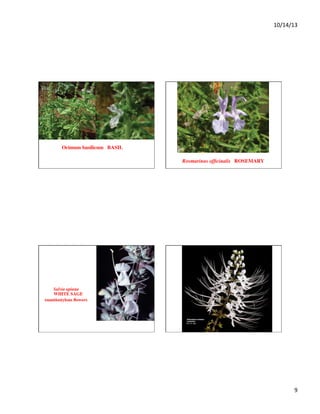
Ocimum basilicum BASIL	

Rosmarinus officinalis ROSEMARY	


Salvia apiana 
WHITE SAGE	

enantiostylous flowers	


9	
  
10/14/13	
  

Solanaceae - Nightshade family
(Latin for sleeping or comforter, after narcotic properties of
some). 94 genera / 2,950 species.

internal phloem,
spiral leaves
usually actinomorphic, 5-merous perianth and
androecium (corolla plicate in bud),
usually bicarpellate, syncarpous gynoecium, and usually
numerous ovules per carpel,
the fruit a berry, drupe, or capsule.
K (5) C (5) [(4),(6)] A 5 [4 or 2+2 staminodes] G
(2) [(3-5)], superior, hypanthium absent.

Members of the family have mostly worldwide
distributions, concentrated in South America.
Capsicum (peppers),
Lycopersicon esculentum (tomato),
Physalis philadelphica (tomatillo),
Solanum tuberosum (potato),
Nicotiana tabacum (tobacco);
alkaloids from various taxa have medicinal properties
(e.g., atropine from Atropa belladona),
hallucinogenic properties (e.g., Datura, Jimson weed)
deadly poisons (e.g., Datura, Solanum spp.)
known carcinogens (e.g., Nicotiana tabacum); some used
as ornamental cultivars, others are noxious weeds.

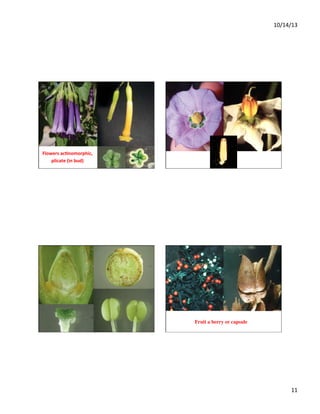
Flowers actinomorphic, 	

plicate (in bud)	


10	
  
10/14/13	
  

Flowers	
  ac+nomorphic,	
  	
  
plicate	
  (in	
  bud)	
  

Fruit a berry or capsule	


11	
  
10/14/13	
  

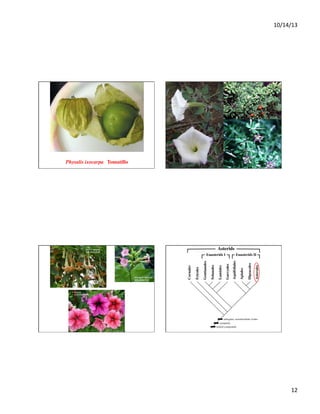
Physalis ixocarpa Tomatillo	


12	
  
10/14/13	
  

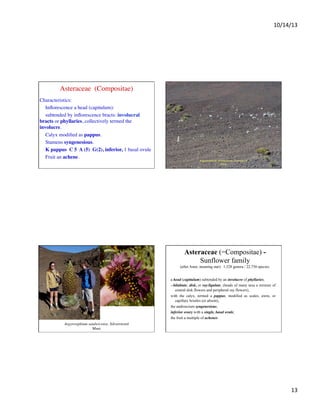
Asteraceae (Compositae)	

Characteristics:	


Inflorescence a head (capitulum): 	


subtended by inflorescence bracts: involucral
bracts or phyllaries, collectively termed the
involucre. 	


Calyx modified as pappus. 	


Stamens syngenesious.	


K pappus C 5 A (5) G(2), inferior, 1 basal ovule	


Fruit an achene. 	


Argyroxiphium	
  sandwicense,	
  Silversword	
  
Maui

Asteraceae (=Compositae) Sunflower family
(after Aster, meaning star). 1,528 genera / 22,750 species.
a head (capitulum) subtended by an involucre of phyllaries,
--bilabiate, disk, or ray/ligulate, (heads of many taxa a mixture of
central disk flowers and peripheral ray flowers),
with the calyx, termed a pappus, modified as scales, awns, or
capillary bristles (or absent),
the androecium syngenesious,
inferior ovary with a single, basal ovule,
the fruit a multiple of achenes.
Argyroxiphium sandwicense, Silversword
Maui


13	
  
10/14/13	
  

Asteraceae (=Compositae) Sunflower family
(after Aster, meaning star). 1,528 genera / 22,750 species.

K 0-∞ (pappus)
C (5) [(4)] or (3) in some ray flowers

Asteraceae: floral variation	

Three types of flowers:	


1) Bilabiate: zygomorphic (bilateral) with 2 lips	


2) Ray (ligulate): zygomorphic (bilateral) with 1
lobe	


3) Disk: actinomorphic (radial), usu. 5-lobed 	


A (5) [(4)]
G (2), inferior, hypanthium absent.

Five types of heads:	

1) discoid, with only disk flowers;
2) disciform, with central disk flowers and
marginal, eligulate female flowers;
3) radiate, with central (bisexual or male) disk
flowers and peripheral (female or sterile) ray
flowers;
4) ligulate, with all ray flowers (typically with
5-toothed corolla apices);
5) bilabiate, with all bilabiate flowers.

Bilabiate flower	

posterior	
  lip	
  	
  
anterior	
  lip	


Acourtia microcephala 	


Trixis	
  californica	


14	
  
10/14/13	
  

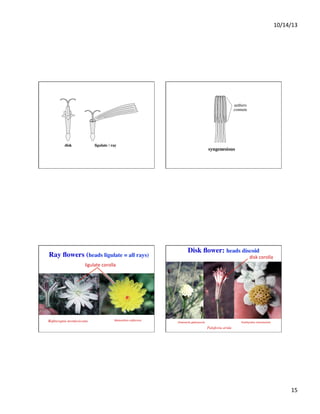
anthers
connate

disk

ligulate / ray

Ray flowers (heads ligulate = all rays)	


syngenesious

Disk flower: heads discoid	


disk	
  corolla	


ligulate	
  corolla	


Rafinesquia neomexicana 	


Malacothrix	
  californica	


Chaenac;s	
  gabriuscula	


Psathyrotes	
  ramosissima	


Palafoxia arida 	


15	
  
10/14/13	
  

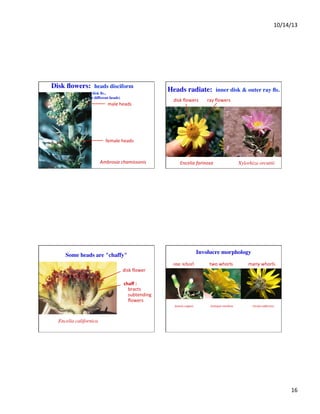
Disk flowers: heads disciform


(2 types of disk fls.,


same or different heads)

male	
  heads	
  

Heads radiate: inner disk  outer ray fls.	

disk	
  flowers	


ray	
  flowers	


female	
  heads	
  

Ambrosia	
  chamissonis	


Encelia	
  farinosa	


Involucre morphology	


Some heads are chaffy	

ovary	


disk	
  flower	


Xylorhiza orcuttii 	


one whorl 	


chaff	
  :	


  bracts	


  subtending	


  flowers	
  	
  
Senecio	
  vulgaris


two	
  whorls	


Coreopsis	
  mari;ma

many	
  whorls	


Encelia	
  californica

Encelia californica 	


16	
  
10/14/13	
  

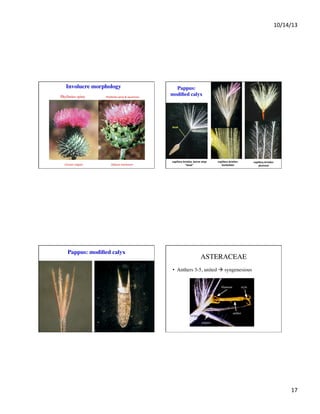
Involucre morphology	

Phyllaries spiny


Phyllaries	
  spiny	
  	
  squarrose

Pappus: 
modified calyx	


beak


Circium	
  vulgare


Silybum	
  marianum

Pappus: modified calyx	


capillary	
  bristles,	
  borne	
  atop	
  
beak


capillary	
  bristles:	
  	
  
barbellate


capillary	
  bristles:	
  	
  
plumose

ASTERACEAE	

•  Anthers 3-5, united à syngenesious	


17	
  
10/14/13	
  

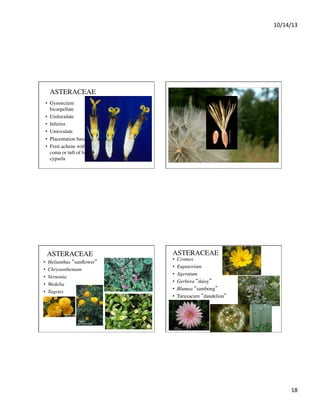
ASTERACEAE	

•  Gynoecium
bicarpellate	

•  Uniloculate	

•  Inferior	

•  Uniovulate	

•  Placentation basal	

•  Fruit achene with
coma or tuft of hairà
cypsela	


ASTERACEAE	

• 
• 
• 
• 
• 

Helianthus “sunflower”	

Chrysanthemum	

Vernonia	

Wedelia	

Tagetes	


ASTERACEAE	

• 
• 
• 
• 
• 
• 

Cosmos	

Eupatorium	

Ageratum	

Gerbera “daisy”	

Blumea “sambong”	

Taraxacum “dandelion” 	


18	
  
10/14/13	
  

19	
  

Eudicots asterids fs2013.pptx

  • 1.
    10/14/13   Diversity AndClassification of Flowering Plants: Eudicots: Asterids Michael G. Simpson Asterids Ovules unitegmic, tenuinucellate •  Very large, diverse group •  10 orders, many families •  Putative apomorphies: –  iridoid compounds –  sympetalous corolla –  ovules: unitegmic (one integument), tenuinucellate (megasporangium 1-cell thick) 1  
  • 2.
    10/14/13   ASTERIDS CORNALES Cornaceae Curtissiaceae Grubbiaceae Hydrangeaceae Hydrostachyaceae Loasaceae ERICALES Actinidiaceae Balsaminaceae Clethraceae Cyrillaceae Diapensiaceae Ebenaceae EUASTERIDS I GENTIANALES Apocynaceae Gelsmiaceae Gentianaceae Loganiaceae Rubiaceae LAMIALES Acanthaceae Bignoniaceae Byblidaceae Calceolariaceae Carlemanniaceae Gesneriaceae Lamiaceae Lentibulariaceae Martyniaceae   Oleaceae Orobanchaceae Paulowniaceae Pedaliaceae Phyrmaceae Plantaginaceae Schlegeliaceae Scrophulariaceae Stilbaceae Tetrachondraceae Verbenaceae SOLANALES Convolvulaceae Hydroleaceae Montiniaceae Solanaceae Sphenocleaceae Ericaceae Fouquieriaceae Lecythidaceae Maesaceae Marcgraviaceae Myrsinaceae Pentaphylacaceae Polemoniaceae Primulaceae Roridulaceae Sapotaceae Sarraceniaceae Styracaceae Symplocaceae Tetrameristaceae Theaceae Theophrastaceae EUASTERIDS II Bruniaceae Columelliaceae Eremosynaceae Escalloniaceae Paracryphiaceae Polyosmaceae Sphenostemonaceae Tribelaceae APIALES Apiaceae Araliaceae Aralidiaceae Griseliniaceae Mackinlayaceae Melanophyllaceae Myodocarpaceae Pennantiaceae Pittosporaceae Torricelliaceae AQUIFOLIALES Aquifoliaceae Cardiopteridaceae Helwingiaceae Phyllonmaceae Stemonuraceae ASTERALES Alseuosmiaceae Argophyllaceae Asteraceae Calyceraceae Campanulaceae Goodeniaceae   EUASTERIDS I Boraginaceae Cordiaceae* Ehretiaceae* Heliotropaceae* Hydrophyllaceae* Lennoaceae* Icacinaceae Oncothecaceae Vahliaceae GARRYALES Eucommiaceae Garryaceae Menyanthaceae Pentaphragmataceae Phellinaceae Rousseaceae Stylidiaceae DIPSACALES Adoxaceae Caprifoliaceae* Diervillaceae* Dipsacaceae* Linnaeaceae* Morinaceae* Valerianaceae* 2  
  • 3.
    10/14/13   Apocynaceae, s.l.- Dogbane/Milkweed family (Greek for "away from dog," in reference to past use of some taxa as a dog poison). 411 genera / 4,650 species. The Apocynaceae, s.l. •  5-merous perianth/androecium, •  the gynoecium usually with 2 carpels, •  ovaries distinct in some taxa with styles connate (in Asclepiadoids androecium adnate to single stigma forming a gynostegium and pollen fused to form pollinia, each half derived from an adjacent anther), K (5) C (5) A 5 or (5) G (2) [(-8)], superior, rarely halfinferior. 3  
  • 4.
    10/14/13   •  •  •  •  APOCYNACEAE Allamanda “yellowbell” Plumeria “kalachuchi” Nerium oleander “adelfa” Thevetia “false yellow bell” retinaculum 4  
  • 5.
    10/14/13   pollinium Rubiaceae —Coffee family (after rubia, name used by Pliny for madder) 630 genera / 10,200 species. Leaves simple, entire, usually decussate leaves connate stipules, the stipules often with mucilagesecreting colleters 2 ovaries, 2 styles, 1 stigma usually a cyme, Flowers bisexual, the perianth dichlamydeous, perianth and androecium often 4 –5-merous (calyx absent in some), ovary usually inferior ovules with a funicular obturator, K (4-5) [0] C (4-5) [(3,8-10)] A 4-5 [3,8-10] G (2) [(3-5+)], usually inferior, rarely superior. 5  
  • 6.
    10/14/13   Rubiaceae —Coffee family (after rubia, name used by Pliny for madder) 630 genera / 10,200 species. worldwide distribution, more concentrated in tropical regions. Cinchona, the source of quinine used to treat malaria, Coffea arabica and other species, the source of coffee, Pausinystalia johimbe, the source of the sexual stimulant yohimbine, some timber trees, fruiting plants, dye plants (such as Rubia, madder), and ornamental cultivars (e.g., Pentas, among others). 6  
  • 7.
    10/14/13   Lamiaceae (=Labiatae)- Mint family (Lamium, gullet, after the shape of the corolla tube or old Latin name used by Pliny). 251 genera / 6,700 species. often aromatic with ethereal oils with usually 4-sided stems, opposite [or whorled] leaves verticillaster or thyrse inflorescence [flowers solitary and axillary in some], and zygomorphic [rarely actinomorphic], usually bilabiate flowers deeply 4-lobed ovary (by formation of false septa) and gynobasic style K (5) C (5) [(4)] A 4 or 2 [+2 staminodes] G (2), superior, hypanthium absent. Mentha, mint; Ocimum, basil; Rosmarinus, rosemary; Salvia, sage; Thymus, thyme Leaves opposite; stems 4-sided 7  
  • 8.
    10/14/13   Inflorescence athyrse or verticillaster (usu.) Flowers zygomorphic; corolla sympetalous, bilabiate Fruit a schizocarp of nutlets carpels 2; style gynobasic 8  
  • 9.
    10/14/13   Ocimum basilicumBASIL Rosmarinus officinalis ROSEMARY Salvia apiana WHITE SAGE enantiostylous flowers 9  
  • 10.
    10/14/13   Solanaceae -Nightshade family (Latin for sleeping or comforter, after narcotic properties of some). 94 genera / 2,950 species. internal phloem, spiral leaves usually actinomorphic, 5-merous perianth and androecium (corolla plicate in bud), usually bicarpellate, syncarpous gynoecium, and usually numerous ovules per carpel, the fruit a berry, drupe, or capsule. K (5) C (5) [(4),(6)] A 5 [4 or 2+2 staminodes] G (2) [(3-5)], superior, hypanthium absent. Members of the family have mostly worldwide distributions, concentrated in South America. Capsicum (peppers), Lycopersicon esculentum (tomato), Physalis philadelphica (tomatillo), Solanum tuberosum (potato), Nicotiana tabacum (tobacco); alkaloids from various taxa have medicinal properties (e.g., atropine from Atropa belladona), hallucinogenic properties (e.g., Datura, Jimson weed) deadly poisons (e.g., Datura, Solanum spp.) known carcinogens (e.g., Nicotiana tabacum); some used as ornamental cultivars, others are noxious weeds. Flowers actinomorphic, plicate (in bud) 10  
  • 11.
    10/14/13   Flowers  ac+nomorphic,     plicate  (in  bud)   Fruit a berry or capsule 11  
  • 12.
  • 13.
    10/14/13   Asteraceae (Compositae) Characteristics: Inflorescencea head (capitulum): subtended by inflorescence bracts: involucral bracts or phyllaries, collectively termed the involucre. Calyx modified as pappus. Stamens syngenesious. K pappus C 5 A (5) G(2), inferior, 1 basal ovule Fruit an achene.   Argyroxiphium  sandwicense,  Silversword   Maui Asteraceae (=Compositae) Sunflower family (after Aster, meaning star). 1,528 genera / 22,750 species. a head (capitulum) subtended by an involucre of phyllaries, --bilabiate, disk, or ray/ligulate, (heads of many taxa a mixture of central disk flowers and peripheral ray flowers), with the calyx, termed a pappus, modified as scales, awns, or capillary bristles (or absent), the androecium syngenesious, inferior ovary with a single, basal ovule, the fruit a multiple of achenes. Argyroxiphium sandwicense, Silversword Maui 13  
  • 14.
    10/14/13   Asteraceae (=Compositae)Sunflower family (after Aster, meaning star). 1,528 genera / 22,750 species. K 0-∞ (pappus) C (5) [(4)] or (3) in some ray flowers Asteraceae: floral variation Three types of flowers: 1) Bilabiate: zygomorphic (bilateral) with 2 lips 2) Ray (ligulate): zygomorphic (bilateral) with 1 lobe 3) Disk: actinomorphic (radial), usu. 5-lobed A (5) [(4)] G (2), inferior, hypanthium absent. Five types of heads: 1) discoid, with only disk flowers; 2) disciform, with central disk flowers and marginal, eligulate female flowers; 3) radiate, with central (bisexual or male) disk flowers and peripheral (female or sterile) ray flowers; 4) ligulate, with all ray flowers (typically with 5-toothed corolla apices); 5) bilabiate, with all bilabiate flowers. Bilabiate flower posterior  lip     anterior  lip     Acourtia microcephala Trixis  californica     14  
  • 15.
    10/14/13   anthers connate disk ligulate /ray Ray flowers (heads ligulate = all rays) syngenesious Disk flower: heads discoid disk  corolla     ligulate  corolla     Rafinesquia neomexicana Malacothrix  californica     Chaenac;s  gabriuscula     Psathyrotes  ramosissima     Palafoxia arida 15  
  • 16.
    10/14/13   Disk flowers:heads disciform (2 types of disk fls., same or different heads) male  heads   Heads radiate: inner disk outer ray fls. disk  flowers     ray  flowers     female  heads   Ambrosia  chamissonis     Encelia  farinosa     Involucre morphology Some heads are chaffy ovary     disk  flower     Xylorhiza orcuttii one whorl chaff  :      bracts      subtending      flowers     Senecio  vulgaris     two  whorls         Coreopsis  mari;ma many  whorls         Encelia  californica Encelia californica 16  
  • 17.
    10/14/13   Involucre morphology Phyllariesspiny     Phyllaries  spiny    squarrose Pappus: modified calyx   beak     Circium  vulgare     Silybum  marianum Pappus: modified calyx   capillary  bristles,  borne  atop   beak   capillary  bristles:     barbellate   capillary  bristles:     plumose ASTERACEAE •  Anthers 3-5, united à syngenesious 17  
  • 18.
    10/14/13   ASTERACEAE •  Gynoecium bicarpellate • Uniloculate •  Inferior •  Uniovulate •  Placentation basal •  Fruit achene with coma or tuft of hairà cypsela ASTERACEAE •  •  •  •  •  Helianthus “sunflower” Chrysanthemum Vernonia Wedelia Tagetes ASTERACEAE •  •  •  •  •  •  Cosmos Eupatorium Ageratum Gerbera “daisy” Blumea “sambong” Taraxacum “dandelion” 18  
  • 19.