1
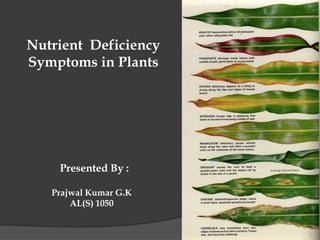
Nutrient Deficiency
Symptoms in Plants
Presented By :
Prajwal Kumar G.K
AL(S) 1050
2
Nitrogen
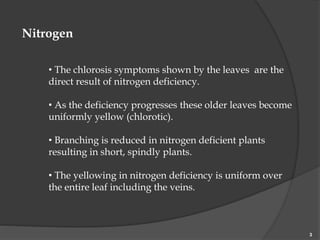
• The chlorosis symptoms shown by the leaves are the
direct result of nitrogen deficiency.
• As the deficiency progresses these older leaves become
uniformly yellow (chlorotic).
• Branching is reduced in nitrogen deficient plants
resulting in short, spindly plants.
• The yellowing in nitrogen deficiency is uniform over
the entire leaf including the veins.
3
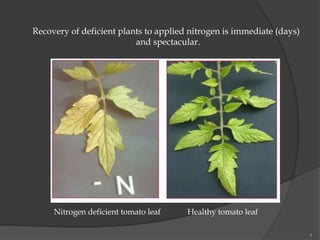
Recovery of deficient plants to applied nitrogen is immediate (days)
and spectacular.
Nitrogen deficient tomato leaf Healthy tomato leaf
4
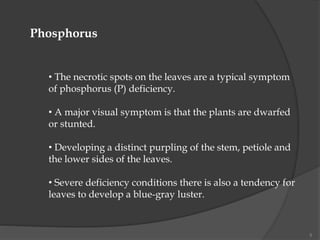
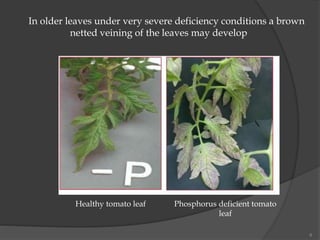
• The necrotic spots on the leaves are a typical symptom
of phosphorus (P) deficiency.
• A major visual symptom is that the plants are dwarfed
or stunted.
• Developing a distinct purpling of the stem, petiole and
the lower sides of the leaves.
• Severe deficiency conditions there is also a tendency for
leaves to develop a blue-gray luster.
Phosphorus
5
6
In older leaves under very severe deficiency conditions a brown
netted veining of the leaves may develop
Healthy tomato leaf Phosphorus deficient tomato
leaf
7
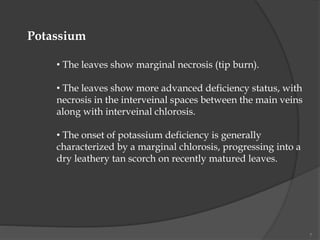
Potassium
• The leaves show marginal necrosis (tip burn).
• The leaves show more advanced deficiency status, with
necrosis in the interveinal spaces between the main veins
along with interveinal chlorosis.
• The onset of potassium deficiency is generally
characterized by a marginal chlorosis, progressing into a
dry leathery tan scorch on recently matured leaves.
8
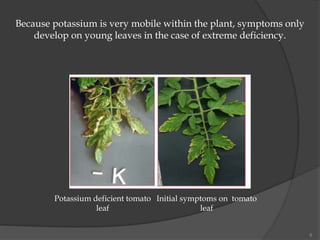
Because potassium is very mobile within the plant, symptoms only
develop on young leaves in the case of extreme deficiency.
Potassium deficient tomato
leaf
Initial symptoms on tomato
leaf
9
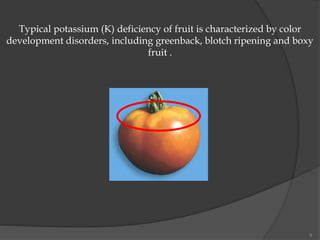
Typical potassium (K) deficiency of fruit is characterized by color
development disorders, including greenback, blotch ripening and boxy
fruit .
10
Calcium
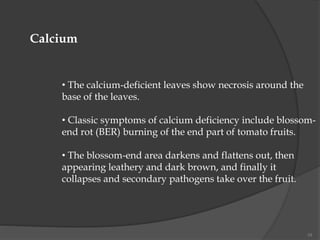
• The calcium-deficient leaves show necrosis around the
base of the leaves.
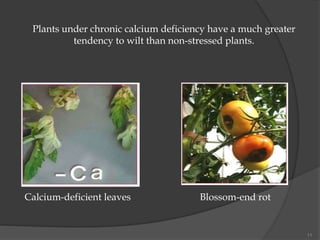
• Classic symptoms of calcium deficiency include blossom-
end rot (BER) burning of the end part of tomato fruits.
• The blossom-end area darkens and flattens out, then
appearing leathery and dark brown, and finally it
collapses and secondary pathogens take over the fruit.
11
Plants under chronic calcium deficiency have a much greater
tendency to wilt than non-stressed plants.
Calcium-deficient leaves Blossom-end rot
12
Magnesium
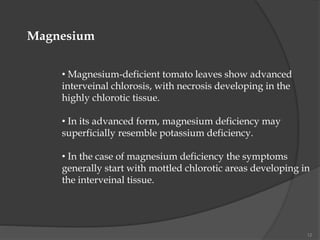
• Magnesium-deficient tomato leaves show advanced
interveinal chlorosis, with necrosis developing in the
highly chlorotic tissue.
• In its advanced form, magnesium deficiency may
superficially resemble potassium deficiency.
• In the case of magnesium deficiency the symptoms
generally start with mottled chlorotic areas developing in
the interveinal tissue.
13
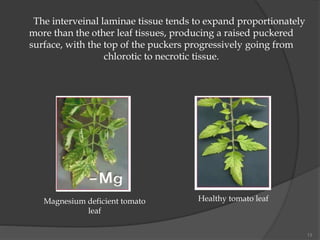
The interveinal laminae tissue tends to expand proportionately
more than the other leaf tissues, producing a raised puckered
surface, with the top of the puckers progressively going from
chlorotic to necrotic tissue.
Magnesium deficient tomato
leaf
Healthy tomato leaf
14
Sulphur
• The veins and petioles exhibit a very distinct
reddish color.
• The visual symptoms of sulfur deficiency are very
similar to the chlorosis found in nitrogen deficiency
• However, in sulfur deficiency the yellowing is
much more uniform over the entire plant including
young leaves.
15
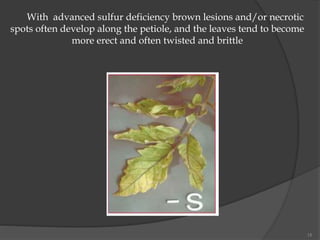
With advanced sulfur deficiency brown lesions and/or necrotic
spots often develop along the petiole, and the leaves tend to become
more erect and often twisted and brittle
16
Manganese
• These leaves show a light interveinal chlorosis
developed under a limited supply of Mn.
• The early stages of the chlorosis induced by
manganese deficiency are somewhat similar to iron
deficiency.
• As the stress increases, the leaves take on a gray
metallic sheen and develop dark freckled and
necrotic areas along the veins.
17
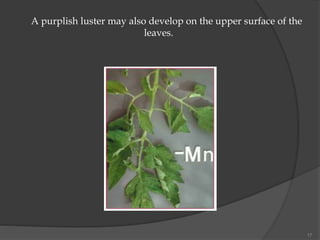
A purplish luster may also develop on the upper surface of the
leaves.
18
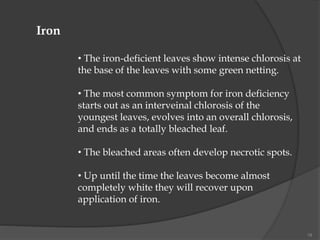
Iron
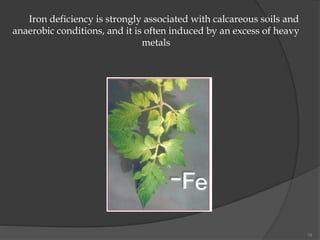
• The iron-deficient leaves show intense chlorosis at
the base of the leaves with some green netting.
• The most common symptom for iron deficiency
starts out as an interveinal chlorosis of the
youngest leaves, evolves into an overall chlorosis,
and ends as a totally bleached leaf.
• The bleached areas often develop necrotic spots.
• Up until the time the leaves become almost
completely white they will recover upon
application of iron.
19
Iron deficiency is strongly associated with calcareous soils and
anaerobic conditions, and it is often induced by an excess of heavy
metals
20
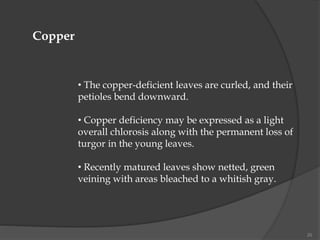
Copper
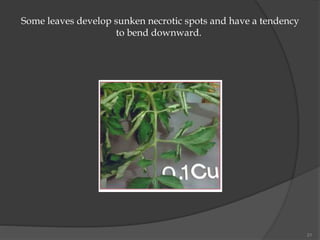
• The copper-deficient leaves are curled, and their
petioles bend downward.
• Copper deficiency may be expressed as a light
overall chlorosis along with the permanent loss of
turgor in the young leaves.
• Recently matured leaves show netted, green
veining with areas bleached to a whitish gray.
21
Some leaves develop sunken necrotic spots and have a tendency
to bend downward.
22
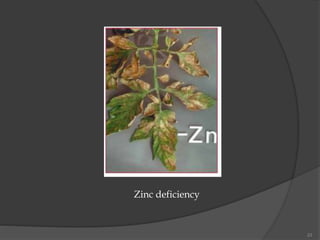
Zinc
• This leaf shows an advanced case of interveinal necrosis.
• In the early stages of zinc deficiency the younger leaves
become yellow and pitting develops in the interveinal
upper surfaces of the mature leaves.
• As the deficiency progresses these symptoms develop
into an intense interveinal necrosis but the main veins
remain green, as in the symptoms of recovering iron
deficiency
23
Zinc deficiency
24
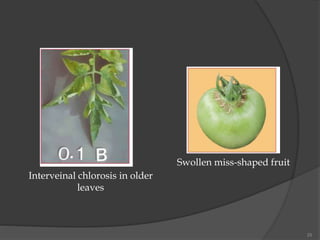
Boron
• The boron-deficient leaf shows a light general
chlorosis.
• Boron deficiency symptoms generally appear in
younger plants at the propagation stage.
• Slight interveinal chlorosis in older leaves
followed by yellow to orange tinting in middle and
older leaves.
• Leaves and stems are brittle and corky, split and
swollen miss-shaped fruit .
25
Interveinal chlorosis in older
leaves
Swollen miss-shaped fruit
26

Nutrient deficiency

  • 1.
  • 2.
    Nutrient Deficiency Symptoms inPlants Presented By : Prajwal Kumar G.K AL(S) 1050 2
  • 3.
    Nitrogen • The chlorosissymptoms shown by the leaves are the direct result of nitrogen deficiency. • As the deficiency progresses these older leaves become uniformly yellow (chlorotic). • Branching is reduced in nitrogen deficient plants resulting in short, spindly plants. • The yellowing in nitrogen deficiency is uniform over the entire leaf including the veins. 3
  • 4.
    Recovery of deficientplants to applied nitrogen is immediate (days) and spectacular. Nitrogen deficient tomato leaf Healthy tomato leaf 4
  • 5.
    • The necroticspots on the leaves are a typical symptom of phosphorus (P) deficiency. • A major visual symptom is that the plants are dwarfed or stunted. • Developing a distinct purpling of the stem, petiole and the lower sides of the leaves. • Severe deficiency conditions there is also a tendency for leaves to develop a blue-gray luster. Phosphorus 5
  • 6.
    6 In older leavesunder very severe deficiency conditions a brown netted veining of the leaves may develop Healthy tomato leaf Phosphorus deficient tomato leaf
  • 7.
    7 Potassium • The leavesshow marginal necrosis (tip burn). • The leaves show more advanced deficiency status, with necrosis in the interveinal spaces between the main veins along with interveinal chlorosis. • The onset of potassium deficiency is generally characterized by a marginal chlorosis, progressing into a dry leathery tan scorch on recently matured leaves.
  • 8.
    8 Because potassium isvery mobile within the plant, symptoms only develop on young leaves in the case of extreme deficiency. Potassium deficient tomato leaf Initial symptoms on tomato leaf
  • 9.
    9 Typical potassium (K)deficiency of fruit is characterized by color development disorders, including greenback, blotch ripening and boxy fruit .
  • 10.
    10 Calcium • The calcium-deficientleaves show necrosis around the base of the leaves. • Classic symptoms of calcium deficiency include blossom- end rot (BER) burning of the end part of tomato fruits. • The blossom-end area darkens and flattens out, then appearing leathery and dark brown, and finally it collapses and secondary pathogens take over the fruit.
  • 11.
    11 Plants under chroniccalcium deficiency have a much greater tendency to wilt than non-stressed plants. Calcium-deficient leaves Blossom-end rot
  • 12.
    12 Magnesium • Magnesium-deficient tomatoleaves show advanced interveinal chlorosis, with necrosis developing in the highly chlorotic tissue. • In its advanced form, magnesium deficiency may superficially resemble potassium deficiency. • In the case of magnesium deficiency the symptoms generally start with mottled chlorotic areas developing in the interveinal tissue.
  • 13.
    13 The interveinal laminaetissue tends to expand proportionately more than the other leaf tissues, producing a raised puckered surface, with the top of the puckers progressively going from chlorotic to necrotic tissue. Magnesium deficient tomato leaf Healthy tomato leaf
  • 14.
    14 Sulphur • The veinsand petioles exhibit a very distinct reddish color. • The visual symptoms of sulfur deficiency are very similar to the chlorosis found in nitrogen deficiency • However, in sulfur deficiency the yellowing is much more uniform over the entire plant including young leaves.
  • 15.
    15 With advanced sulfurdeficiency brown lesions and/or necrotic spots often develop along the petiole, and the leaves tend to become more erect and often twisted and brittle
  • 16.
    16 Manganese • These leavesshow a light interveinal chlorosis developed under a limited supply of Mn. • The early stages of the chlorosis induced by manganese deficiency are somewhat similar to iron deficiency. • As the stress increases, the leaves take on a gray metallic sheen and develop dark freckled and necrotic areas along the veins.
  • 17.
    17 A purplish lustermay also develop on the upper surface of the leaves.
  • 18.
    18 Iron • The iron-deficientleaves show intense chlorosis at the base of the leaves with some green netting. • The most common symptom for iron deficiency starts out as an interveinal chlorosis of the youngest leaves, evolves into an overall chlorosis, and ends as a totally bleached leaf. • The bleached areas often develop necrotic spots. • Up until the time the leaves become almost completely white they will recover upon application of iron.
  • 19.
    19 Iron deficiency isstrongly associated with calcareous soils and anaerobic conditions, and it is often induced by an excess of heavy metals
  • 20.
    20 Copper • The copper-deficientleaves are curled, and their petioles bend downward. • Copper deficiency may be expressed as a light overall chlorosis along with the permanent loss of turgor in the young leaves. • Recently matured leaves show netted, green veining with areas bleached to a whitish gray.
  • 21.
    21 Some leaves developsunken necrotic spots and have a tendency to bend downward.
  • 22.
    22 Zinc • This leafshows an advanced case of interveinal necrosis. • In the early stages of zinc deficiency the younger leaves become yellow and pitting develops in the interveinal upper surfaces of the mature leaves. • As the deficiency progresses these symptoms develop into an intense interveinal necrosis but the main veins remain green, as in the symptoms of recovering iron deficiency
  • 23.
  • 24.
    24 Boron • The boron-deficientleaf shows a light general chlorosis. • Boron deficiency symptoms generally appear in younger plants at the propagation stage. • Slight interveinal chlorosis in older leaves followed by yellow to orange tinting in middle and older leaves. • Leaves and stems are brittle and corky, split and swollen miss-shaped fruit .
  • 25.
    25 Interveinal chlorosis inolder leaves Swollen miss-shaped fruit
  • 26.