PRESENTED BY: Pawan Nagar
Reg. no.: 04-2690-2015
M.Sc.(Fruit Science)
Ideotype Breeding
Introduction to Ideotype breeding
In broad sense an Ideotype is a “biological model
which is expected to perform or behave in a predictable
manner within a defined environment.”
More specifically, crop Ideotype is a plant model
which is expected to yield greater quantity of grains,
fiber, oil or other useful product when developed as a
cultivar.
The term Ideotype was first proposed by Donald
in 1968 working on wheat.
MAIN POINT OF IDEOTYPE :
 Crop Ideotype refers to model plants for specific environment.
 Ideotype differs from Idiotype.
 It include morphological as well as physiological and biochemical traits.
 Ideotype is a moving goal.
 It is difficult and slow method of cultivar development.
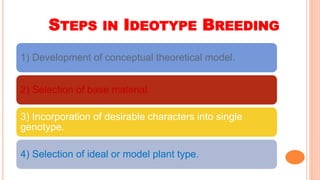
STEPS IN IDEOTYPE BREEDING
1) Development of conceptual theoretical model.
2) Selection of base material.
3) Incorporation of desirable characters into single
genotype.
4) Selection of ideal or model plant type.
DEVELOPMENT OF CONCEPTUAL THEORETICAL MODEL
 Ideotype consists of various morphological and physiological traits. The values
of various morphological and physiological traits are specified to develop a
conceptual theoretical model.
 For example,
 Plant height is important in fodder crops.
 Maturity duration is important in rainfed.
 Similarly leaf number, leaf angle, leaf size, photosynthetic rate,etc are
specified for each crops and situation.
SELECTION OF BASE MATERIAL
 Selection of base material is an important step after development of
conceptual model of Ideotype.
 Genotype to be used in devising a model plant type should have broad
genetic base and wider adaptability so that the new plant type can be
successfully grown over a wide range of environmental condition with stable
yield.
 Genotypes for plant stature, maturity duration, leaf size, and angles are
selected from the global gene pool of the concerned crop species.
 Genotypes resistant or tolerant to drought, soil salinity, alkalinity, disease and
insects are selected from the gene pool with the cooperation of physiologist,
soil scientist, pathologist and entomologist.
INCORPORATION OF DESIRABLE TRAITS
 The next important step is combining of various morphological and
physiological traits from different selected genotypes into single
genotype.
 Knowledge of the association between various characters is essential
before starting hybridization programme, because it help in combining
of various characters.
 Linkage between procedures, viz single cross, three way cross,
multiple cross, backcross, composite crossing. E.g. Mutation
breeding, heterosis breeding, etc. are used for the development of
ideal plant types in majority of field crops. Backcross technique is
commonly used for transfer of oligogenic traits from selected
germplasm lines into the background of an adapted genotype.
SELECTION OF IDEAL PLANT TYPE
 Plant combining desirable morphological and physiological traits are selected
in segregating population and intermated to achieve the desired plant type.
 Morphological features are judged through visual observation and
physiological parameters are recorded with the help of sophisticated
instruments.
 Screening for resistance to drought, soil salinity, alkalinity, disease and
insects is done under controlled conditions. This task is completed with the
help of scientist from the disciplines of physiology, soil science, pathology and
entomology.
 Finally, genotypes combining traits specified in the conceptual model are
selected, multiplied, tested over several locations, and released for
commercial cultivation.
FEATURES OF CROP IDEOTYPE
• The crop Ideotype consists of several morphological and physiological traits which
contribute for enhanced yield or higher yield than currently prevalent crop cultivars.
• The morphological and physiological features of crop Ideotype is required for
irrigated cultivation or rainfed cultivation.
• Ideal plant whether the Ideotype is required for irrigated cultivation or rainfed
cultivation.
• Ideal plant types or model plants have been discussed in several crops like wheat,
maize, cotton, and pulses.
• The important features of Ideotype for some crops are briefly described below:
WHEAT
1. A short strong stem. It imparts lodging resistance and reduces the losses due to
lodging.
2. Erect leaves. Such leaves provide better arrangement for proper light
distribution resulting in high photosynthesis or CO2 fixation.
3. Few small leaves. Leaves are the important sites of photosynthesis, respiration,
and transpiration. Few and small reduce water loss due to transpiration.
4. Larger ear. It will produce more grains per ear.
5. A presence of owns. Awns contribute towards photosynthesis
6. single culm.
MAIZE
In 1975, Mock and Pearce proposed ideal plant type of maize.
In Maize , higher yields were obtained from the plants consisting of
1) Low tillers,
2) Large cobs, and
3) Angled leaves for good light interception. Planting of such type at closer
spacing resulted in higher yields.
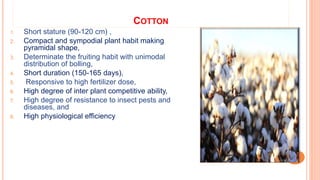
COTTON
1. Short stature (90-120 cm) ,
2. Compact and sympodial plant habit making
pyramidal shape,
3. Determinate the fruiting habit with unimodal
distribution of bolling,
4. Short duration (150-165 days),
5. Responsive to high fertilizer dose,
6. High degree of inter plant competitive ability,
7. High degree of resistance to insect pests and
diseases, and
8. High physiological efficiency
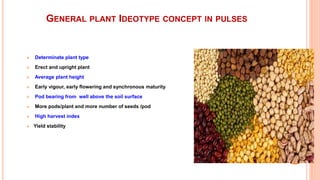
GENERAL PLANT IDEOTYPE CONCEPT IN PULSES
 Determinate plant type
 Erect and upright plant
 Average plant height
 Early vigour, early flowering and synchronous maturity
 Pod bearing from well above the soil surface
 More pods/plant and more number of seeds /pod
 High harvest index
 Yield stability
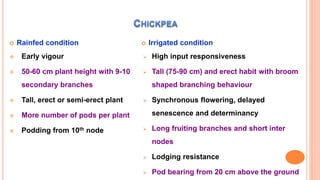
 Rainfed condition
 Early vigour
 50-60 cm plant height with 9-10
secondary branches
 Tall, erect or semi-erect plant
 More number of pods per plant
 Podding from 10th node
 Irrigated condition
 High input responsiveness
 Tall (75-90 cm) and erect habit with broom
shaped branching behaviour
 Synchronous flowering, delayed
senescence and determinancy
 Long fruiting branches and short inter
nodes
 Lodging resistance
 Pod bearing from 20 cm above the ground
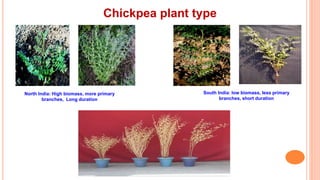
Chickpea plant type
North India: High biomass, more primary
branches, Long duration
South India: low biomass, less primary
branches, short duration
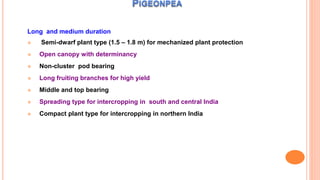
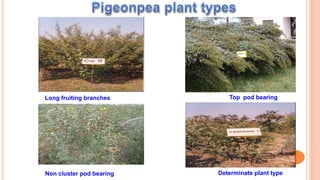
Long and medium duration
 Semi-dwarf plant type (1.5 – 1.8 m) for mechanized plant protection
 Open canopy with determinancy
 Non-cluster pod bearing
 Long fruiting branches for high yield
 Middle and top bearing
 Spreading type for intercropping in south and central India
 Compact plant type for intercropping in northern India
Long fruiting branches Top pod bearing
Non cluster pod bearing Determinate plant type
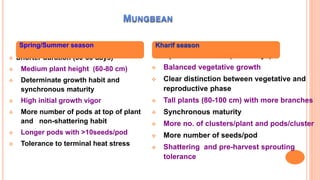
 Shorter duration (50-60 days)
 Medium plant height (60-80 cm)
 Determinate growth habit and
synchronous maturity
 High initial growth vigor
 More number of pods at top of plant
and non-shattering habit
 Longer pods with >10seeds/pod
 Tolerance to terminal heat stress
 Optimum duration (65-75 days)
 Balanced vegetative growth
 Clear distinction between vegetative and
reproductive phase
 Tall plants (80-100 cm) with more branches
 Synchronous maturity
 More no. of clusters/plant and pods/cluster
 More number of seeds/pod
 Shattering and pre-harvest sprouting
tolerance
Spring/Summer season Kharif season
MERITS OF IDEOTYPE BREEDING
1. Ideotype breeding is an effective method of enhancing yield through manipulation of
various morphological and physiological crop characters. Thus, it exploits both
morphological and physiological variation.
2. In this method of various morphological and physiological traits are specified and
each character or trait contributes towards enhanced yield.
3. Ideotype breeding involves experts from the discipline of plant breeding, physiology,
biochemistry, entomology and plant pathology. Each specialist contributes in the
development of model plants for traits related to his field.
MERITS OF IDEOTYPE BREEDING
4. Ideotype breeding is an effective method of breaking yield barriers through the use
of genetically controlled physiological variation for various characters contributing
towards higher yield.
5. Ideotype breeding provides solution to several problems at a time like disease,
insect and lodging resistance, maturity duration, yield and quality by combining
desirable genes for these traits from different sources into a single genotype.
6. It is efficient method of developing cultivars for specific or environment.
DEMERITS OF IDEOTYPE BREEDING
1. Incorporation of several desirable morphological and physiological and disease
resistance traits from different sources into a single genotype is a difficult task.
Sometimes, combining of some characters is not possible due to tight linkage
between desirable and undesirable characters. Presence of such linkage hinders the
progress of Ideotype breeding.
2. Ideotype breeding is a slow method of cultivar development, because combining
together of various morphological and physiological features from different
sources takes more time than traditional breeding where improvement is made in
yield and one or two other characters.
DEMERITS OF IDEOTYPE BREEDING
3. Ideotype breeding is not a substitute for traditional or conventional
breeding. It is a supplement to the former.
4. Ideotype is a moving object which changes with change in
knowledge, new requirements, national policy, etc. Thus new
Ideotype have to evolved to meet the changing and increasing
demands of economic products.
Ideotype breeding

Ideotype breeding

  • 1.
    PRESENTED BY: PawanNagar Reg. no.: 04-2690-2015 M.Sc.(Fruit Science) Ideotype Breeding
  • 2.
    Introduction to Ideotypebreeding In broad sense an Ideotype is a “biological model which is expected to perform or behave in a predictable manner within a defined environment.” More specifically, crop Ideotype is a plant model which is expected to yield greater quantity of grains, fiber, oil or other useful product when developed as a cultivar. The term Ideotype was first proposed by Donald in 1968 working on wheat.
  • 3.
    MAIN POINT OFIDEOTYPE :  Crop Ideotype refers to model plants for specific environment.  Ideotype differs from Idiotype.  It include morphological as well as physiological and biochemical traits.  Ideotype is a moving goal.  It is difficult and slow method of cultivar development.
  • 4.
    STEPS IN IDEOTYPEBREEDING 1) Development of conceptual theoretical model. 2) Selection of base material. 3) Incorporation of desirable characters into single genotype. 4) Selection of ideal or model plant type.
  • 5.
    DEVELOPMENT OF CONCEPTUALTHEORETICAL MODEL  Ideotype consists of various morphological and physiological traits. The values of various morphological and physiological traits are specified to develop a conceptual theoretical model.  For example,  Plant height is important in fodder crops.  Maturity duration is important in rainfed.  Similarly leaf number, leaf angle, leaf size, photosynthetic rate,etc are specified for each crops and situation.
  • 6.
    SELECTION OF BASEMATERIAL  Selection of base material is an important step after development of conceptual model of Ideotype.  Genotype to be used in devising a model plant type should have broad genetic base and wider adaptability so that the new plant type can be successfully grown over a wide range of environmental condition with stable yield.  Genotypes for plant stature, maturity duration, leaf size, and angles are selected from the global gene pool of the concerned crop species.  Genotypes resistant or tolerant to drought, soil salinity, alkalinity, disease and insects are selected from the gene pool with the cooperation of physiologist, soil scientist, pathologist and entomologist.
  • 7.
    INCORPORATION OF DESIRABLETRAITS  The next important step is combining of various morphological and physiological traits from different selected genotypes into single genotype.  Knowledge of the association between various characters is essential before starting hybridization programme, because it help in combining of various characters.  Linkage between procedures, viz single cross, three way cross, multiple cross, backcross, composite crossing. E.g. Mutation breeding, heterosis breeding, etc. are used for the development of ideal plant types in majority of field crops. Backcross technique is commonly used for transfer of oligogenic traits from selected germplasm lines into the background of an adapted genotype.
  • 8.
    SELECTION OF IDEALPLANT TYPE  Plant combining desirable morphological and physiological traits are selected in segregating population and intermated to achieve the desired plant type.  Morphological features are judged through visual observation and physiological parameters are recorded with the help of sophisticated instruments.  Screening for resistance to drought, soil salinity, alkalinity, disease and insects is done under controlled conditions. This task is completed with the help of scientist from the disciplines of physiology, soil science, pathology and entomology.  Finally, genotypes combining traits specified in the conceptual model are selected, multiplied, tested over several locations, and released for commercial cultivation.
  • 9.
    FEATURES OF CROPIDEOTYPE • The crop Ideotype consists of several morphological and physiological traits which contribute for enhanced yield or higher yield than currently prevalent crop cultivars. • The morphological and physiological features of crop Ideotype is required for irrigated cultivation or rainfed cultivation. • Ideal plant whether the Ideotype is required for irrigated cultivation or rainfed cultivation. • Ideal plant types or model plants have been discussed in several crops like wheat, maize, cotton, and pulses. • The important features of Ideotype for some crops are briefly described below:
  • 10.
    WHEAT 1. A shortstrong stem. It imparts lodging resistance and reduces the losses due to lodging. 2. Erect leaves. Such leaves provide better arrangement for proper light distribution resulting in high photosynthesis or CO2 fixation. 3. Few small leaves. Leaves are the important sites of photosynthesis, respiration, and transpiration. Few and small reduce water loss due to transpiration. 4. Larger ear. It will produce more grains per ear. 5. A presence of owns. Awns contribute towards photosynthesis 6. single culm.
  • 11.
    MAIZE In 1975, Mockand Pearce proposed ideal plant type of maize. In Maize , higher yields were obtained from the plants consisting of 1) Low tillers, 2) Large cobs, and 3) Angled leaves for good light interception. Planting of such type at closer spacing resulted in higher yields.
  • 12.
    COTTON 1. Short stature(90-120 cm) , 2. Compact and sympodial plant habit making pyramidal shape, 3. Determinate the fruiting habit with unimodal distribution of bolling, 4. Short duration (150-165 days), 5. Responsive to high fertilizer dose, 6. High degree of inter plant competitive ability, 7. High degree of resistance to insect pests and diseases, and 8. High physiological efficiency
  • 13.
    GENERAL PLANT IDEOTYPECONCEPT IN PULSES  Determinate plant type  Erect and upright plant  Average plant height  Early vigour, early flowering and synchronous maturity  Pod bearing from well above the soil surface  More pods/plant and more number of seeds /pod  High harvest index  Yield stability
  • 14.
     Rainfed condition Early vigour  50-60 cm plant height with 9-10 secondary branches  Tall, erect or semi-erect plant  More number of pods per plant  Podding from 10th node  Irrigated condition  High input responsiveness  Tall (75-90 cm) and erect habit with broom shaped branching behaviour  Synchronous flowering, delayed senescence and determinancy  Long fruiting branches and short inter nodes  Lodging resistance  Pod bearing from 20 cm above the ground
  • 15.
    Chickpea plant type NorthIndia: High biomass, more primary branches, Long duration South India: low biomass, less primary branches, short duration
  • 16.
    Long and mediumduration  Semi-dwarf plant type (1.5 – 1.8 m) for mechanized plant protection  Open canopy with determinancy  Non-cluster pod bearing  Long fruiting branches for high yield  Middle and top bearing  Spreading type for intercropping in south and central India  Compact plant type for intercropping in northern India
  • 17.
    Long fruiting branchesTop pod bearing Non cluster pod bearing Determinate plant type
  • 18.
     Shorter duration(50-60 days)  Medium plant height (60-80 cm)  Determinate growth habit and synchronous maturity  High initial growth vigor  More number of pods at top of plant and non-shattering habit  Longer pods with >10seeds/pod  Tolerance to terminal heat stress  Optimum duration (65-75 days)  Balanced vegetative growth  Clear distinction between vegetative and reproductive phase  Tall plants (80-100 cm) with more branches  Synchronous maturity  More no. of clusters/plant and pods/cluster  More number of seeds/pod  Shattering and pre-harvest sprouting tolerance Spring/Summer season Kharif season
  • 19.
    MERITS OF IDEOTYPEBREEDING 1. Ideotype breeding is an effective method of enhancing yield through manipulation of various morphological and physiological crop characters. Thus, it exploits both morphological and physiological variation. 2. In this method of various morphological and physiological traits are specified and each character or trait contributes towards enhanced yield. 3. Ideotype breeding involves experts from the discipline of plant breeding, physiology, biochemistry, entomology and plant pathology. Each specialist contributes in the development of model plants for traits related to his field.
  • 20.
    MERITS OF IDEOTYPEBREEDING 4. Ideotype breeding is an effective method of breaking yield barriers through the use of genetically controlled physiological variation for various characters contributing towards higher yield. 5. Ideotype breeding provides solution to several problems at a time like disease, insect and lodging resistance, maturity duration, yield and quality by combining desirable genes for these traits from different sources into a single genotype. 6. It is efficient method of developing cultivars for specific or environment.
  • 21.
    DEMERITS OF IDEOTYPEBREEDING 1. Incorporation of several desirable morphological and physiological and disease resistance traits from different sources into a single genotype is a difficult task. Sometimes, combining of some characters is not possible due to tight linkage between desirable and undesirable characters. Presence of such linkage hinders the progress of Ideotype breeding. 2. Ideotype breeding is a slow method of cultivar development, because combining together of various morphological and physiological features from different sources takes more time than traditional breeding where improvement is made in yield and one or two other characters.
  • 22.
    DEMERITS OF IDEOTYPEBREEDING 3. Ideotype breeding is not a substitute for traditional or conventional breeding. It is a supplement to the former. 4. Ideotype is a moving object which changes with change in knowledge, new requirements, national policy, etc. Thus new Ideotype have to evolved to meet the changing and increasing demands of economic products.