Plant Growth Regulators
GROWTH
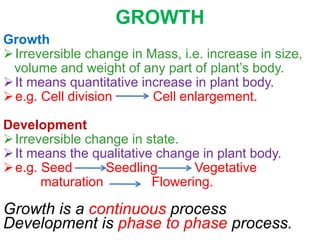
Growth
Irreversible change in Mass, i.e. increase in size,
volume and weight of any part of plant’s body.
It means quantitative increase in plant body.
e.g. Cell division Cell enlargement.
Development
Irreversible change in state.
It means the qualitative change in plant body.
e.g. Seed Seedling Vegetative
maturation Flowering.
Growth is a continuous process
Development is phase to phase process.
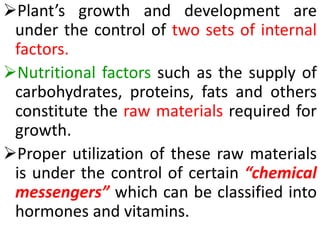
Plant’s growth and development are
under the control of two sets of internal
factors.
Nutritional factors such as the supply of
carbohydrates, proteins, fats and others
constitute the raw materials required for
growth.
Proper utilization of these raw materials
is under the control of certain “chemical
messengers” which can be classified into
hormones and vitamins.
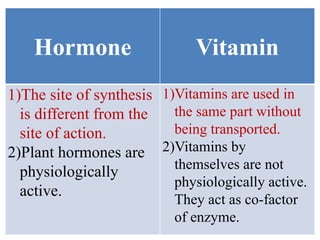
Hormone Vitamin
1)The site of synthesis
is different from the
site of action.
2)Plant hormones are
physiologically
active.
1)Vitamins are used in
the same part without
being transported.
2)Vitamins by
themselves are not
physiologically active.
They act as co-factor
of enzyme.
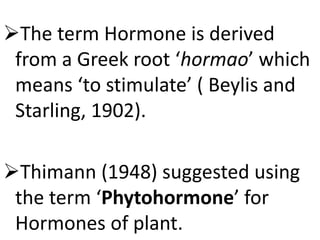
The term Hormone is derived
from a Greek root ‘hormao’ which
means ‘to stimulate’ ( Beylis and
Starling, 1902).
Thimann (1948) suggested using
the term ‘Phytohormone’ for
Hormones of plant.
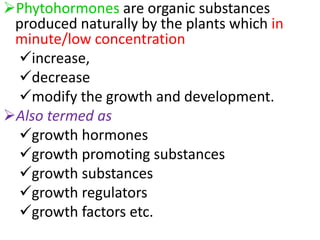
Phytohormones are organic substances
produced naturally by the plants which in
minute/low concentration
increase,
decrease
modify the growth and development.
Also termed as
growth hormones
growth promoting substances
growth substances
growth regulators
growth factors etc.
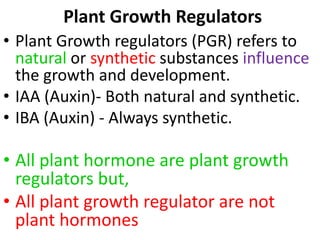
Plant Growth Regulators
• Plant Growth regulators (PGR) refers to
natural or synthetic substances influence
the growth and development.
• IAA (Auxin)- Both natural and synthetic.
• IBA (Auxin) - Always synthetic.
• All plant hormone are plant growth
regulators but,
• All plant growth regulator are not
plant hormones
Classification of PGR
On the Basis of Origin
• Natural hormone: Produced by some tissues in
the plant. Also called Endogenous hormones. e.g.
IAA.
• Synthetic hormone: Produced artificially and
similar to natural hormone in physiological
activity. Also called Exogenous hormones. e.g. 2,4-
D, NAA etc.
• Postulated hormone: Also produced
spontaneously in the plant body, but their
structure and function is not discovered clearly.
e.g. Florigen, Vernalin.
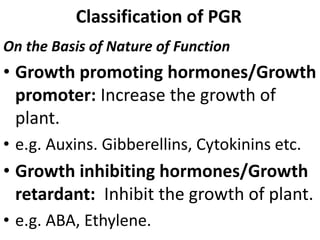
Classification of PGR
On the Basis of Nature of Function
• Growth promoting hormones/Growth
promoter: Increase the growth of
plant.
• e.g. Auxins. Gibberellins, Cytokinins etc.
• Growth inhibiting hormones/Growth
retardant: Inhibit the growth of plant.
• e.g. ABA, Ethylene.
AUXINS
• Derived from the Greek word
"auxein" means- "to grow/increase".
• Auxins may be defined as growth
promoting substances which
promote growth along the vertical
axis when applied in low
concentration to the shoot of the
plant.
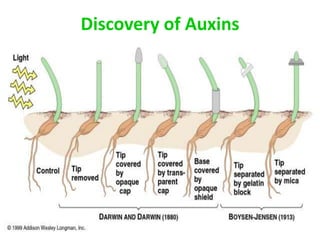
Discovery of Auxins
Discovery of Auxins
Discovery of Auxins
Discovery of Auxins
Discovery of Auxins
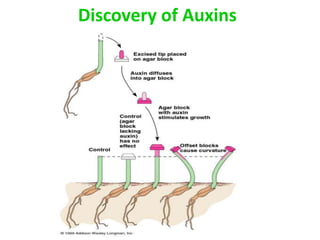
• The idea of existence of auxin was proposed by
Charles Darwin (1880) in his book “The Power of
Movements in Plants”.
• Coleoptiles of Canary grass (Phallaris canariensis) to
unilateral light and observed it to bend towards
light.
• He covered the coleoptiles tip with tin foil or cut it
off and observed that coleoptiles did not bend
towards unilateral light.
• Concluded - some stimulus is transmitted from
upper to the lower part which induced bending of
the coleoptiles.
Discovery of Auxins
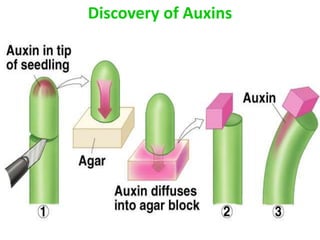
• Arpad Paál (1919) - Asymmetrical placement
of cut tips on coleoptiles resulted in a bending
of the coleoptile away from the side onto
which the tips were placed
• F.W. Went (1926) successfully discovered
and isolated this growth substance from
Avena sativa (Oat) coleoptiles tips.
• Kogl and Haagen-Smit(1931) named it as
“auxin”.
Occurrence and Distribution of Auxins
Occurs universally in all plants.
Where there is active growth there is auxin
production.
Growing meristem and enlarging organs produces
auxin.
Shoot apex produces much auxin than root apex.
Apical bud synthesizes more auxin than lateral
buds.
Developing seeds contain more auxin than matured
seeds.
Apical bud synthesizes six times more auxin than
expanding leaves.
Auxin Translocation
Auxin transported basipetally.
It moves from apical to basal end.
Velocity of transport is-
1 to 1.5 cm/hr in stem &
coleoptiles
0.1 to 0.2 cm/hr in root.
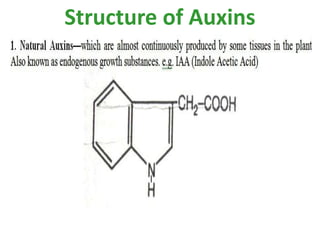
Structure of Auxins
Structure of Auxins
Synthetic Auxins—produced artificially and
similar to natural in their physiological activity.
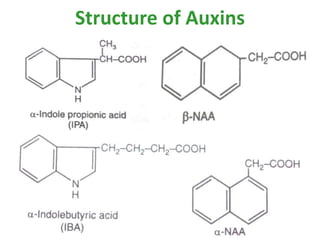
IPA (Indole Propionic Acid)
IBA (Indole Butyric Acid)
NAA (Napthalene Acetic Acid)
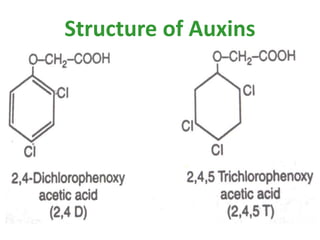
2,4-D (2,4 – Dichlorophenoxy acetic acid)
2,4,5-T (2,4,5 – Trichlorophenoxy acetic acid)
etc.
Structure of Auxins
Structure of Auxins
Structural Requirements of Auxin
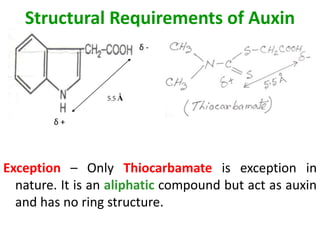
Exception – Only Thiocarbamate is exception in
nature. It is an aliphatic compound but act as auxin
and has no ring structure.
δ +
δ -
5.5Å
Structural Requirements of Auxin
An unsaturated ring (at least one double bond in
the ring).
An acidic Side Chain containing carboxyl group
(COOH ).
At least one carbon atom between the ring and
carboxyl group.
Spatial difference between the ring and carboxyl
group, i.e. molecule should be 5.5 Å.
Others –
Easy transportability to plant cell,
preventive to enzyme degradation,
desirable dissociation constant etc.
Structural Variations and Auxin Activity
A. Nature of ring system
• A six carbon ring together with five carbons (i.e. indole
ring) shows greater activity.
• The ring bigger than Indole ring possesses high activity,
eg. NAA
• Saturated ring does not show auxin activity.
• At least one double bond in the ring is necessary and it
should be adjacent to the side chain.
• Increasing the number of double bonds in the ring
increases the activity of molecules.
• Substitution of N of pyrrole ring with either carbon or
oxygen reduces the auxin activity.
Structural Variations and Auxin Activity
B. Nature of Side Chain:
• When carboxylic group (-COOH) in the side
chain is separated by a carbon or a carbon &
oxygen it produces optimal activity (i.e. IAA)
• If the intervening number of carbon atoms
(carbon atom between ring and carboxylic group)
–is of even number, the activity decreases
–is of odd number, the activity increses.
Structural Variations and Auxin Activity
C. Others:
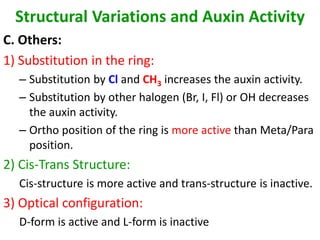
1) Substitution in the ring:
– Substitution by Cl and CH3 increases the auxin activity.
– Substitution by other halogen (Br, I, Fl) or OH decreases
the auxin activity.
– Ortho position of the ring is more active than Meta/Para
position.
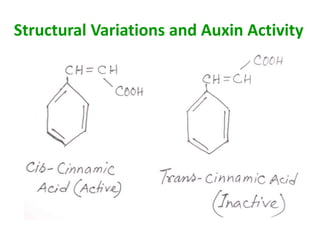
2) Cis-Trans Structure:
Cis-structure is more active and trans-structure is inactive.
3) Optical configuration:
D-form is active and L-form is inactive
Mode of Action of Auxin (in cell elongation)
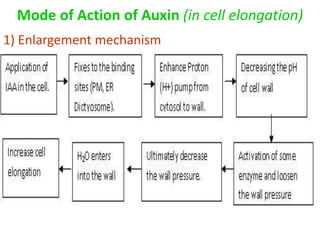
1) Enlargement mechanism
Mode of Action of Auxin (in cell elongation)
2) Wall Rigidity Mechanism
• Fixing on binding sites auxin sends a messenger to
nucleus.
• Nature of this messenger is unknown to the
physiologist.
• So that a structural change of DNA happens; mRNA
forms from DNA.
• These mRNA carries some new information – comes
outside the nucleus and generate new enzyme.
• This enzyme produces new cell wall materials which
gives wall plasticity and rigidity. So enlargement get
permanency.
• In other cases, new DNA , mRNA formation is the basic
principle of mode of action.
Effects of different Auxin on
Plant Growth and Development
Cell Elongation and Cell Division
• Causes growth in coleoptiles and stem due to
elongation of already existing cells.
• The main causes of cell elongation-
– By increasing the osmotic content, permeability of cell to
water, wall synthesis.
– By reducing wall pressure.
– By inducing the synthesis of RNA & protein which in turn
lead to an increase in cell wall plasticity & extension.
• Auxin also induces / promotes cell division within
the cambial region.
Effects of different Auxin on
Plant Growth and Development
Apical Dominance
• Apical or terminal buds of many vascular plants are
very active while the lateral buds remain inactive.
• Removal of apical buds promotes lateral buds to grow.
• Apical dominance is due to much higher auxin content
in the apical buds than lateral buds.
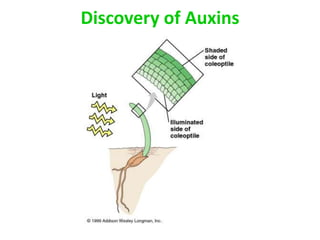
Phototropism
• Plant bend towards unilateral light.
• This is due to higher concentration of auxin on the
shaded side.
Effects of different Auxin on
Plant Growth and Development
Geotropism
• Movement of a plant’s organ in response to gravity is
known as geotropism/ gravitropism.
• Stem and roots accumulate IAA on the lower side in
response to gravity.
• Increased auxin concentration on the lower side in
stems causes those cells to grow more than cells on the
upper side.
– stem bends up against the force of gravity
• negative gravitropism
• Upper side of roots grow more rapidly than the lower
side.
– roots ultimately grow downward
• positive gravitropism
Effects of different Auxin on
Plant Growth and Development
Root initiation
• Application of IAA to cut end of a stem promotes
root formation.
Control or Prevention of Abscission
• Abscission does not occur when auxin content is
high on distal end and low in the proximal end of
abscission zone.
Parthenocarpy
• Auxin induces Parthenocarpy.
Effects of different Auxin on
Plant Growth and Development
Callus Formation
• Undifferentiated mass of parenchymatous
tissue is known as callus.
• Application of IAA causes cells to elongate &
adventitious root.
Sex Expression
• Auxin induced the changing of sex ratio of
flowers towards femaleness, i.e. increase the
number of female flowers.
Use of Auxin in Agriculture
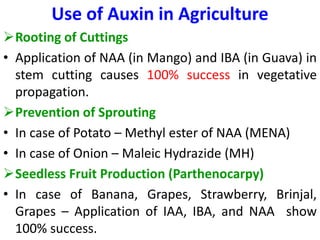
Rooting of Cuttings
• Application of NAA (in Mango) and IBA (in Guava) in
stem cutting causes 100% success in vegetative
propagation.
Prevention of Sprouting
• In case of Potato – Methyl ester of NAA (MENA)
• In case of Onion – Maleic Hydrazide (MH)
Seedless Fruit Production (Parthenocarpy)
• In case of Banana, Grapes, Strawberry, Brinjal,
Grapes – Application of IAA, IBA, and NAA show
100% success.
Use of Auxin in Agriculture
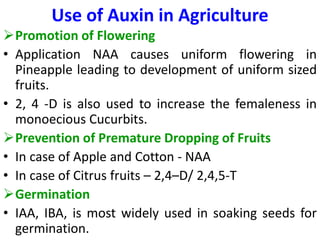
Promotion of Flowering
• Application NAA causes uniform flowering in
Pineapple leading to development of uniform sized
fruits.
• 2, 4 -D is also used to increase the femaleness in
monoecious Cucurbits.
Prevention of Premature Dropping of Fruits
• In case of Apple and Cotton - NAA
• In case of Citrus fruits – 2,4–D/ 2,4,5-T
Germination
• IAA, IBA, is most widely used in soaking seeds for
germination.
Use of Auxin in Agriculture
Fruit Setting
• 2, 4, 5-T is used for improved fruit setting in berries.
Thinning of Flower, Fruit and Leaves
• 2, 4-D is used for defoliation of Cotton plant before
boll harvesting.
• NAA is used for fruit thinning in Apple.
Prevention of Lodging in Cereals
• 30-40% Yield loss in traditional tall varieties. Alpha
naphthalene acetamide is used to prevent lodging
in cereals.
Use of Auxin in Agriculture
Weedicide
• 2, 4-D, MCPA (Methyl Chloro-Phenoxy Acetic
Acid) are weed killer.
• 2,4-D is highly toxic to broad leaved plants or
dicotyledons.
Tissue Culture
• Auxin along with cytokinin shows successful
callus formation, root-shoot differentiation
etc.
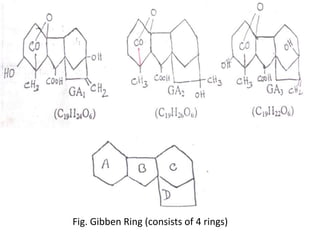
GIBBERELLINS
Discovered by Kurosawa, a Japanese Plant
Pathologist in 1928.
Rice plants infected by the fungus Gibberella
fujikuroi (Synonym: Fusarium moniliforme) showed
excessive stem elongation.
Symptom is called ‘Bakane’ diseases.
Chemical was extracted & purified and named as
Gibberellic Acid (GA).
Now 80 different Gibberellins are available- GA1 to
GA80 is available.
The most commonly occurring gibberellins is GA3.
Fig. Gibben Ring (consists of 4 rings)
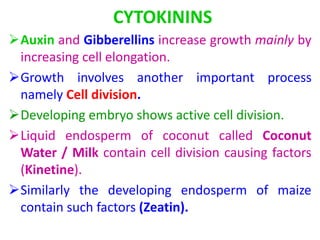
CYTOKININS
Auxin and Gibberellins increase growth mainly by
increasing cell elongation.
Growth involves another important process
namely Cell division.
Developing embryo shows active cell division.
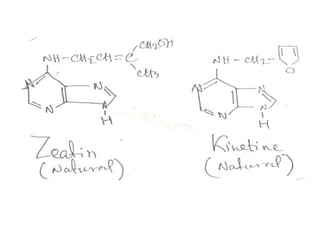
Liquid endosperm of coconut called Coconut
Water / Milk contain cell division causing factors
(Kinetine).
Similarly the developing endosperm of maize
contain such factors (Zeatin).
Growth Retardant
1. ETHYLENE (CH2=CH2)
• Growth retardant.
• Ethylene promotes ripening
2. ABSCISSIC ACID (ABA)
• Growth retardant.
• Induce stomata closing.
• Inhibition of bud growth and shoot formation.

Plant growth regulators

  • 1.
  • 2.
    GROWTH Growth Irreversible change inMass, i.e. increase in size, volume and weight of any part of plant’s body. It means quantitative increase in plant body. e.g. Cell division Cell enlargement. Development Irreversible change in state. It means the qualitative change in plant body. e.g. Seed Seedling Vegetative maturation Flowering. Growth is a continuous process Development is phase to phase process.
  • 3.
    Plant’s growth anddevelopment are under the control of two sets of internal factors. Nutritional factors such as the supply of carbohydrates, proteins, fats and others constitute the raw materials required for growth. Proper utilization of these raw materials is under the control of certain “chemical messengers” which can be classified into hormones and vitamins.
  • 4.
    Hormone Vitamin 1)The siteof synthesis is different from the site of action. 2)Plant hormones are physiologically active. 1)Vitamins are used in the same part without being transported. 2)Vitamins by themselves are not physiologically active. They act as co-factor of enzyme.
  • 5.
    The term Hormoneis derived from a Greek root ‘hormao’ which means ‘to stimulate’ ( Beylis and Starling, 1902). Thimann (1948) suggested using the term ‘Phytohormone’ for Hormones of plant.
  • 6.
    Phytohormones are organicsubstances produced naturally by the plants which in minute/low concentration increase, decrease modify the growth and development. Also termed as growth hormones growth promoting substances growth substances growth regulators growth factors etc.
  • 7.
    Plant Growth Regulators •Plant Growth regulators (PGR) refers to natural or synthetic substances influence the growth and development. • IAA (Auxin)- Both natural and synthetic. • IBA (Auxin) - Always synthetic. • All plant hormone are plant growth regulators but, • All plant growth regulator are not plant hormones
  • 8.
    Classification of PGR Onthe Basis of Origin • Natural hormone: Produced by some tissues in the plant. Also called Endogenous hormones. e.g. IAA. • Synthetic hormone: Produced artificially and similar to natural hormone in physiological activity. Also called Exogenous hormones. e.g. 2,4- D, NAA etc. • Postulated hormone: Also produced spontaneously in the plant body, but their structure and function is not discovered clearly. e.g. Florigen, Vernalin.
  • 9.
    Classification of PGR Onthe Basis of Nature of Function • Growth promoting hormones/Growth promoter: Increase the growth of plant. • e.g. Auxins. Gibberellins, Cytokinins etc. • Growth inhibiting hormones/Growth retardant: Inhibit the growth of plant. • e.g. ABA, Ethylene.
  • 10.
    AUXINS • Derived fromthe Greek word "auxein" means- "to grow/increase". • Auxins may be defined as growth promoting substances which promote growth along the vertical axis when applied in low concentration to the shoot of the plant.
  • 11.
  • 12.
  • 13.
  • 14.
  • 15.
    Discovery of Auxins •The idea of existence of auxin was proposed by Charles Darwin (1880) in his book “The Power of Movements in Plants”. • Coleoptiles of Canary grass (Phallaris canariensis) to unilateral light and observed it to bend towards light. • He covered the coleoptiles tip with tin foil or cut it off and observed that coleoptiles did not bend towards unilateral light. • Concluded - some stimulus is transmitted from upper to the lower part which induced bending of the coleoptiles.
  • 16.
    Discovery of Auxins •Arpad Paál (1919) - Asymmetrical placement of cut tips on coleoptiles resulted in a bending of the coleoptile away from the side onto which the tips were placed • F.W. Went (1926) successfully discovered and isolated this growth substance from Avena sativa (Oat) coleoptiles tips. • Kogl and Haagen-Smit(1931) named it as “auxin”.
  • 17.
    Occurrence and Distributionof Auxins Occurs universally in all plants. Where there is active growth there is auxin production. Growing meristem and enlarging organs produces auxin. Shoot apex produces much auxin than root apex. Apical bud synthesizes more auxin than lateral buds. Developing seeds contain more auxin than matured seeds. Apical bud synthesizes six times more auxin than expanding leaves.
  • 18.
    Auxin Translocation Auxin transportedbasipetally. It moves from apical to basal end. Velocity of transport is- 1 to 1.5 cm/hr in stem & coleoptiles 0.1 to 0.2 cm/hr in root.
  • 19.
  • 20.
    Structure of Auxins SyntheticAuxins—produced artificially and similar to natural in their physiological activity. IPA (Indole Propionic Acid) IBA (Indole Butyric Acid) NAA (Napthalene Acetic Acid) 2,4-D (2,4 – Dichlorophenoxy acetic acid) 2,4,5-T (2,4,5 – Trichlorophenoxy acetic acid) etc.
  • 21.
  • 22.
  • 23.
    Structural Requirements ofAuxin Exception – Only Thiocarbamate is exception in nature. It is an aliphatic compound but act as auxin and has no ring structure. δ + δ - 5.5Å
  • 24.
    Structural Requirements ofAuxin An unsaturated ring (at least one double bond in the ring). An acidic Side Chain containing carboxyl group (COOH ). At least one carbon atom between the ring and carboxyl group. Spatial difference between the ring and carboxyl group, i.e. molecule should be 5.5 Å. Others – Easy transportability to plant cell, preventive to enzyme degradation, desirable dissociation constant etc.
  • 25.
    Structural Variations andAuxin Activity A. Nature of ring system • A six carbon ring together with five carbons (i.e. indole ring) shows greater activity. • The ring bigger than Indole ring possesses high activity, eg. NAA • Saturated ring does not show auxin activity. • At least one double bond in the ring is necessary and it should be adjacent to the side chain. • Increasing the number of double bonds in the ring increases the activity of molecules. • Substitution of N of pyrrole ring with either carbon or oxygen reduces the auxin activity.
  • 26.
    Structural Variations andAuxin Activity B. Nature of Side Chain: • When carboxylic group (-COOH) in the side chain is separated by a carbon or a carbon & oxygen it produces optimal activity (i.e. IAA) • If the intervening number of carbon atoms (carbon atom between ring and carboxylic group) –is of even number, the activity decreases –is of odd number, the activity increses.
  • 27.
  • 28.
    Structural Variations andAuxin Activity C. Others: 1) Substitution in the ring: – Substitution by Cl and CH3 increases the auxin activity. – Substitution by other halogen (Br, I, Fl) or OH decreases the auxin activity. – Ortho position of the ring is more active than Meta/Para position. 2) Cis-Trans Structure: Cis-structure is more active and trans-structure is inactive. 3) Optical configuration: D-form is active and L-form is inactive
  • 29.
    Mode of Actionof Auxin (in cell elongation) 1) Enlargement mechanism
  • 30.
    Mode of Actionof Auxin (in cell elongation) 2) Wall Rigidity Mechanism • Fixing on binding sites auxin sends a messenger to nucleus. • Nature of this messenger is unknown to the physiologist. • So that a structural change of DNA happens; mRNA forms from DNA. • These mRNA carries some new information – comes outside the nucleus and generate new enzyme. • This enzyme produces new cell wall materials which gives wall plasticity and rigidity. So enlargement get permanency. • In other cases, new DNA , mRNA formation is the basic principle of mode of action.
  • 31.
    Effects of differentAuxin on Plant Growth and Development Cell Elongation and Cell Division • Causes growth in coleoptiles and stem due to elongation of already existing cells. • The main causes of cell elongation- – By increasing the osmotic content, permeability of cell to water, wall synthesis. – By reducing wall pressure. – By inducing the synthesis of RNA & protein which in turn lead to an increase in cell wall plasticity & extension. • Auxin also induces / promotes cell division within the cambial region.
  • 32.
    Effects of differentAuxin on Plant Growth and Development Apical Dominance • Apical or terminal buds of many vascular plants are very active while the lateral buds remain inactive. • Removal of apical buds promotes lateral buds to grow. • Apical dominance is due to much higher auxin content in the apical buds than lateral buds. Phototropism • Plant bend towards unilateral light. • This is due to higher concentration of auxin on the shaded side.
  • 33.
    Effects of differentAuxin on Plant Growth and Development Geotropism • Movement of a plant’s organ in response to gravity is known as geotropism/ gravitropism. • Stem and roots accumulate IAA on the lower side in response to gravity. • Increased auxin concentration on the lower side in stems causes those cells to grow more than cells on the upper side. – stem bends up against the force of gravity • negative gravitropism • Upper side of roots grow more rapidly than the lower side. – roots ultimately grow downward • positive gravitropism
  • 34.
    Effects of differentAuxin on Plant Growth and Development Root initiation • Application of IAA to cut end of a stem promotes root formation. Control or Prevention of Abscission • Abscission does not occur when auxin content is high on distal end and low in the proximal end of abscission zone. Parthenocarpy • Auxin induces Parthenocarpy.
  • 35.
    Effects of differentAuxin on Plant Growth and Development Callus Formation • Undifferentiated mass of parenchymatous tissue is known as callus. • Application of IAA causes cells to elongate & adventitious root. Sex Expression • Auxin induced the changing of sex ratio of flowers towards femaleness, i.e. increase the number of female flowers.
  • 36.
    Use of Auxinin Agriculture Rooting of Cuttings • Application of NAA (in Mango) and IBA (in Guava) in stem cutting causes 100% success in vegetative propagation. Prevention of Sprouting • In case of Potato – Methyl ester of NAA (MENA) • In case of Onion – Maleic Hydrazide (MH) Seedless Fruit Production (Parthenocarpy) • In case of Banana, Grapes, Strawberry, Brinjal, Grapes – Application of IAA, IBA, and NAA show 100% success.
  • 37.
    Use of Auxinin Agriculture Promotion of Flowering • Application NAA causes uniform flowering in Pineapple leading to development of uniform sized fruits. • 2, 4 -D is also used to increase the femaleness in monoecious Cucurbits. Prevention of Premature Dropping of Fruits • In case of Apple and Cotton - NAA • In case of Citrus fruits – 2,4–D/ 2,4,5-T Germination • IAA, IBA, is most widely used in soaking seeds for germination.
  • 38.
    Use of Auxinin Agriculture Fruit Setting • 2, 4, 5-T is used for improved fruit setting in berries. Thinning of Flower, Fruit and Leaves • 2, 4-D is used for defoliation of Cotton plant before boll harvesting. • NAA is used for fruit thinning in Apple. Prevention of Lodging in Cereals • 30-40% Yield loss in traditional tall varieties. Alpha naphthalene acetamide is used to prevent lodging in cereals.
  • 39.
    Use of Auxinin Agriculture Weedicide • 2, 4-D, MCPA (Methyl Chloro-Phenoxy Acetic Acid) are weed killer. • 2,4-D is highly toxic to broad leaved plants or dicotyledons. Tissue Culture • Auxin along with cytokinin shows successful callus formation, root-shoot differentiation etc.
  • 40.
    GIBBERELLINS Discovered by Kurosawa,a Japanese Plant Pathologist in 1928. Rice plants infected by the fungus Gibberella fujikuroi (Synonym: Fusarium moniliforme) showed excessive stem elongation. Symptom is called ‘Bakane’ diseases. Chemical was extracted & purified and named as Gibberellic Acid (GA). Now 80 different Gibberellins are available- GA1 to GA80 is available. The most commonly occurring gibberellins is GA3.
  • 41.
    Fig. Gibben Ring(consists of 4 rings)
  • 42.
    CYTOKININS Auxin and Gibberellinsincrease growth mainly by increasing cell elongation. Growth involves another important process namely Cell division. Developing embryo shows active cell division. Liquid endosperm of coconut called Coconut Water / Milk contain cell division causing factors (Kinetine). Similarly the developing endosperm of maize contain such factors (Zeatin).
  • 44.
    Growth Retardant 1. ETHYLENE(CH2=CH2) • Growth retardant. • Ethylene promotes ripening 2. ABSCISSIC ACID (ABA) • Growth retardant. • Induce stomata closing. • Inhibition of bud growth and shoot formation.