10/14/13


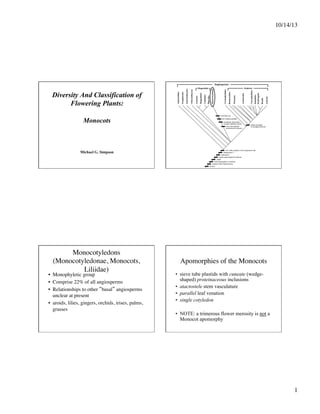
Diversity And Classification of
Flowering Plants:
Monocots

Michael G. Simpson

Monocotyledons 
(Monocotyledonae, Monocots,
Liliidae)	


•  Monophyletic group 	

•  Comprise 22% of all angiosperms	

•  Relationships to other “basal” angiosperms
unclear at present	

•  aroids, lilies, gingers, orchids, irises, palms,
grasses	


Apomorphies of the Monocots	

•  sieve tube plastids with cuneate (wedgeshaped) proteinaceous inclusions
•  atactostele stem vasculature
•  parallel leaf venation
•  single cotyledon
•  NOTE: a trimerous flower merosity is not a
Monocot apomorphy

1
10/14/13


Apomorphies of the Monocots	

•  sieve tube plastids with cuneate (wedge-shaped)
proteinaceous inclusions

•  No monocot has true vascular cambium that
produces wood	


Apomorphies of the Monocots	

•  atactostele stem vasculature

Apomorphies of the Monocots	

•  parallel leaf venation (penni-parallel in some)

2
10/14/13


Apomorphies of the Monocots	

•  single cotyledon

ALISMATALES
Alismataceae
Aponogetonaceae
Araceae (including Lemnaceae)
Butomaceae
Cymodoceaceae
Hydrocharitaceae
Juncaginaceae
Limnocharitaceae
Posidoniaceae
Potamogetonaceae
Ruppiaceae
Scheuchzeriaceae
Tofieldiaceae
Zosteraceae


3
10/14/13


ALISMATALES
Araceae - Arum family
(Arum, a name used by Theophrastus).
111 genera / 2980 species

The Araceae are distinguished from related
families in having bifacial leaves, a spadix of
numerous, small flowers with a subtending spathe,
endospermous seeds, and raphide crystals.
P 2+2,3+3,(2+2),(3+3) or 0 [4+4,(4+4)] A 4,6,8 or
(4,6,8) [1-12] G (3) [1-(∞)] superior, hypanthium
absent.


Araceae - Arum family
•  Members of the family have distributions in
tropical and subtropical regions.
•  Economic importance includes many taxa
important food sources (rootstocks, leaves, or
fruits) in the tropics, e.g., Alocasia, Colocasia
esculenta (taro), Monstera; some species are
cultivated ornamentals, e.g., Anthurium, Caladium
(elephant's ear), Dieffenbachia (dumb cane),
Monstera, Philodendron, Zantedeschia (calla-lily).
•  Amorphophallus titanum is unique in having the
largest inflorescences of any flowering plant.

ARACEAE	

• 
• 
• 
• 
• 

Colocasia “gabi” or “taro” 	

Alocasia	

Caladium “Corazon de Maria”	

Dieffenbachia “dumb cane”	

Anthurium	


Aglaonema commutatum

A. modestum	


4
10/14/13


Amorphophallus titanum	

Largest inflorescence in world	


Arisaema triphyllum Jack-in-the-pulpit	


Wolffia sp. Watermeal	

Smallest flower in world	

Lemna minuscula	

Duckweed	


5
10/14/13


Pistia stratiotes Water-lettuce	


Monstera deliciosa	


Monstera deliciosa	


Monstera deliciosa	


6
10/14/13


Pothos sp.	


Xanthosoma sagittifolium	


Xanthosoma sagittifolium	

Zantedeschia aethiopica Calla-lily	


7
10/14/13


Zantedeschia aethiopica Calla-lily	


ASPARAGALES
•  Very large order!	

•  Apomorphy: phytomelan in seed coat
(lost in some taxa)	


8
10/14/13


ASPARAGALES
Agapanthaceae* [Alliaceae]

Hyacinthaceae* [Asparagaceae]

Agavaceae* [Asparagaceae]

Hypoxidaceae

Alliaceae*

Iridaceae

Amaryllidaceae [Alliaceae]

Ixioliriaceae

Aphyllanthaceae* [Asparagaceae]

Lanariaceae

Asparagaceae

Laxmanniaceae* [Asparagaceae]

Asphodelaceae* [Xanthorrhoeaceae]

Orchidaceae

Asteliaceae

Ruscaceae* [Asparagaceae]

Blandfordiaceae

(incl. Convallariaceae)

Boryaceae

Tecophilaeaceae

Doryanthaceae

Themidaceae* [Asparagaceae]

Hemerocallidaceae* [Xanthorrhoeaceae]	


Xanthorrhoeaceae*
Xeronemataceae


Orchidaceae - Orchid family
(orchis, testicle, from the shape of the root tubers). 700-800
genera / ca. 20,000 species

•  mycorrhizal, mostly perrennial, terrestrial or epiphytic
herbs having trimerous,
•  often resupinate flowers with a showy labellum
•  androecium and gynoecium adnate (termed a column,
gynostegium, or gynostemium)
•  the pollen grains often fused into a 1-several masses
(pollinia), bearing a sticky-tipped stalk, pollinia and
stalk termed a pollinarium, which is the unit of pollen
dispersal during pollination.
P (3+3) A 1-3, when 1 a pollinarium G (3), inferior, with
gynostemium


9
10/14/13


labellum	


column	


Caladenia longiclavata Australia	


Calopogon - a non-resupinate orchid	


Cattleya sp.	

Cymbidium sp.	


10
10/14/13


Dendrobium
phalaenopsis	

Cypripedium sp. Lady’s Slipper	


Dracula chimaera	


Dracula vampira	


Encyclia sp. Cockleshell Orchid	


11
10/14/13


Epidendrum sp.	


Ludisia sp.	


Orchis spectabilis	

Oncidium lanceanum	


12
10/14/13


Paphiopedilum sp.	


Pseudobulb	


Stanhopea trigrinum	

Thelymitra antennifera Australia	


13
10/14/13


Vanilla planifolia- fermented capsules
Vanilla Orchid	


Commelinid Monocots	

Apomorphy: 
UV-fluorescent
organic acids
(including
coumaric, diferulic,
and ferulic acid)
that impregnate the
cell walls.

14
10/14/13


ARECALES
Arecaceae (Palmae) - Palm family
(from areca, Portuguese for the betel palm). ca. 190 genera / ca. 2,000 species.

The Arecaceae are distinctive in having a rhizomatous, lianous, or
usually arborescent stem, with large, sheathing, plicate leaves, a
fleshy, usually drupaceous fruit, and seeds lacking starch. The
plicate leaves is an apomorphy for the family.
P 3+3 [0,2+2,∞] A 3+3 or (3+3) [3,∞; 0 in female fls.] G 3 or (3)
[1,2,4-10; 0 in male fls.], superior.

Arecaceae
	

•  Leaves- acrocaulis; simple, pinnate,
bipinnate, costapalmate, palmate	

•  Pseudopetiole	

•  Crownshaft	

•  Rhizomatous, lianous, herbs, trees	


Fruit a drupe	


reduplicate vs. induplicate	


15
10/14/13


• 
• 
• 
• 
• 
• 

Cocos nucifera- coconut	

Phoenix dactylifera- date palm	

Elaeis oleifera- oil palm	

Metryoxylon- sago palms	

Copernicia cerifera- wax palm	

Areca catechu- as a stimulant	


Archontophoenix cunnighamiana King Palm	


16
10/14/13


Syagrus romanzoffianum Queen Palm	


Chamaerops humilis Mediterranean Palm	


Calamus Rattan Palm	


Jubea chilensis	


17
10/14/13


Nypa fruticans - a rhizomatous palm	


Licuala peltata	


Phoenix canariensis	

Canary I. Palm	


Phoenix dactylifera	

Date Palm	


18
10/14/13


Rhopalostylis sapida	


ZINGIBERALES - Ginger Group	

Apomorphies:	

Penni-parallel venation
Supervolute leaf “ptyxis”
(1/2 of leaf rolled within the other)

Diaphraghmed air chambers
Silica cells
Inferior ovary	


19
10/14/13


midrib	


Zingiberaceae - Ginger family
(from a pre-Gr. name, possibly from India). 50 genera / 1,200 species

The Zingiberaceae are distinguished from related families
of the Zingiberales in having distichous, usually ligulate
leaves with a single, dithecal stamen and a petaloid
labellum derived from two staminodes.
P (3+3) A 1 fertile + 2 + (2) petaloid staminodes G (3), inferior.

20
10/14/13


Zingiberaceae - Ginger family
(from a pre-Gr. name, possibly from India). 50 genera / 1,200 species

Economic importance includes the source of important spice plants,
e.g., Curcuma spp., including C. domestica (turmeric), Elettaria

Musaceae	


Strelitziaceae	


cardamomum (cardamom), and Zingiber spp., including Z. officinale
(ginger); some species are grown as cultivated ornamentals, e.g.,
Alpinia and Hedychium.

Zingiberaceae	


ZINGIBERACEAE
	

•  1 style, clasped
by anther (like
Schistosoma)	

•  Fruit capsule	


21
10/14/13


inner tepal	


Outer tepal	

Connate staminodes	


Alpinia Shell Ginger	


Hedychium	


Hedychium	


22
10/14/13


filament	

staminodes 	

Inner tepals	


Ovary 	

Outer tepals	


Hedychium	


Nicolaia elatior	


Cannaceae - Canna-Lily family
(Gr. canna, a reed). 1 genus (Canna) / 25 species

The Cannaceae are distinguished from related
families of the Zingiberales in having usually
distichous leaves and flowers with one petaloid,
monothecal stamen associated with 1-4[5]
petaloid staminodes.
P 3+3 A 1, petaloid  monothecal + 1-4 petaloid
staminodes G (3), inferior.

23
10/14/13


Musaceae	


Cannaceae	


Canna sp. Cannaceae	


staminodes	

Inner tepal	

Outer tepal	


Canna sp. Cannaceae	


Canna sp. Cannaceae	


24
10/14/13


Canna sp. Cannaceae	


staminode	

half staminode	

style/stigma	


•  Fruit capsule	

•  Canna sp.	


half anther	


25
10/14/13


26
10/14/13


Cyperaceae - Sedge family

Cyperaceae - Sedge family

(Gr. for several species of Cyperus). 98 genera / 4,350 species

(Gr. for several species of Cyperus). 98 genera / 4,350 species

The Cyperaceae are distinctive in being herbs with usually
3-sided, solid-pithed stems, closed-sheathed, often tristichous
leaves, the inflorescence a “sedge spikelet,” consisting of a
central axis bearing many sessile, distichous or spiral bracts,
each subtending a single, reduced unisexual or bisexual
flower, with perianth absent or reduced to bristles or scales,
usually 3 stamens, and a 2–3-carpellate ovary, the fruit a 2- or
3-sided achene.

Economic importance is limited, with some
species used as mats, thatch, weaving material, or writing
material (Cyperus papyrus, papyrus, the culm pith of which
was historically used to make paperlike scrolls), a few used
as ornamental cultivars (e.g., Cyperus involucratus, umbrella
plant), and some species, such as the nutsedges, being
noxious weeds.

P 6 or 0 [1-∞] A 3 [1-6+] G (2-3)[(4)], superior.

Glomerule	


27
10/14/13


involucral	

bracts 	

 spikelet 	


perigynia	

enclosing	

ovaries 	


female	

spikelet 	


Carex praegracilis 	

Cyperus involucratus Umbrella Sedge 	


28
10/14/13


spikelet: 	

bracts 	

distichous 	


Cyperus sp. 	


Cyperus involucratus	


29
10/14/13


Poaceae/ Graminae - Grass family
(after Poa, Gr. name for a grass). 668 genera / 9,500 species

STEMS: hollow-pithed
LEAVES: open-sheathed, distichous, with a ligule at inner
junction with blade
INFLORESCENCE: grass spikelet
= axis + two basal glumes + 1-∞ florets
Floret = short lateral axis + lemma + palea + flower
FLOWER: P 2-3 lodicules A 2-3 (pendulous) G (2-3)
FRUIT: caryopsis (grain).

POACEAE
	

•  Spikelet – basic inflorescence, made up of
florets, subtended by 2 bracts called glumes	

•  Floret – flower, each subtended by even
more glumes called lemma and palea, unior bisexual	

•  Rachilla – axis of spikelet	


POACEAE
	

•  Lemma – outer, flowering glume	

•  Palea – inner bract, between flower and
rachilla	

•  Lodicules – modified perianth	

•  Stamens in 3 whorls	


30
10/14/13


DISTRIBUTION: worldwide.
ECONOMIC IMPORTANCE:
1) agricultural grains (most important food in world):
barley (Hordeum)
corn (Zea)
oats (Avena)
rice (Oryza)
rye (Secale)
wheat (Triticum);
2) alcoholic beverages: beer, whiskey, gin
3) forage and grazing plants;
4) important components of many ecosystems, such as
grasslands and savannahs.

POACEAE
	

• 
• 
• 
• 
• 
• 
• 
• 
• 
• 
• 

Oryza sativa “rice”	

Zea mays “corn”	

Triticum “wheat”	

Avena “oats”	

Hordeum “barley”	

Saccharum “sugar cane”	

Panicum	

Axonopus	

Eleusine	

Digitaria	

Paspalum	


31
10/14/13


distichous	

leaf	

arrangement	


open sheath	


ligule	


32
10/14/13


Bamboos	


Fruit: Grain	


33
10/14/13


Cynodon dactylon	

Bermuda Grass	


Pennisetum setaceum	


Melinis repens	


34

Monocots bio20 fs2013.ppt

  • 1.
    10/14/13 Diversity And Classificationof Flowering Plants: Monocots Michael G. Simpson Monocotyledons (Monocotyledonae, Monocots, Liliidae) •  Monophyletic group •  Comprise 22% of all angiosperms •  Relationships to other “basal” angiosperms unclear at present •  aroids, lilies, gingers, orchids, irises, palms, grasses Apomorphies of the Monocots •  sieve tube plastids with cuneate (wedgeshaped) proteinaceous inclusions •  atactostele stem vasculature •  parallel leaf venation •  single cotyledon •  NOTE: a trimerous flower merosity is not a Monocot apomorphy 1
  • 2.
    10/14/13 Apomorphies of theMonocots •  sieve tube plastids with cuneate (wedge-shaped) proteinaceous inclusions •  No monocot has true vascular cambium that produces wood Apomorphies of the Monocots •  atactostele stem vasculature Apomorphies of the Monocots •  parallel leaf venation (penni-parallel in some) 2
  • 3.
    10/14/13 Apomorphies of theMonocots •  single cotyledon ALISMATALES Alismataceae Aponogetonaceae Araceae (including Lemnaceae) Butomaceae Cymodoceaceae Hydrocharitaceae Juncaginaceae Limnocharitaceae Posidoniaceae Potamogetonaceae Ruppiaceae Scheuchzeriaceae Tofieldiaceae Zosteraceae 3
  • 4.
    10/14/13 ALISMATALES Araceae - Arumfamily (Arum, a name used by Theophrastus). 111 genera / 2980 species The Araceae are distinguished from related families in having bifacial leaves, a spadix of numerous, small flowers with a subtending spathe, endospermous seeds, and raphide crystals. P 2+2,3+3,(2+2),(3+3) or 0 [4+4,(4+4)] A 4,6,8 or (4,6,8) [1-12] G (3) [1-(∞)] superior, hypanthium absent. Araceae - Arum family •  Members of the family have distributions in tropical and subtropical regions. •  Economic importance includes many taxa important food sources (rootstocks, leaves, or fruits) in the tropics, e.g., Alocasia, Colocasia esculenta (taro), Monstera; some species are cultivated ornamentals, e.g., Anthurium, Caladium (elephant's ear), Dieffenbachia (dumb cane), Monstera, Philodendron, Zantedeschia (calla-lily). •  Amorphophallus titanum is unique in having the largest inflorescences of any flowering plant. ARACEAE •  •  •  •  •  Colocasia “gabi” or “taro” Alocasia Caladium “Corazon de Maria” Dieffenbachia “dumb cane” Anthurium Aglaonema commutatum A. modestum 4
  • 5.
    10/14/13 Amorphophallus titanum Largest inflorescencein world Arisaema triphyllum Jack-in-the-pulpit Wolffia sp. Watermeal Smallest flower in world Lemna minuscula Duckweed 5
  • 6.
    10/14/13 Pistia stratiotes Water-lettuce Monsteradeliciosa Monstera deliciosa Monstera deliciosa 6
  • 7.
    10/14/13 Pothos sp. Xanthosoma sagittifolium Xanthosomasagittifolium Zantedeschia aethiopica Calla-lily 7
  • 8.
    10/14/13 Zantedeschia aethiopica Calla-lily ASPARAGALES • Very large order! •  Apomorphy: phytomelan in seed coat (lost in some taxa) 8
  • 9.
    10/14/13 ASPARAGALES Agapanthaceae* [Alliaceae] Hyacinthaceae* [Asparagaceae] Agavaceae*[Asparagaceae] Hypoxidaceae Alliaceae* Iridaceae Amaryllidaceae [Alliaceae] Ixioliriaceae Aphyllanthaceae* [Asparagaceae] Lanariaceae Asparagaceae Laxmanniaceae* [Asparagaceae] Asphodelaceae* [Xanthorrhoeaceae] Orchidaceae Asteliaceae Ruscaceae* [Asparagaceae] Blandfordiaceae (incl. Convallariaceae) Boryaceae Tecophilaeaceae Doryanthaceae Themidaceae* [Asparagaceae] Hemerocallidaceae* [Xanthorrhoeaceae] Xanthorrhoeaceae* Xeronemataceae Orchidaceae - Orchid family (orchis, testicle, from the shape of the root tubers). 700-800 genera / ca. 20,000 species •  mycorrhizal, mostly perrennial, terrestrial or epiphytic herbs having trimerous, •  often resupinate flowers with a showy labellum •  androecium and gynoecium adnate (termed a column, gynostegium, or gynostemium) •  the pollen grains often fused into a 1-several masses (pollinia), bearing a sticky-tipped stalk, pollinia and stalk termed a pollinarium, which is the unit of pollen dispersal during pollination. P (3+3) A 1-3, when 1 a pollinarium G (3), inferior, with gynostemium 9
  • 10.
    10/14/13 labellum column Caladenia longiclavata Australia Calopogon- a non-resupinate orchid Cattleya sp. Cymbidium sp. 10
  • 11.
    10/14/13 Dendrobium phalaenopsis Cypripedium sp. Lady’sSlipper Dracula chimaera Dracula vampira Encyclia sp. Cockleshell Orchid 11
  • 12.
    10/14/13 Epidendrum sp. Ludisia sp. Orchisspectabilis Oncidium lanceanum 12
  • 13.
  • 14.
    10/14/13 Vanilla planifolia- fermentedcapsules Vanilla Orchid Commelinid Monocots Apomorphy: UV-fluorescent organic acids (including coumaric, diferulic, and ferulic acid) that impregnate the cell walls. 14
  • 15.
    10/14/13 ARECALES Arecaceae (Palmae) -Palm family (from areca, Portuguese for the betel palm). ca. 190 genera / ca. 2,000 species. The Arecaceae are distinctive in having a rhizomatous, lianous, or usually arborescent stem, with large, sheathing, plicate leaves, a fleshy, usually drupaceous fruit, and seeds lacking starch. The plicate leaves is an apomorphy for the family. P 3+3 [0,2+2,∞] A 3+3 or (3+3) [3,∞; 0 in female fls.] G 3 or (3) [1,2,4-10; 0 in male fls.], superior. Arecaceae •  Leaves- acrocaulis; simple, pinnate, bipinnate, costapalmate, palmate •  Pseudopetiole •  Crownshaft •  Rhizomatous, lianous, herbs, trees Fruit a drupe reduplicate vs. induplicate 15
  • 16.
    10/14/13 •  •  •  •  •  •  Cocos nucifera- coconut Phoenixdactylifera- date palm Elaeis oleifera- oil palm Metryoxylon- sago palms Copernicia cerifera- wax palm Areca catechu- as a stimulant Archontophoenix cunnighamiana King Palm 16
  • 17.
    10/14/13 Syagrus romanzoffianum QueenPalm Chamaerops humilis Mediterranean Palm Calamus Rattan Palm Jubea chilensis 17
  • 18.
    10/14/13 Nypa fruticans -a rhizomatous palm Licuala peltata Phoenix canariensis Canary I. Palm Phoenix dactylifera Date Palm 18
  • 19.
    10/14/13 Rhopalostylis sapida ZINGIBERALES -Ginger Group Apomorphies: Penni-parallel venation Supervolute leaf “ptyxis” (1/2 of leaf rolled within the other) Diaphraghmed air chambers Silica cells Inferior ovary 19
  • 20.
    10/14/13 midrib Zingiberaceae - Gingerfamily (from a pre-Gr. name, possibly from India). 50 genera / 1,200 species The Zingiberaceae are distinguished from related families of the Zingiberales in having distichous, usually ligulate leaves with a single, dithecal stamen and a petaloid labellum derived from two staminodes. P (3+3) A 1 fertile + 2 + (2) petaloid staminodes G (3), inferior. 20
  • 21.
    10/14/13 Zingiberaceae - Gingerfamily (from a pre-Gr. name, possibly from India). 50 genera / 1,200 species Economic importance includes the source of important spice plants, e.g., Curcuma spp., including C. domestica (turmeric), Elettaria Musaceae Strelitziaceae cardamomum (cardamom), and Zingiber spp., including Z. officinale (ginger); some species are grown as cultivated ornamentals, e.g., Alpinia and Hedychium. Zingiberaceae ZINGIBERACEAE •  1 style, clasped by anther (like Schistosoma) •  Fruit capsule 21
  • 22.
    10/14/13 inner tepal Outer tepal Connatestaminodes Alpinia Shell Ginger Hedychium Hedychium 22
  • 23.
    10/14/13 filament staminodes Inner tepals Ovary Outer tepals Hedychium Nicolaia elatior Cannaceae - Canna-Lily family (Gr. canna, a reed). 1 genus (Canna) / 25 species The Cannaceae are distinguished from related families of the Zingiberales in having usually distichous leaves and flowers with one petaloid, monothecal stamen associated with 1-4[5] petaloid staminodes. P 3+3 A 1, petaloid monothecal + 1-4 petaloid staminodes G (3), inferior. 23
  • 24.
    10/14/13 Musaceae Cannaceae Canna sp. Cannaceae staminodes Innertepal Outer tepal Canna sp. Cannaceae Canna sp. Cannaceae 24
  • 25.
    10/14/13 Canna sp. Cannaceae staminode halfstaminode style/stigma •  Fruit capsule •  Canna sp. half anther 25
  • 26.
  • 27.
    10/14/13 Cyperaceae - Sedgefamily Cyperaceae - Sedge family (Gr. for several species of Cyperus). 98 genera / 4,350 species (Gr. for several species of Cyperus). 98 genera / 4,350 species The Cyperaceae are distinctive in being herbs with usually 3-sided, solid-pithed stems, closed-sheathed, often tristichous leaves, the inflorescence a “sedge spikelet,” consisting of a central axis bearing many sessile, distichous or spiral bracts, each subtending a single, reduced unisexual or bisexual flower, with perianth absent or reduced to bristles or scales, usually 3 stamens, and a 2–3-carpellate ovary, the fruit a 2- or 3-sided achene. Economic importance is limited, with some species used as mats, thatch, weaving material, or writing material (Cyperus papyrus, papyrus, the culm pith of which was historically used to make paperlike scrolls), a few used as ornamental cultivars (e.g., Cyperus involucratus, umbrella plant), and some species, such as the nutsedges, being noxious weeds. P 6 or 0 [1-∞] A 3 [1-6+] G (2-3)[(4)], superior. Glomerule 27
  • 28.
    10/14/13 involucral bracts spikelet perigynia enclosing ovaries female spikelet Carex praegracilis Cyperus involucratus Umbrella Sedge 28
  • 29.
    10/14/13 spikelet: bracts distichous Cyperus sp. Cyperus involucratus 29
  • 30.
    10/14/13 Poaceae/ Graminae -Grass family (after Poa, Gr. name for a grass). 668 genera / 9,500 species STEMS: hollow-pithed LEAVES: open-sheathed, distichous, with a ligule at inner junction with blade INFLORESCENCE: grass spikelet = axis + two basal glumes + 1-∞ florets Floret = short lateral axis + lemma + palea + flower FLOWER: P 2-3 lodicules A 2-3 (pendulous) G (2-3) FRUIT: caryopsis (grain). POACEAE •  Spikelet – basic inflorescence, made up of florets, subtended by 2 bracts called glumes •  Floret – flower, each subtended by even more glumes called lemma and palea, unior bisexual •  Rachilla – axis of spikelet POACEAE •  Lemma – outer, flowering glume •  Palea – inner bract, between flower and rachilla •  Lodicules – modified perianth •  Stamens in 3 whorls 30
  • 31.
    10/14/13 DISTRIBUTION: worldwide. ECONOMIC IMPORTANCE: 1)agricultural grains (most important food in world): barley (Hordeum) corn (Zea) oats (Avena) rice (Oryza) rye (Secale) wheat (Triticum); 2) alcoholic beverages: beer, whiskey, gin 3) forage and grazing plants; 4) important components of many ecosystems, such as grasslands and savannahs. POACEAE •  •  •  •  •  •  •  •  •  •  •  Oryza sativa “rice” Zea mays “corn” Triticum “wheat” Avena “oats” Hordeum “barley” Saccharum “sugar cane” Panicum Axonopus Eleusine Digitaria Paspalum 31
  • 32.
  • 33.
  • 34.