9/24/13	
  
1	
  
EVOLUTION AND DIVERSITY OF VASCULAR
PLANTS
9/24/13	
  
2	
  
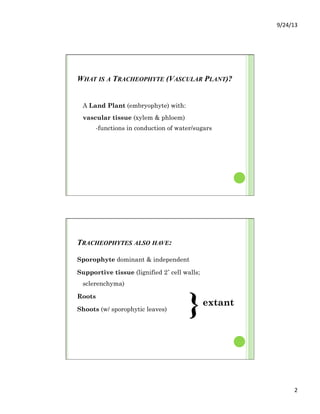
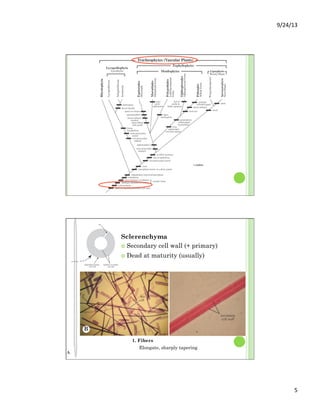
WHAT IS A TRACHEOPHYTE (VASCULAR PLANT)?
A Land Plant (embryophyte) with:
vascular tissue (xylem & phloem)
-functions in conduction of water/sugars
TRACHEOPHYTES ALSO HAVE:
Sporophyte dominant & independent
Supportive tissue (lignified 2˚ cell walls;
sclerenchyma)
Roots
Shoots (w/ sporophytic leaves) }extant
9/24/13	
  
3	
  
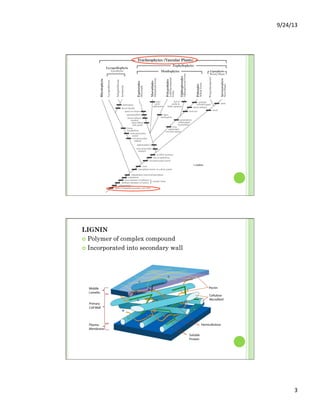
LIGNIN
¢  Polymer of complex compound
¢  Incorporated into secondary wall
9/24/13	
  
4	
  
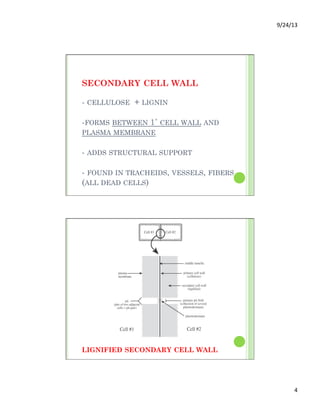
SECONDARY CELL WALL
- CELLULOSE + LIGNIN
-FORMS BETWEEN 1˚ CELL WALL AND
PLASMA MEMBRANE
- ADDS STRUCTURAL SUPPORT
- FOUND IN TRACHEIDS, VESSELS, FIBERS
(ALL DEAD CELLS)
LIGNIFIED SECONDARY CELL WALL
9/24/13	
  
5	
  
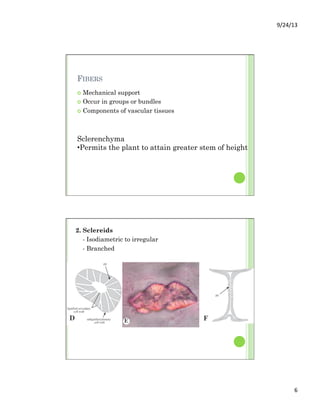
Sclerenchyma
¢  Secondary cell wall (+ primary)
¢  Dead at maturity (usually)
1. Fibers
Elongate, sharply tapering
9/24/13	
  
6	
  
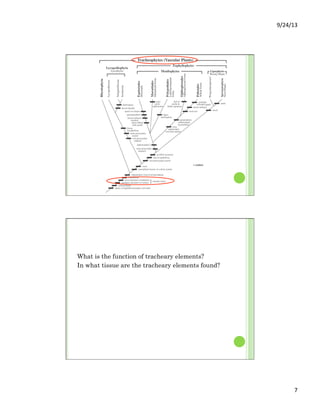
FIBERS
¢  Mechanical support
¢  Occur in groups or bundles
¢  Components of vascular tissues
Sclerenchyma
• Permits the plant to attain greater stem of height
2. Sclereids
- Isodiametric to irregular
- Branched
9/24/13	
  
7	
  
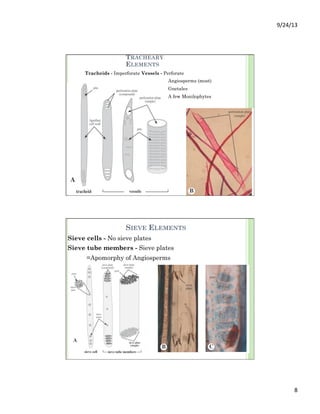
What is the function of tracheary elements?
In what tissue are the tracheary elements found?
9/24/13	
  
8	
  
TRACHEARY
ELEMENTS
Tracheids - Imperforate Vessels - Perforate
Angiosperms (most)
Gnetales
A few Monilophytes
SIEVE ELEMENTS
Sieve cells - No sieve plates
Sieve tube members - Sieve plates
=Apomorphy of Angiosperms
9/24/13	
  
9	
  
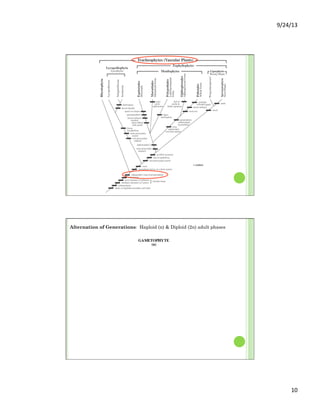
Endodermis
Casparian Strip: forces fluids from outside
through plasma membrane = selective
absorption
9/24/13	
  
10	
  
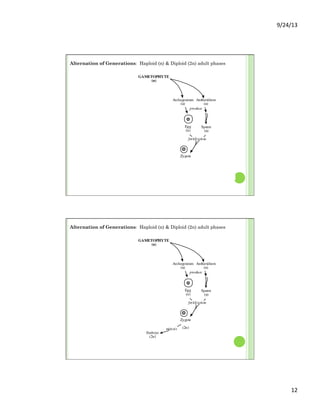
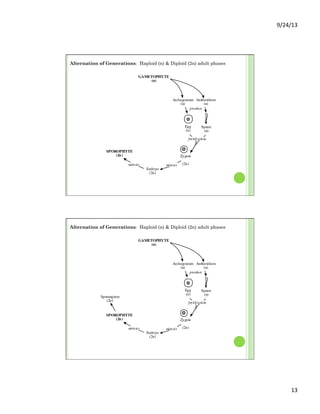
GAMETOPHYTE
(n)
Egg
(n)
Sperm
(n)
Zygote
(2n)
HAPLODIPLONTIC
("Alternation of
Generations")
SPOROPHYTE
(2n)
Embryo
(2n)
Spores
(n)
lost by reduction and modification
in the Angiosperms
and some Gnetales
Sporangium
(2n)
Archegonium
(n)
Antheridium
(n)
fertilization
mitosismitosis
meiosis
mitosis
}
(Sperm non-flagellate in Conifers,
Gnetales, and Angiosperms)
Sporocyte
(2n)
produce
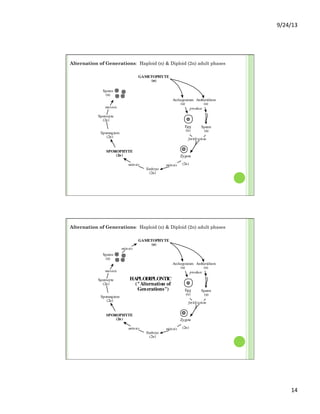
Alternation of Generations: Haploid (n) & Diploid (2n) adult phases
9/24/13	
  
11	
  
GAMETOPHYTE
(n)
Egg
(n)
Sperm
(n)
Zygote
(2n)
HAPLODIPLONTIC
("Alternation of
Generations")
SPOROPHYTE
(2n)
Embryo
(2n)
Spores
(n)
lost by reduction and modification
in the Angiosperms
and some Gnetales
Sporangium
(2n)
Archegonium
(n)
Antheridium
(n)
fertilization
mitosismitosis
meiosis
mitosis
}
(Sperm non-flagellate in Conifers,
Gnetales, and Angiosperms)
Sporocyte
(2n)
produce
Alternation of Generations: Haploid (n) & Diploid (2n) adult phases
GAMETOPHYTE
(n)
Egg
(n)
Sperm
(n)
Zygote
(2n)
HAPLODIPLONTIC
("Alternation of
Generations")
SPOROPHYTE
(2n)
Embryo
(2n)
Spores
(n)
lost by reduction and modification
in the Angiosperms
and some Gnetales
Sporangium
(2n)
Archegonium
(n)
Antheridium
(n)
fertilization
mitosismitosis
meiosis
mitosis
}
(Sperm non-flagellate in Conifers,
Gnetales, and Angiosperms)
Sporocyte
(2n)
produce
Alternation of Generations: Haploid (n) & Diploid (2n) adult phases
9/24/13	
  
12	
  
GAMETOPHYTE
(n)
Egg
(n)
Sperm
(n)
Zygote
(2n)
HAPLODIPLONTIC
("Alternation of
Generations")
SPOROPHYTE
(2n)
Embryo
(2n)
Spores
(n)
lost by reduction and modification
in the Angiosperms
and some Gnetales
Sporangium
(2n)
Archegonium
(n)
Antheridium
(n)
fertilization
mitosismitosis
meiosis
mitosis
}
(Sperm non-flagellate in Conifers,
Gnetales, and Angiosperms)
Sporocyte
(2n)
produce
Alternation of Generations: Haploid (n) & Diploid (2n) adult phases
GAMETOPHYTE
(n)
Egg
(n)
Sperm
(n)
Zygote
(2n)
HAPLODIPLONTIC
("Alternation of
Generations")
SPOROPHYTE
(2n)
Embryo
(2n)
Spores
(n)
lost by reduction and modification
in the Angiosperms
and some Gnetales
Sporangium
(2n)
Archegonium
(n)
Antheridium
(n)
fertilization
mitosismitosis
meiosis
mitosis
}
(Sperm non-flagellate in Conifers,
Gnetales, and Angiosperms)
Sporocyte
(2n)
produce
Alternation of Generations: Haploid (n) & Diploid (2n) adult phases
9/24/13	
  
13	
  
GAMETOPHYTE
(n)
Egg
(n)
Sperm
(n)
Zygote
(2n)
HAPLODIPLONTIC
("Alternation of
Generations")
SPOROPHYTE
(2n)
Embryo
(2n)
Spores
(n)
lost by reduction and modification
in the Angiosperms
and some Gnetales
Sporangium
(2n)
Archegonium
(n)
Antheridium
(n)
fertilization
mitosismitosis
meiosis
mitosis
}
(Sperm non-flagellate in Conifers,
Gnetales, and Angiosperms)
Sporocyte
(2n)
produce
Alternation of Generations: Haploid (n) & Diploid (2n) adult phases
GAMETOPHYTE
(n)
Egg
(n)
Sperm
(n)
Zygote
(2n)
HAPLODIPLONTIC
("Alternation of
Generations")
SPOROPHYTE
(2n)
Embryo
(2n)
Spores
(n)
lost by reduction and modification
in the Angiosperms
and some Gnetales
Sporangium
(2n)
Archegonium
(n)
Antheridium
(n)
fertilization
mitosismitosis
meiosis
mitosis
}
(Sperm non-flagellate in Conifers,
Gnetales, and Angiosperms)
Sporocyte
(2n)
produce
Alternation of Generations: Haploid (n) & Diploid (2n) adult phases
9/24/13	
  
14	
  
GAMETOPHYTE
(n)
Egg
(n)
Sperm
(n)
Zygote
(2n)
HAPLODIPLONTIC
("Alternation of
Generations")
SPOROPHYTE
(2n)
Embryo
(2n)
Spores
(n)
lost by reduction and modification
in the Angiosperms
and some Gnetales
Sporangium
(2n)
Archegonium
(n)
Antheridium
(n)
fertilization
mitosismitosis
meiosis
mitosis
}
(Sperm non-flagellate in Conifers,
Gnetales, and Angiosperms)
Sporocyte
(2n)
produce
Alternation of Generations: Haploid (n) & Diploid (2n) adult phases
GAMETOPHYTE
(n)
Egg
(n)
Sperm
(n)
Zygote
(2n)
HAPLODIPLONTIC
("Alternation of
Generations")
SPOROPHYTE
(2n)
Embryo
(2n)
Spores
(n)
lost by reduction and modification
in the Angiosperms
and some Gnetales
Sporangium
(2n)
Archegonium
(n)
Antheridium
(n)
fertilization
mitosismitosis
meiosis
mitosis
}
(Sperm non-flagellate in Conifers,
Gnetales, and Angiosperms)
Sporocyte
(2n)
produce
Alternation of Generations: Haploid (n) & Diploid (2n) adult phases
9/24/13	
  
15	
  
GAMETOPHYTE
(n)
Egg
(n)
Sperm
(n)
Zygote
(2n)
HAPLODIPLONTIC
("Alternation of
Generations")
SPOROPHYTE
(2n)
Embryo
(2n)
Spores
(n)
lost by reduction and modification
in the Angiosperms
and some Gnetales
Sporangium
(2n)
Archegonium
(n)
Antheridium
(n)
fertilization
mitosismitosis
meiosis
mitosis
}
(Sperm non-flagellate in Conifers,
Gnetales, and Angiosperms)
Sporocyte
(2n)
produce
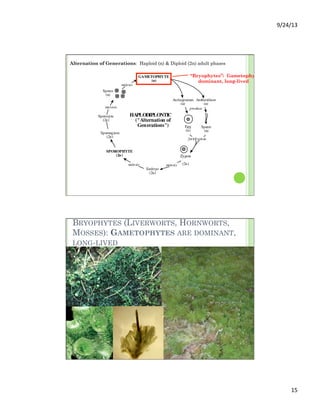
Alternation of Generations: Haploid (n) & Diploid (2n) adult phases
“Bryophytes”: Gametophyte
dominant, long-lived
BRYOPHYTES (LIVERWORTS, HORNWORTS,
MOSSES): GAMETOPHYTES ARE DOMINANT,
LONG-LIVED
9/24/13	
  
16	
  
GAMETOPHYTE
(n)
Egg
(n)
Sperm
(n)
Zygote
(2n)
HAPLODIPLONTIC
("Alternation of
Generations")
SPOROPHYTE
(2n)
Embryo
(2n)
Spores
(n)
lost by reduction and modification
in the Angiosperms
and some Gnetales
Sporangium
(2n)
Archegonium
(n)
Antheridium
(n)
fertilization
mitosismitosis
meiosis
mitosis
}
(Sperm non-flagellate in Conifers,
Gnetales, and Angiosperms)
Sporocyte
(2n)
produce
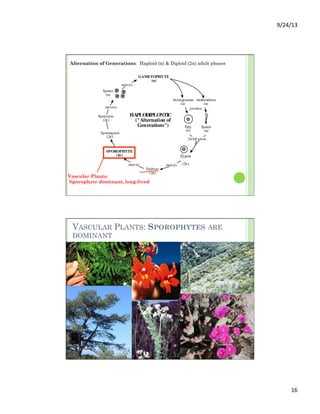
Alternation of Generations: Haploid (n) & Diploid (2n) adult phases
Vascular Plants:
Sporophyte dominant, long-lived
VASCULAR PLANTS: SPOROPHYTES ARE
DOMINANT
9/24/13	
  
17	
  
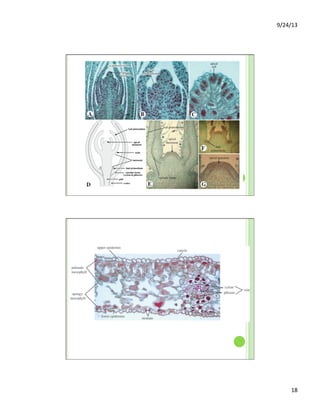
lateral branch
root
shoot
axillary
bud
shoot
apex
lateral
branch
node
internode
root tip
root apical
meristem
root cap
root hairs
shoot tip
shoot apical
meristem
bud
primordium
lateral roots
SPOROPHYTIC LEAVES AND SHOOTS
Leavesà
The same with
Mosses and
Liverworts?
9/24/13	
  
18	
  
9/24/13	
  
19	
  
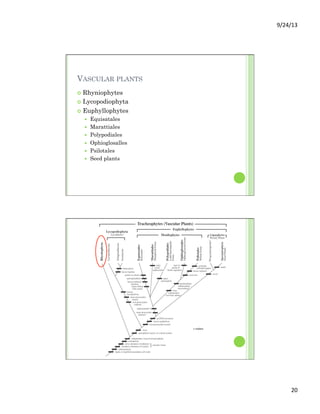
Do bryophytes have roots?
DIVERSITY OF VASCULAR PLANTS
9/24/13	
  
20	
  
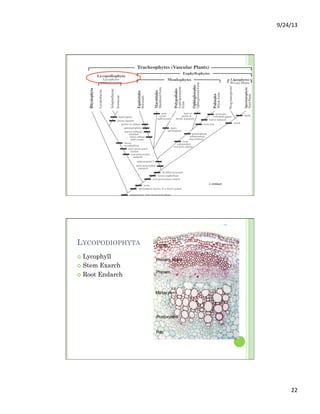
VASCULAR PLANTS
¢  Rhyniophytes
¢  Lycopodiophyta
¢  Euphyllophytes
—  Equisatales
—  Marattiales
—  Polypodiales
—  Ophioglosalles
—  Psilotales
—  Seed plants
9/24/13	
  
21	
  
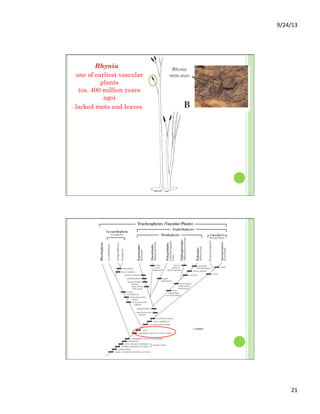
Rhynia
-  one of earliest vascular
plants
(ca. 400 million years
ago)
- lacked roots and leaves
9/24/13	
  
22	
  
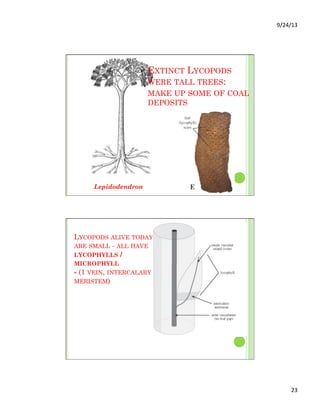
LYCOPODIOPHYTA
¢  Lycophyll
¢  Stem Exarch
¢  Root Endarch
9/24/13	
  
23	
  
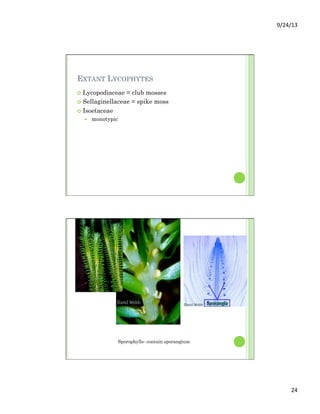
Lepidodendron
EXTINCT LYCOPODS
WERE TALL TREES:
MAKE UP SOME OF COAL
DEPOSITS
LYCOPODS ALIVE TODAY
ARE SMALL - ALL HAVE
LYCOPHYLLS /
MICROPHYLL
- (1 VEIN, INTERCALARY
MERISTEM)
9/24/13	
  
24	
  
EXTANT LYCOPHYTES
¢  Lycopodiaceae = club mosses
¢  Sellaginellaceae = spike moss
¢  Isoetaceae
—  monotypic
Sporophylls- contain sporangium
9/24/13	
  
25	
  
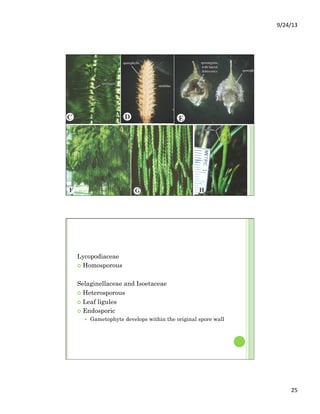
Lycopodiaceae
¢  Homosporous
Selaginellaceae and Isoetaceae
¢  Heterosporous
¢  Leaf ligules
¢  Endosporic
—  Gametophyte develops within the original spore wall
9/24/13	
  
26	
  
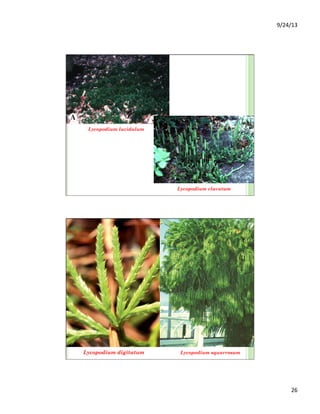
Lycopodium clavatum
Lycopodium lucidulum
Lycopodium digitatum Lycopodium squarrosum
9/24/13	
  
27	
  
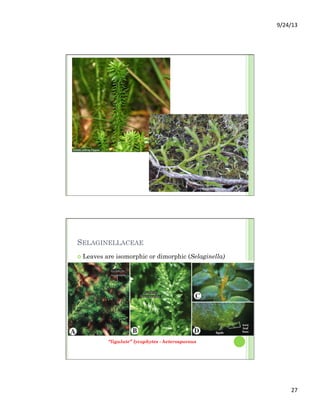
SELAGINELLACEAE
¢  Leaves are isomorphic or dimorphic (Selaginella)
“ligulate” lycophytes - heterosporous
9/24/13	
  
28	
  
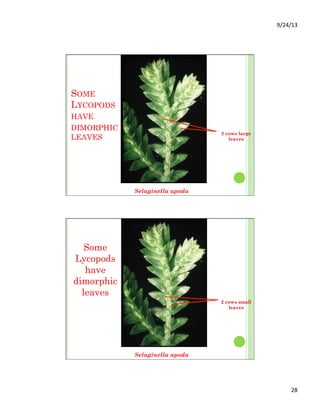
SOME
LYCOPODS
HAVE
DIMORPHIC
LEAVES
Selaginella apoda
2 rows large
leaves
Selaginella apoda
2 rows small
leaves
Some
Lycopods
have
dimorphic
leaves
9/24/13	
  
29	
  
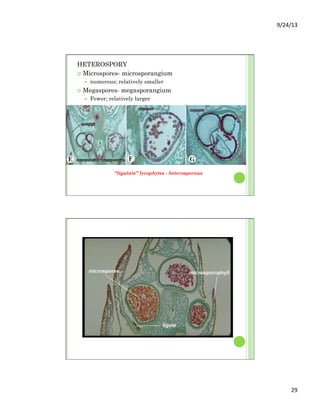
HETEROSPORY
¢  Microspores- microsporangium
—  numerous; relatively smaller
¢  Megaspores- megasporangium
—  Fewer; relatively larger
“ligulate” lycophytes - heterosporous
9/24/13	
  
30	
  
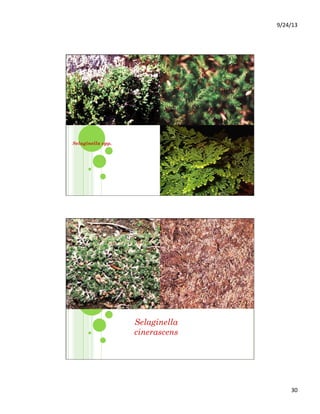
Selaginella spp.
Selaginella
cinerascens
9/24/13	
  
31	
  
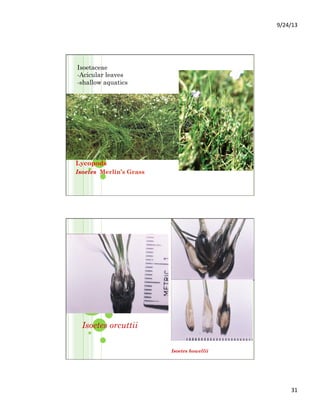
Lycopods
Isoetes Merlin’s Grass
Isoetaceae
- Acicular leaves
-shallow aquatics
Isoetes orcuttii
Isoetes howellii
9/24/13	
  
32	
  
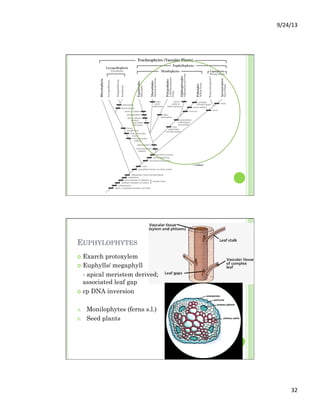
EUPHYLOPHYTES
¢  Exarch protoxylem
¢  Euphylls/ megaphyll
- apical meristem derived;
associated leaf gap
¢  cp DNA inversion
A.  Monilophytes (ferns s.l.)
B.  Seed plants
9/24/13	
  
33	
  
9/24/13	
  
34	
  
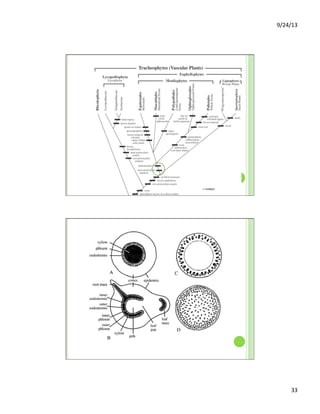
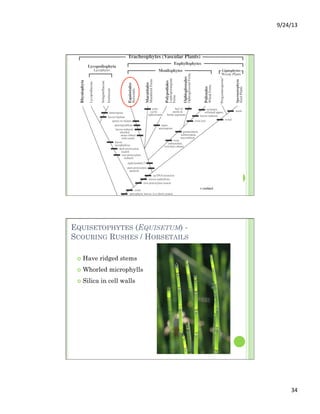
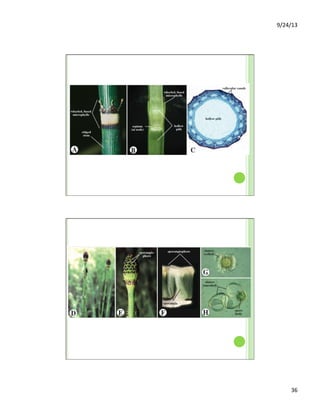
EQUISETOPHYTES (EQUISETUM) -
SCOURING RUSHES / HORSETAILS
¢  Have ridged stems
¢  Whorled microphylls
¢  Silica in cell walls
9/24/13	
  
35	
  
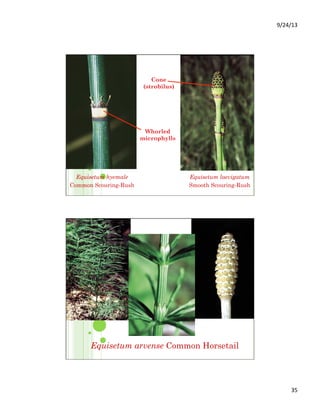
Equisetum hyemale
Common Scouring-Rush
Equisetum laevigatum
Smooth Scouring-Rush
Whorled
microphylls
Cone
(strobilus)
Equisetum arvense Common Horsetail
9/24/13	
  
36	
  
9/24/13	
  
37	
  
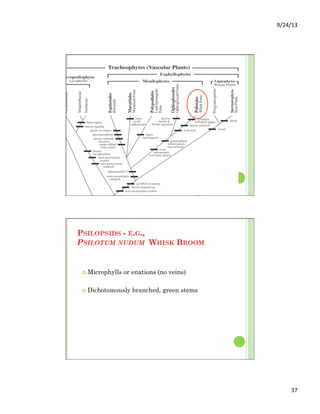
PSILOPSIDS - E.G.,
PSILOTUM NUDUM WHISK BROOM
¢  Microphylls or enations (no veins)
¢  Dichotomously branched, green stems
9/24/13	
  
38	
  
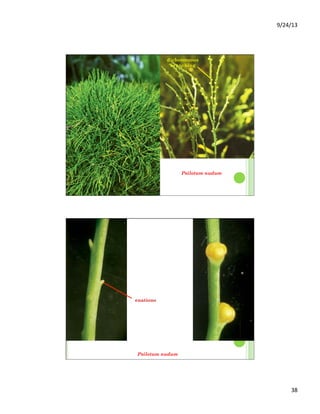
Psilotum nudum
dichotomous
branching
Psilotum nudum
enations
9/24/13	
  
39	
  
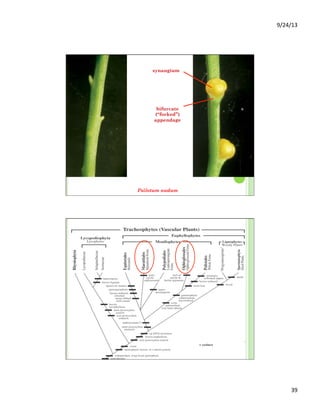
Psilotum nudum
synangium
bifurcate
(“forked”)
appendage
9/24/13	
  
40	
  
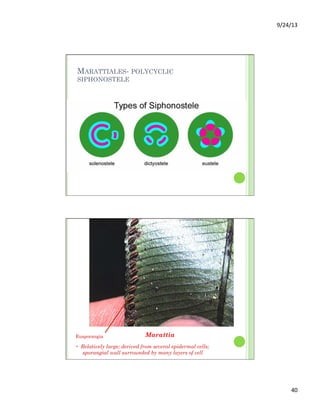
MARATTIALES- POLYCYCLIC
SIPHONOSTELE
MarattiaEusporangia
- Relatively large; derived from several epidermal cells;
sporangial wall surrounded by many layers of cell
9/24/13	
  
41	
  
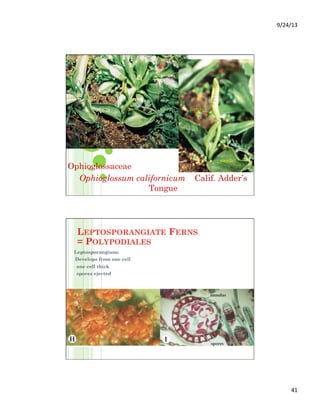
Ophioglossaceae
Ophioglossum californicum Calif. Adder’s
Tongue
fertile
sterile
LEPTOSPORANGIATE FERNS
= POLYPODIALES
Leptosporangium:
- Develops from one cell
-  one cell thick
-  spores ejected
9/24/13	
  
42	
  
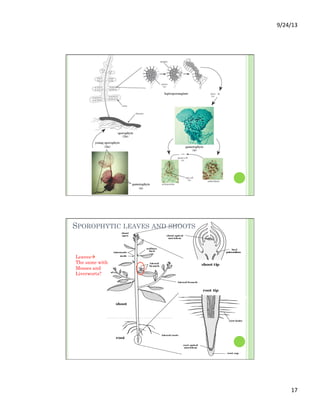
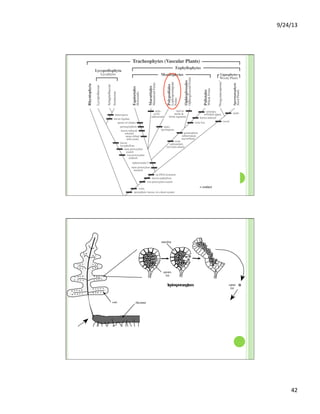
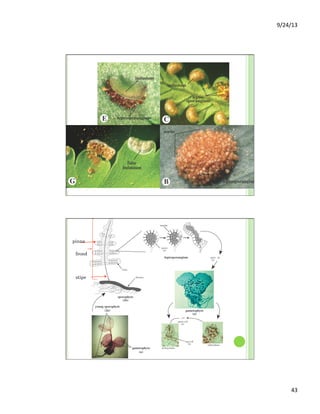
spor ophyte
(2n)
gametophyte
(n)
young
spor ophyte
(2n)
sperm cell
(n)
egg cell
(n)
archegonium
antheridium
spore
(n)
rhizomesori
leptosporangium
gametophyte
(n)
annulus
spores
(n)
9/24/13	
  
43	
  
frond
stipe
pinna
9/24/13	
  
44	
  
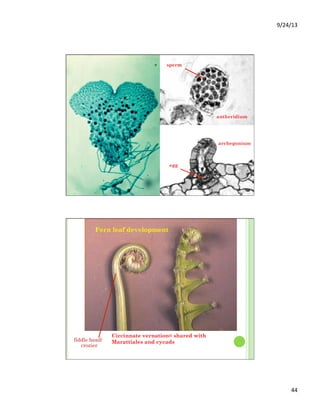
antheridium
archegonium
egg
sperm
Fern leaf development
fiddle head/
crozier
Circinnate vernation= shared with
Marattiales and cycads
9/24/13	
  
45	
  
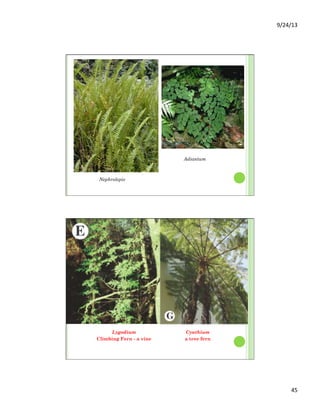
Nephrolepis
Adiantum
Lygodium
Climbing Fern - a vine
Cyathium
a tree fern
9/24/13	
  
46	
  
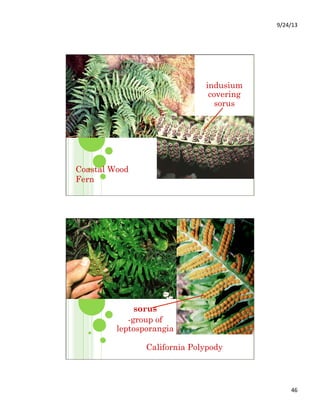
Coastal Wood
Fern
indusium
covering
sorus
California Polypody
sorus
-group of
leptosporangia
9/24/13	
  
47	
  
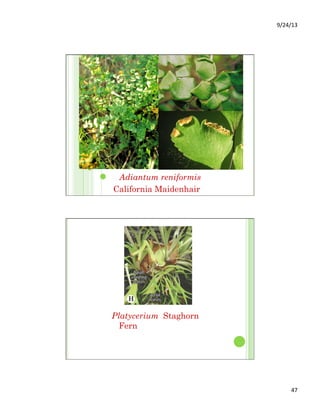
Adiantum reniformis
California Maidenhair
Fern
Platycerium Staghorn
Fern
9/24/13	
  
48	
  
Aquatic ferns
Marsilea Salvinia Azolla
9/24/13	
  
49	
  
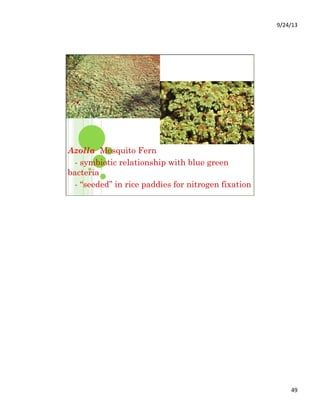
Azolla Mosquito Fern
- symbiotic relationship with blue green
bacteria
- “seeded” in rice paddies for nitrogen fixation

Vascular plants diversity.pptx

  • 1.
    9/24/13   1   EVOLUTIONAND DIVERSITY OF VASCULAR PLANTS
  • 2.
    9/24/13   2   WHATIS A TRACHEOPHYTE (VASCULAR PLANT)? A Land Plant (embryophyte) with: vascular tissue (xylem & phloem) -functions in conduction of water/sugars TRACHEOPHYTES ALSO HAVE: Sporophyte dominant & independent Supportive tissue (lignified 2˚ cell walls; sclerenchyma) Roots Shoots (w/ sporophytic leaves) }extant
  • 3.
    9/24/13   3   LIGNIN ¢ Polymer of complex compound ¢  Incorporated into secondary wall
  • 4.
    9/24/13   4   SECONDARYCELL WALL - CELLULOSE + LIGNIN -FORMS BETWEEN 1˚ CELL WALL AND PLASMA MEMBRANE - ADDS STRUCTURAL SUPPORT - FOUND IN TRACHEIDS, VESSELS, FIBERS (ALL DEAD CELLS) LIGNIFIED SECONDARY CELL WALL
  • 5.
    9/24/13   5   Sclerenchyma ¢ Secondary cell wall (+ primary) ¢  Dead at maturity (usually) 1. Fibers Elongate, sharply tapering
  • 6.
    9/24/13   6   FIBERS ¢ Mechanical support ¢  Occur in groups or bundles ¢  Components of vascular tissues Sclerenchyma • Permits the plant to attain greater stem of height 2. Sclereids - Isodiametric to irregular - Branched
  • 7.
    9/24/13   7   Whatis the function of tracheary elements? In what tissue are the tracheary elements found?
  • 8.
    9/24/13   8   TRACHEARY ELEMENTS Tracheids- Imperforate Vessels - Perforate Angiosperms (most) Gnetales A few Monilophytes SIEVE ELEMENTS Sieve cells - No sieve plates Sieve tube members - Sieve plates =Apomorphy of Angiosperms
  • 9.
    9/24/13   9   Endodermis CasparianStrip: forces fluids from outside through plasma membrane = selective absorption
  • 10.
    9/24/13   10   GAMETOPHYTE (n) Egg (n) Sperm (n) Zygote (2n) HAPLODIPLONTIC ("Alternationof Generations") SPOROPHYTE (2n) Embryo (2n) Spores (n) lost by reduction and modification in the Angiosperms and some Gnetales Sporangium (2n) Archegonium (n) Antheridium (n) fertilization mitosismitosis meiosis mitosis } (Sperm non-flagellate in Conifers, Gnetales, and Angiosperms) Sporocyte (2n) produce Alternation of Generations: Haploid (n) & Diploid (2n) adult phases
  • 11.
    9/24/13   11   GAMETOPHYTE (n) Egg (n) Sperm (n) Zygote (2n) HAPLODIPLONTIC ("Alternationof Generations") SPOROPHYTE (2n) Embryo (2n) Spores (n) lost by reduction and modification in the Angiosperms and some Gnetales Sporangium (2n) Archegonium (n) Antheridium (n) fertilization mitosismitosis meiosis mitosis } (Sperm non-flagellate in Conifers, Gnetales, and Angiosperms) Sporocyte (2n) produce Alternation of Generations: Haploid (n) & Diploid (2n) adult phases GAMETOPHYTE (n) Egg (n) Sperm (n) Zygote (2n) HAPLODIPLONTIC ("Alternation of Generations") SPOROPHYTE (2n) Embryo (2n) Spores (n) lost by reduction and modification in the Angiosperms and some Gnetales Sporangium (2n) Archegonium (n) Antheridium (n) fertilization mitosismitosis meiosis mitosis } (Sperm non-flagellate in Conifers, Gnetales, and Angiosperms) Sporocyte (2n) produce Alternation of Generations: Haploid (n) & Diploid (2n) adult phases
  • 12.
    9/24/13   12   GAMETOPHYTE (n) Egg (n) Sperm (n) Zygote (2n) HAPLODIPLONTIC ("Alternationof Generations") SPOROPHYTE (2n) Embryo (2n) Spores (n) lost by reduction and modification in the Angiosperms and some Gnetales Sporangium (2n) Archegonium (n) Antheridium (n) fertilization mitosismitosis meiosis mitosis } (Sperm non-flagellate in Conifers, Gnetales, and Angiosperms) Sporocyte (2n) produce Alternation of Generations: Haploid (n) & Diploid (2n) adult phases GAMETOPHYTE (n) Egg (n) Sperm (n) Zygote (2n) HAPLODIPLONTIC ("Alternation of Generations") SPOROPHYTE (2n) Embryo (2n) Spores (n) lost by reduction and modification in the Angiosperms and some Gnetales Sporangium (2n) Archegonium (n) Antheridium (n) fertilization mitosismitosis meiosis mitosis } (Sperm non-flagellate in Conifers, Gnetales, and Angiosperms) Sporocyte (2n) produce Alternation of Generations: Haploid (n) & Diploid (2n) adult phases
  • 13.
    9/24/13   13   GAMETOPHYTE (n) Egg (n) Sperm (n) Zygote (2n) HAPLODIPLONTIC ("Alternationof Generations") SPOROPHYTE (2n) Embryo (2n) Spores (n) lost by reduction and modification in the Angiosperms and some Gnetales Sporangium (2n) Archegonium (n) Antheridium (n) fertilization mitosismitosis meiosis mitosis } (Sperm non-flagellate in Conifers, Gnetales, and Angiosperms) Sporocyte (2n) produce Alternation of Generations: Haploid (n) & Diploid (2n) adult phases GAMETOPHYTE (n) Egg (n) Sperm (n) Zygote (2n) HAPLODIPLONTIC ("Alternation of Generations") SPOROPHYTE (2n) Embryo (2n) Spores (n) lost by reduction and modification in the Angiosperms and some Gnetales Sporangium (2n) Archegonium (n) Antheridium (n) fertilization mitosismitosis meiosis mitosis } (Sperm non-flagellate in Conifers, Gnetales, and Angiosperms) Sporocyte (2n) produce Alternation of Generations: Haploid (n) & Diploid (2n) adult phases
  • 14.
    9/24/13   14   GAMETOPHYTE (n) Egg (n) Sperm (n) Zygote (2n) HAPLODIPLONTIC ("Alternationof Generations") SPOROPHYTE (2n) Embryo (2n) Spores (n) lost by reduction and modification in the Angiosperms and some Gnetales Sporangium (2n) Archegonium (n) Antheridium (n) fertilization mitosismitosis meiosis mitosis } (Sperm non-flagellate in Conifers, Gnetales, and Angiosperms) Sporocyte (2n) produce Alternation of Generations: Haploid (n) & Diploid (2n) adult phases GAMETOPHYTE (n) Egg (n) Sperm (n) Zygote (2n) HAPLODIPLONTIC ("Alternation of Generations") SPOROPHYTE (2n) Embryo (2n) Spores (n) lost by reduction and modification in the Angiosperms and some Gnetales Sporangium (2n) Archegonium (n) Antheridium (n) fertilization mitosismitosis meiosis mitosis } (Sperm non-flagellate in Conifers, Gnetales, and Angiosperms) Sporocyte (2n) produce Alternation of Generations: Haploid (n) & Diploid (2n) adult phases
  • 15.
    9/24/13   15   GAMETOPHYTE (n) Egg (n) Sperm (n) Zygote (2n) HAPLODIPLONTIC ("Alternationof Generations") SPOROPHYTE (2n) Embryo (2n) Spores (n) lost by reduction and modification in the Angiosperms and some Gnetales Sporangium (2n) Archegonium (n) Antheridium (n) fertilization mitosismitosis meiosis mitosis } (Sperm non-flagellate in Conifers, Gnetales, and Angiosperms) Sporocyte (2n) produce Alternation of Generations: Haploid (n) & Diploid (2n) adult phases “Bryophytes”: Gametophyte dominant, long-lived BRYOPHYTES (LIVERWORTS, HORNWORTS, MOSSES): GAMETOPHYTES ARE DOMINANT, LONG-LIVED
  • 16.
    9/24/13   16   GAMETOPHYTE (n) Egg (n) Sperm (n) Zygote (2n) HAPLODIPLONTIC ("Alternationof Generations") SPOROPHYTE (2n) Embryo (2n) Spores (n) lost by reduction and modification in the Angiosperms and some Gnetales Sporangium (2n) Archegonium (n) Antheridium (n) fertilization mitosismitosis meiosis mitosis } (Sperm non-flagellate in Conifers, Gnetales, and Angiosperms) Sporocyte (2n) produce Alternation of Generations: Haploid (n) & Diploid (2n) adult phases Vascular Plants: Sporophyte dominant, long-lived VASCULAR PLANTS: SPOROPHYTES ARE DOMINANT
  • 17.
    9/24/13   17   lateralbranch root shoot axillary bud shoot apex lateral branch node internode root tip root apical meristem root cap root hairs shoot tip shoot apical meristem bud primordium lateral roots SPOROPHYTIC LEAVES AND SHOOTS Leavesà The same with Mosses and Liverworts?
  • 18.
  • 19.
    9/24/13   19   Dobryophytes have roots? DIVERSITY OF VASCULAR PLANTS
  • 20.
    9/24/13   20   VASCULARPLANTS ¢  Rhyniophytes ¢  Lycopodiophyta ¢  Euphyllophytes —  Equisatales —  Marattiales —  Polypodiales —  Ophioglosalles —  Psilotales —  Seed plants
  • 21.
    9/24/13   21   Rhynia - one of earliest vascular plants (ca. 400 million years ago) - lacked roots and leaves
  • 22.
    9/24/13   22   LYCOPODIOPHYTA ¢ Lycophyll ¢  Stem Exarch ¢  Root Endarch
  • 23.
    9/24/13   23   Lepidodendron EXTINCTLYCOPODS WERE TALL TREES: MAKE UP SOME OF COAL DEPOSITS LYCOPODS ALIVE TODAY ARE SMALL - ALL HAVE LYCOPHYLLS / MICROPHYLL - (1 VEIN, INTERCALARY MERISTEM)
  • 24.
    9/24/13   24   EXTANTLYCOPHYTES ¢  Lycopodiaceae = club mosses ¢  Sellaginellaceae = spike moss ¢  Isoetaceae —  monotypic Sporophylls- contain sporangium
  • 25.
    9/24/13   25   Lycopodiaceae ¢ Homosporous Selaginellaceae and Isoetaceae ¢  Heterosporous ¢  Leaf ligules ¢  Endosporic —  Gametophyte develops within the original spore wall
  • 26.
    9/24/13   26   Lycopodiumclavatum Lycopodium lucidulum Lycopodium digitatum Lycopodium squarrosum
  • 27.
    9/24/13   27   SELAGINELLACEAE ¢ Leaves are isomorphic or dimorphic (Selaginella) “ligulate” lycophytes - heterosporous
  • 28.
    9/24/13   28   SOME LYCOPODS HAVE DIMORPHIC LEAVES Selaginellaapoda 2 rows large leaves Selaginella apoda 2 rows small leaves Some Lycopods have dimorphic leaves
  • 29.
    9/24/13   29   HETEROSPORY ¢ Microspores- microsporangium —  numerous; relatively smaller ¢  Megaspores- megasporangium —  Fewer; relatively larger “ligulate” lycophytes - heterosporous
  • 30.
    9/24/13   30   Selaginellaspp. Selaginella cinerascens
  • 31.
    9/24/13   31   Lycopods IsoetesMerlin’s Grass Isoetaceae - Acicular leaves -shallow aquatics Isoetes orcuttii Isoetes howellii
  • 32.
    9/24/13   32   EUPHYLOPHYTES ¢ Exarch protoxylem ¢  Euphylls/ megaphyll - apical meristem derived; associated leaf gap ¢  cp DNA inversion A.  Monilophytes (ferns s.l.) B.  Seed plants
  • 33.
  • 34.
    9/24/13   34   EQUISETOPHYTES(EQUISETUM) - SCOURING RUSHES / HORSETAILS ¢  Have ridged stems ¢  Whorled microphylls ¢  Silica in cell walls
  • 35.
    9/24/13   35   Equisetumhyemale Common Scouring-Rush Equisetum laevigatum Smooth Scouring-Rush Whorled microphylls Cone (strobilus) Equisetum arvense Common Horsetail
  • 36.
  • 37.
    9/24/13   37   PSILOPSIDS- E.G., PSILOTUM NUDUM WHISK BROOM ¢  Microphylls or enations (no veins) ¢  Dichotomously branched, green stems
  • 38.
    9/24/13   38   Psilotumnudum dichotomous branching Psilotum nudum enations
  • 39.
    9/24/13   39   Psilotumnudum synangium bifurcate (“forked”) appendage
  • 40.
    9/24/13   40   MARATTIALES-POLYCYCLIC SIPHONOSTELE MarattiaEusporangia - Relatively large; derived from several epidermal cells; sporangial wall surrounded by many layers of cell
  • 41.
    9/24/13   41   Ophioglossaceae Ophioglossumcalifornicum Calif. Adder’s Tongue fertile sterile LEPTOSPORANGIATE FERNS = POLYPODIALES Leptosporangium: - Develops from one cell -  one cell thick -  spores ejected
  • 42.
    9/24/13   42   sporophyte (2n) gametophyte (n) young spor ophyte (2n) sperm cell (n) egg cell (n) archegonium antheridium spore (n) rhizomesori leptosporangium gametophyte (n) annulus spores (n)
  • 43.
  • 44.
    9/24/13   44   antheridium archegonium egg sperm Fernleaf development fiddle head/ crozier Circinnate vernation= shared with Marattiales and cycads
  • 45.
  • 46.
    9/24/13   46   CoastalWood Fern indusium covering sorus California Polypody sorus -group of leptosporangia
  • 47.
    9/24/13   47   Adiantumreniformis California Maidenhair Fern Platycerium Staghorn Fern
  • 48.
    9/24/13   48   Aquaticferns Marsilea Salvinia Azolla
  • 49.
    9/24/13   49   AzollaMosquito Fern - symbiotic relationship with blue green bacteria - “seeded” in rice paddies for nitrogen fixation