
POLYPLOIDY IN ORNAMENTAL CROPS
Presented by: Jay Khaniya
Genetics and Plant Breeding M.Sc
(Agri.)
Submitted to: Dr. N. B. Patel
Department of Genetics and Plant
Breeding, JAU, Junagadh
GP 507: Principles of Cytology
Introduction
 An organism having more than two sets of
homologous chromosomes is known as polyploid and
this phenomenon is known as polyploidy.
 It was discovered by Lutz.
 It is rarely found in animals but is of general
occurrence in plants.
 A survey of the chromosome numbers of the species
in a family shows that these species generally fall in to
polyploid series e.g., 2n, 3n, 4n, 5n, 6n etc.
Types of Polyploidy
1) Autopolyploidy (Genome doubling): Multiplication
of one basic set of chromosomes.
2) Allopolyploidy: The combination of genetically
distinct, but similar chromosome sets.
 Autopolyploids are derived within a single species;
while Allopolyploids arise via hybridization between
two species.
Autoployploids
 Triploid (three sets; 3x), for example seedless
watermelons,
 Tetraploid (four sets; 4x) for example potato
 Pentaploid (five sets; 5x)
 Hexaploid (six sets; 6x)
 Heptaploid (seven sets; 7x)
 Octaploid (eight sets; 8x)
Origin of Polyploidy
1) Somatic doubling during mitosis
2) Non-reduction in meiosis leading to the
production of unreduced gametes
3) Polyspermaty (Fertilization of egg by two
nuclei)
4) Endoreplication (Replication of DNA but no
cytokinesis)
Somatic doubling during mitosis
 Chromosome doubling can occur either in the zygote to
produce a completely polyploid individual or locally in some
apical meristem to give polyploid chimeras.
 In somatic doubling the main cause is mitotic nondisjunction.
 This doubling may occur in purely vegetative tissues (as in root
nodules of some leguminous plants) or at times in a branch
that may produce flowers or in early embryos (and may
therefore be carried further down).
Non-reduction in meiosis leading to the
production of unreduced gametes
 Non reduction could be due to meiotic non-disjunction
(failure of the chromosome to separate and subsequent
reduction in chromosome number)
 Failure of cell wall formation or formation of gametes by
mitosis instead of meiosis.
 Raphanobrassica, originated by a one step process of fusion
of two non- reduced gametes.
Polyspermaty (fertilization of the egg by two male
nuclei)
 Polyspermy is observed in many plants but it’s contribution
as a mechanism for polyploid formation is rather rare except
perhaps in some orchids .
Endoreplication (replication of the DNA but no
cytokinesis)
 Endoreduplication is a form of nuclear polyploidization
resulting in multiple uniform copies of chromosomes.
 It has been known to occur in the endosperm and the
cotyledons of developing seeds, leaves and stems of plants.
Traits in species , suited for
induction of polyploidy (by Dewey)
 Should have low CN
 Economic part should be vegetative.
 Should be cross- pollinated
 Should be perennial in habitat.
 Have ability to reproduce vegetatively.
Effect of polyploidy:
 Increased fruit weight, fruit size, seed size, crop load, flower
size etc.
 Reduction in fertility (in odd ploidy level individuals).
 Change in growth pattern.
 Can be used to create higher diversity.
 Greater ability to colonize new habitats than diploid
ancestors.
 Increase blooming period; (marigold, Begonia, ageratum)
Application in crop improvement:
 Tracing the origin of crop species.
 Speciation & evolution
 Interspecific gene transfer.
 As a bridging cross
Rose
 CN from 2n=14 to 56
 Early miniatures diploid, later ones, tetraploid.
 Hybrid teas and floribundas generally tetraploids
 Sterility of some diploid Interspecific hybrids arise
through genomic differences, chromosome no may be
expected to increase fertility.
 Thus sterile diploid R. rugosa x wichuriana ‘Max Graf’
spontaneously produced a tetraploid seedling, R.
kordessi
 Doubling of chromosome being tried
 For sterile hybrids & diploid species to avoid production of sterile triploids
after cross with tetraploid cultivars.
 Polyploidy induced in species & F1 interspecific hybrids by colchicine to
shoots of seedlings
 The frequency of tetraploid was low
 Chimerism complicating factor
 In-vitro, controlled application of spindle inhibitoRS
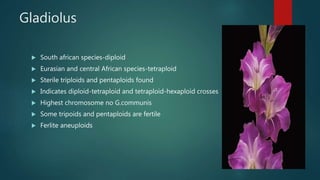
Gladiolus
 South african species-diploid
 Eurasian and central African species-tetraploid
 Sterile triploids and pentaploids found
 Indicates diploid-tetraploid and tetraploid-hexaploid crosses
 Highest chromosome no G.communis
 Some tripoids and pentaploids are fertile
 Ferlite aneuploids
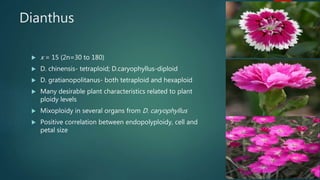
Dianthus
 x = 15 (2n=30 to 180)
 D. chinensis- tetraploid; D.caryophyllus-diploid
 D. gratianopolitanus- both tetraploid and hexaploid
 Many desirable plant characteristics related to plant
ploidy levels
 Mixoploidy in several organs from D. caryophyllus
 Positive correlation between endopolyploidy, cell and
petal size
Chrysenthemum
 CN from 2x to 25x
 2n=36, 45, 47, 51, 75 by T.N. Khushoo
 Intraspecies and intrapopulation variations in ploidy
 C. indicum - 2x,4x & 6x
 C. zawadskii - 4x & 6x
 Polyploids widely distributed
 Evolution & regulation of flower size of large-flower
population possible.
 evidence of low ploidy in large-flower chrysanthemum
Anthurium
 Mostly diploid, some polyploid also present
 A.andreanum, A.magnificum & A.hookeri- diploid
 A.digitatum & A.wallism –tetraploid; A.scandens-
triploid.
 chloroplast number in the guard cell convenient &
reliable indicator of ploidy level in anthurium.
 Micropropagation of A. scherzerianum poses very
little risk in ploidy changes
Dahlia
 2n=32, others 2n=64
 Sorenson- 2n=32 species were diploid
and 2n=64 species tetraploid
 Lawrence (1929) suggested that the
2n=32 species were allotetraploids,
arising from hybrids between now-
extinct diploids with 2n=16.
 Garden dahlia (D. vŠ ariabilis) with
2n=64, a hybrid that combined the
genomes of two species
 It is an autoallopolyploid, rather than an
allooctoploid
Gerbera
 2n=50
 G jamesoni=tetraploid
 Tetraploid plantlets – slower proliferation, higher
vigour and thickened broad leaves.
 Tetraploid plants developed larger flowers, longer
stalks, and have improved vase-life
 No of chloroplast present in the stomata of guard
cell is indicator
 Haploid use for development of new varieties
Jasmine
 Important role in origin of new cultivars in essential oil
bearing plants.
 Spontaneous triploid in J. sambac & J. autumnale(Sharma
and Sharma), J. grandiflorum( Murthy and Khanna)
 Spontaneous tetraploidy in J.calophyllum (Dutta)
 Triploidy in J.grandiflorum increase concrete content and
thereby hold promise as useful avenue for improvement of
this crop.
 Attempt to induce tetraploidy in Jasmine.
 Induced tetraploidy in J. grandiflorum did not reveal
superiority.
Polyploidy in ornamental crops

Polyploidy in ornamental crops

  • 2.
    POLYPLOIDY IN ORNAMENTALCROPS Presented by: Jay Khaniya Genetics and Plant Breeding M.Sc (Agri.) Submitted to: Dr. N. B. Patel Department of Genetics and Plant Breeding, JAU, Junagadh GP 507: Principles of Cytology
  • 3.
    Introduction  An organismhaving more than two sets of homologous chromosomes is known as polyploid and this phenomenon is known as polyploidy.  It was discovered by Lutz.  It is rarely found in animals but is of general occurrence in plants.  A survey of the chromosome numbers of the species in a family shows that these species generally fall in to polyploid series e.g., 2n, 3n, 4n, 5n, 6n etc.
  • 4.
    Types of Polyploidy 1)Autopolyploidy (Genome doubling): Multiplication of one basic set of chromosomes. 2) Allopolyploidy: The combination of genetically distinct, but similar chromosome sets.  Autopolyploids are derived within a single species; while Allopolyploids arise via hybridization between two species.
  • 5.
    Autoployploids  Triploid (threesets; 3x), for example seedless watermelons,  Tetraploid (four sets; 4x) for example potato  Pentaploid (five sets; 5x)  Hexaploid (six sets; 6x)  Heptaploid (seven sets; 7x)  Octaploid (eight sets; 8x)
  • 7.
    Origin of Polyploidy 1)Somatic doubling during mitosis 2) Non-reduction in meiosis leading to the production of unreduced gametes 3) Polyspermaty (Fertilization of egg by two nuclei) 4) Endoreplication (Replication of DNA but no cytokinesis)
  • 8.
    Somatic doubling duringmitosis  Chromosome doubling can occur either in the zygote to produce a completely polyploid individual or locally in some apical meristem to give polyploid chimeras.  In somatic doubling the main cause is mitotic nondisjunction.  This doubling may occur in purely vegetative tissues (as in root nodules of some leguminous plants) or at times in a branch that may produce flowers or in early embryos (and may therefore be carried further down).
  • 9.
    Non-reduction in meiosisleading to the production of unreduced gametes  Non reduction could be due to meiotic non-disjunction (failure of the chromosome to separate and subsequent reduction in chromosome number)  Failure of cell wall formation or formation of gametes by mitosis instead of meiosis.  Raphanobrassica, originated by a one step process of fusion of two non- reduced gametes.
  • 10.
    Polyspermaty (fertilization ofthe egg by two male nuclei)  Polyspermy is observed in many plants but it’s contribution as a mechanism for polyploid formation is rather rare except perhaps in some orchids . Endoreplication (replication of the DNA but no cytokinesis)  Endoreduplication is a form of nuclear polyploidization resulting in multiple uniform copies of chromosomes.  It has been known to occur in the endosperm and the cotyledons of developing seeds, leaves and stems of plants.
  • 11.
    Traits in species, suited for induction of polyploidy (by Dewey)  Should have low CN  Economic part should be vegetative.  Should be cross- pollinated  Should be perennial in habitat.  Have ability to reproduce vegetatively.
  • 12.
    Effect of polyploidy: Increased fruit weight, fruit size, seed size, crop load, flower size etc.  Reduction in fertility (in odd ploidy level individuals).  Change in growth pattern.  Can be used to create higher diversity.  Greater ability to colonize new habitats than diploid ancestors.  Increase blooming period; (marigold, Begonia, ageratum)
  • 13.
    Application in cropimprovement:  Tracing the origin of crop species.  Speciation & evolution  Interspecific gene transfer.  As a bridging cross
  • 14.
    Rose  CN from2n=14 to 56  Early miniatures diploid, later ones, tetraploid.  Hybrid teas and floribundas generally tetraploids  Sterility of some diploid Interspecific hybrids arise through genomic differences, chromosome no may be expected to increase fertility.  Thus sterile diploid R. rugosa x wichuriana ‘Max Graf’ spontaneously produced a tetraploid seedling, R. kordessi  Doubling of chromosome being tried
  • 15.
     For sterilehybrids & diploid species to avoid production of sterile triploids after cross with tetraploid cultivars.  Polyploidy induced in species & F1 interspecific hybrids by colchicine to shoots of seedlings  The frequency of tetraploid was low  Chimerism complicating factor  In-vitro, controlled application of spindle inhibitoRS
  • 16.
    Gladiolus  South africanspecies-diploid  Eurasian and central African species-tetraploid  Sterile triploids and pentaploids found  Indicates diploid-tetraploid and tetraploid-hexaploid crosses  Highest chromosome no G.communis  Some tripoids and pentaploids are fertile  Ferlite aneuploids
  • 17.
    Dianthus  x =15 (2n=30 to 180)  D. chinensis- tetraploid; D.caryophyllus-diploid  D. gratianopolitanus- both tetraploid and hexaploid  Many desirable plant characteristics related to plant ploidy levels  Mixoploidy in several organs from D. caryophyllus  Positive correlation between endopolyploidy, cell and petal size
  • 18.
    Chrysenthemum  CN from2x to 25x  2n=36, 45, 47, 51, 75 by T.N. Khushoo  Intraspecies and intrapopulation variations in ploidy  C. indicum - 2x,4x & 6x  C. zawadskii - 4x & 6x  Polyploids widely distributed  Evolution & regulation of flower size of large-flower population possible.  evidence of low ploidy in large-flower chrysanthemum
  • 19.
    Anthurium  Mostly diploid,some polyploid also present  A.andreanum, A.magnificum & A.hookeri- diploid  A.digitatum & A.wallism –tetraploid; A.scandens- triploid.  chloroplast number in the guard cell convenient & reliable indicator of ploidy level in anthurium.  Micropropagation of A. scherzerianum poses very little risk in ploidy changes
  • 20.
    Dahlia  2n=32, others2n=64  Sorenson- 2n=32 species were diploid and 2n=64 species tetraploid  Lawrence (1929) suggested that the 2n=32 species were allotetraploids, arising from hybrids between now- extinct diploids with 2n=16.  Garden dahlia (D. vŠ ariabilis) with 2n=64, a hybrid that combined the genomes of two species  It is an autoallopolyploid, rather than an allooctoploid
  • 21.
    Gerbera  2n=50  Gjamesoni=tetraploid  Tetraploid plantlets – slower proliferation, higher vigour and thickened broad leaves.  Tetraploid plants developed larger flowers, longer stalks, and have improved vase-life  No of chloroplast present in the stomata of guard cell is indicator  Haploid use for development of new varieties
  • 22.
    Jasmine  Important rolein origin of new cultivars in essential oil bearing plants.  Spontaneous triploid in J. sambac & J. autumnale(Sharma and Sharma), J. grandiflorum( Murthy and Khanna)  Spontaneous tetraploidy in J.calophyllum (Dutta)  Triploidy in J.grandiflorum increase concrete content and thereby hold promise as useful avenue for improvement of this crop.  Attempt to induce tetraploidy in Jasmine.  Induced tetraploidy in J. grandiflorum did not reveal superiority.