ESSENTIAL NUTRIENTS FOR PLANTS, THEIR
FUNCTION AND DEFICIENCY SYMPTOMS
HILL AGRICULTURE
हमारा प्रयास किसानो िा वििास
PRESENTED BY : VINOD
Introduction
Plant require elements for their growth and completion of life
cycle. The elements that are required by plants to grow and
develop are called essential elements.
Plant analysis using modern techniques reveal that plant body
contains about 30 elements, in some cases 60 elements but
the presence of these elements does not mean that all are
essential for plants.
There are 17 essential nutrients that are essential for growth
and development of plants. According to the criteria of
essentiality proposed by Arnon and stout(1939), refined by
Arnon (1954).
A deficiency of an essential nutrient make it impossible for
the plant to complete the vegetative or reproductive
stage of its life cycle. The deficiency in plant can be
recover or filled by only supply this nutrient.
When the element directly involved in metabolism of
Classification of essential
nutrients
 Essential nutrients (17)
1. Macro nutrients (9)
2. Micro nutrients (8)
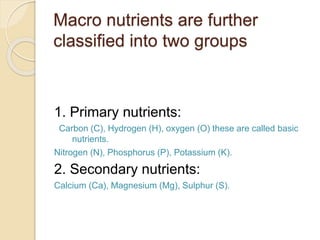
Macro nutrients are further
classified into two groups
1. Primary nutrients:
Carbon (C), Hydrogen (H), oxygen (O) these are called basic
nutrients.
Nitrogen (N), Phosphorus (P), Potassium (K).
2. Secondary nutrients:
Calcium (Ca), Magnesium (Mg), Sulphur (S).
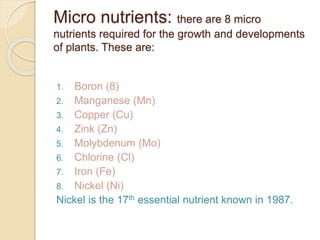
Micro nutrients: there are 8 micro
nutrients required for the growth and developments
of plants. These are:
1. Boron (8)
2. Manganese (Mn)
3. Copper (Cu)
4. Zink (Zn)
5. Molybdenum (Mo)
6. Chlorine (Cl)
7. Iron (Fe)
8. Nickel (Ni)
Nickel is the 17th essential nutrient known in 1987.
Function and deficiency
symptoms of macro
nutrients/ primary nutrients
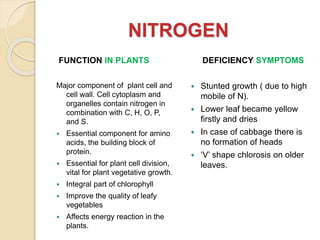
NITROGEN
FUNCTION IN PLANTS
Major component of plant cell and
cell wall. Cell cytoplasm and
organelles contain nitrogen in
combination with C, H, O, P,
and S.
 Essential component for amino
acids, the building block of
protein.
 Essential for plant cell division,
vital for plant vegetative growth.
 Integral part of chlorophyll
 Improve the quality of leafy
vegetables
 Affects energy reaction in the
plants.
DEFICIENCY SYMPTOMS
 Stunted growth ( due to high
mobile of N).
 Lower leaf became yellow
firstly and dries
 In case of cabbage there is
no formation of heads
 ‘V’ shape chlorosis on older
leaves.
PHOSPHORUS
Function in plant
 Involved in photosynthesis,
respiration, cell division and
enlargement
 Promote early root formation
and growth
 Involve in nutrient movement
in plants
 Over amount of P can cause
deficiency of certain
micronutrient like Zn and Fe
Deficiency
symptoms
 Symptoms appear first on
older leaves
 Development of lateral buds is
suppressed
 Leaves became narrow, stem
bluish green, older leaves
becomes bronzed, radish and
purplesh
POTASSIUM
Function in plant
 Regulate the opening and closing of
stomata
 Play important role in transformation
of water and nutrients throughout
the plant in xylem
 Improve drought tolerant
 Increase root growth
 Increase photosynthesis
 In plants K+ also reduce the
transpiration rate and increase
photosynthesis rate
 Provide disease resistance
 Increase water use efficiency
 Improve the quality of fruit and
seeds
Deficiency symptoms
 Scorching or burning of
margins of older leaves
 Reduce in turgidity of cell
 Sloe and stunted growth of
plant
 The size and quality of seed
and fruits reduced
These elements constitute
96% of total dry matter of
plants
Carbon and Oxygen constitute
45% each
BASIC NUTRIENTS
C,H and O
FUNCTION AND DEFICIENCY
SYMPTOMPS OF MACRO
NUTRIENTS/ SECONDARY
NUTRIENTS
CALCIUM
Function in plant
 Constituent of cell wall
 Helps to maintain membrane
permeability and stability
 Important for growth of meristems
and functioning of root tips
 Play role in cell division and cell
elongation
 Protect root cell
 Play an important role in
germination and growth of pollens
 Increase nodulation in legumes
Deficiency symptoms
 Deficiency symptoms first appear on
younger leaves
 Root system is stunted
 leaves became cup shaped and
crinkled
 Slow growth of plant
MAGNESIUM
Function in plant
 Key element of chlorophyll
production
 improve utilization and mobility
of phosphorus
 Activator and component of
many plant enzyme
 Increase iron utilization in plant
 Required for the reaction
involving phosphate
transformation from ATP.
Deficiency symptoms
 Symptoms first appear on older
leaves
 Streaked and patchy effect on
older leaves
 Leaf tissue dry and die
 May occur on acidic soil, sandy
soil or soil with high K level
 Deficiency symptom manifests
themselves in term of interveinal
chlorosis
 Sand drawn disease in tobacco
SULPHUR
Function in plant
 Required for S containing amino
acids i.e Cystrine, Cystin,
Methionine
 Improve the oil quality of oil
seed crops
 Improve the backing quality in
cereals grains
 Necessary in chlorophyll
formation
 Take part in biological N fixation
Deficiency symptoms
 First appear in younger growths
as it is immobile in plants
 Fading of normal green colour
of the leaves followed by
cholorosis is the most common
deficiency symptom
 Older leaves become puckered
with inward raised area between
the veins
Function and deficiency
symptoms of micro
nutrient
BORON
Function in plant
 Boron is the only non-metal
element among the micro
nutrient
 Essential for germination of
pollen grains and growth of
pollen tube
 Necessary for sugar
translocation
 Essential for seed and cell wall
formation
 Promotes maturity
Deficiency symptoms
 Top sickness of tobacco
 Hard fruit of citrus
 Hollow stem of cauliflower
 Internode became bushy and
give bushy or rosette
appearance
 Petiole give rise to typical crack
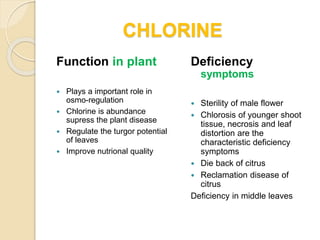
CHLORINE
Function in plant
 Plays a important role in
osmo-regulation
 Chlorine is abundance
supress the plant disease
 Regulate the turgor potential
of leaves
 Improve nutrional quality
Deficiency
symptoms
 Sterility of male flower
 Chlorosis of younger shoot
tissue, necrosis and leaf
distortion are the
characteristic deficiency
symptoms
 Die back of citrus
 Reclamation disease of
citrus
Deficiency in middle leaves
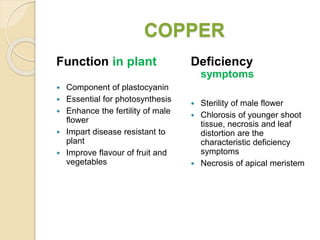
COPPER
Function in plant
 Component of plastocyanin
 Essential for photosynthesis
 Enhance the fertility of male
flower
 Impart disease resistant to
plant
 Improve flavour of fruit and
vegetables
Deficiency
symptoms
 Sterility of male flower
 Chlorosis of younger shoot
tissue, necrosis and leaf
distortion are the
characteristic deficiency
symptoms
 Necrosis of apical meristem
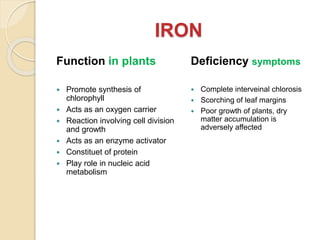
IRON
Function in plants
 Promote synthesis of
chlorophyll
 Acts as an oxygen carrier
 Reaction involving cell division
and growth
 Acts as an enzyme activator
 Constituet of protein
 Play role in nucleic acid
metabolism
Deficiency symptoms
 Complete interveinal chlorosis
 Scorching of leaf margins
 Poor growth of plants, dry
matter accumulation is
adversely affected
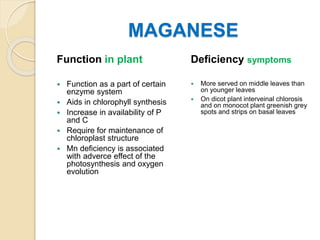
MAGANESE
Function in plant
 Function as a part of certain
enzyme system
 Aids in chlorophyll synthesis
 Increase in availability of P
and C
 Require for maintenance of
chloroplast structure
 Mn deficiency is associated
with adverce effect of the
photosynthesis and oxygen
evolution
Deficiency symptoms
 More served on middle leaves than
on younger leaves
 On dicot plant interveinal chlorosis
and on monocot plant greenish grey
spots and strips on basal leaves
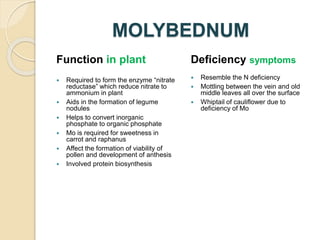
MOLYBEDNUM
Function in plant
 Required to form the enzyme “nitrate
reductase” which reduce nitrate to
ammonium in plant
 Aids in the formation of legume
nodules
 Helps to convert inorganic
phosphate to organic phosphate
 Mo is required for sweetness in
carrot and raphanus
 Affect the formation of viability of
pollen and development of anthesis
 Involved protein biosynthesis
Deficiency symptoms
 Resemble the N deficiency
 Mottling between the vein and old
middle leaves all over the surface
 Whiptail of cauliflower due to
deficiency of Mo
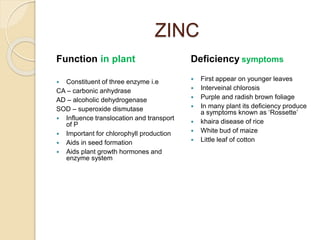
ZINC
Function in plant
 Constituent of three enzyme i.e
CA – carbonic anhydrase
AD – alcoholic dehydrogenase
SOD – superoxide dismutase
 Influence translocation and transport
of P
 Important for chlorophyll production
 Aids in seed formation
 Aids plant growth hormones and
enzyme system
Deficiency symptoms
 First appear on younger leaves
 Interveinal chlorosis
 Purple and radish brown foliage
 In many plant its deficiency produce
a symptoms known as ‘Rossette’
 khaira disease of rice
 White bud of maize
 Little leaf of cotton
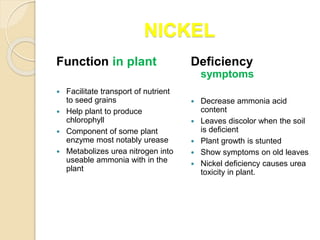
NICKEL
Function in plant
 Facilitate transport of nutrient
to seed grains
 Help plant to produce
chlorophyll
 Component of some plant
enzyme most notably urease
 Metabolizes urea nitrogen into
useable ammonia with in the
plant
Deficiency
symptoms
 Decrease ammonia acid
content
 Leaves discolor when the soil
is deficient
 Plant growth is stunted
 Show symptoms on old leaves
 Nickel deficiency causes urea
toxicity in plant.
THANK YOU

Essential nutrients for plants, their function and deficiency symptoms 1

  • 1.
    ESSENTIAL NUTRIENTS FORPLANTS, THEIR FUNCTION AND DEFICIENCY SYMPTOMS HILL AGRICULTURE हमारा प्रयास किसानो िा वििास PRESENTED BY : VINOD
  • 2.
    Introduction Plant require elementsfor their growth and completion of life cycle. The elements that are required by plants to grow and develop are called essential elements. Plant analysis using modern techniques reveal that plant body contains about 30 elements, in some cases 60 elements but the presence of these elements does not mean that all are essential for plants. There are 17 essential nutrients that are essential for growth and development of plants. According to the criteria of essentiality proposed by Arnon and stout(1939), refined by Arnon (1954). A deficiency of an essential nutrient make it impossible for the plant to complete the vegetative or reproductive stage of its life cycle. The deficiency in plant can be recover or filled by only supply this nutrient. When the element directly involved in metabolism of
  • 3.
    Classification of essential nutrients Essential nutrients (17) 1. Macro nutrients (9) 2. Micro nutrients (8)
  • 4.
    Macro nutrients arefurther classified into two groups 1. Primary nutrients: Carbon (C), Hydrogen (H), oxygen (O) these are called basic nutrients. Nitrogen (N), Phosphorus (P), Potassium (K). 2. Secondary nutrients: Calcium (Ca), Magnesium (Mg), Sulphur (S).
  • 5.
    Micro nutrients: thereare 8 micro nutrients required for the growth and developments of plants. These are: 1. Boron (8) 2. Manganese (Mn) 3. Copper (Cu) 4. Zink (Zn) 5. Molybdenum (Mo) 6. Chlorine (Cl) 7. Iron (Fe) 8. Nickel (Ni) Nickel is the 17th essential nutrient known in 1987.
  • 6.
    Function and deficiency symptomsof macro nutrients/ primary nutrients
  • 7.
    NITROGEN FUNCTION IN PLANTS Majorcomponent of plant cell and cell wall. Cell cytoplasm and organelles contain nitrogen in combination with C, H, O, P, and S.  Essential component for amino acids, the building block of protein.  Essential for plant cell division, vital for plant vegetative growth.  Integral part of chlorophyll  Improve the quality of leafy vegetables  Affects energy reaction in the plants. DEFICIENCY SYMPTOMS  Stunted growth ( due to high mobile of N).  Lower leaf became yellow firstly and dries  In case of cabbage there is no formation of heads  ‘V’ shape chlorosis on older leaves.
  • 8.
    PHOSPHORUS Function in plant Involved in photosynthesis, respiration, cell division and enlargement  Promote early root formation and growth  Involve in nutrient movement in plants  Over amount of P can cause deficiency of certain micronutrient like Zn and Fe Deficiency symptoms  Symptoms appear first on older leaves  Development of lateral buds is suppressed  Leaves became narrow, stem bluish green, older leaves becomes bronzed, radish and purplesh
  • 9.
    POTASSIUM Function in plant Regulate the opening and closing of stomata  Play important role in transformation of water and nutrients throughout the plant in xylem  Improve drought tolerant  Increase root growth  Increase photosynthesis  In plants K+ also reduce the transpiration rate and increase photosynthesis rate  Provide disease resistance  Increase water use efficiency  Improve the quality of fruit and seeds Deficiency symptoms  Scorching or burning of margins of older leaves  Reduce in turgidity of cell  Sloe and stunted growth of plant  The size and quality of seed and fruits reduced
  • 10.
    These elements constitute 96%of total dry matter of plants Carbon and Oxygen constitute 45% each BASIC NUTRIENTS C,H and O
  • 11.
    FUNCTION AND DEFICIENCY SYMPTOMPSOF MACRO NUTRIENTS/ SECONDARY NUTRIENTS
  • 12.
    CALCIUM Function in plant Constituent of cell wall  Helps to maintain membrane permeability and stability  Important for growth of meristems and functioning of root tips  Play role in cell division and cell elongation  Protect root cell  Play an important role in germination and growth of pollens  Increase nodulation in legumes Deficiency symptoms  Deficiency symptoms first appear on younger leaves  Root system is stunted  leaves became cup shaped and crinkled  Slow growth of plant
  • 13.
    MAGNESIUM Function in plant Key element of chlorophyll production  improve utilization and mobility of phosphorus  Activator and component of many plant enzyme  Increase iron utilization in plant  Required for the reaction involving phosphate transformation from ATP. Deficiency symptoms  Symptoms first appear on older leaves  Streaked and patchy effect on older leaves  Leaf tissue dry and die  May occur on acidic soil, sandy soil or soil with high K level  Deficiency symptom manifests themselves in term of interveinal chlorosis  Sand drawn disease in tobacco
  • 14.
    SULPHUR Function in plant Required for S containing amino acids i.e Cystrine, Cystin, Methionine  Improve the oil quality of oil seed crops  Improve the backing quality in cereals grains  Necessary in chlorophyll formation  Take part in biological N fixation Deficiency symptoms  First appear in younger growths as it is immobile in plants  Fading of normal green colour of the leaves followed by cholorosis is the most common deficiency symptom  Older leaves become puckered with inward raised area between the veins
  • 15.
  • 16.
    BORON Function in plant Boron is the only non-metal element among the micro nutrient  Essential for germination of pollen grains and growth of pollen tube  Necessary for sugar translocation  Essential for seed and cell wall formation  Promotes maturity Deficiency symptoms  Top sickness of tobacco  Hard fruit of citrus  Hollow stem of cauliflower  Internode became bushy and give bushy or rosette appearance  Petiole give rise to typical crack
  • 17.
    CHLORINE Function in plant Plays a important role in osmo-regulation  Chlorine is abundance supress the plant disease  Regulate the turgor potential of leaves  Improve nutrional quality Deficiency symptoms  Sterility of male flower  Chlorosis of younger shoot tissue, necrosis and leaf distortion are the characteristic deficiency symptoms  Die back of citrus  Reclamation disease of citrus Deficiency in middle leaves
  • 18.
    COPPER Function in plant Component of plastocyanin  Essential for photosynthesis  Enhance the fertility of male flower  Impart disease resistant to plant  Improve flavour of fruit and vegetables Deficiency symptoms  Sterility of male flower  Chlorosis of younger shoot tissue, necrosis and leaf distortion are the characteristic deficiency symptoms  Necrosis of apical meristem
  • 19.
    IRON Function in plants Promote synthesis of chlorophyll  Acts as an oxygen carrier  Reaction involving cell division and growth  Acts as an enzyme activator  Constituet of protein  Play role in nucleic acid metabolism Deficiency symptoms  Complete interveinal chlorosis  Scorching of leaf margins  Poor growth of plants, dry matter accumulation is adversely affected
  • 20.
    MAGANESE Function in plant Function as a part of certain enzyme system  Aids in chlorophyll synthesis  Increase in availability of P and C  Require for maintenance of chloroplast structure  Mn deficiency is associated with adverce effect of the photosynthesis and oxygen evolution Deficiency symptoms  More served on middle leaves than on younger leaves  On dicot plant interveinal chlorosis and on monocot plant greenish grey spots and strips on basal leaves
  • 21.
    MOLYBEDNUM Function in plant Required to form the enzyme “nitrate reductase” which reduce nitrate to ammonium in plant  Aids in the formation of legume nodules  Helps to convert inorganic phosphate to organic phosphate  Mo is required for sweetness in carrot and raphanus  Affect the formation of viability of pollen and development of anthesis  Involved protein biosynthesis Deficiency symptoms  Resemble the N deficiency  Mottling between the vein and old middle leaves all over the surface  Whiptail of cauliflower due to deficiency of Mo
  • 22.
    ZINC Function in plant Constituent of three enzyme i.e CA – carbonic anhydrase AD – alcoholic dehydrogenase SOD – superoxide dismutase  Influence translocation and transport of P  Important for chlorophyll production  Aids in seed formation  Aids plant growth hormones and enzyme system Deficiency symptoms  First appear on younger leaves  Interveinal chlorosis  Purple and radish brown foliage  In many plant its deficiency produce a symptoms known as ‘Rossette’  khaira disease of rice  White bud of maize  Little leaf of cotton
  • 23.
    NICKEL Function in plant Facilitate transport of nutrient to seed grains  Help plant to produce chlorophyll  Component of some plant enzyme most notably urease  Metabolizes urea nitrogen into useable ammonia with in the plant Deficiency symptoms  Decrease ammonia acid content  Leaves discolor when the soil is deficient  Plant growth is stunted  Show symptoms on old leaves  Nickel deficiency causes urea toxicity in plant.
  • 24.