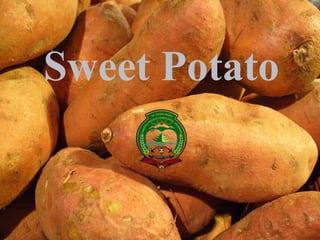
Sweet Potato
INTRODUCTION
 Botanical name: Ipomoea batatus
 Family: Convolvulaceae
 Chromosome no.: 2n=90
 Origin: South America
 It is an important starchy food crop throughout the
tropical and subtropical countries.
 Popularly known as Sakarkand in India
AREA AND PRODUCTION
 Area = 111 thousand hectare
 Production = 1338 thousand tones per hectare
 The leading states in terms of area and production are
Bihar, Orissa and U.P.
 Sweet potato is grown in almost all the states of India
except Jammu and Kashmir.
USES
 Eaten usually after boiling, baking and frying and may
be candied with or used as a puree.
 Tubers are utilized for canning, dehydrating and flour
manufacture.
 Important source of starch, glucose, pectin, sugar syrup
and industrial alcohol.
 Sweet potato is the cheapest source of calories.
 Also contains appreciable amount of vitamin A, B, and
C.
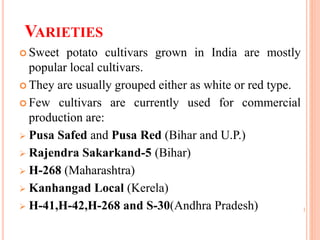
VARIETIES
 Sweet potato cultivars grown in India are mostly
popular local cultivars.
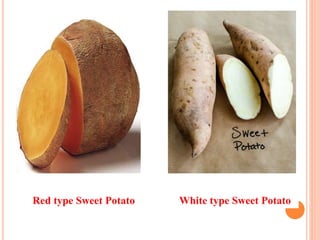
 They are usually grouped either as white or red type.
 Few cultivars are currently used for commercial
production are:
 Pusa Safed and Pusa Red (Bihar and U.P.)
 Rajendra Sakarkand-5 (Bihar)
 H-268 (Maharashtra)
 Kanhangad Local (Kerela)
 H-41,H-42,H-268 and S-30(Andhra Pradesh)
POPULAR VARIETIES
 Co 3,
 Co CIP 1
 Sree Kanaka( high carotene sweet potato)
 Sree Nandini
 Sree Vardhini
 Kiran
 Sree Bhadra
 Sree Rathna
 Gouri
 Sankar
 Others are:
OP-1,H-260,Cross-4,V-35,Kalmegh
Red type Sweet Potato White type Sweet Potato
SOIL
 The best soil is sandy loam and clay subsoil.
 It can be grown in loamy to clay loam soil also.
 Soil should be well drained and soil pH varies from 5.2
to 6.7.
 Heavy clay soil and highly sandy soil are undesirable.
CLIMATE
 It requires moderately warm weather.
 Temperature ranges between 21.1-26.7 ̊C
 Temperature less than 20̊C was found critical for
tuberisation.
 Requires plenty of sunshine and moderate rainfall i.e. 75
to 150 cm.
 High rainfall and long photoperiod promote vine growth
and reduces tuber yield.
PROPAGATION
 Sweet potatoes are propagated from sprouts or from slips (vine
cuttings); sprouts are preferred. Sprouts are grown from plant
stock selected for its appearance, freedom from disease and
off-types.
 Approximately 75-100 kg of planting stock sweet potatoes are
needed to produce enough sprouts to plant one hectare.
Selected tubers are planted at a spacing of 45 x 30 cm & 5-6
cm deep.
 The sprouts are cut after 40-45 days and planted in secondary
nursery. The cuttings 20-30 cm in length are planted in this
nursery at a distance of 60 x 30 cm.
 For 1 ha, primary nursery of 100m² and a secondary nursery of
500 m² are required.
SWEET POTATO CUTTINGS
 Planting Season:
June-July and September are highly suitable for planting.
 Manures and Fertilizers:
Farmyard manure :100-150 q/ha.
90: 60: 90 kg N, P₂O₅ and K₂O per ha. Half of dose
nitrogenous fertilizer is applied as basal and half dose 40 days
after planting.
 Irrigation:
The critical stage of moisture supply is 40 days after
planting and earthing up (35DAP) may be followed by
irrigation.
 Interculture and Weed control:
In early stages of crop growth i.e. up to two months after
planting, weeds are a problem to sweet potato. Two manual
weedings at 20 and 45 days after planting are sufficient to keep
the weeds under control. Earthing up is done at second
weeding to prevent exposure of roots (particularly during rainy
season). Fluchloralin @ 1.0 kg/ha in the soil as pre-planting to
control the weeds is effective. Also, application of chloramben
@ 3.0 kg/ha at post planting stage control the weeds.
EFFECT OF GROWTH SUBSTANCES
 Foliar application of CCC at 250,500 and 1000 ppm
increased the yield.
 Application of ethephon at 250 ppm results in larger
number of tubers and higher yield.
 Foliar application of kinetin at 50 and 100 ppm caused
higher tuber yield of (number, fresh and dry weight)
HARVESTING
 Sweet potato is usually harvested when the leaves turn
yellow begin to shed.
 Maturity can be ascertained by cutting tuber and the latex
from mature tuber dries up without turning black.
 The time of harvesting differs with cultivar which may
extend from 120-180 days.
 Avoid mechanical injuries while digging out tubers.
YIELD AND STORAGE
 Yield:
Under irrigated conditions= 35-40 t/ha
Under rainfed conditions= 8-10t/ha
 Storage:
Highly perishable nature of tubers of sweet potato
does not permit it to be stored for a long period in the
tropics.
Sweet potato were successfully cured at RH 80-
90% and temperature 29-40̊C for 5-7 days.
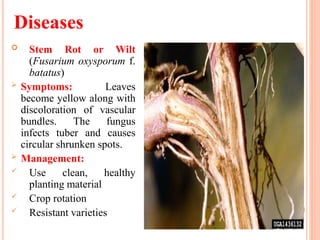
 Stem Rot or Wilt
(Fusarium oxysporum f.
batatus)
 Symptoms: Leaves
become yellow along with
discoloration of vascular
bundles. The fungus
infects tuber and causes
circular shrunken spots.
 Management:
 Use clean, healthy
planting material
 Crop rotation
 Resistant varieties
Diseases
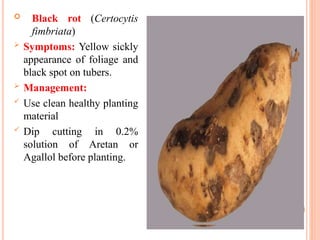
 Black rot (Certocytis
fimbriata)
 Symptoms: Yellow sickly
appearance of foliage and
black spot on tubers.
 Management:
 Use clean healthy planting
material
 Dip cutting in 0.2%
solution of Aretan or
Agallol before planting.
 Cercospora leaf spot ( Cercospora bataticola)
 Symptoms: Dark brown leaf spots with a light shade
at the centre.
 Management:
 Three spraying of 0.25% Dithane M-45 at fortnightly
interval is effective.
 Soil rot (Streptomyces ipomoea)
 Symptoms: On tubers infection starts as a spot and
the skin collapses leaving cavities with irregular
margins.
 Management:
 Maintain Soil pH (5.2 or less)
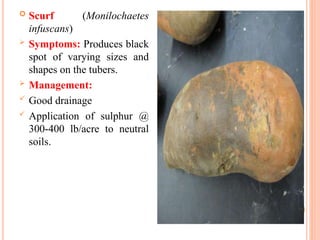
 Scurf (Monilochaetes
infuscans)
 Symptoms: Produces black
spot of varying sizes and
shapes on the tubers.
 Management:
 Good drainage
 Application of sulphur @
300-400 lb/acre to neutral
soils.
 Soft rot (Rhizopus nigricans)
 Symptoms: Soft watery rot on tuber and fleshy tissue
becomes soft and water exudes from affected skin
Tissue becomes brownish.
 Management:
 Proper temperature and a RH of 85-90% should be
maintained.
PESTS
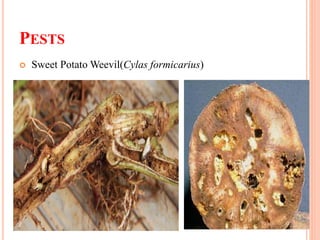
 Sweet Potato Weevil(Cylas formicarius)
 Management
 Clean Cultivation
 Crop rotation
 Treatment of planting material with 0.05% Monocrotophos,
spraying at tri-weekly interval from one month after planting.
 Other pests are
Stem borer
Leaf feeding caterpillars
Leaf feeding beetles
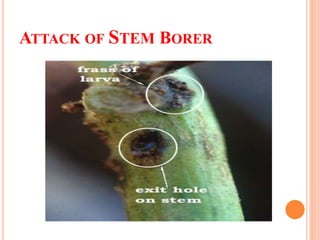
ATTACK OF STEM BORER
Thank You

Sweet potato

  • 1.
  • 2.
    INTRODUCTION  Botanical name:Ipomoea batatus  Family: Convolvulaceae  Chromosome no.: 2n=90  Origin: South America  It is an important starchy food crop throughout the tropical and subtropical countries.  Popularly known as Sakarkand in India
  • 3.
    AREA AND PRODUCTION Area = 111 thousand hectare  Production = 1338 thousand tones per hectare  The leading states in terms of area and production are Bihar, Orissa and U.P.  Sweet potato is grown in almost all the states of India except Jammu and Kashmir.
  • 4.
    USES  Eaten usuallyafter boiling, baking and frying and may be candied with or used as a puree.  Tubers are utilized for canning, dehydrating and flour manufacture.  Important source of starch, glucose, pectin, sugar syrup and industrial alcohol.  Sweet potato is the cheapest source of calories.  Also contains appreciable amount of vitamin A, B, and C.
  • 5.
    VARIETIES  Sweet potatocultivars grown in India are mostly popular local cultivars.  They are usually grouped either as white or red type.  Few cultivars are currently used for commercial production are:  Pusa Safed and Pusa Red (Bihar and U.P.)  Rajendra Sakarkand-5 (Bihar)  H-268 (Maharashtra)  Kanhangad Local (Kerela)  H-41,H-42,H-268 and S-30(Andhra Pradesh)
  • 6.
    POPULAR VARIETIES  Co3,  Co CIP 1  Sree Kanaka( high carotene sweet potato)  Sree Nandini  Sree Vardhini  Kiran  Sree Bhadra  Sree Rathna  Gouri  Sankar  Others are: OP-1,H-260,Cross-4,V-35,Kalmegh
  • 7.
    Red type SweetPotato White type Sweet Potato
  • 8.
    SOIL  The bestsoil is sandy loam and clay subsoil.  It can be grown in loamy to clay loam soil also.  Soil should be well drained and soil pH varies from 5.2 to 6.7.  Heavy clay soil and highly sandy soil are undesirable.
  • 9.
    CLIMATE  It requiresmoderately warm weather.  Temperature ranges between 21.1-26.7 ̊C  Temperature less than 20̊C was found critical for tuberisation.  Requires plenty of sunshine and moderate rainfall i.e. 75 to 150 cm.  High rainfall and long photoperiod promote vine growth and reduces tuber yield.
  • 10.
    PROPAGATION  Sweet potatoesare propagated from sprouts or from slips (vine cuttings); sprouts are preferred. Sprouts are grown from plant stock selected for its appearance, freedom from disease and off-types.  Approximately 75-100 kg of planting stock sweet potatoes are needed to produce enough sprouts to plant one hectare. Selected tubers are planted at a spacing of 45 x 30 cm & 5-6 cm deep.  The sprouts are cut after 40-45 days and planted in secondary nursery. The cuttings 20-30 cm in length are planted in this nursery at a distance of 60 x 30 cm.  For 1 ha, primary nursery of 100m² and a secondary nursery of 500 m² are required.
  • 11.
  • 12.
     Planting Season: June-Julyand September are highly suitable for planting.  Manures and Fertilizers: Farmyard manure :100-150 q/ha. 90: 60: 90 kg N, P₂O₅ and K₂O per ha. Half of dose nitrogenous fertilizer is applied as basal and half dose 40 days after planting.
  • 13.
     Irrigation: The criticalstage of moisture supply is 40 days after planting and earthing up (35DAP) may be followed by irrigation.  Interculture and Weed control: In early stages of crop growth i.e. up to two months after planting, weeds are a problem to sweet potato. Two manual weedings at 20 and 45 days after planting are sufficient to keep the weeds under control. Earthing up is done at second weeding to prevent exposure of roots (particularly during rainy season). Fluchloralin @ 1.0 kg/ha in the soil as pre-planting to control the weeds is effective. Also, application of chloramben @ 3.0 kg/ha at post planting stage control the weeds.
  • 14.
    EFFECT OF GROWTHSUBSTANCES  Foliar application of CCC at 250,500 and 1000 ppm increased the yield.  Application of ethephon at 250 ppm results in larger number of tubers and higher yield.  Foliar application of kinetin at 50 and 100 ppm caused higher tuber yield of (number, fresh and dry weight)
  • 15.
    HARVESTING  Sweet potatois usually harvested when the leaves turn yellow begin to shed.  Maturity can be ascertained by cutting tuber and the latex from mature tuber dries up without turning black.  The time of harvesting differs with cultivar which may extend from 120-180 days.  Avoid mechanical injuries while digging out tubers.
  • 16.
    YIELD AND STORAGE Yield: Under irrigated conditions= 35-40 t/ha Under rainfed conditions= 8-10t/ha  Storage: Highly perishable nature of tubers of sweet potato does not permit it to be stored for a long period in the tropics. Sweet potato were successfully cured at RH 80- 90% and temperature 29-40̊C for 5-7 days.
  • 17.
     Stem Rotor Wilt (Fusarium oxysporum f. batatus)  Symptoms: Leaves become yellow along with discoloration of vascular bundles. The fungus infects tuber and causes circular shrunken spots.  Management:  Use clean, healthy planting material  Crop rotation  Resistant varieties Diseases
  • 18.
     Black rot(Certocytis fimbriata)  Symptoms: Yellow sickly appearance of foliage and black spot on tubers.  Management:  Use clean healthy planting material  Dip cutting in 0.2% solution of Aretan or Agallol before planting.
  • 19.
     Cercospora leafspot ( Cercospora bataticola)  Symptoms: Dark brown leaf spots with a light shade at the centre.  Management:  Three spraying of 0.25% Dithane M-45 at fortnightly interval is effective.  Soil rot (Streptomyces ipomoea)  Symptoms: On tubers infection starts as a spot and the skin collapses leaving cavities with irregular margins.  Management:  Maintain Soil pH (5.2 or less)
  • 20.
     Scurf (Monilochaetes infuscans) Symptoms: Produces black spot of varying sizes and shapes on the tubers.  Management:  Good drainage  Application of sulphur @ 300-400 lb/acre to neutral soils.
  • 21.
     Soft rot(Rhizopus nigricans)  Symptoms: Soft watery rot on tuber and fleshy tissue becomes soft and water exudes from affected skin Tissue becomes brownish.  Management:  Proper temperature and a RH of 85-90% should be maintained.
  • 22.
    PESTS  Sweet PotatoWeevil(Cylas formicarius)
  • 23.
     Management  CleanCultivation  Crop rotation  Treatment of planting material with 0.05% Monocrotophos, spraying at tri-weekly interval from one month after planting.  Other pests are Stem borer Leaf feeding caterpillars Leaf feeding beetles
  • 24.
  • 25.