Control Systems (CS)
Dr. K. Hussain
Associate Professor & Head
Dept. of EE, SITCOE
Unit-5:
PID Controllers
Lecture Outline
Introduction
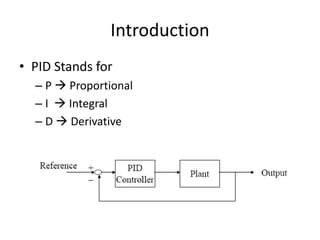
• PID Stands for
– P  Proportional
– I  Integral
– D  Derivative
Introduction
• The usefulness of PID controls lies in their general
applicability to most control systems.
• In particular, when the mathematical model of the plant
is not known and therefore analytical design methods
cannot be used, PID controls prove to be most useful.
• In the field of process control systems, it is well known
that the basic and modified PID control schemes have
proved their usefulness in providing satisfactory control,
although in many given situations they may not provide
optimal control.
Introduction
• It is interesting to note that more than half of the
industrial controllers in use today are PID controllers or
modified PID controllers.
• Because most PID controllers are adjusted on-site, many
different types of tuning rules have been proposed in the
literature.
• Using these tuning rules, delicate and fine tuning of PID
controllers can be made on-site.
6
Four Modes of Controllers
• Each mode of control has specific advantages and
limitations.
• On-Off (Bang Bang) Control
• Proportional (P)
• Proportional plus Integral (PI)
• Proportional plus Derivative (PD)
• Proportional plus Integral plus Derivative (PID)
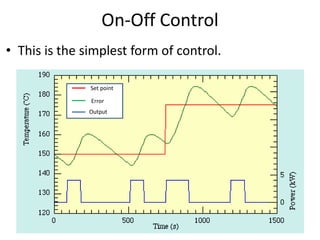
On-Off Control
• This is the simplest form of control.
Set point
Error
Output
8
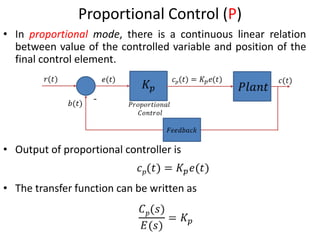
Proportional Control (P)
• In proportional mode, there is a continuous linear relation
between value of the controlled variable and position of the
final control element.
• Output of proportional controller is
• The transfer function can be written as
-
9
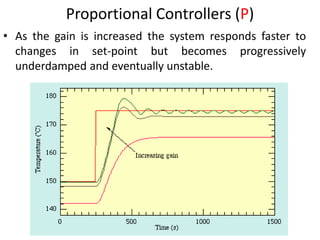
Proportional Controllers (P)
• As the gain is increased the system responds faster to
changes in set-point but becomes progressively
underdamped and eventually unstable.
10
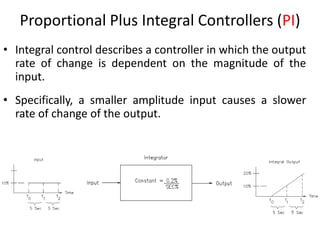
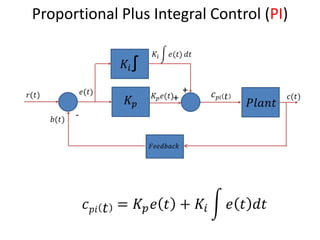
Proportional Plus Integral Controllers (PI)
• Integral control describes a controller in which the output
rate of change is dependent on the magnitude of the
input.
• Specifically, a smaller amplitude input causes a slower
rate of change of the output.
11
Proportional Plus Integral Controllers (PI)
• The major advantage of integral controllers is that they have
the unique ability to return the controlled variable back to the
exact set point following a disturbance.
• Disadvantages of the integral control mode are that it
responds relatively slowly to an error signal and that it can
initially allow a large deviation at the instant the error is
produced.
• This can lead to system instability and cyclic operation. For
this reason, the integral control mode is not normally used
alone, but is combined with another control mode.
12
Proportional Plus Integral Control (PI)
-
+
+
13
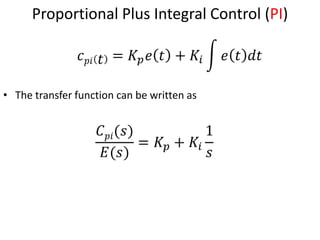
Proportional Plus Integral Control (PI)
• The transfer function can be written as
14
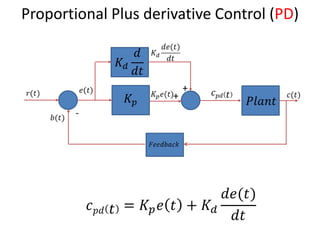
Proportional Plus derivative Control (PD)
-
+
+
15
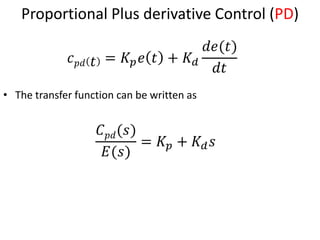
Proportional Plus derivative Control (PD)
• The transfer function can be written as
16
Proportional Plus derivative Control (PD)
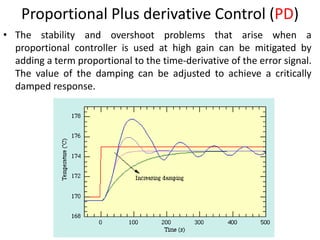
• The stability and overshoot problems that arise when a
proportional controller is used at high gain can be mitigated by
adding a term proportional to the time-derivative of the error signal.
The value of the damping can be adjusted to achieve a critically
damped response.
17
Proportional Plus derivative Control (PD)
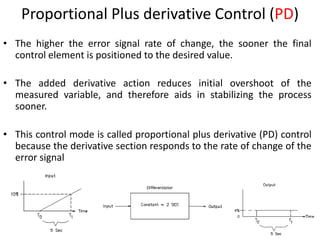
• The higher the error signal rate of change, the sooner the final
control element is positioned to the desired value.
• The added derivative action reduces initial overshoot of the
measured variable, and therefore aids in stabilizing the process
sooner.
• This control mode is called proportional plus derivative (PD) control
because the derivative section responds to the rate of change of the
error signal
18
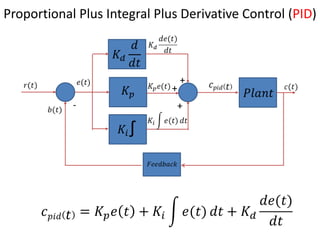
Proportional Plus Integral Plus Derivative Control (PID)
-
+
+
+
19
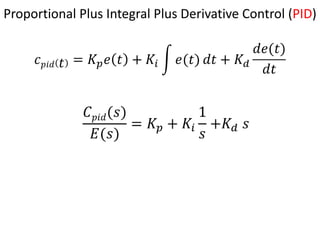
Proportional Plus Integral Plus Derivative Control (PID)
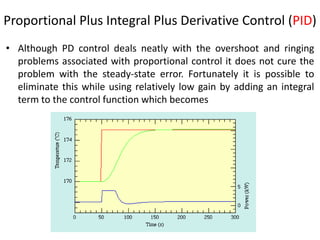
• Although PD control deals neatly with the overshoot and ringing
problems associated with proportional control it does not cure the
problem with the steady-state error. Fortunately it is possible to
eliminate this while using relatively low gain by adding an integral
term to the control function which becomes
20
P – controller
The transfer function of this controller is KP.
The main disadvantage in P – controllers is that as KP value
increases, decreases & hence overshoot increases.
As overshoot increases system stability decreases.
I – controller
The transfer function of this controller is Ki/s.
It introduces a pole at origin and hence type is increased and
as type increases, the SS error decrease but system stability
is affected.
D – controller
It’s purpose is to improve the stability.
The transfer function of this controller is sKD.
It introduces a zero at origin so system type is decreased but
steady state error increases.
Effect of P,I,PI,PD & PID Controller on systems
Effect of P,I,PI,PD and PID on system
• PI – controller
• It’s purpose SS error without affection stability.
• It adds pole at origin, so type increases & SS error decreases.
• It adds a zero in LHP, so stability is not affected.
• Effects:
• o Improves damping and reduces maximum overshoot.
• o Increases rise time.
• o Decreases BW.
• o Improves Gain Margin, Phase margin & Mr.
• o Filter out high frequency noise.
PD controller
Its purpose is to improve stability without affecting stability.
Transfer function: KP+sKD
It adds a zero in LHP, so stability improved.
Effects:
o Improves damping and maximum overshoot.
o Reduces rise time & setting time.
o Increases BW.
o Improves GM, PM, Mr.
o May attenuate high frequency noise.
PID controller
Its purpose is to improve stability as well as to decrease ess.
o If adds a pole at origin which increases type & hence
steady state error decreases.
o If adds 2 zeroes in LHP, one finite zero to avoid effect on
stability & other zero to improve stability of system.
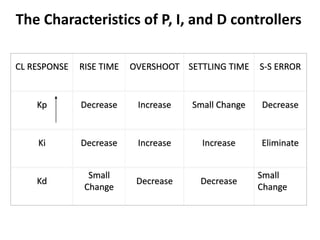
CL RESPONSE RISE TIME OVERSHOOT SETTLING TIME S-S ERROR
Kp Decrease Increase Small Change Decrease
Ki Decrease Increase Increase Eliminate
Kd
Small
Change
Decrease Decrease
Small
Change
The Characteristics of P, I, and D controllers

Pid controllers

  • 1.
    Control Systems (CS) Dr.K. Hussain Associate Professor & Head Dept. of EE, SITCOE Unit-5: PID Controllers
  • 2.
  • 3.
    Introduction • PID Standsfor – P  Proportional – I  Integral – D  Derivative
  • 4.
    Introduction • The usefulnessof PID controls lies in their general applicability to most control systems. • In particular, when the mathematical model of the plant is not known and therefore analytical design methods cannot be used, PID controls prove to be most useful. • In the field of process control systems, it is well known that the basic and modified PID control schemes have proved their usefulness in providing satisfactory control, although in many given situations they may not provide optimal control.
  • 5.
    Introduction • It isinteresting to note that more than half of the industrial controllers in use today are PID controllers or modified PID controllers. • Because most PID controllers are adjusted on-site, many different types of tuning rules have been proposed in the literature. • Using these tuning rules, delicate and fine tuning of PID controllers can be made on-site.
  • 6.
    6 Four Modes ofControllers • Each mode of control has specific advantages and limitations. • On-Off (Bang Bang) Control • Proportional (P) • Proportional plus Integral (PI) • Proportional plus Derivative (PD) • Proportional plus Integral plus Derivative (PID)
  • 7.
    On-Off Control • Thisis the simplest form of control. Set point Error Output
  • 8.
    8 Proportional Control (P) •In proportional mode, there is a continuous linear relation between value of the controlled variable and position of the final control element. • Output of proportional controller is • The transfer function can be written as -
  • 9.
    9 Proportional Controllers (P) •As the gain is increased the system responds faster to changes in set-point but becomes progressively underdamped and eventually unstable.
  • 10.
    10 Proportional Plus IntegralControllers (PI) • Integral control describes a controller in which the output rate of change is dependent on the magnitude of the input. • Specifically, a smaller amplitude input causes a slower rate of change of the output.
  • 11.
    11 Proportional Plus IntegralControllers (PI) • The major advantage of integral controllers is that they have the unique ability to return the controlled variable back to the exact set point following a disturbance. • Disadvantages of the integral control mode are that it responds relatively slowly to an error signal and that it can initially allow a large deviation at the instant the error is produced. • This can lead to system instability and cyclic operation. For this reason, the integral control mode is not normally used alone, but is combined with another control mode.
  • 12.
  • 13.
    13 Proportional Plus IntegralControl (PI) • The transfer function can be written as
  • 14.
  • 15.
    15 Proportional Plus derivativeControl (PD) • The transfer function can be written as
  • 16.
    16 Proportional Plus derivativeControl (PD) • The stability and overshoot problems that arise when a proportional controller is used at high gain can be mitigated by adding a term proportional to the time-derivative of the error signal. The value of the damping can be adjusted to achieve a critically damped response.
  • 17.
    17 Proportional Plus derivativeControl (PD) • The higher the error signal rate of change, the sooner the final control element is positioned to the desired value. • The added derivative action reduces initial overshoot of the measured variable, and therefore aids in stabilizing the process sooner. • This control mode is called proportional plus derivative (PD) control because the derivative section responds to the rate of change of the error signal
  • 18.
    18 Proportional Plus IntegralPlus Derivative Control (PID) - + + +
  • 19.
    19 Proportional Plus IntegralPlus Derivative Control (PID)
  • 20.
    Proportional Plus IntegralPlus Derivative Control (PID) • Although PD control deals neatly with the overshoot and ringing problems associated with proportional control it does not cure the problem with the steady-state error. Fortunately it is possible to eliminate this while using relatively low gain by adding an integral term to the control function which becomes 20
  • 21.
    P – controller Thetransfer function of this controller is KP. The main disadvantage in P – controllers is that as KP value increases, decreases & hence overshoot increases. As overshoot increases system stability decreases. I – controller The transfer function of this controller is Ki/s. It introduces a pole at origin and hence type is increased and as type increases, the SS error decrease but system stability is affected. D – controller It’s purpose is to improve the stability. The transfer function of this controller is sKD. It introduces a zero at origin so system type is decreased but steady state error increases. Effect of P,I,PI,PD & PID Controller on systems
  • 22.
    Effect of P,I,PI,PDand PID on system • PI – controller • It’s purpose SS error without affection stability. • It adds pole at origin, so type increases & SS error decreases. • It adds a zero in LHP, so stability is not affected. • Effects: • o Improves damping and reduces maximum overshoot. • o Increases rise time. • o Decreases BW. • o Improves Gain Margin, Phase margin & Mr. • o Filter out high frequency noise.
  • 23.
    PD controller Its purposeis to improve stability without affecting stability. Transfer function: KP+sKD It adds a zero in LHP, so stability improved. Effects: o Improves damping and maximum overshoot. o Reduces rise time & setting time. o Increases BW. o Improves GM, PM, Mr. o May attenuate high frequency noise. PID controller Its purpose is to improve stability as well as to decrease ess. o If adds a pole at origin which increases type & hence steady state error decreases. o If adds 2 zeroes in LHP, one finite zero to avoid effect on stability & other zero to improve stability of system.
  • 24.
    CL RESPONSE RISETIME OVERSHOOT SETTLING TIME S-S ERROR Kp Decrease Increase Small Change Decrease Ki Decrease Increase Increase Eliminate Kd Small Change Decrease Decrease Small Change The Characteristics of P, I, and D controllers