The Classical Three-Term Controller
PID Controller
https://en.wikipedia.org/wiki/PID_controller#Origins1922
Mostafa Ragab
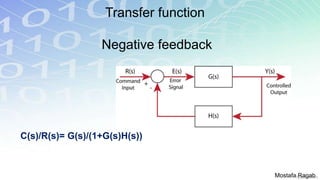
Transfer function
Negative feedback
C(s)/R(s)= G(s)/(1+G(s)H(s))
Mostafa Ragab
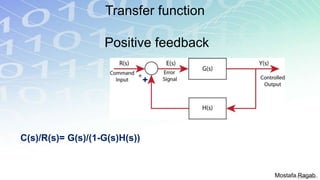
Transfer function
Positive feedback
C(s)/R(s)= G(s)/(1-G(s)H(s))
+
Mostafa Ragab
Negative vs. Positive Feedback
• It turns out that negative feedback is almost always the most useful type of feedback.
When we subtract the value of the output from the value of the input (our desired value),
we get a value called the error signal. The error signal shows us how far off our output is
from our desired input.
• Positive feedback has the property that signals tend to reinforce themselves, and grow
larger. In a positive feedback system, noise from the system is added back to the input,
and that in turn produces more noise. As an example of a positive feedback system,
consider an audio amplification system with a speaker and a microphone. Placing
the microphone near the speaker creates a positive feedback loop, and the result is a
sound that grows louder and louder. Because the majority of noise in an electrical system
is high-frequency, the sound output of the system becomes high-pitched.
Mostafa Ragab
What is feedback and feedforward
control system?
 Feedback.
• The output of the process is measured with the help of a sensor and the sensor value is given
to the controller to take a proper controlling action.
• Feedback: correcting perturbations after the fact
• Controller takes control action only after the process variables and disturbance effects the
process and the control action is also given to the process directly.
For example a thermostat will counteract a drop in temperature by switching on the
heating.
Mostafa Ragab
FeedForward FF
• A feed forward system will proactively turn on the
furnace to prevent system change.
For example, Feedforward control might be applied to the
thermostatically controlled room by installing a
temperature sensor outside of the room, which would warn
the thermostat about a drop in the outside temperature, so
that it could start heating before this would affect the inside
temperature.
Mostafa Ragab
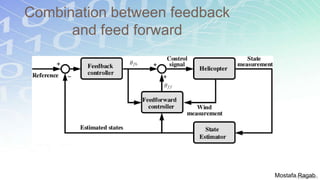
Combination between feedback
and feed forward
Mostafa Ragab
Rationale (Physical Sense)
4
 How to determine the control action?
 based on the error (the difference between the set-point and the
actual output value)
 PID = Proportional + Integral + Derivative
 Proportional mode
reacts to the present error
 Integral mode
reacts to the past history of the error signal
 Derivative mode
reacts to the expected future of the error signal (rate)
RTECS
Mostafa Ragab
Block Diagram
6
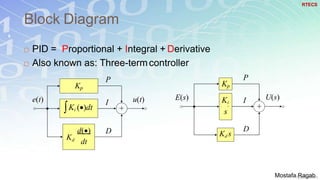
 PID = Proportional + Integral + Derivative
 Also known as: Three-termcontroller
Kp
Ki ()dt
d()
Kd
dt
+
P
I
D
e(t) u(t)
Kp
Ki
s
Kd s
P
I
D
E(s) U(s)
+
RTECS
Mostafa Ragab
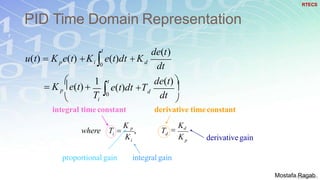
PID Time Domain Representation
7




 dtT
dt
d
t
i
dp
de(t) 
e(t)dt T K p e(t) 

de(t)t
u(t)  K e(t) K e(t)dt K
0
i 0
1
p
d
i
i
KK
T 
Kd
where T 
K p
,
proportional gain integral gain
derivativegain
derivative timeconstantintegral timeconstant
RTECS
Mostafa Ragab
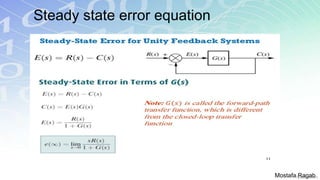
Steady state error equation
Mostafa Ragab
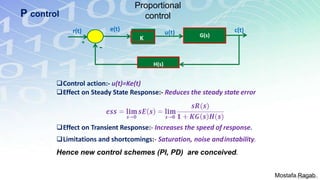
Proportional
control
+
r(t) u(t) G(s)
K
H(s)
c(t)e(t)
-
Control action:- u(t)=Ke(t)
Effect on Steady State Response:- Reduces the steady state error
Effect on Transient Response:- Increases the speed of response.
Limitations and shortcomings:- Saturation, noise andinstability.
Hence new control schemes (PI, PD) are conceived.
P control
Mostafa Ragab
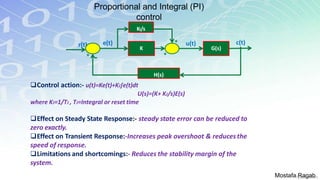
Proportional and Integral (PI)
control
r(t)
+
u(t)
K G(s)
H(s)
KI/s
c(t)e(t)
- +
+
Control action:- u(t)=Ke(t)+KI∫e(t)dt
U(s)=(K+ KI/s)E(s)
where KI=1/TI , TI=Integral or reset time
Effect on Steady State Response:- steady state error can be reduced to
zero exactly.
Effect on Transient Response:-Increases peak overshoot & reducesthe
speed of response.
Limitations and shortcomings:- Reduces the stability margin of the
system.
Mostafa Ragab
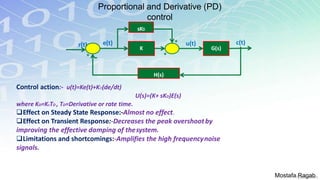
Proportional and Derivative (PD)
control
r(t)
+
u(t)
K G(s)
H(s)
sKD
c(t)e(t)
- +
+
Control action:- u(t)=Ke(t)+KD(de/dt)
U(s)=(K+ sKD)E(s)
where KD=KcTD , TD=Derivative or rate time.
Effect on Steady State Response:-Almost no effect.
Effect on Transient Response:-Decreases the peak overshootby
improving the effective damping of thesystem.
Limitations and shortcomings:-Amplifies the high frequencynoise
signals.
Mostafa Ragab
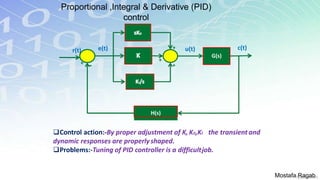
Proportional ,Integral & Derivative (PID)
control
the transient andControl action:-By proper adjustment of K,KD,KI
dynamic responses are properlyshaped.
Problems:-Tuning of PID controller is a difficultjob.
+
r(t) u(t)
G(s)
H(s)
c(t)e(t)
-
+
+
+
Mostafa Ragab
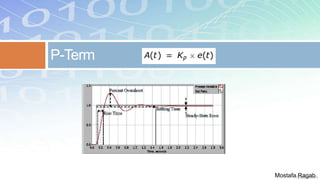
P-Term
Mostafa Ragab
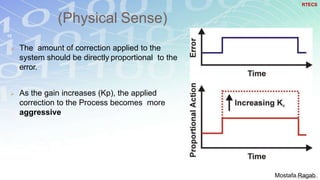
(Physical Sense)
15
 The amount of correction applied to the
system should be directly proportional to the
error.
 As the gain increases (Kp), the applied
correction to the Process becomes more
aggressive
RTECS
Mostafa Ragab
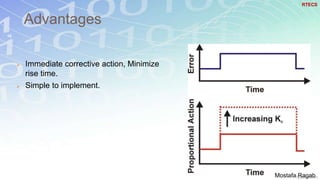
Advantages
16
 Immediate corrective action, Minimize
rise time.
 Simple to implement.
RTECS
Mostafa Ragab
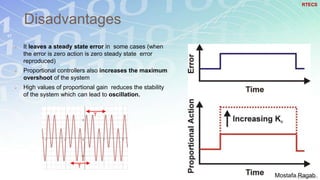
Disadvantages
17
 It leaves a steady state error in some cases (when
the error is zero action is zero steady state error
reproduced)
 Proportional controllers also increases the maximum
overshoot of the system
 High values of proportional gain reduces the stability
of the system which can lead to oscillation.
RTECS
Mostafa Ragab
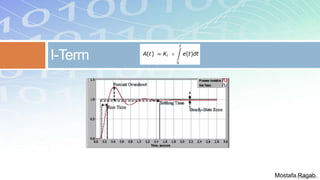
I-Term
Mostafa Ragab
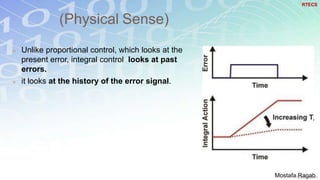
(Physical Sense)
 Unlike proportional control, which looks at the
present error, integral control looks at past
errors.
 it looks at the history of the error signal.
RTECS
Mostafa Ragab
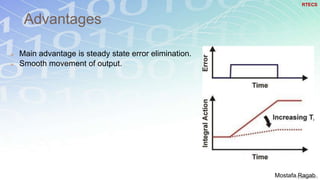
Advantages
 Main advantage is steady state error elimination.
 Smooth movement of output.
RTECS
Mostafa Ragab
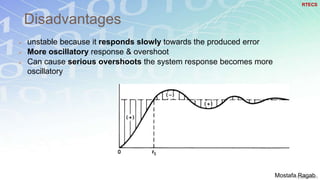
Disadvantages
 unstable because it responds slowly towards the produced error
 More oscillatory response & overshoot
 Can cause serious overshoots the system response becomes more
oscillatory
RTECS
Mostafa Ragab
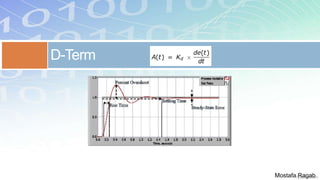
D-Term
Mostafa Ragab
(Physical Sense)
37
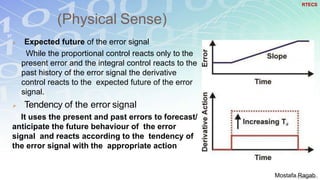
 Expected future of the error signal
While the proportional control reacts only to the
present error and the integral control reacts to the
past history of the error signal the derivative
control reacts to the expected future of the error
signal.
 Tendency of the error signal
It uses the present and past errors to forecast/
anticipate the future behaviour of the error
signal and reacts according to the tendency of
the error signal with the appropriate action
RTECS
Mostafa Ragab
Rationale (Physical Sense)
38
 Avoiding overshoot
if the error is decreasing too fast that means that the current control
action is very high so it needs to be decreased substantially to avoid
overshoots in the system.
 Braking system
derivative action is against other actions like the proportional or the
integral actions, so the derivative action acts as a braking system for
the response.
RTECS
Mostafa Ragab
Advantages
40
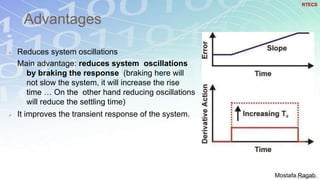
 Reduces system oscillations
Main advantage: reduces system oscillations
by braking the response (braking here will
not slow the system, it will increase the rise
time … On the other hand reducing oscillations
will reduce the settling time)
 It improves the transient response of the system.
RTECS
Mostafa Ragab
Disadvantages
42
The derivative action amplifies noise
RTECS
Mostafa Ragab
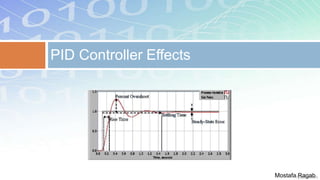
PID Controller Effects
Mostafa Ragab
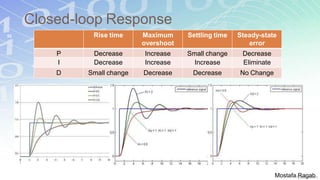
Closed-loop Response
52 Rise time Maximum
overshoot
Settling time Steady-state
error
P Decrease Increase Small change Decrease
I Decrease Increase Increase Eliminate
D Small change Decrease Decrease No Change
Mostafa Ragab
Controller Effects
53
 Proportional controller (P)
 reduces error responses to disturbances,
 speeds up the process response
 but still allows a steady-state error.
 Integral controller (I)
 When the controller includes a term proportional to the integral of the
error (I), then the steady state error to a constant input is
eliminated,
 Derivative controller (D)
 typically makes the system better damped and more stable.
PID Video
Mostafa Ragab
Variations of PID Controller
Mostafa Ragab
Variations of PID Controller
63
 P
 P+D (Lead) Compensation
 P+I (Lag) Compensation
Is generally adequate when plant/process dynamics are essentially
of 1st-order
 P+I+D (Lead-Lag) Compensation
Is generally ok if dominant plant dynamics are of 2nd-order
RTECS
Mostafa Ragab
Combinations pros and
cons
 Advantages:
I. Proportional ( P ) : Speed controlled ( Increase gain)
II. Proportional - Integrated ( PI ) : Good damping, No steady state error
III. Proportional - Differential ( PD ) : Maximum overshoot, decreases Rise time, settling time is
reduced , Bandwidth is increased.
IV. Proportional - Integrated - Differential ( PID ) : Decreases rise time (Kp), Eliminates steady state
error (Ki), Decreases overshoot and settling time ( Kd).
 Disadvantages:
I. Proportional ( P ) : Steady state error.
II. Proportional - Integrated ( PI ) : Slow Response, Stability
III. Proportional - Differential ( PD ) : Steady state error
Mostafa Ragab
Design Guidelines
66
 Liquid level
 Integrating process
 Use P or PI controller with high gain
 D-mode is not suitable since level signal is usually noisy due to the
splashing and turbulence of the liquid entering the tank
 Flow control
 Use PI controller with intermediate gain
 No D-mode because of high frequency noise
 Fast response, no time delay
RTECS
Mostafa Ragab
Design Guidelines
67
 Temperature
 Various characteristics with time delay.
 Use PID or PI controller
 (D-mode can accelerate the response)
RTECS
Mostafa Ragab
General Tips for Designing a PID Controller
54
1. Obtain an open-loop response and determine what needs tobe
improved
2. Add a proportional control to improve the rise time
3. Add an integral control to eliminate the steady-stateerror
4. Add a derivative control to improve the overshoot
5. Adjust each of Kp, Ki, and Kd until you obtain a desired overall
response
Mostafa Ragab
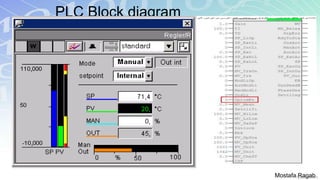
PLC Block diagram
Mostafa Ragab

Proportional integral and derivative PID controller

  • 1.
    The Classical Three-TermController PID Controller https://en.wikipedia.org/wiki/PID_controller#Origins1922 Mostafa Ragab
  • 2.
    Transfer function Negative feedback C(s)/R(s)=G(s)/(1+G(s)H(s)) Mostafa Ragab
  • 3.
    Transfer function Positive feedback C(s)/R(s)=G(s)/(1-G(s)H(s)) + Mostafa Ragab
  • 4.
    Negative vs. PositiveFeedback • It turns out that negative feedback is almost always the most useful type of feedback. When we subtract the value of the output from the value of the input (our desired value), we get a value called the error signal. The error signal shows us how far off our output is from our desired input. • Positive feedback has the property that signals tend to reinforce themselves, and grow larger. In a positive feedback system, noise from the system is added back to the input, and that in turn produces more noise. As an example of a positive feedback system, consider an audio amplification system with a speaker and a microphone. Placing the microphone near the speaker creates a positive feedback loop, and the result is a sound that grows louder and louder. Because the majority of noise in an electrical system is high-frequency, the sound output of the system becomes high-pitched. Mostafa Ragab
  • 5.
    What is feedbackand feedforward control system?  Feedback. • The output of the process is measured with the help of a sensor and the sensor value is given to the controller to take a proper controlling action. • Feedback: correcting perturbations after the fact • Controller takes control action only after the process variables and disturbance effects the process and the control action is also given to the process directly. For example a thermostat will counteract a drop in temperature by switching on the heating. Mostafa Ragab
  • 6.
    FeedForward FF • Afeed forward system will proactively turn on the furnace to prevent system change. For example, Feedforward control might be applied to the thermostatically controlled room by installing a temperature sensor outside of the room, which would warn the thermostat about a drop in the outside temperature, so that it could start heating before this would affect the inside temperature. Mostafa Ragab
  • 7.
    Combination between feedback andfeed forward Mostafa Ragab
  • 8.
    Rationale (Physical Sense) 4 How to determine the control action?  based on the error (the difference between the set-point and the actual output value)  PID = Proportional + Integral + Derivative  Proportional mode reacts to the present error  Integral mode reacts to the past history of the error signal  Derivative mode reacts to the expected future of the error signal (rate) RTECS Mostafa Ragab
  • 9.
    Block Diagram 6  PID= Proportional + Integral + Derivative  Also known as: Three-termcontroller Kp Ki ()dt d() Kd dt + P I D e(t) u(t) Kp Ki s Kd s P I D E(s) U(s) + RTECS Mostafa Ragab
  • 10.
    PID Time DomainRepresentation 7      dtT dt d t i dp de(t)  e(t)dt T K p e(t)   de(t)t u(t)  K e(t) K e(t)dt K 0 i 0 1 p d i i KK T  Kd where T  K p , proportional gain integral gain derivativegain derivative timeconstantintegral timeconstant RTECS Mostafa Ragab
  • 11.
    Steady state errorequation Mostafa Ragab
  • 12.
    Proportional control + r(t) u(t) G(s) K H(s) c(t)e(t) - Controlaction:- u(t)=Ke(t) Effect on Steady State Response:- Reduces the steady state error Effect on Transient Response:- Increases the speed of response. Limitations and shortcomings:- Saturation, noise andinstability. Hence new control schemes (PI, PD) are conceived. P control Mostafa Ragab
  • 13.
    Proportional and Integral(PI) control r(t) + u(t) K G(s) H(s) KI/s c(t)e(t) - + + Control action:- u(t)=Ke(t)+KI∫e(t)dt U(s)=(K+ KI/s)E(s) where KI=1/TI , TI=Integral or reset time Effect on Steady State Response:- steady state error can be reduced to zero exactly. Effect on Transient Response:-Increases peak overshoot & reducesthe speed of response. Limitations and shortcomings:- Reduces the stability margin of the system. Mostafa Ragab
  • 14.
    Proportional and Derivative(PD) control r(t) + u(t) K G(s) H(s) sKD c(t)e(t) - + + Control action:- u(t)=Ke(t)+KD(de/dt) U(s)=(K+ sKD)E(s) where KD=KcTD , TD=Derivative or rate time. Effect on Steady State Response:-Almost no effect. Effect on Transient Response:-Decreases the peak overshootby improving the effective damping of thesystem. Limitations and shortcomings:-Amplifies the high frequencynoise signals. Mostafa Ragab
  • 15.
    Proportional ,Integral &Derivative (PID) control the transient andControl action:-By proper adjustment of K,KD,KI dynamic responses are properlyshaped. Problems:-Tuning of PID controller is a difficultjob. + r(t) u(t) G(s) H(s) c(t)e(t) - + + + Mostafa Ragab
  • 16.
  • 17.
    (Physical Sense) 15  Theamount of correction applied to the system should be directly proportional to the error.  As the gain increases (Kp), the applied correction to the Process becomes more aggressive RTECS Mostafa Ragab
  • 18.
    Advantages 16  Immediate correctiveaction, Minimize rise time.  Simple to implement. RTECS Mostafa Ragab
  • 19.
    Disadvantages 17  It leavesa steady state error in some cases (when the error is zero action is zero steady state error reproduced)  Proportional controllers also increases the maximum overshoot of the system  High values of proportional gain reduces the stability of the system which can lead to oscillation. RTECS Mostafa Ragab
  • 20.
  • 21.
    (Physical Sense)  Unlikeproportional control, which looks at the present error, integral control looks at past errors.  it looks at the history of the error signal. RTECS Mostafa Ragab
  • 22.
    Advantages  Main advantageis steady state error elimination.  Smooth movement of output. RTECS Mostafa Ragab
  • 23.
    Disadvantages  unstable becauseit responds slowly towards the produced error  More oscillatory response & overshoot  Can cause serious overshoots the system response becomes more oscillatory RTECS Mostafa Ragab
  • 24.
  • 25.
    (Physical Sense) 37  Expectedfuture of the error signal While the proportional control reacts only to the present error and the integral control reacts to the past history of the error signal the derivative control reacts to the expected future of the error signal.  Tendency of the error signal It uses the present and past errors to forecast/ anticipate the future behaviour of the error signal and reacts according to the tendency of the error signal with the appropriate action RTECS Mostafa Ragab
  • 26.
    Rationale (Physical Sense) 38 Avoiding overshoot if the error is decreasing too fast that means that the current control action is very high so it needs to be decreased substantially to avoid overshoots in the system.  Braking system derivative action is against other actions like the proportional or the integral actions, so the derivative action acts as a braking system for the response. RTECS Mostafa Ragab
  • 27.
    Advantages 40  Reduces systemoscillations Main advantage: reduces system oscillations by braking the response (braking here will not slow the system, it will increase the rise time … On the other hand reducing oscillations will reduce the settling time)  It improves the transient response of the system. RTECS Mostafa Ragab
  • 28.
    Disadvantages 42 The derivative actionamplifies noise RTECS Mostafa Ragab
  • 29.
  • 30.
    Closed-loop Response 52 Risetime Maximum overshoot Settling time Steady-state error P Decrease Increase Small change Decrease I Decrease Increase Increase Eliminate D Small change Decrease Decrease No Change Mostafa Ragab
  • 31.
    Controller Effects 53  Proportionalcontroller (P)  reduces error responses to disturbances,  speeds up the process response  but still allows a steady-state error.  Integral controller (I)  When the controller includes a term proportional to the integral of the error (I), then the steady state error to a constant input is eliminated,  Derivative controller (D)  typically makes the system better damped and more stable. PID Video Mostafa Ragab
  • 32.
    Variations of PIDController Mostafa Ragab
  • 33.
    Variations of PIDController 63  P  P+D (Lead) Compensation  P+I (Lag) Compensation Is generally adequate when plant/process dynamics are essentially of 1st-order  P+I+D (Lead-Lag) Compensation Is generally ok if dominant plant dynamics are of 2nd-order RTECS Mostafa Ragab
  • 34.
    Combinations pros and cons Advantages: I. Proportional ( P ) : Speed controlled ( Increase gain) II. Proportional - Integrated ( PI ) : Good damping, No steady state error III. Proportional - Differential ( PD ) : Maximum overshoot, decreases Rise time, settling time is reduced , Bandwidth is increased. IV. Proportional - Integrated - Differential ( PID ) : Decreases rise time (Kp), Eliminates steady state error (Ki), Decreases overshoot and settling time ( Kd).  Disadvantages: I. Proportional ( P ) : Steady state error. II. Proportional - Integrated ( PI ) : Slow Response, Stability III. Proportional - Differential ( PD ) : Steady state error Mostafa Ragab
  • 35.
    Design Guidelines 66  Liquidlevel  Integrating process  Use P or PI controller with high gain  D-mode is not suitable since level signal is usually noisy due to the splashing and turbulence of the liquid entering the tank  Flow control  Use PI controller with intermediate gain  No D-mode because of high frequency noise  Fast response, no time delay RTECS Mostafa Ragab
  • 36.
    Design Guidelines 67  Temperature Various characteristics with time delay.  Use PID or PI controller  (D-mode can accelerate the response) RTECS Mostafa Ragab
  • 37.
    General Tips forDesigning a PID Controller 54 1. Obtain an open-loop response and determine what needs tobe improved 2. Add a proportional control to improve the rise time 3. Add an integral control to eliminate the steady-stateerror 4. Add a derivative control to improve the overshoot 5. Adjust each of Kp, Ki, and Kd until you obtain a desired overall response Mostafa Ragab
  • 38.