
Network Analysis
Duality & Dual Networks
By
Dr. K Hussain
Associate Professor & Head
Dept. of EE, SITCOE
The duality principle asserts a parallelism between pairs of
characterizing equations and theorems of electric circuits.
The concept of duality is a time-saving, effort-effective measure of
solving circuit problems.
The two equations are the same, except that we must interchange
the following quantities: (1) voltage and current, (2) resistance
and conductance, (3) capacitance and inductance.
Thus, it sometimes occurs in circuit analysis that two different
circuits have the same equations and solutions, except that the
roles of certain complementary elements are interchanged. This
interchangeability is known as the principle of duality.
Duality
TABLE Dual Pairs
Resistance R Conductance G
Inductance L Capacitance C
Voltage V Current i
Voltage source Current source
Node Mesh
Series path Parallel path
Open circuit Short circuit
KVL KCL
Thevenin Norton
The usefulness of the duality principle is self-evident. Once we
know the solution to one circuit, we automatically have the
solution for the dual circuit.
To find the dual of a given circuit, we do not need to write down
the mesh or node equations.
We can use a graphical technique.
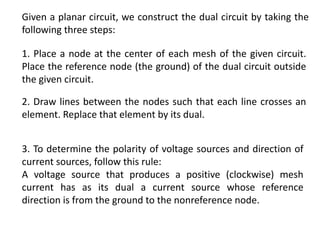
Given a planar circuit, we construct the dual circuit by taking the
following three steps:
1. Place a node at the center of each mesh of the given circuit.
Place the reference node (the ground) of the dual circuit outside
the given circuit.
2. Draw lines between the nodes such that each line crosses an
element. Replace that element by its dual.
3. To determine the polarity of voltage sources and direction of
current sources, follow this rule:
A voltage source that produces a positive (clockwise) mesh
current has as its dual a current source whose reference
direction is from the ground to the nonreference node.
In case of doubt, one may verify the dual circuit by writing the nodal or mesh
equations.
The mesh (or nodal) equations of the original circuit are similar to the nodal (or
mesh) equations of the dual circuit.
The duality principle is illustrated with the following two examples.
Example 1: Construct the dual of the circuit in Fig.(a)
Solution:
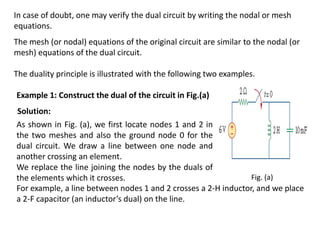
As shown in Fig. (a), we first locate nodes 1 and 2 in
the two meshes and also the ground node 0 for the
dual circuit. We draw a line between one node and
another crossing an element.
We replace the line joining the nodes by the duals of
the elements which it crosses.
For example, a line between nodes 1 and 2 crosses a 2-H inductor, and we place
a 2-F capacitor (an inductor’s dual) on the line.
Fig. (a)
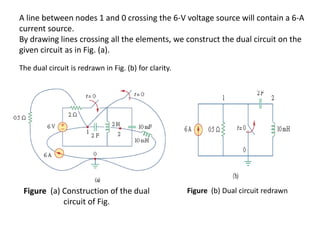
A line between nodes 1 and 0 crossing the 6-V voltage source will contain a 6-A
current source.
By drawing lines crossing all the elements, we construct the dual circuit on the
given circuit as in Fig. (a).
The dual circuit is redrawn in Fig. (b) for clarity.
Figure (a) Construction of the dual
circuit of Fig.
Figure (b) Dual circuit redrawn
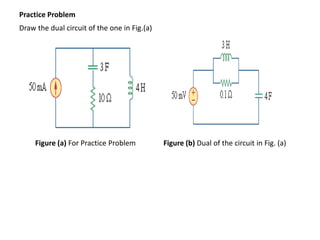
Practice Problem
Draw the dual circuit of the one in Fig.(a)
Figure (a) For Practice Problem Figure (b) Dual of the circuit in Fig. (a)
Example 2: Obtain the dual of the circuit in Fig.
Solution:
The dual circuit is constructed on the
original circuit as in Fig.
We first locate nodes 1 to 3 and the reference node 0. Joining nodes 1 and 2, we
cross the 2-F capacitor, which is replaced by a 2-H inductor.
Joining nodes 2 and 3, we cross the resistor, which is replaced by a resistor. We keep
doing this until all the elements are crossed.
The result is in Fig. (a). The dual circuit is redrawn in Fig. (b).
Figure For Example: (a) construction of the dual circuit of Fig. (b) dual circuit redrawn.
To verify the polarity of the voltage source and the direction of the current source,
we may apply mesh currents and (all in the clockwise direction) in the original circuit
in Fig.
The 10-V voltage source produces positive mesh current so that its dual is a 10-A
current source directed from 0 to 1. Also, in Fig. has as its dual v3 3 V in Fig. (b).
Practice Problem
For the circuit in Fig., obtain the dual circuit.
Figure (a) For Practice Problem Figure (b) Dual of the circuit in Fig. (a)
THANK YOU

NA-Duality& Dual Networks.pptx

  • 1.
    Network Analysis Duality &Dual Networks By Dr. K Hussain Associate Professor & Head Dept. of EE, SITCOE
  • 2.
    The duality principleasserts a parallelism between pairs of characterizing equations and theorems of electric circuits. The concept of duality is a time-saving, effort-effective measure of solving circuit problems. The two equations are the same, except that we must interchange the following quantities: (1) voltage and current, (2) resistance and conductance, (3) capacitance and inductance. Thus, it sometimes occurs in circuit analysis that two different circuits have the same equations and solutions, except that the roles of certain complementary elements are interchanged. This interchangeability is known as the principle of duality. Duality
  • 3.
    TABLE Dual Pairs ResistanceR Conductance G Inductance L Capacitance C Voltage V Current i Voltage source Current source Node Mesh Series path Parallel path Open circuit Short circuit KVL KCL Thevenin Norton The usefulness of the duality principle is self-evident. Once we know the solution to one circuit, we automatically have the solution for the dual circuit. To find the dual of a given circuit, we do not need to write down the mesh or node equations. We can use a graphical technique.
  • 4.
    Given a planarcircuit, we construct the dual circuit by taking the following three steps: 1. Place a node at the center of each mesh of the given circuit. Place the reference node (the ground) of the dual circuit outside the given circuit. 2. Draw lines between the nodes such that each line crosses an element. Replace that element by its dual. 3. To determine the polarity of voltage sources and direction of current sources, follow this rule: A voltage source that produces a positive (clockwise) mesh current has as its dual a current source whose reference direction is from the ground to the nonreference node.
  • 5.
    In case ofdoubt, one may verify the dual circuit by writing the nodal or mesh equations. The mesh (or nodal) equations of the original circuit are similar to the nodal (or mesh) equations of the dual circuit. The duality principle is illustrated with the following two examples. Example 1: Construct the dual of the circuit in Fig.(a) Solution: As shown in Fig. (a), we first locate nodes 1 and 2 in the two meshes and also the ground node 0 for the dual circuit. We draw a line between one node and another crossing an element. We replace the line joining the nodes by the duals of the elements which it crosses. For example, a line between nodes 1 and 2 crosses a 2-H inductor, and we place a 2-F capacitor (an inductor’s dual) on the line. Fig. (a)
  • 6.
    A line betweennodes 1 and 0 crossing the 6-V voltage source will contain a 6-A current source. By drawing lines crossing all the elements, we construct the dual circuit on the given circuit as in Fig. (a). The dual circuit is redrawn in Fig. (b) for clarity. Figure (a) Construction of the dual circuit of Fig. Figure (b) Dual circuit redrawn
  • 7.
    Practice Problem Draw thedual circuit of the one in Fig.(a) Figure (a) For Practice Problem Figure (b) Dual of the circuit in Fig. (a)
  • 8.
    Example 2: Obtainthe dual of the circuit in Fig. Solution: The dual circuit is constructed on the original circuit as in Fig. We first locate nodes 1 to 3 and the reference node 0. Joining nodes 1 and 2, we cross the 2-F capacitor, which is replaced by a 2-H inductor. Joining nodes 2 and 3, we cross the resistor, which is replaced by a resistor. We keep doing this until all the elements are crossed. The result is in Fig. (a). The dual circuit is redrawn in Fig. (b).
  • 9.
    Figure For Example:(a) construction of the dual circuit of Fig. (b) dual circuit redrawn. To verify the polarity of the voltage source and the direction of the current source, we may apply mesh currents and (all in the clockwise direction) in the original circuit in Fig. The 10-V voltage source produces positive mesh current so that its dual is a 10-A current source directed from 0 to 1. Also, in Fig. has as its dual v3 3 V in Fig. (b).
  • 10.
    Practice Problem For thecircuit in Fig., obtain the dual circuit. Figure (a) For Practice Problem Figure (b) Dual of the circuit in Fig. (a)
  • 11.