CHAPTER-5
TWO PORT NETWORKS
by
Dr. K Hussain
Associate Professor & Head,
Dept. of EE, SITCOE
OBJECTIVES
• To understand about two – port networks and its
functions.
• To understand the different between z-
parameter, y-parameter, ABCD- parameter and
terminated two port networks.
• To investigate and analysis the behavior of two –
port networks.
Dr. K Hussain
TWO – PORT NETWORKS
• A pair of terminals through which a current may enter or leave a
network is known as a port.
• Two terminal devices or elements (such as resistors, capacitors,
and inductors) results in one – port network.
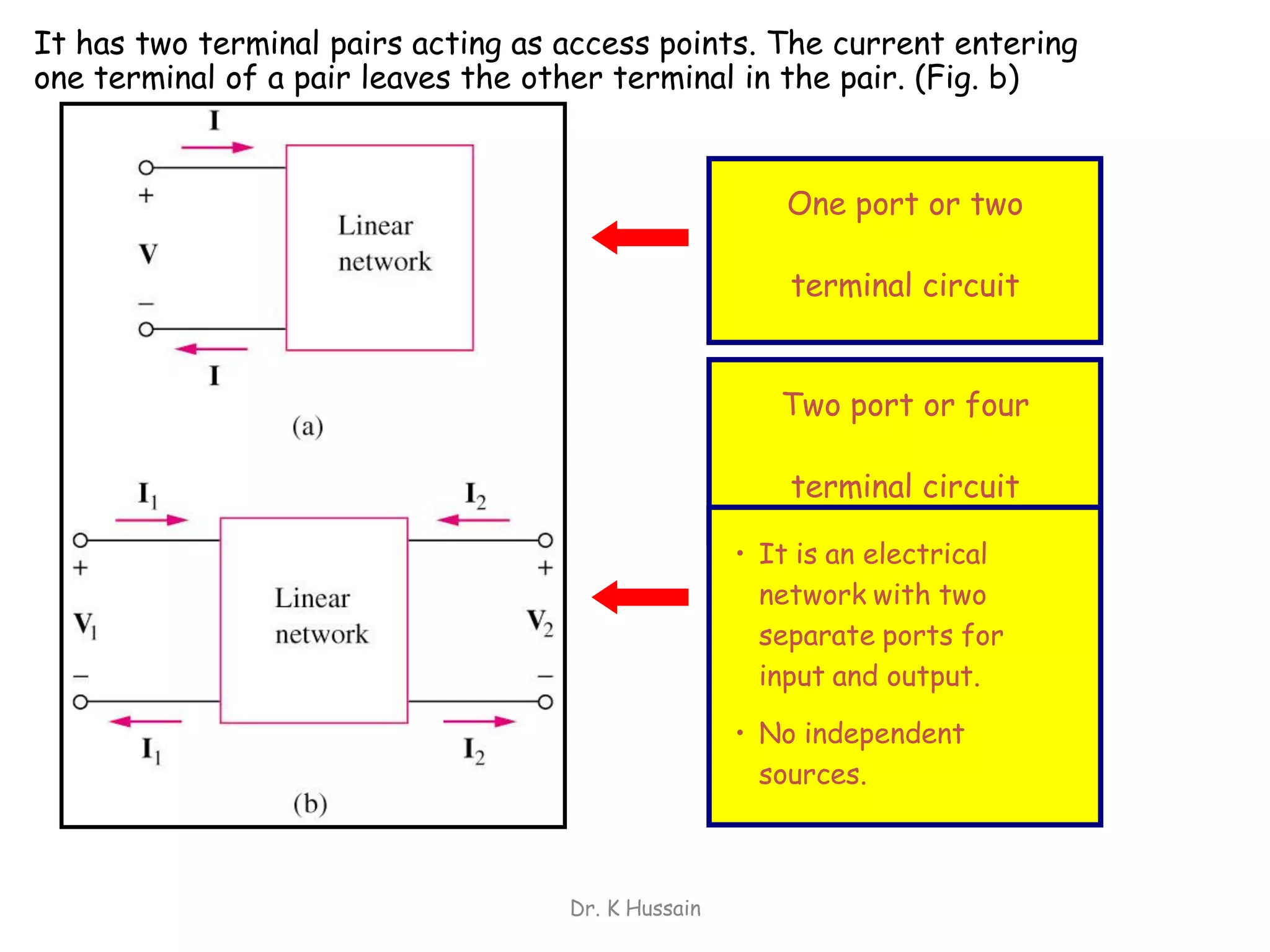
• Most of the circuits we have dealt with so far are two – terminal
or one –port circuits. (Fig. a)
• A two – port network is an electrical network with two separate
ports for input and output.
Dr. K Hussain
Dr. K Hussain
One port or two
terminal circuit
Two port or four
terminal circuit
• It is an electrical
network with two
separate ports for
input and output.
• No independent
sources.
It has two terminal pairs acting as access points. The current entering
one terminal of a pair leaves the other terminal in the pair. (Fig. b)
Z – PARAMETER
• Z – parameter also called as impedance parameter and the unit is
ohm (Ω)
• The “black box” is replace with Z-parameter is as shown below.
Dr. K Hussain
+
V1
-
I1
I2
+
V2
-
Z11
Z21
Z12
Z22
2221212
2121111
IzIzV
IzIzV


  























2
1
2
1
2221
1211
2
1
I
I
z
I
I
zz
zz
V
V
where the z terms are called the impedance parameters, or
simply z parameters, and have units of ohms.
Dr. K Hussain
z11 = Open-circuit input impedance
z21 = Open-circuit transfer
impedance from port 1 to port 2
z12 = Open-circuit transfer
impedance from port 2 to port 1
z22 = Open-circuit output
impedance
0I1
2
21
0I1
1
11
22
I
V
zand
I
V
z


0I2
2
22
0I2
1
12
11
I
V
zand
I
V
z


Example 1
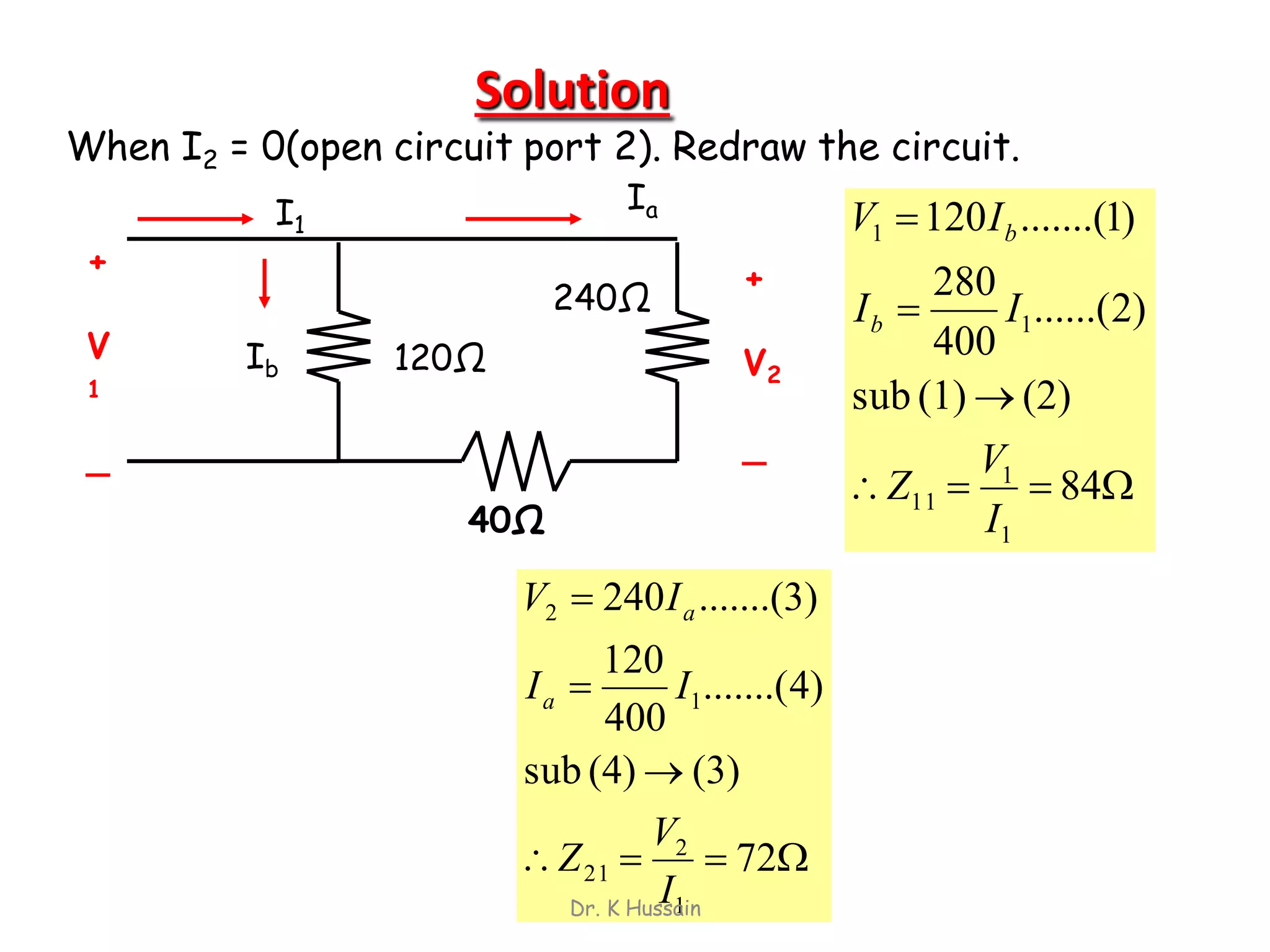
Q. Find the Z – parameter of the circuit below.
40Ω
240Ω
120Ω
+
V1
_
+
V2
_
I1
I2
Dr. K Hussain
Solution
40Ω
240Ω
120Ω
+
V
1
_
+
V2
_
I1
Ia
Ib
When I2 = 0(open circuit port 2). Redraw the circuit.




84
(2)(1)sub
)2......(
400
280
)1.......(120
1
1
11
1
1
I
V
Z
II
IV
b
b




72
(3)(4)sub
)4.......(
400
120
.......(3)240
1
2
21
1
2
I
V
Z
II
IV
a
a
Dr. K Hussain
40Ω
240Ω
120Ω
+
V1
_
+
V2
_
Iy I2
Ix
When I1 = 0 (open circuit port 1). Redraw the circuit.




96Z
(2)(1)sub
)2.......(
400
160
)1.......(240
2
2
22
2
2
I
V
II
IV
x
x




72
(3)(4)sub
)4.......(
400
240
)3.......(120
2
1
12
2
1
I
V
Z
II
IV
y
y
  






9672
7284
ZIn matrix form:
Dr. K Hussain
Y - PARAMETER
• Y – parameter also called admittance parameter and the unit is
Siemens (S).
• The “black box” that we want to replace with the Y-parameter is
shown below.
Dr. K Hussain
+
V1
-
I1
I2
+
V2
-
Y11
Y21
Y12
Y22
2221212
2121111
VyVyI
VyVyI


  























2
1
2
1
2221
1211
2
1
V
V
y
V
V
yy
yy
I
I
where the y terms are called the admittance parameters, or
simply y parameters, and they have units of Siemens.
Dr. K Hussain
0V2
2
22
0V2
1
12
11
V
I
yand
V
I
y


y11 = Short-circuit input
admittance
y21 = Short-circuit transfer
admittance from port 1 to port 2
y12 = Short-circuit transfer
admittance from port 2 to port 1
y22 = Short-circuit output
admittance
0V1
2
21
0V1
1
11
22
V
I
yand
V
I
y


Example 2
Q. Find the Y – parameter of the circuit shown below.
5Ω
15Ω20Ω
+
V1
_
+
V2
_
I1
I2
Dr. K Hussain
Solution
i) V2 = 0
5Ω
20Ω
+
V1
_
I1
I2
Ia S
V
I
Y
II
IV
a
a
4
1
(2)(1)sub
)2.......(
25
5
)1.......(20
1
1
11
1
1




S
V
I
Y
IV
5
1
5
1
2
21
21


Dr. K Hussain
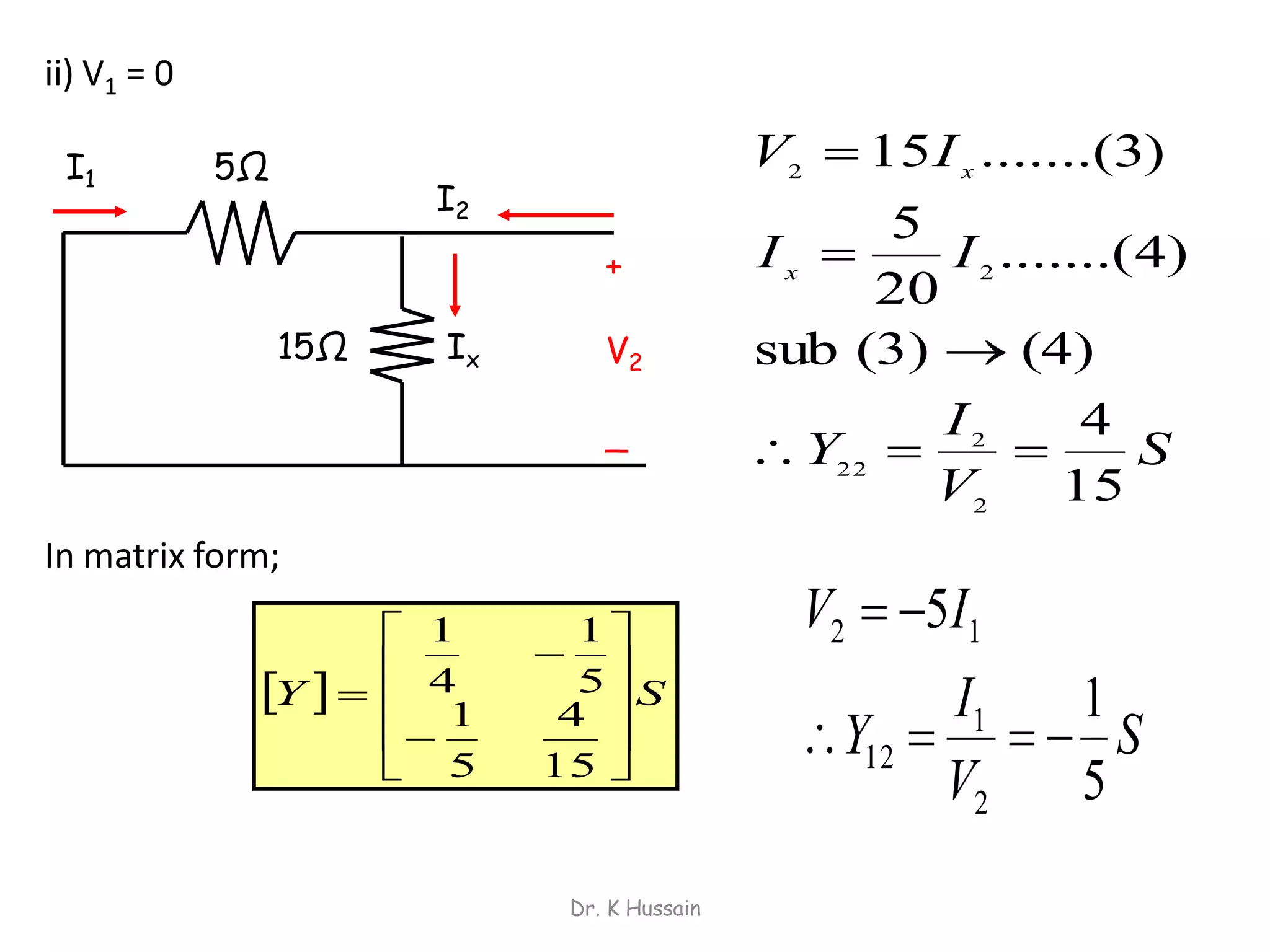
ii) V1 = 0
In matrix form;
5Ω
15Ω
+
V2
_
I1
I2
Ix
S
V
I
Y
II
IV
x
x
15
4
(4)(3)sub
)4.......(
20
5
)3.......(15
2
2
22
2
2




S
V
I
Y
IV
5
1
5
2
1
12
12


  SY













15
4
5
1
5
1
4
1
Dr. K Hussain
T (ABCD) PARAMETER
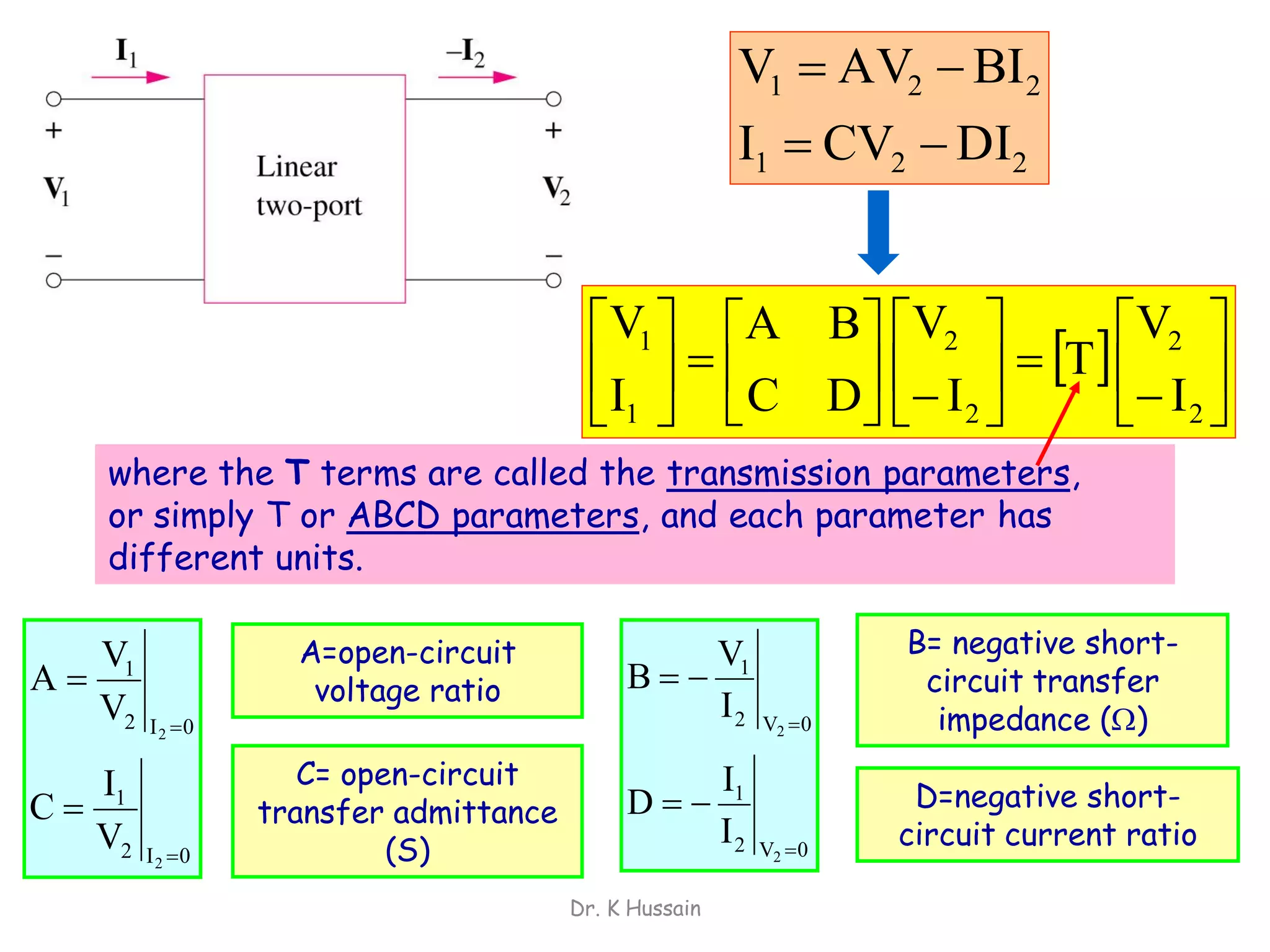
• T – parameter or also ABCD – parameter is a another set of
parameters relates the variables at the input port to those at
the output port.
• T – parameter also called transmission parameters because
this parameter are useful in the analysis of transmission lines
because they express sending – end variables (V1 and I1) in
terms of the receiving – end variables (V2 and -I2).
• The “black box” that we want to replace with T – parameter
is as shown below.
Dr. K Hussain
+
V1
-
I1
I2
+
V2
-
A11
C21
B12
D22
Dr. K Hussain
221
221
DICVI
BIAVV


  
























2
2
2
2
1
1
I
V
T
I
V
DC
BA
I
V
where the T terms are called the transmission parameters,
or simply T or ABCD parameters, and each parameter has
different units.
0I2
1
0I2
1
2
2
V
I
C
V
V
A




0V2
1
0V2
1
2
2
I
I
D
I
V
B




A=open-circuit
voltage ratio
C= open-circuit
transfer admittance
(S)
B= negative short-
circuit transfer
impedance ()
D=negative short-
circuit current ratio
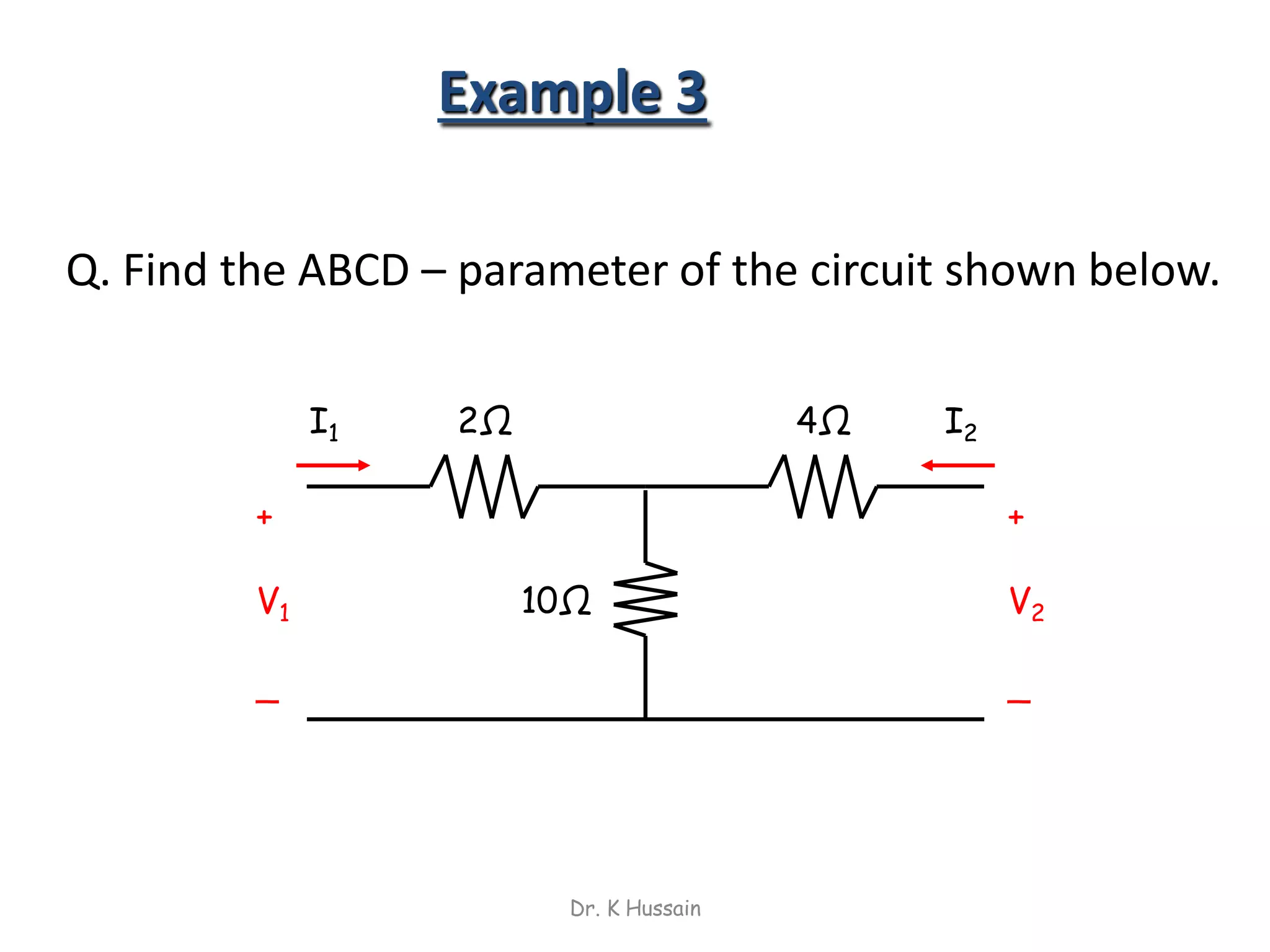
Example 3
Q. Find the ABCD – parameter of the circuit shown below.
2Ω
10Ω
+
V2
_
I1 I2
+
V1
_
4Ω
Dr. K Hussain
Solution
i) I2 = 0,
2Ω
10Ω
+
V2
_
I1
+
V1
_
2.1
5
6
10
2
2
1.0
10
2
1
22
2
1
211
2
1
12











V
V
A
VV
V
V
VIV
S
V
I
C
IV
Dr. K Hussain
ii) V2 = 0,
 












8.6
10
10
14
12
1012
102
4.1
14
10
2
1
221
211
2111
2
1
12
I
V
B
IIV
IIV
IIIV
I
I
D
II
2Ω
10Ω
I1 I2
+
V1
_
4Ω
I1 + I2
  




 

4.11.0
8.62.1
S
T
In matrix form;
Dr. K Hussain
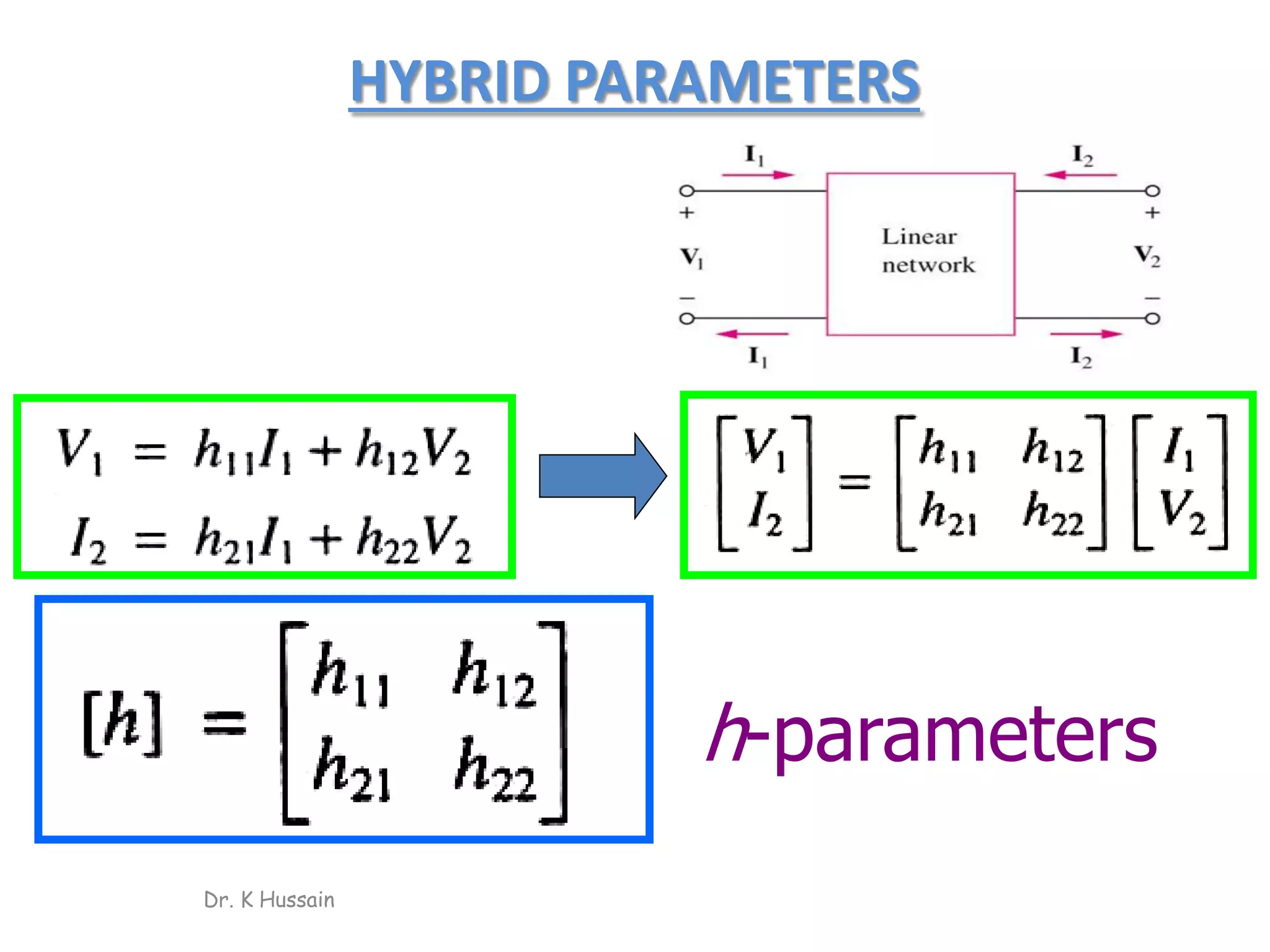
HYBRID PARAMETERS
Dr. K Hussain
h-parameters
Dr. K Hussain
1. Input impedance with output short-circuited
2
1
11
1 0V
V
h
I 
 
2. Reverse voltage gain with input open-circuited
1
1
12
2 0I
V
h
V 

Dr. K Hussain
3. Forward current gain with output short-circuited
2
2
21
1 0V
I
h
I 

4. Output admittance with input open-circuited
1
2
22
2 0
S
V
I
h
V 

• Note that the four h-parameters have mixed
dimensions.
• This is the reason why these parameters are called
hybrid parameters.
• Using h-parameter equivalent circuit for a transistor
proves beneficial in two ways.
• Firstly, the measurement of these parameters for a
transistor is quite easy.
• Secondly, the analysis of the transistor amplifier
becomes much simpler.
Dr. K Hussain
Dr. K Hussain
Example: Find the hybrid parameters for the two-port network of Fig.
To find h11 and h21, we short-circuit the
output port and connect a current
source I1 to the input port as shown in
Fig.(a). From Fig.(a),
Also, from Fig. (a) we obtain, by current division,
Solution:
Dr. K Hussain
To obtain h12 and h22, we open-circuit the input port and connect a
voltage source V2 to the output port as in Fig. (b). By voltage division,
RELATIONSHIPS BETWEEN PARAMETERS
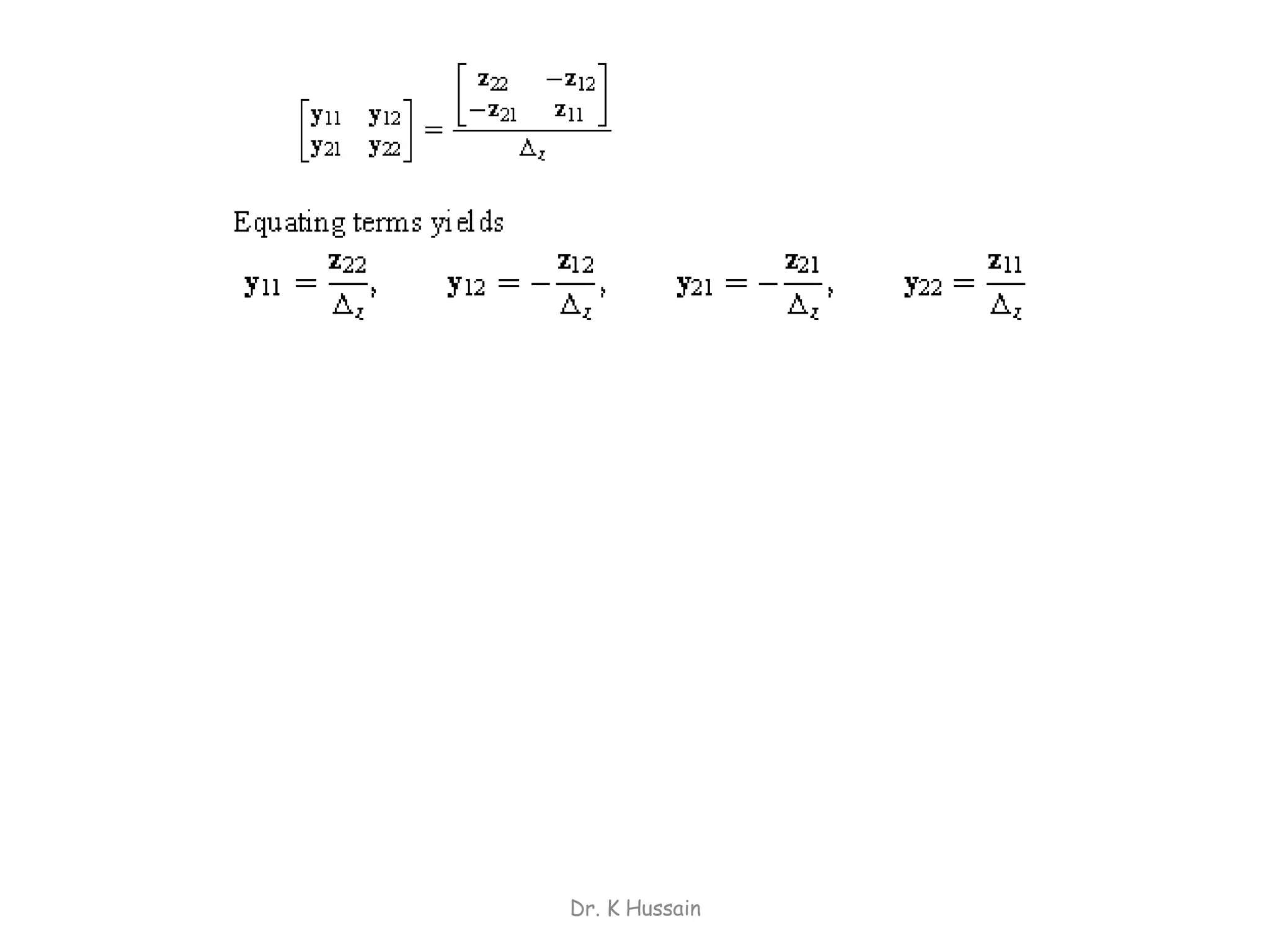
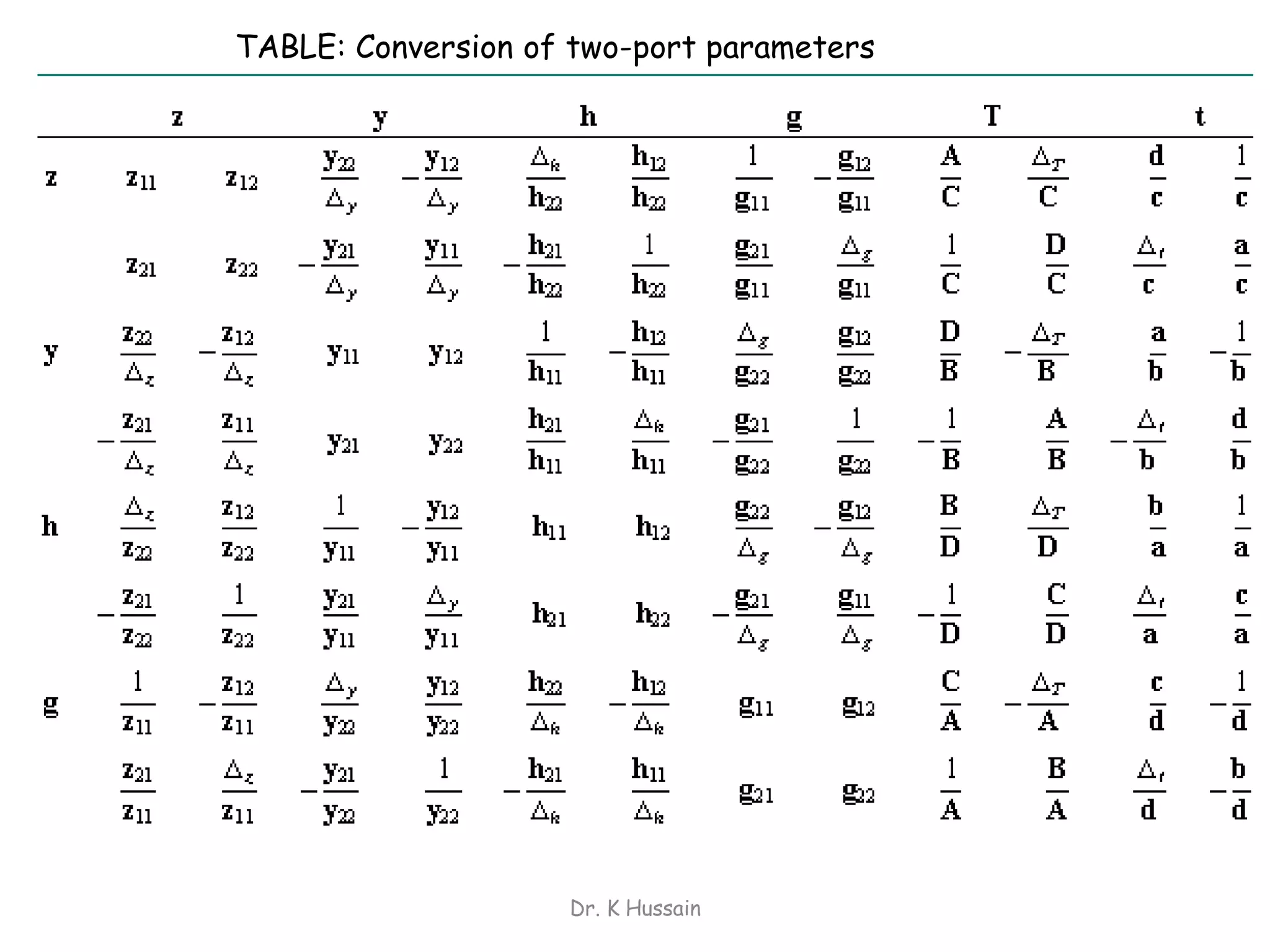
• Since the six sets of parameters relate the same input and output terminal
variables of the same two-port network, they should be interrelated.
Dr. K Hussain
Q. Determine the y-Parameters in terms of z-Parameters.
Dr. K Hussain
Dr. K Hussain
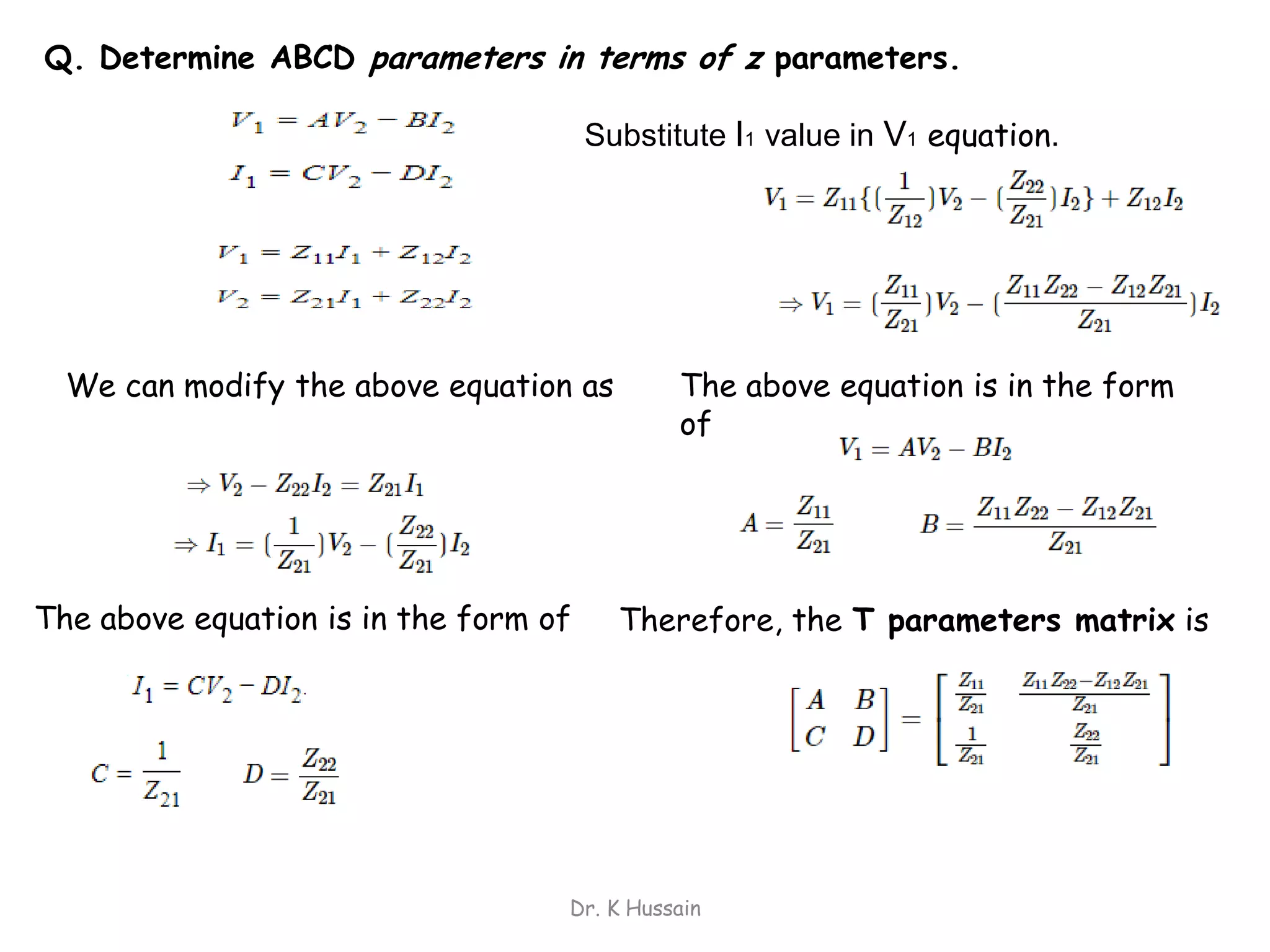
Q. Determine ABCD parameters in terms of z parameters.
The above equation is in the form
of
We can modify the above equation as
The above equation is in the form of
Substitute I1 value in V1 equation.
Therefore, the T parameters matrix is
Dr. K Hussain
Q. Determine the h parameters in terms of z parameters.
Making I2 the subject of Eq.
Substituting this into Eq.
Putting Eqs. (V1) and (I2) in matrix form
Comparing this with Eq., we obtain
Dr. K Hussain
TABLE: Conversion of two-port parameters
Dr. K Hussain
Dr. K Hussain
Exercise1: Determine z, y & ABCD parameters from h-parameters.
Exercise2: Determine z, ABCD & h parameters from y-parameters.
Exercise3: Determine z, y & h parameters from ABCD-parameters.
Exercise 4: Find out condition of symmetry and reciprocity?
Conditions for Symmetry & Reciprocity
Dr. K Hussain
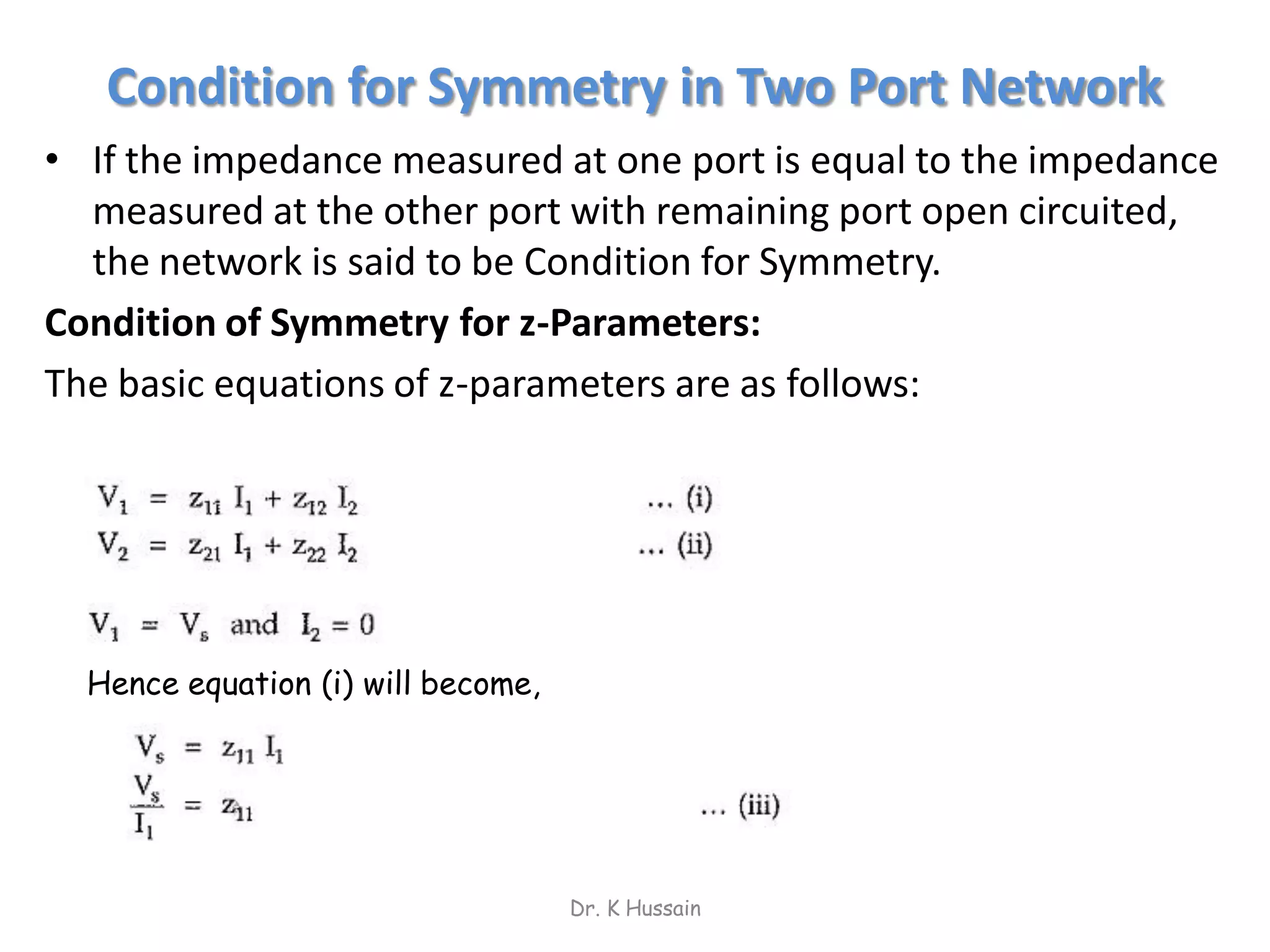
Condition for Symmetry in Two Port Network
• If the impedance measured at one port is equal to the impedance
measured at the other port with remaining port open circuited,
the network is said to be Condition for Symmetry.
Condition of Symmetry for z-Parameters:
The basic equations of z-parameters are as follows:
Dr. K Hussain
Hence equation (i) will become,
Equation (ii) can be written as,
Dr. K Hussain
For symmetrical networks, both the port impedances must be equal i.e.,
Condition of Symmetry for z-Parameters ..Contd..
Dr. K Hussain
Condition of Symmetry for Y-Parameters
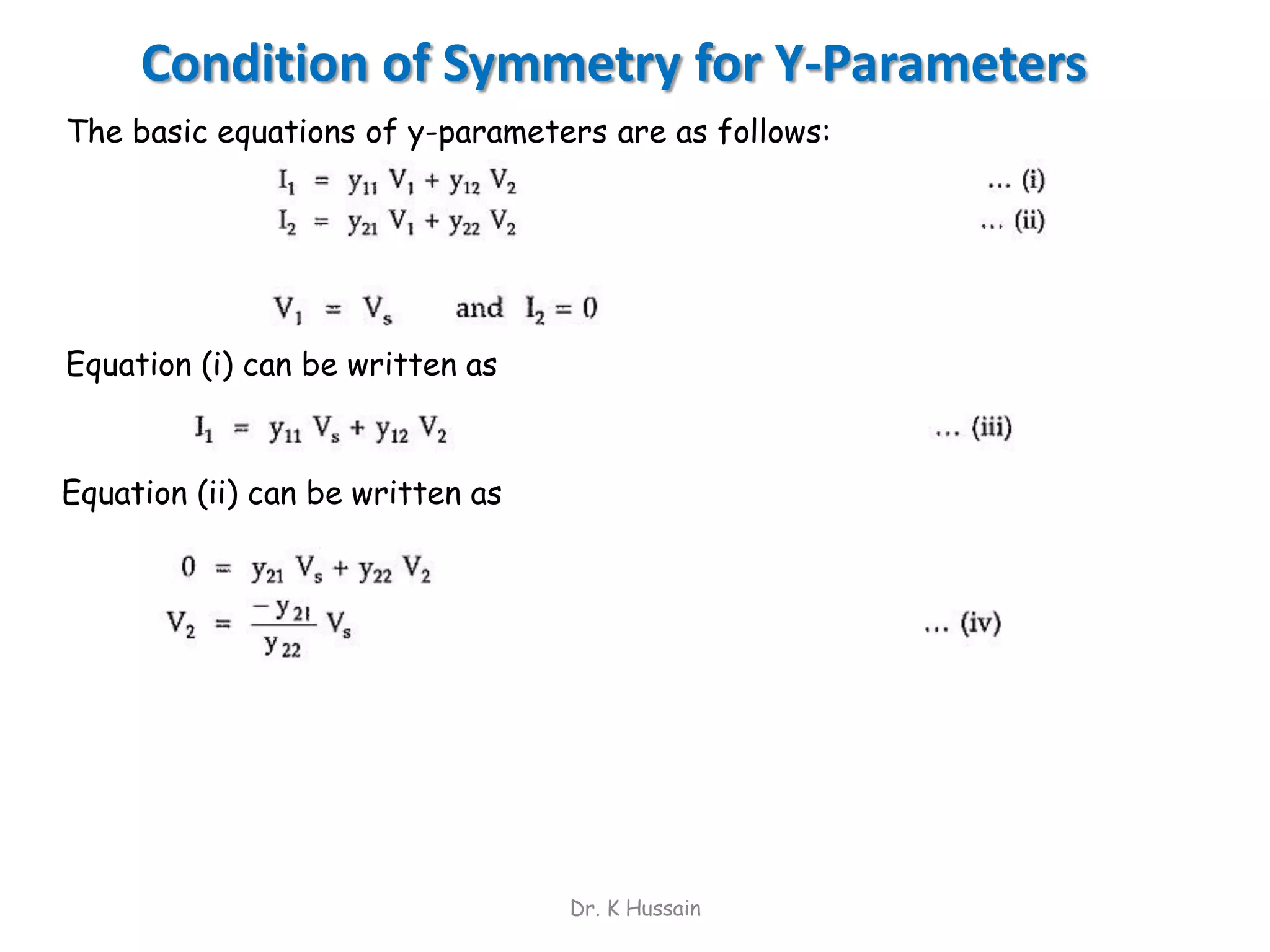
The basic equations of y-parameters are as follows:
Equation (i) can be written as
Equation (ii) can be written as
Dr. K Hussain
Equation (ii) can be written as,
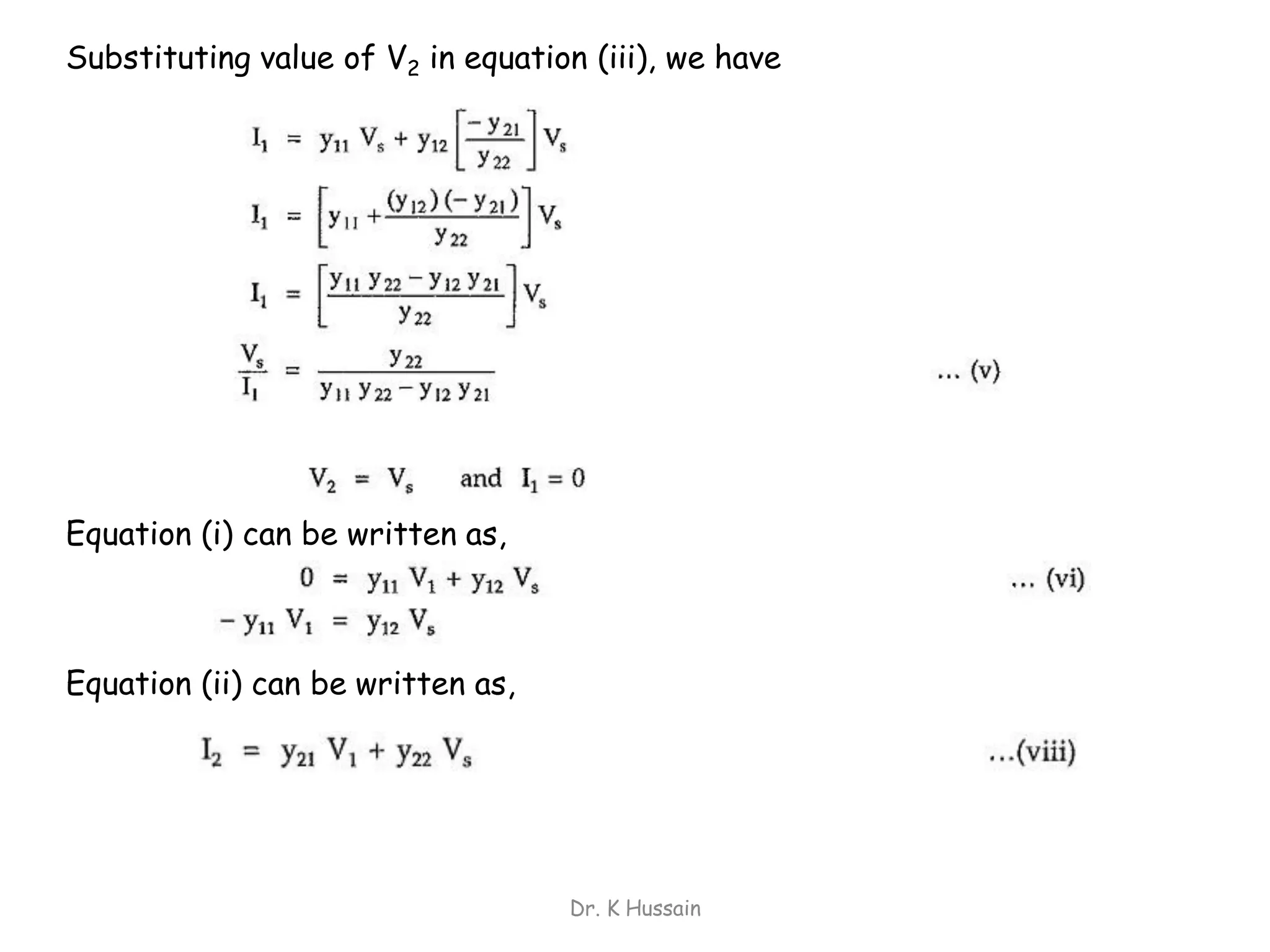
Substituting value of V2 in equation (iii), we have
Equation (i) can be written as,
Dr. K Hussain
For symmetrical networks, both the port impedances must be equal i.e.,
Substituting value of V1 in equation (viii) from equation (vii), we have
Dr. K Hussain
Condition of Symmetry for Transmission Parameters
The basic equations for the transmission parameters are as following
Equation (ii) can be written as,
Equation (i) can be written as,
Case (i)
Dr. K Hussain
For the symmetrical network, both the port impedances must be equal.
Equation (ii) can be written as,
Equation (i) can be written as,
Case (ii)
Dr. K Hussain
Conditions of Symmetry for h-Parameters
The basic equations of h-parameters are as follows,
Equation (ii) can be written as
Equation (i) can be written as,
Case (i):
Dr. K Hussain
Substituting value of V2 in equation (iii), we have
Equation (i) can be written as
Equation (ii) can be written as
For symmetrical networks, both the port impedances must be equal i.e.,
Case (ii):
Dr. K Hussain
Additional Topics
Dr. K Hussain
INTERCONNECTION OF NETWORKS
A large, complex network may be divided into subnetworks for the
purposes of analysis and design. The subnetworks are modeled as
two-port networks, interconnected to form the original network.
The two-port networks may therefore be regarded as building
blocks that can be interconnected to form a complex network. The
interconnection can be in series, in parallel, or in cascade. Although
the interconnected network can be described by any of the six
parameter sets, a certain set of parameters may have a definite
advantage.
For ex:
when the networks are in series, their individual z parameters add up
to give the z parameters of the larger network.
When they are in parallel, their individual y parameters add up to
give the y parameters the larger network.
When they are cascaded, their individual transmission parameters
can be multiplied together to get the transmission parameters of
the larger network.
Dr. K Hussain
Consider the series connection of two-port networks shown in Fig. 1. The
networks are regarded as being in series because their input currents are the
same and their voltages add.
For network Na,
For network Nb,
SERIES CONNECTION OF TWO-PORT NETWORKS
It is showing that the z parameters for the overall network are the sum of the
z parameters for the individual networks.
Fig. 1
In addition, each network has a common reference, and when the circuits are
placed in series, the common reference points of each circuit are connected
together.
Dr. K Hussain
Two two-port networks are in parallel when their port voltages are equal and
the port currents of the larger network are the sums of the individual port
currents. In addition, each circuit must have a common reference and when
the networks are connected together, they must all have their common
references tied together. The parallel connection of two two-port networks is
shown in Fig. 2.
For the two networks
Thus, the y parameters for the overall network are
It is showing that the y parameters of the overall network are the sum of
the y parameters of the individual networks.
PARALLEL CONNECTION OF TWO-PORT NETWORKS
Fig. 2
Dr. K Hussain
The connection of two two-port networks in
cascade is shown in Fig 3.
For the two networks,
Substituting these into Eqs.
Thus, the transmission parameters for the overall network are the product
of the transmission parameters for the individual transmission parameters:
It is this property that makes the transmission parameters so useful.
Keep in mind that the multiplication of the matrices must be in the order in
which the networks Na and Nb are cascaded.
CASCADE CONNECTION OF TWO-PORT NETWORKS
Fig. 3
ONE PORT NETWORK
• A port is combination of two terminals on the same side of
network. Thus a terminal pair is nothing but a port as shown in
fig .
• A network having only one terminal pair or port is called one
port network.
• One port network can be represented as below.
R
1I
1V
+
-
+
-

1I
1V
Dr. K Hussain
NETWORK FUNCTION FOR ONE PORT NETWORK
• Voltage and current for the one port linear network as shown
in fig.
• As there is one port , voltage and current measured at same
port. thus for one port network only driving function can be
defined as below.
DRIVING POINT IMPEDANCE FUNCTION:
• The ratio of laplace transform of voltage and current measured
at port under zero initial condition is called driving point
impedance function
• It is denoted by Z(s)
Z(s)=V(s)/I(s)
Dr. K Hussain
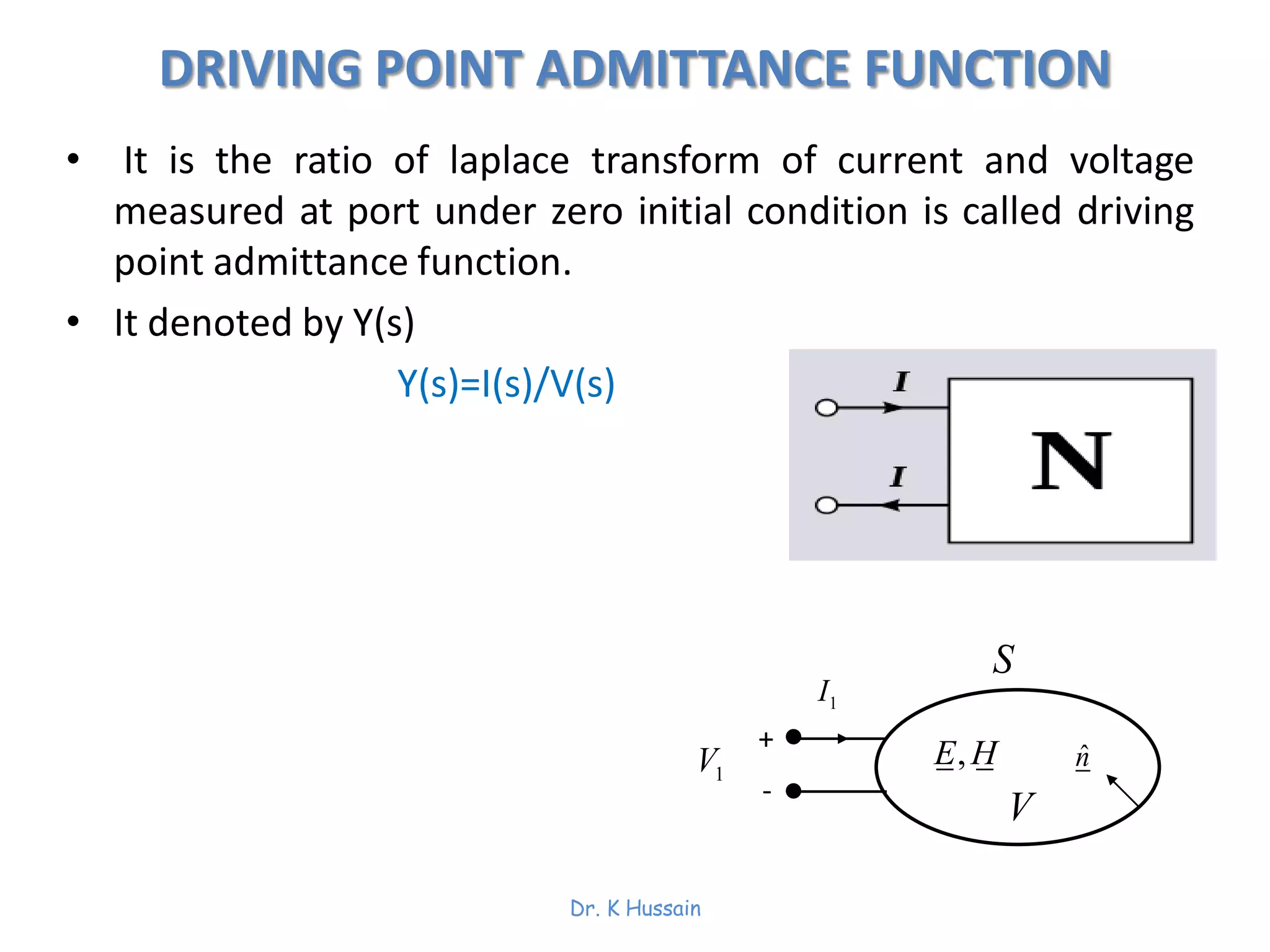
DRIVING POINT ADMITTANCE FUNCTION
• It is the ratio of laplace transform of current and voltage
measured at port under zero initial condition is called driving
point admittance function.
• It denoted by Y(s)
Y(s)=I(s)/V(s)
,E H ˆn
S
V
1V
1I
+
-
Dr. K Hussain
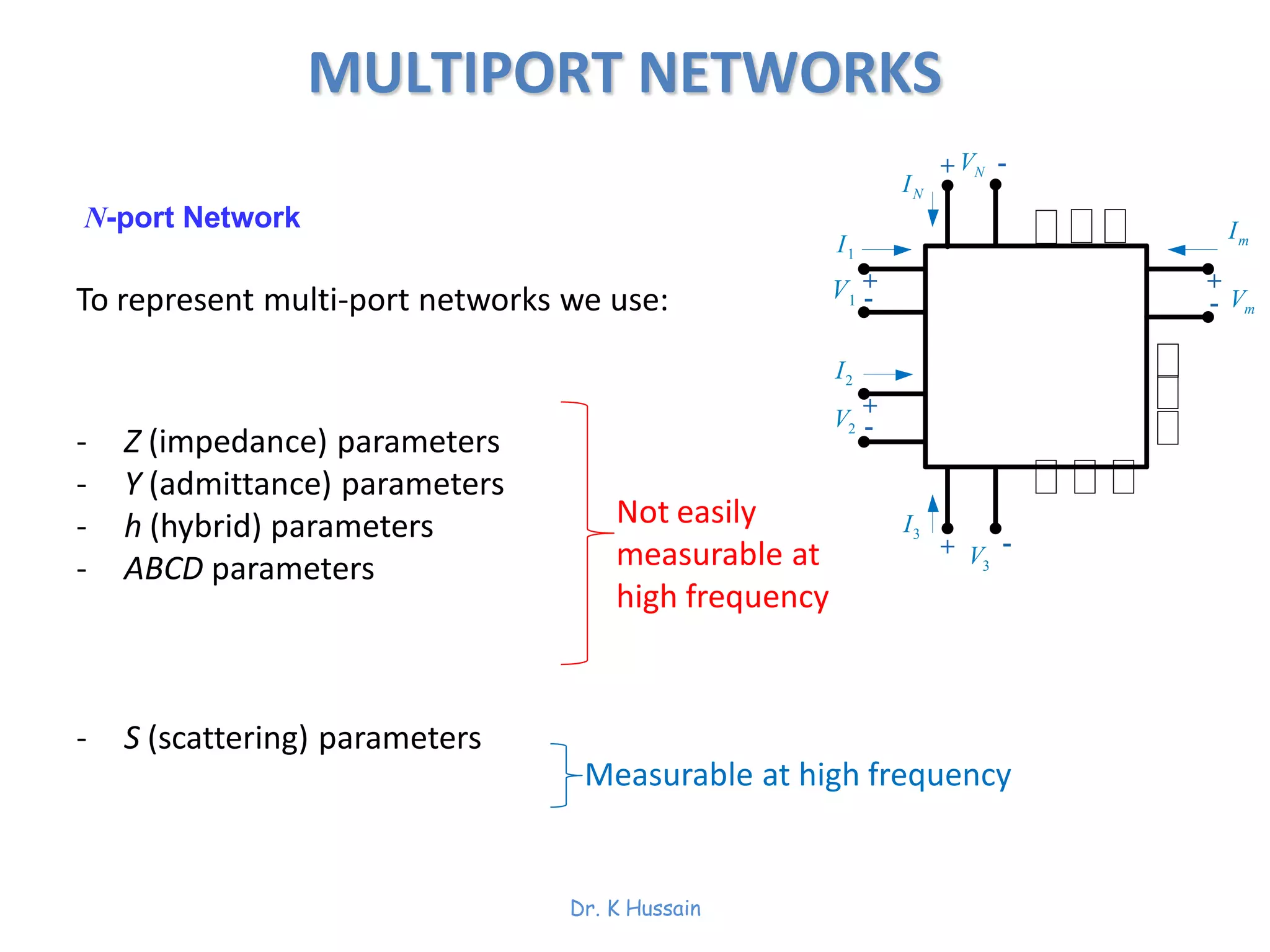
N-port Network
To represent multi-port networks we use:
- Z (impedance) parameters
- Y (admittance) parameters
- h (hybrid) parameters
- ABCD parameters
- S (scattering) parameters
Not easily
measurable at
high frequency
Measurable at high frequency
MULTIPORT NETWORKS
 




+
+
+
+
+
1I
2I
3I
mI
NI
1V
2V
3V
mV
NV
-
-
-
-
-
Dr. K Hussain
NETWORK FUNCTIONS FOR TWO-PORT NETWORK
• Consider a two port network with voltages and currents at ports
1-1’ and 2-2’ as V1(t), I1(t) and V2(t), I2(t) respectively as shown in
figure.
Dr. K Hussain
1
1’
2
2’
NETWORK FUNCTIONS FOR TWO-PORT NETWORKS
1. Driving Point Functions:
• Driving point impedance functions
• Driving point admittance functions
2. Transfer Functions:
• Voltage transfer functions
• Current transfer functions
• Transfer impedance functions
• Transfer admittance functions
Dr. K Hussain
DRIVING POINT FUNCTIONS
Driving Point Impedance Functions:
• The ratio of Laplace transform of voltage and current at port 1-1’
or 2-2’ is defined as driving point impedance function.
Two types of driving point impedance functions:
• At port 1-1’ denoted as Z11(s)
Z11(s)= V1(s)/I1(s)
• At port 2-2’ denoted as Z22(s)
Z22(s)= V2(s)/I2(s)
Dr. K Hussain
1
1’
2
2’
DRIVING POINT FUNCTIONS
Driving Point Admittance Functions:
• The ratio of Laplace transform of current and voltage at port 1-1’
or 2-2’ is defined as driving point admittance function.
Two types of driving point admittance functions:
• At port 1-1’ denoted as Y11(s)
Y11(s)=I1(s)/V1(s)
• At port 2-2’ denoted as Y11(s)
Y22(s)=I2(s)/V2(s)
Dr. K Hussain
1
1’
2
2’
TRANSFER FUNCTIONS
Voltage Transfer Function:
• It is defined as the ratio of Laplace transform of voltage at one
port and voltage at another port.
• It is denoted as G(s).
• G12(s) =V1(s)/V2(s)
and G21(s) =V2(s)/V1(s)
Current Transfer Function:
• It is defined as the ratio of Laplace transform of current at one
port and current at another port.
• It is denoted as (s).
• 12(s) = I1(s)/I2(s) and 21(s) =I2(s)/I1(s)
Dr. K Hussain
1
1’
2
2’
TRANSFER FUNCTIONS
Transfer Impedance Function:
• It is defined as the ratio of Laplace transform of voltage at one
port and current at another port.
Z12(s)=V1(s)/I2(s) and Z21(s)=V2(s)/I1(s)
Transfer Admittance Function:
• It is defined as the ratio of Laplace transform of current at one
port and voltage at another port.
Y12(s) =I1(s)/V2(s) and Y21(s) =I2(s)/V1(s)
Dr. K Hussain
Dr. K Hussain
CONCEPT OF POLES AND ZEROS
The transfer function provides a basis for determining important system
response characteristics without solving the complete differential equation.
As defined, the transfer function is a rational function in the complex
variable s = σ + jω, that is
It is often convenient to factor the polynomials in the numerator and
denominator, and to write the transfer function in terms of those factors:
where the numerator and denominator polynomials, N(s) and D(s), have real
coefficients defined by the system’s differential equation and K = bm/an.
As written in Eq. (2) the zi’s are the roots of the equation N(s) = 0, and are
defined to be the system zeros, and the pi’s are the roots of the equation
D(s) = 0, and are defined to be the system poles.
Dr. K Hussain
Together with the gain constant K they completely characterize the
differential equation, and provide a complete description of the system.
Example: A system has a pair of complex conjugate poles p1, p2 = −1j2, a single
real zero z1 = −4, and a gain factor K = 3. Find the differential equation
representing the system.
Solution: The transfer function is
and the differential equation is
Figure 1: The pole-zero plot for a typical third-order system with one real pole
and a complex conjugate pole pair, and a single real zero.
The poles and zeros are properties of the transfer function, and therefore
of the differential equation describing the input-output system dynamics.
Dr. K Hussain
Example:
A linear system is described by the differential equation
Find the system poles and zeros.
which may be written in factored form
The system therefore has a single real zero at s = −1/2, and a pair of
real poles at s = −3 and s = −2.
Solution: From the differential equation the transfer function is
Dr. K Hussain
Two more important applications:
Network Stability and
Network Synthesis.
APPLICATIONS
So far we have considered three applications of Laplace’s transform:
circuit analysis in general, obtaining transfer functions, and solving
linear Integro-differential equations.
The Laplace transform also finds application in other areas in circuit
analysis, signal processing, and control systems.
Dr. K Hussain
Network Synthesis
Network synthesis may be regarded as the process of obtaining an appropriate
network to represent a given transfer function.
Network synthesis is easier in the s domain than in the time domain
In network analysis, we find the transfer function of a given network.
In network synthesis, we reverse the approach: given a transfer function, we
are required to find a suitable network.
Network synthesis is finding a network that represents a given transfer
function.
Keep in mind that in synthesis, there may be many different answers—or
possibly no answers—because there are many circuits that can be used to
represent the same transfer function; in network analysis, there is only one
answer.
Network synthesis is an exciting field of prime engineering importance.
Being able to look at a transfer function and come up with the type of circuit it
represents is a great asset to a circuit designer. Although network synthesis
constitutes a whole course by itself and requires some experience, the
following examples are meant to whet your appetite.
Dr. K Hussain
Example: Given the transfer function
Realize the function using the circuit in Fig.(a).
(a) Select R = 5 , and find L and C. (b) Select R = 1 , and find L and C.
The s-domain equivalent of the circuit in Fig. (a) is shown in Fig. (b).
The parallel combination of R and C gives
Using the voltage division principle,
Comparing this with the given transfer function H(s) reveals that
There are several values of R, L, and C that satisfy these requirements.
This is the reason for specifying one element value so that others can be
determined.
Solution:
Dr. K Hussain
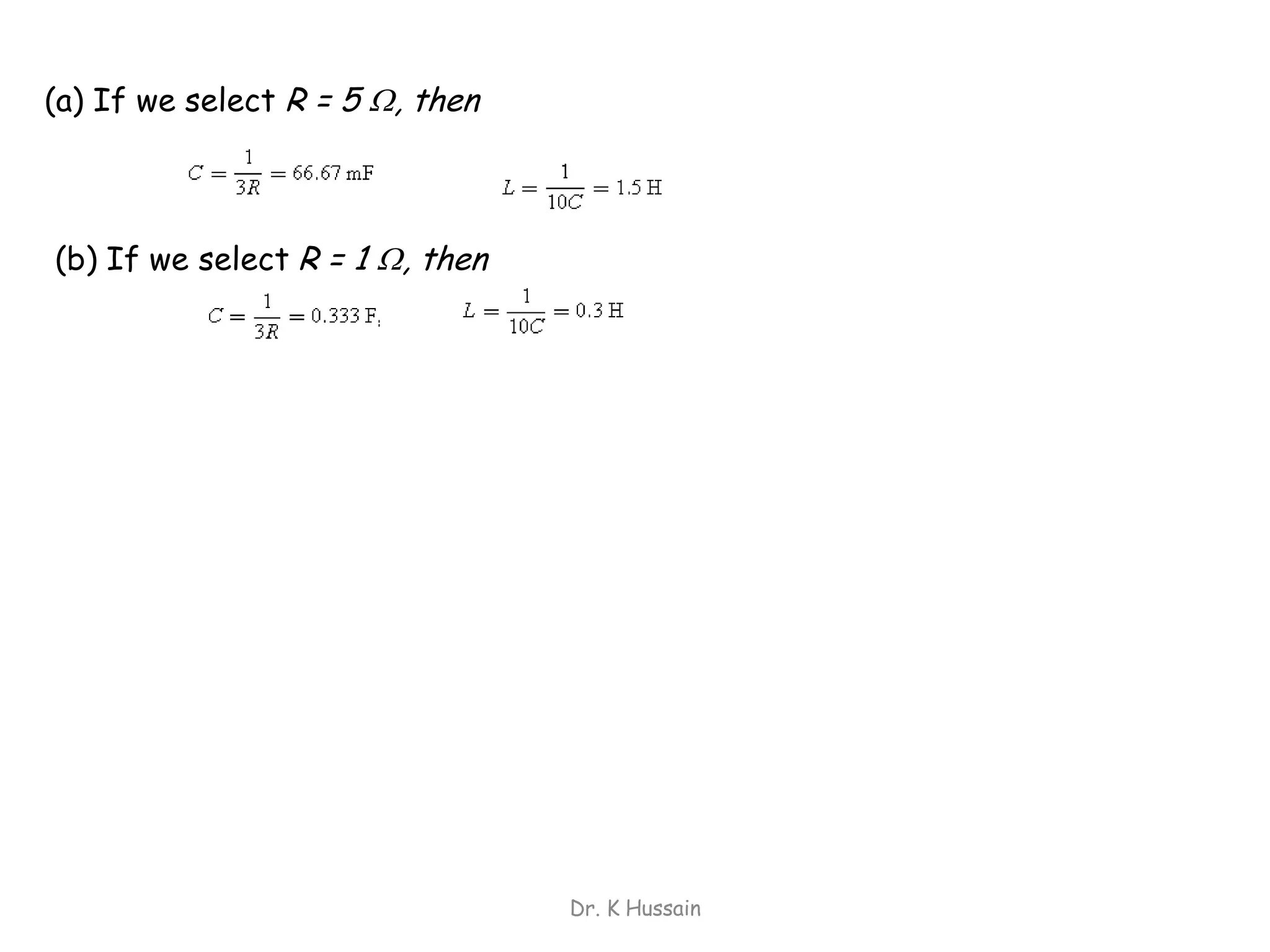
(a) If we select R = 5 , then
(b) If we select R = 1 , then

NAS-Unit-5_Two Port Networks

  • 1.
    CHAPTER-5 TWO PORT NETWORKS by Dr.K Hussain Associate Professor & Head, Dept. of EE, SITCOE
  • 2.
    OBJECTIVES • To understandabout two – port networks and its functions. • To understand the different between z- parameter, y-parameter, ABCD- parameter and terminated two port networks. • To investigate and analysis the behavior of two – port networks. Dr. K Hussain
  • 3.
    TWO – PORTNETWORKS • A pair of terminals through which a current may enter or leave a network is known as a port. • Two terminal devices or elements (such as resistors, capacitors, and inductors) results in one – port network. • Most of the circuits we have dealt with so far are two – terminal or one –port circuits. (Fig. a) • A two – port network is an electrical network with two separate ports for input and output. Dr. K Hussain
  • 4.
    Dr. K Hussain Oneport or two terminal circuit Two port or four terminal circuit • It is an electrical network with two separate ports for input and output. • No independent sources. It has two terminal pairs acting as access points. The current entering one terminal of a pair leaves the other terminal in the pair. (Fig. b)
  • 5.
    Z – PARAMETER •Z – parameter also called as impedance parameter and the unit is ohm (Ω) • The “black box” is replace with Z-parameter is as shown below. Dr. K Hussain + V1 - I1 I2 + V2 - Z11 Z21 Z12 Z22 2221212 2121111 IzIzV IzIzV                             2 1 2 1 2221 1211 2 1 I I z I I zz zz V V where the z terms are called the impedance parameters, or simply z parameters, and have units of ohms.
  • 6.
    Dr. K Hussain z11= Open-circuit input impedance z21 = Open-circuit transfer impedance from port 1 to port 2 z12 = Open-circuit transfer impedance from port 2 to port 1 z22 = Open-circuit output impedance 0I1 2 21 0I1 1 11 22 I V zand I V z   0I2 2 22 0I2 1 12 11 I V zand I V z  
  • 7.
    Example 1 Q. Findthe Z – parameter of the circuit below. 40Ω 240Ω 120Ω + V1 _ + V2 _ I1 I2 Dr. K Hussain
  • 8.
    Solution 40Ω 240Ω 120Ω + V 1 _ + V2 _ I1 Ia Ib When I2 =0(open circuit port 2). Redraw the circuit.     84 (2)(1)sub )2......( 400 280 )1.......(120 1 1 11 1 1 I V Z II IV b b     72 (3)(4)sub )4.......( 400 120 .......(3)240 1 2 21 1 2 I V Z II IV a a Dr. K Hussain
  • 9.
    40Ω 240Ω 120Ω + V1 _ + V2 _ Iy I2 Ix When I1= 0 (open circuit port 1). Redraw the circuit.     96Z (2)(1)sub )2.......( 400 160 )1.......(240 2 2 22 2 2 I V II IV x x     72 (3)(4)sub )4.......( 400 240 )3.......(120 2 1 12 2 1 I V Z II IV y y          9672 7284 ZIn matrix form: Dr. K Hussain
  • 10.
    Y - PARAMETER •Y – parameter also called admittance parameter and the unit is Siemens (S). • The “black box” that we want to replace with the Y-parameter is shown below. Dr. K Hussain + V1 - I1 I2 + V2 - Y11 Y21 Y12 Y22 2221212 2121111 VyVyI VyVyI                             2 1 2 1 2221 1211 2 1 V V y V V yy yy I I where the y terms are called the admittance parameters, or simply y parameters, and they have units of Siemens.
  • 11.
    Dr. K Hussain 0V2 2 22 0V2 1 12 11 V I yand V I y   y11= Short-circuit input admittance y21 = Short-circuit transfer admittance from port 1 to port 2 y12 = Short-circuit transfer admittance from port 2 to port 1 y22 = Short-circuit output admittance 0V1 2 21 0V1 1 11 22 V I yand V I y  
  • 12.
    Example 2 Q. Findthe Y – parameter of the circuit shown below. 5Ω 15Ω20Ω + V1 _ + V2 _ I1 I2 Dr. K Hussain
  • 13.
    Solution i) V2 =0 5Ω 20Ω + V1 _ I1 I2 Ia S V I Y II IV a a 4 1 (2)(1)sub )2.......( 25 5 )1.......(20 1 1 11 1 1     S V I Y IV 5 1 5 1 2 21 21   Dr. K Hussain
  • 14.
    ii) V1 =0 In matrix form; 5Ω 15Ω + V2 _ I1 I2 Ix S V I Y II IV x x 15 4 (4)(3)sub )4.......( 20 5 )3.......(15 2 2 22 2 2     S V I Y IV 5 1 5 2 1 12 12     SY              15 4 5 1 5 1 4 1 Dr. K Hussain
  • 15.
    T (ABCD) PARAMETER •T – parameter or also ABCD – parameter is a another set of parameters relates the variables at the input port to those at the output port. • T – parameter also called transmission parameters because this parameter are useful in the analysis of transmission lines because they express sending – end variables (V1 and I1) in terms of the receiving – end variables (V2 and -I2). • The “black box” that we want to replace with T – parameter is as shown below. Dr. K Hussain + V1 - I1 I2 + V2 - A11 C21 B12 D22
  • 16.
    Dr. K Hussain 221 221 DICVI BIAVV                             2 2 2 2 1 1 I V T I V DC BA I V where the T terms are called the transmission parameters, or simply T or ABCD parameters, and each parameter has different units. 0I2 1 0I2 1 2 2 V I C V V A     0V2 1 0V2 1 2 2 I I D I V B     A=open-circuit voltage ratio C= open-circuit transfer admittance (S) B= negative short- circuit transfer impedance () D=negative short- circuit current ratio
  • 17.
    Example 3 Q. Findthe ABCD – parameter of the circuit shown below. 2Ω 10Ω + V2 _ I1 I2 + V1 _ 4Ω Dr. K Hussain
  • 18.
    Solution i) I2 =0, 2Ω 10Ω + V2 _ I1 + V1 _ 2.1 5 6 10 2 2 1.0 10 2 1 22 2 1 211 2 1 12            V V A VV V V VIV S V I C IV Dr. K Hussain
  • 19.
    ii) V2 =0,               8.6 10 10 14 12 1012 102 4.1 14 10 2 1 221 211 2111 2 1 12 I V B IIV IIV IIIV I I D II 2Ω 10Ω I1 I2 + V1 _ 4Ω I1 + I2           4.11.0 8.62.1 S T In matrix form; Dr. K Hussain
  • 20.
    HYBRID PARAMETERS Dr. KHussain h-parameters
  • 21.
    Dr. K Hussain 1.Input impedance with output short-circuited 2 1 11 1 0V V h I    2. Reverse voltage gain with input open-circuited 1 1 12 2 0I V h V  
  • 22.
    Dr. K Hussain 3.Forward current gain with output short-circuited 2 2 21 1 0V I h I   4. Output admittance with input open-circuited 1 2 22 2 0 S V I h V  
  • 23.
    • Note thatthe four h-parameters have mixed dimensions. • This is the reason why these parameters are called hybrid parameters. • Using h-parameter equivalent circuit for a transistor proves beneficial in two ways. • Firstly, the measurement of these parameters for a transistor is quite easy. • Secondly, the analysis of the transistor amplifier becomes much simpler. Dr. K Hussain
  • 24.
    Dr. K Hussain Example:Find the hybrid parameters for the two-port network of Fig. To find h11 and h21, we short-circuit the output port and connect a current source I1 to the input port as shown in Fig.(a). From Fig.(a), Also, from Fig. (a) we obtain, by current division, Solution:
  • 25.
    Dr. K Hussain Toobtain h12 and h22, we open-circuit the input port and connect a voltage source V2 to the output port as in Fig. (b). By voltage division,
  • 26.
    RELATIONSHIPS BETWEEN PARAMETERS •Since the six sets of parameters relate the same input and output terminal variables of the same two-port network, they should be interrelated. Dr. K Hussain Q. Determine the y-Parameters in terms of z-Parameters.
  • 27.
  • 28.
    Dr. K Hussain Q.Determine ABCD parameters in terms of z parameters. The above equation is in the form of We can modify the above equation as The above equation is in the form of Substitute I1 value in V1 equation. Therefore, the T parameters matrix is
  • 29.
    Dr. K Hussain Q.Determine the h parameters in terms of z parameters. Making I2 the subject of Eq. Substituting this into Eq. Putting Eqs. (V1) and (I2) in matrix form Comparing this with Eq., we obtain
  • 30.
    Dr. K Hussain TABLE:Conversion of two-port parameters
  • 31.
  • 32.
    Dr. K Hussain Exercise1:Determine z, y & ABCD parameters from h-parameters. Exercise2: Determine z, ABCD & h parameters from y-parameters. Exercise3: Determine z, y & h parameters from ABCD-parameters. Exercise 4: Find out condition of symmetry and reciprocity?
  • 33.
    Conditions for Symmetry& Reciprocity Dr. K Hussain
  • 34.
    Condition for Symmetryin Two Port Network • If the impedance measured at one port is equal to the impedance measured at the other port with remaining port open circuited, the network is said to be Condition for Symmetry. Condition of Symmetry for z-Parameters: The basic equations of z-parameters are as follows: Dr. K Hussain Hence equation (i) will become,
  • 35.
    Equation (ii) canbe written as, Dr. K Hussain For symmetrical networks, both the port impedances must be equal i.e., Condition of Symmetry for z-Parameters ..Contd..
  • 36.
    Dr. K Hussain Conditionof Symmetry for Y-Parameters The basic equations of y-parameters are as follows: Equation (i) can be written as Equation (ii) can be written as
  • 37.
    Dr. K Hussain Equation(ii) can be written as, Substituting value of V2 in equation (iii), we have Equation (i) can be written as,
  • 38.
    Dr. K Hussain Forsymmetrical networks, both the port impedances must be equal i.e., Substituting value of V1 in equation (viii) from equation (vii), we have
  • 39.
    Dr. K Hussain Conditionof Symmetry for Transmission Parameters The basic equations for the transmission parameters are as following Equation (ii) can be written as, Equation (i) can be written as, Case (i)
  • 40.
    Dr. K Hussain Forthe symmetrical network, both the port impedances must be equal. Equation (ii) can be written as, Equation (i) can be written as, Case (ii)
  • 41.
    Dr. K Hussain Conditionsof Symmetry for h-Parameters The basic equations of h-parameters are as follows, Equation (ii) can be written as Equation (i) can be written as, Case (i):
  • 42.
    Dr. K Hussain Substitutingvalue of V2 in equation (iii), we have Equation (i) can be written as Equation (ii) can be written as For symmetrical networks, both the port impedances must be equal i.e., Case (ii):
  • 43.
  • 44.
    Dr. K Hussain INTERCONNECTIONOF NETWORKS A large, complex network may be divided into subnetworks for the purposes of analysis and design. The subnetworks are modeled as two-port networks, interconnected to form the original network. The two-port networks may therefore be regarded as building blocks that can be interconnected to form a complex network. The interconnection can be in series, in parallel, or in cascade. Although the interconnected network can be described by any of the six parameter sets, a certain set of parameters may have a definite advantage. For ex: when the networks are in series, their individual z parameters add up to give the z parameters of the larger network. When they are in parallel, their individual y parameters add up to give the y parameters the larger network. When they are cascaded, their individual transmission parameters can be multiplied together to get the transmission parameters of the larger network.
  • 45.
    Dr. K Hussain Considerthe series connection of two-port networks shown in Fig. 1. The networks are regarded as being in series because their input currents are the same and their voltages add. For network Na, For network Nb, SERIES CONNECTION OF TWO-PORT NETWORKS It is showing that the z parameters for the overall network are the sum of the z parameters for the individual networks. Fig. 1 In addition, each network has a common reference, and when the circuits are placed in series, the common reference points of each circuit are connected together.
  • 46.
    Dr. K Hussain Twotwo-port networks are in parallel when their port voltages are equal and the port currents of the larger network are the sums of the individual port currents. In addition, each circuit must have a common reference and when the networks are connected together, they must all have their common references tied together. The parallel connection of two two-port networks is shown in Fig. 2. For the two networks Thus, the y parameters for the overall network are It is showing that the y parameters of the overall network are the sum of the y parameters of the individual networks. PARALLEL CONNECTION OF TWO-PORT NETWORKS Fig. 2
  • 47.
    Dr. K Hussain Theconnection of two two-port networks in cascade is shown in Fig 3. For the two networks, Substituting these into Eqs. Thus, the transmission parameters for the overall network are the product of the transmission parameters for the individual transmission parameters: It is this property that makes the transmission parameters so useful. Keep in mind that the multiplication of the matrices must be in the order in which the networks Na and Nb are cascaded. CASCADE CONNECTION OF TWO-PORT NETWORKS Fig. 3
  • 48.
    ONE PORT NETWORK •A port is combination of two terminals on the same side of network. Thus a terminal pair is nothing but a port as shown in fig . • A network having only one terminal pair or port is called one port network. • One port network can be represented as below. R 1I 1V + - + -  1I 1V Dr. K Hussain
  • 49.
    NETWORK FUNCTION FORONE PORT NETWORK • Voltage and current for the one port linear network as shown in fig. • As there is one port , voltage and current measured at same port. thus for one port network only driving function can be defined as below. DRIVING POINT IMPEDANCE FUNCTION: • The ratio of laplace transform of voltage and current measured at port under zero initial condition is called driving point impedance function • It is denoted by Z(s) Z(s)=V(s)/I(s) Dr. K Hussain
  • 50.
    DRIVING POINT ADMITTANCEFUNCTION • It is the ratio of laplace transform of current and voltage measured at port under zero initial condition is called driving point admittance function. • It denoted by Y(s) Y(s)=I(s)/V(s) ,E H ˆn S V 1V 1I + - Dr. K Hussain
  • 51.
    N-port Network To representmulti-port networks we use: - Z (impedance) parameters - Y (admittance) parameters - h (hybrid) parameters - ABCD parameters - S (scattering) parameters Not easily measurable at high frequency Measurable at high frequency MULTIPORT NETWORKS       + + + + + 1I 2I 3I mI NI 1V 2V 3V mV NV - - - - - Dr. K Hussain
  • 52.
    NETWORK FUNCTIONS FORTWO-PORT NETWORK • Consider a two port network with voltages and currents at ports 1-1’ and 2-2’ as V1(t), I1(t) and V2(t), I2(t) respectively as shown in figure. Dr. K Hussain 1 1’ 2 2’
  • 53.
    NETWORK FUNCTIONS FORTWO-PORT NETWORKS 1. Driving Point Functions: • Driving point impedance functions • Driving point admittance functions 2. Transfer Functions: • Voltage transfer functions • Current transfer functions • Transfer impedance functions • Transfer admittance functions Dr. K Hussain
  • 54.
    DRIVING POINT FUNCTIONS DrivingPoint Impedance Functions: • The ratio of Laplace transform of voltage and current at port 1-1’ or 2-2’ is defined as driving point impedance function. Two types of driving point impedance functions: • At port 1-1’ denoted as Z11(s) Z11(s)= V1(s)/I1(s) • At port 2-2’ denoted as Z22(s) Z22(s)= V2(s)/I2(s) Dr. K Hussain 1 1’ 2 2’
  • 55.
    DRIVING POINT FUNCTIONS DrivingPoint Admittance Functions: • The ratio of Laplace transform of current and voltage at port 1-1’ or 2-2’ is defined as driving point admittance function. Two types of driving point admittance functions: • At port 1-1’ denoted as Y11(s) Y11(s)=I1(s)/V1(s) • At port 2-2’ denoted as Y11(s) Y22(s)=I2(s)/V2(s) Dr. K Hussain 1 1’ 2 2’
  • 56.
    TRANSFER FUNCTIONS Voltage TransferFunction: • It is defined as the ratio of Laplace transform of voltage at one port and voltage at another port. • It is denoted as G(s). • G12(s) =V1(s)/V2(s) and G21(s) =V2(s)/V1(s) Current Transfer Function: • It is defined as the ratio of Laplace transform of current at one port and current at another port. • It is denoted as (s). • 12(s) = I1(s)/I2(s) and 21(s) =I2(s)/I1(s) Dr. K Hussain 1 1’ 2 2’
  • 57.
    TRANSFER FUNCTIONS Transfer ImpedanceFunction: • It is defined as the ratio of Laplace transform of voltage at one port and current at another port. Z12(s)=V1(s)/I2(s) and Z21(s)=V2(s)/I1(s) Transfer Admittance Function: • It is defined as the ratio of Laplace transform of current at one port and voltage at another port. Y12(s) =I1(s)/V2(s) and Y21(s) =I2(s)/V1(s) Dr. K Hussain
  • 58.
    Dr. K Hussain CONCEPTOF POLES AND ZEROS The transfer function provides a basis for determining important system response characteristics without solving the complete differential equation. As defined, the transfer function is a rational function in the complex variable s = σ + jω, that is It is often convenient to factor the polynomials in the numerator and denominator, and to write the transfer function in terms of those factors: where the numerator and denominator polynomials, N(s) and D(s), have real coefficients defined by the system’s differential equation and K = bm/an. As written in Eq. (2) the zi’s are the roots of the equation N(s) = 0, and are defined to be the system zeros, and the pi’s are the roots of the equation D(s) = 0, and are defined to be the system poles.
  • 59.
    Dr. K Hussain Togetherwith the gain constant K they completely characterize the differential equation, and provide a complete description of the system. Example: A system has a pair of complex conjugate poles p1, p2 = −1j2, a single real zero z1 = −4, and a gain factor K = 3. Find the differential equation representing the system. Solution: The transfer function is and the differential equation is Figure 1: The pole-zero plot for a typical third-order system with one real pole and a complex conjugate pole pair, and a single real zero. The poles and zeros are properties of the transfer function, and therefore of the differential equation describing the input-output system dynamics.
  • 60.
    Dr. K Hussain Example: Alinear system is described by the differential equation Find the system poles and zeros. which may be written in factored form The system therefore has a single real zero at s = −1/2, and a pair of real poles at s = −3 and s = −2. Solution: From the differential equation the transfer function is
  • 61.
    Dr. K Hussain Twomore important applications: Network Stability and Network Synthesis. APPLICATIONS So far we have considered three applications of Laplace’s transform: circuit analysis in general, obtaining transfer functions, and solving linear Integro-differential equations. The Laplace transform also finds application in other areas in circuit analysis, signal processing, and control systems.
  • 62.
    Dr. K Hussain NetworkSynthesis Network synthesis may be regarded as the process of obtaining an appropriate network to represent a given transfer function. Network synthesis is easier in the s domain than in the time domain In network analysis, we find the transfer function of a given network. In network synthesis, we reverse the approach: given a transfer function, we are required to find a suitable network. Network synthesis is finding a network that represents a given transfer function. Keep in mind that in synthesis, there may be many different answers—or possibly no answers—because there are many circuits that can be used to represent the same transfer function; in network analysis, there is only one answer. Network synthesis is an exciting field of prime engineering importance. Being able to look at a transfer function and come up with the type of circuit it represents is a great asset to a circuit designer. Although network synthesis constitutes a whole course by itself and requires some experience, the following examples are meant to whet your appetite.
  • 63.
    Dr. K Hussain Example:Given the transfer function Realize the function using the circuit in Fig.(a). (a) Select R = 5 , and find L and C. (b) Select R = 1 , and find L and C. The s-domain equivalent of the circuit in Fig. (a) is shown in Fig. (b). The parallel combination of R and C gives Using the voltage division principle, Comparing this with the given transfer function H(s) reveals that There are several values of R, L, and C that satisfy these requirements. This is the reason for specifying one element value so that others can be determined. Solution:
  • 64.
    Dr. K Hussain (a)If we select R = 5 , then (b) If we select R = 1 , then