Network Analysis and Synthesis
Chapter 3: Solution of Network Equations
By
Dr. K Hussain
Associate Professor and Head
Dept. of EE, SITCOE
•Classification solution of first, Second order differential
equations of series & parallel R-L, R-C, R-L-C circuits,
•General & particular solutions, Particular integral &
Complimentary functions, Time constant,
•Mathematical analysis of circuit transients, initial
conditions in network, Procedure of evaluality,
Conditions in network problems,
•Solution of D.C. resistive network & A. C. sinusoidal
steady state networks,
•Writing loop equations, Node equations directly in
matrices form. Numericals
CONTENTS
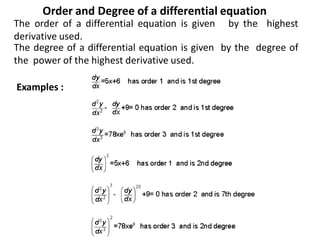
The order of a differential equation is given by the highest
derivative used.
Examples :
The degree of a differential equation is given by the degree of
the power of the highest derivative used.
Order and Degree of a differential equation
The differential equations resulting from analyzing RC and RL
circuits are of the first order. Hence, the circuits are collectively
known as first-order circuits.
A first-order circuit is characterized by a first-order differential
equation.
In addition to there being two types of first-order circuits (RC and
RL), there are two ways to excite the circuits.
First Order Circuits
Finally, we consider four typical applications of RC and RL circuits:
delay and relay circuits, a photoflash unit, and an automobile
ignition circuit.
The second way of exciting first-order circuits is by independent
sources.
The first way is by initial conditions of the storage elements in the
circuits. In these so called source-free circuits, we assume that
energy is initially stored in the capacitive or inductive element.
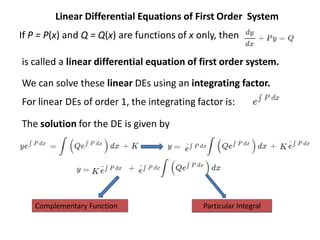
Linear Differential Equations of First Order System
If P = P(x) and Q = Q(x) are functions of x only, then
is called a linear differential equation of first order system.
We can solve these linear DEs using an integrating factor.
For linear DEs of order 1, the integrating factor is:
The solution for the DE is given by
Complementary Function Particular Integral
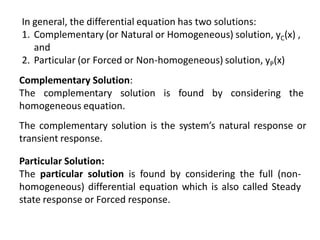
In general, the differential equation has two solutions:
1. Complementary (or Natural or Homogeneous) solution, yC(x) ,
and
2. Particular (or Forced or Non-homogeneous) solution, yP(x)
Complementary Solution:
The complementary solution is found by considering the
homogeneous equation.
The complementary solution is the system’s natural response or
transient response.
Particular Solution:
The particular solution is found by considering the full (non-
homogeneous) differential equation which is also called Steady
state response or Forced response.
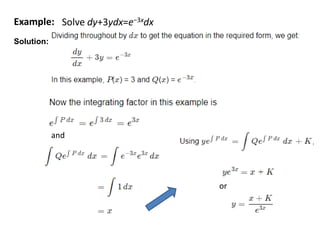
and
or
Solve dy+3ydx=e−3xdxExample:
Solution:
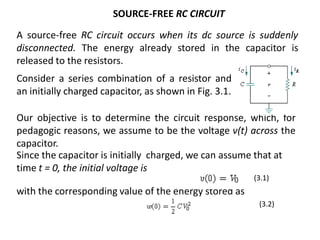
SOURCE-FREE RC CIRCUIT
A source-free RC circuit occurs when its dc source is suddenly
disconnected. The energy already stored in the capacitor is
released to the resistors.
Consider a series combination of a resistor and
an initially charged capacitor, as shown in Fig. 3.1.
Our objective is to determine the circuit response, which, for
pedagogic reasons, we assume to be the voltage v(t) across the
capacitor.
with the corresponding value of the energy stored as
(3.1)
(3.2)
Since the capacitor is initially charged, we can assume that at
time t = 0, the initial voltage is
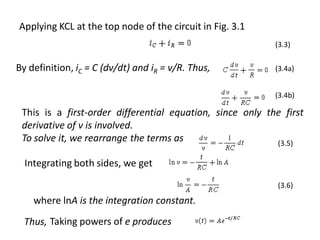
Applying KCL at the top node of the circuit in Fig. 3.1
By definition, iC = C (dv/dt) and iR = v/R. Thus,
This is a first-order differential equation, since only the first
derivative of v is involved.
To solve it, we rearrange the terms as
Integrating both sides, we get
where lnA is the integration constant.
(3.5)
(3.4b)
(3.4a)
(3.3)
(3.6)
Taking powers of e producesThus,
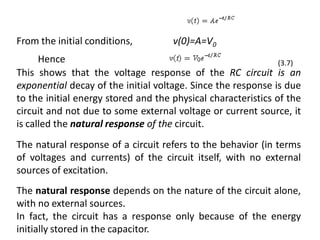
From the initial conditions, v(0)=A=V0
This shows that the voltage response of the RC circuit is an
exponential decay of the initial voltage. Since the response is due
to the initial energy stored and the physical characteristics of the
circuit and not due to some external voltage or current source, it
is called the natural response of the circuit.
The natural response of a circuit refers to the behavior (in terms
of voltages and currents) of the circuit itself, with no external
sources of excitation.
The natural response depends on the nature of the circuit alone,
with no external sources.
In fact, the circuit has a response only because of the energy
initially stored in the capacitor.
(3.7)Hence
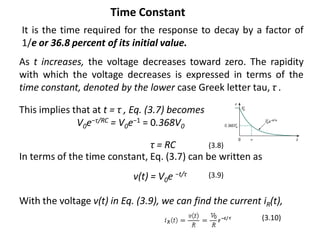
It is the time required for the response to decay by a factor of
1/e or 36.8 percent of its initial value.
As t increases, the voltage decreases toward zero. The rapidity
with which the voltage decreases is expressed in terms of the
time constant, denoted by the lower case Greek letter tau, τ .
This implies that at t = τ , Eq. (3.7) becomes
V0e−τ/RC = V0e−1 = 0.368V0
τ = RC
In terms of the time constant, Eq. (3.7) can be written as
v(t) = V0e −t/τ
(3.8)
(3.9)
With the voltage v(t) in Eq. (3.9), we can find the current iR(t),
(3.10)
Time Constant
The Key to Working with a Source - free RC Circuit is Finding:
1. The initial voltage v(0) = V0 across the capacitor.
2. The time constant τ .
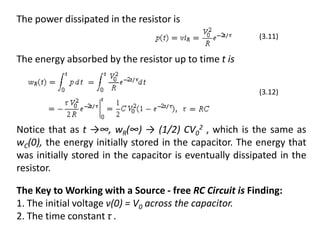
The power dissipated in the resistor is
The energy absorbed by the resistor up to time t is
Notice that as t →∞, wR(∞) → (1/2) CV0
2 , which is the same as
wC(0), the energy initially stored in the capacitor. The energy that
was initially stored in the capacitor is eventually dissipated in the
resistor.
(3.12)
(3.11)
SOURCE-FREE RL CIRCUIT
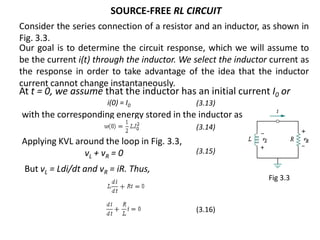
Consider the series connection of a resistor and an inductor, as shown in
Fig. 3.3.
with the corresponding energy stored in the inductor as
Applying KVL around the loop in Fig. 3.3,
vL + vR = 0
(3.13)
(3.14)
(3.15)
(3.16)
Fig 3.3
i(0) = I0
At t = 0, we assume that the inductor has an initial current I0 or
But vL = Ldi/dt and vR = iR. Thus,
Our goal is to determine the circuit response, which we will assume to
be the current i(t) through the inductor. We select the inductor current as
the response in order to take advantage of the idea that the inductor
current cannot change instantaneously.
Rearranging terms and integrating gives
Taking the powers of e, we have
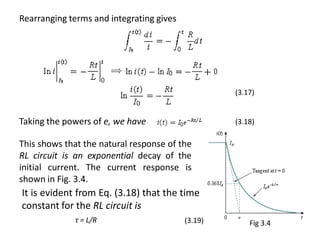
This shows that the natural response of the
RL circuit is an exponential decay of the
initial current. The current response is
shown in Fig. 3.4.
τ = L/R
(3.18)
(3.17)
(3.19) Fig 3.4
It is evident from Eq. (3.18) that the time
constant for the RL circuit is
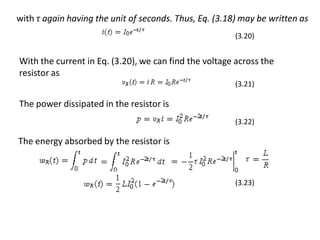
with τ again having the unit of seconds. Thus, Eq. (3.18) may be written as
With the current in Eq. (3.20), we can find the voltage across the
resistor as
The power dissipated in the resistor is
The energy absorbed by the resistor is
(3.23)
(3.22)
(3.21)
(3.20)
The Key to Working with a Source - free RL Circuit is Finding:
1. The initial current i(0) = I0 through the inductor.
2. The time constant τ of the circuit.
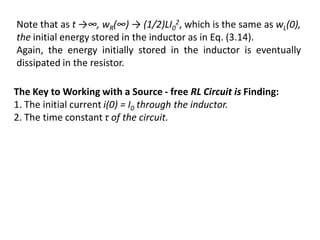
Note that as t →∞, wR(∞) → (1/2)LI0
2, which is the same as wL(0),
the initial energy stored in the inductor as in Eq. (3.14).
Again, the energy initially stored in the inductor is eventually
dissipated in the resistor.
The transient response is the circuit’s temporary response
that will die out with time.
The steady-state response is the behavior of the circuit a
long time after an external excitation is applied.
Complete Response =Transient Response+ Steady State Response
(temporary part) (permanent part)
Analysis of RLC Circuits
RC Circuits: Such a circuit also finds applications in electric
spot welding and the radar transmitter tube.
RL Circuits: Relays were used in the earliest digital circuits
and are still used for switching high-power circuits.
Applications
The various devices in which RC and RL circuits find
applications include filtering in dc power supplies, smoothing
circuits in digital communications, differentiators, integrators,
delay circuits, and relay circuits.
Some of these applications take advantage of the short or
long time constants of the RC or RL circuits.
Series RL Circuit
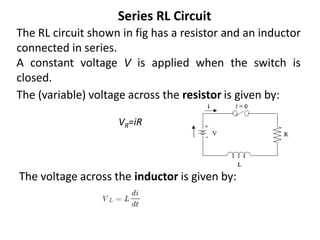
The RL circuit shown in fig has a resistor and an inductor
connected in series.
A constant voltage V is applied when the switch is
closed.
The voltage across the inductor is given by:
The (variable) voltage across the resistor is given by:
VR​=iR
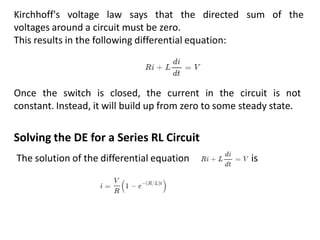
Kirchhoff's voltage law says that the directed sum of the
voltages around a circuit must be zero.
This results in the following differential equation:
Once the switch is closed, the current in the circuit is not
constant. Instead, it will build up from zero to some steady state.
Solving the DE for a Series RL Circuit
The solution of the differential equation is
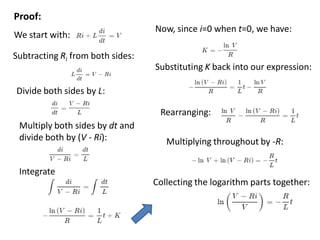
We start with:
Subtracting Ri from both sides:
Divide both sides by L:
Multiply both sides by dt and
divide both by (V - Ri):
Integrate
Now, since i=0 when t=0, we have:
Substituting K back into our expression:
Rearranging:
Multiplying throughout by -R:
Collecting the logarithm parts together:
Proof:
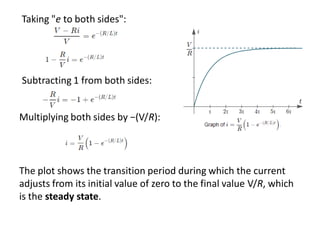
Subtracting 1 from both sides:
Multiplying both sides by −(V/R​):
Taking "e to both sides":
The plot shows the transition period during which the current
adjusts from its initial value of zero to the final value V/R​, which
is the steady state.
Time Constant
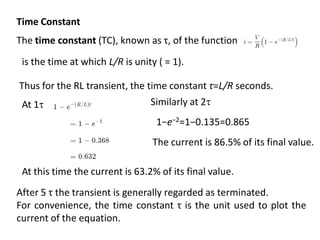
The time constant (TC), known as τ, of the function
is the time at which L/R​ is unity ( = 1).
At 1
At this time the current is 63.2% of its final value.
The current is 86.5% of its final value.
Similarly at 2
1−e−2=1−0.135=0.865
After 5 τ the transient is generally regarded as terminated.
For convenience, the time constant τ is the unit used to plot the
current of the equation.
Thus for the RL transient, the time constant τ=L/R​ seconds.
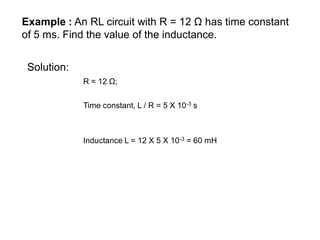
Example : An RL circuit with R = 12 Ω has time constant
of 5 ms. Find the value of the inductance.
Solution:
R = 12 Ω;
Inductance L = 12 X 5 X 10-3 = 60 mH
Time constant, L / R = 5 X 10⁻³ s
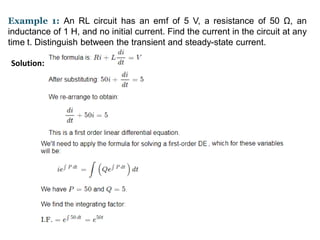
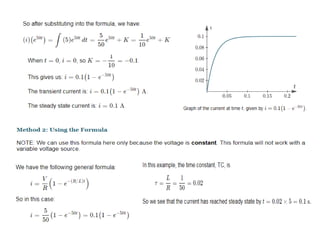
Example 1: An RL circuit has an emf of 5 V, a resistance of 50 Ω, an
inductance of 1 H, and no initial current. Find the current in the circuit at any
time t. Distinguish between the transient and steady-state current.
Solution:
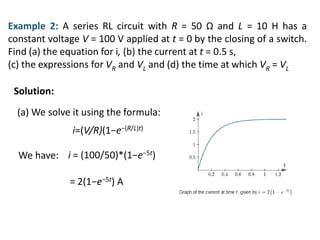
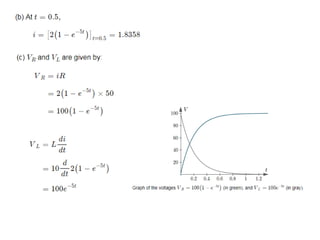
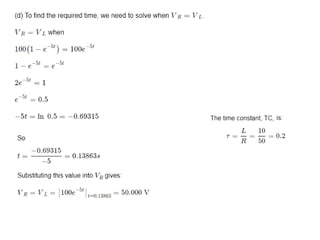
Example 2: A series RL circuit with R = 50 Ω and L = 10 H has a
constant voltage V = 100 V applied at t = 0 by the closing of a switch.
Find (a) the equation for i, (b) the current at t = 0.5 s,
(c) the expressions for VR and VL and (d) the time at which VR = VL
(a) We solve it using the formula:
Solution:
i=(V/R)​(1−e−(R/L)t)
We have: i = (100/50)*​(1−e−5t)
= 2(1−e−5t) A
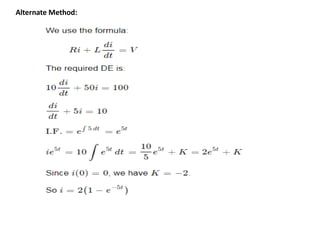
Alternate Method:
Series RC Circuit
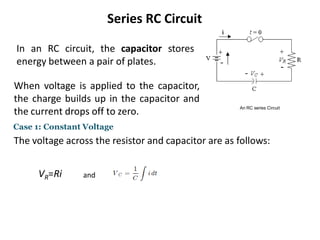
An RC series Circuit
In an RC circuit, the capacitor stores
energy between a pair of plates.
Case 1: Constant Voltage
The voltage across the resistor and capacitor are as follows:
VR​=Ri and
When voltage is applied to the capacitor,
the charge builds up in the capacitor and
the current drops off to zero.
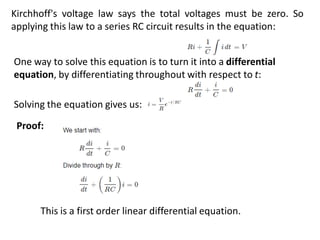
Kirchhoff's voltage law says the total voltages must be zero. So
applying this law to a series RC circuit results in the equation:
Proof:
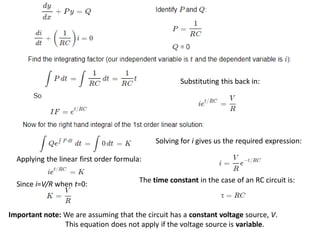
This is a first order linear differential equation.
One way to solve this equation is to turn it into a differential
equation, by differentiating throughout with respect to t:
Solving the equation gives us:
Applying the linear first order formula:
Since i=V/R​ when t=0:
Substituting this back in:
Solving for i gives us the required expression:
Important note: We are assuming that the circuit has a constant voltage source, V.
This equation does not apply if the voltage source is variable.
The time constant in the case of an RC circuit is:
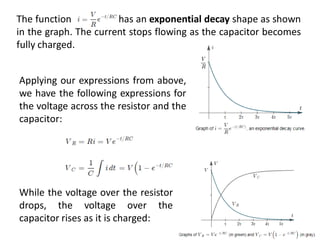
The function has an exponential decay shape as shown
in the graph. The current stops flowing as the capacitor becomes
fully charged.
Applying our expressions from above,
we have the following expressions for
the voltage across the resistor and the
capacitor:
While the voltage over the resistor
drops, the voltage over the
capacitor rises as it is charged:
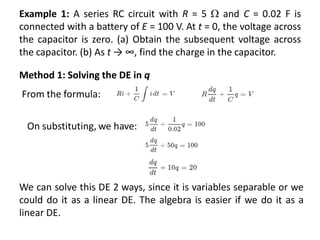
Example 1: A series RC circuit with R = 5  and C = 0.02 F is
connected with a battery of E = 100 V. At t = 0, the voltage across
the capacitor is zero. (a) Obtain the subsequent voltage across
the capacitor. (b) As t → ∞, find the charge in the capacitor.
Method 1: Solving the DE in q
From the formula:
On substituting, we have:
We can solve this DE 2 ways, since it is variables separable or we
could do it as a linear DE. The algebra is easier if we do it as a
linear DE.
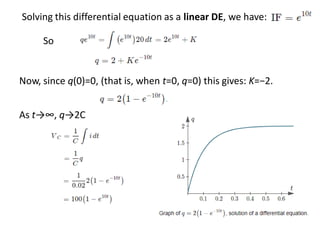
Solving this differential equation as a linear DE, we have:
So
Now, since q(0)=0, (that is, when t=0, q=0) this gives: K=−2.
As t→∞, q→2C
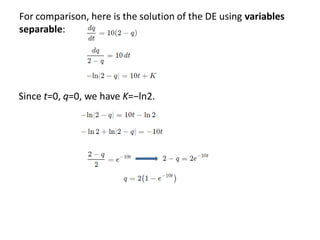
For comparison, here is the solution of the DE using variables
separable:
Since t=0, q=0, we have K=−ln2.
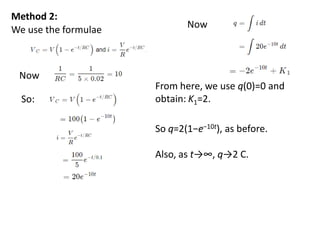
From here, we use q(0)=0 and
obtain: K1​=2.
So q=2(1−e−10t), as before.
Also, as t→∞, q→2 C.
Now
We use the formulae
So:
Now
Method 2:
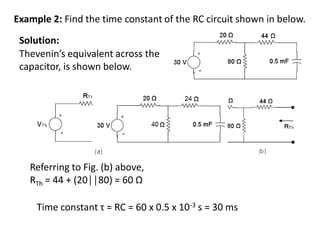
Example 2: Find the time constant of the RC circuit shown in below.
Thevenin’s equivalent across the
capacitor, is shown below.
Solution:
Referring to Fig. (b) above,
RTh = 44 + (20││80) = 60 Ω
Time constant τ = RC = 60 x 0.5 x 10-3 s = 30 ms
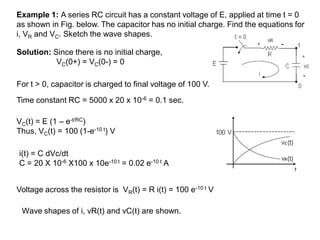
Example 1: A series RC circuit has a constant voltage of E, applied at time t = 0
as shown in Fig. below. The capacitor has no initial charge. Find the equations for
i, VR and VC. Sketch the wave shapes.
Solution: Since there is no initial charge,
VC(0+) = VC(0-) = 0
VC(t) = E (1 – e-t/RC)
Thus, VC(t) = 100 (1-e-10 t) V
Wave shapes of i, vR(t) and vC(t) are shown.
For t ˃ 0, capacitor is charged to final voltage of 100 V.
Time constant RC = 5000 x 20 x 10-6 = 0.1 sec.
i(t) = C dVc/dt
C = 20 X 10-6 X100 x 10e-10 t = 0.02 e-10 t A
Voltage across the resistor is VR(t) = R i(t) = 100 e-10 t V
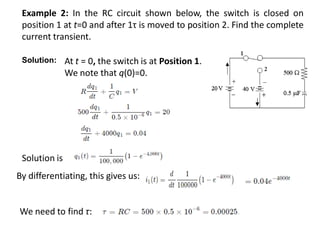
Example 2: In the RC circuit shown below, the switch is closed on
position 1 at t=0 and after 1τ is moved to position 2. Find the complete
current transient.
At t = 0, the switch is at Position 1.
We note that q(0)=0.
Solution is
By differentiating, this gives us:
We need to find τ:
Solution:
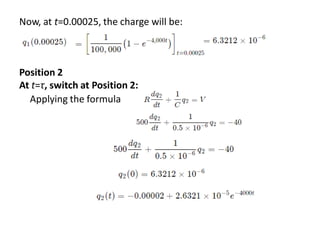
Now, at t=0.00025, the charge will be:
Position 2
At t=τ, switch at Position 2:
Applying the formula
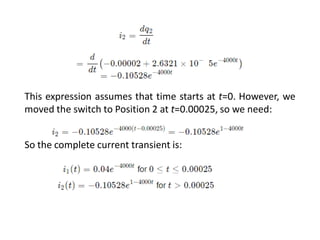
This expression assumes that time starts at t=0. However, we
moved the switch to Position 2 at t=0.00025, so we need:
So the complete current transient is:
Second Order Homogeneous Linear DEs With
Constant Coefficients
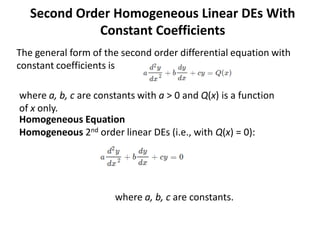
The general form of the second order differential equation with
constant coefficients is
where a, b, c are constants with a > 0 and Q(x) is a function
of x only.
Homogeneous Equation
Homogeneous 2nd order linear DEs (i.e., with Q(x) = 0):
where a, b, c are constants.
Method of Solution
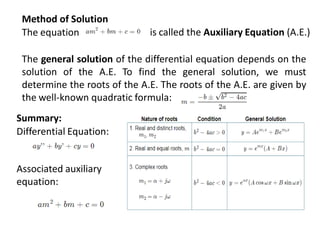
The equation is called the Auxiliary Equation (A.E.)
The general solution of the differential equation depends on the
solution of the A.E. To find the general solution, we must
determine the roots of the A.E. The roots of the A.E. are given by
the well-known quadratic formula:
Summary:
Differential Equation:
Associated auxiliary
equation:
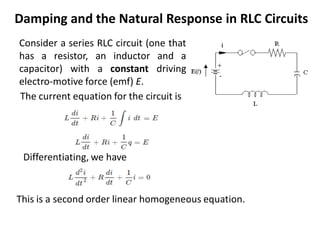
Damping and the Natural Response in RLC Circuits
Consider a series RLC circuit (one that
has a resistor, an inductor and a
capacitor) with a constant driving
electro-motive force (emf) E.
Differentiating, we have
The current equation for the circuit is
This is a second order linear homogeneous equation.
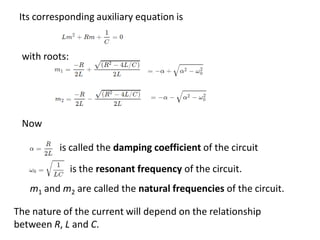
is called the damping coefficient of the circuit
is the resonant frequency of the circuit.
m1 and m2 are called the natural frequencies of the circuit.
Its corresponding auxiliary equation is
with roots:
Now
The nature of the current will depend on the relationship
between R, L and C.
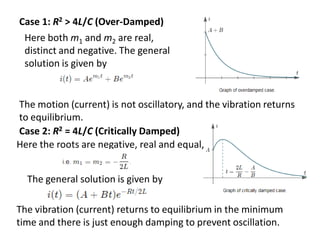
Case 1: R2 > 4L/C (Over-Damped)
Here both m1 and m2 are real,
distinct and negative. The general
solution is given by
The motion (current) is not oscillatory, and the vibration returns
to equilibrium.
Case 2: R2 = 4L/C (Critically Damped)
Here the roots are negative, real and equal,
The general solution is given by
The vibration (current) returns to equilibrium in the minimum
time and there is just enough damping to prevent oscillation.
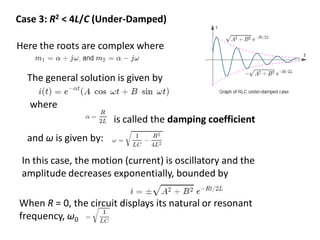
Case 3: R2 < 4L/C (Under-Damped)
Here the roots are complex where
The general solution is given by
where
is called the damping coefficient
and ω is given by:
In this case, the motion (current) is oscillatory and the
amplitude decreases exponentially, bounded by
When R = 0, the circuit displays its natural or resonant
frequency, ω0
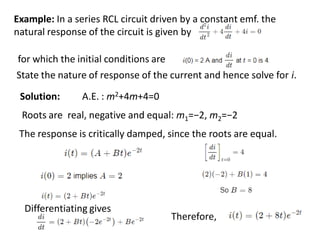
Example: In a series RCL circuit driven by a constant emf, the
natural response of the circuit is given by
for which the initial conditions are
State the nature of response of the current and hence solve for i.
Solution: A.E. : m2+4m+4=0
Roots are real, negative and equal: m1​=−2, m2​=−2
The response is critically damped, since the roots are equal.
Therefore,
Differentiating gives
The Forced Response - Second Order Linear DEs
As in first order circuits, the forced response has the form of the
driving function. For a constant driving source, it results in a
constant forced response.
Complete response of a circuit is the sum of a natural response
and a forced response.
Constant Forced Response
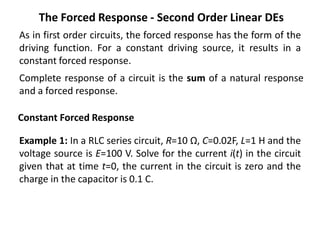
Example 1: In a RLC series circuit, R=10 Ω, C=0.02F, L=1 H and the
voltage source is E=100 V. Solve for the current i(t) in the circuit
given that at time t=0, the current in the circuit is zero and the
charge in the capacitor is 0.1 C.
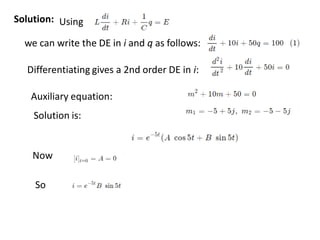
we can write the DE in i and q as follows:
Differentiating gives a 2nd order DE in i:
Auxiliary equation:
Solution is:
UsingSolution:
Now
So
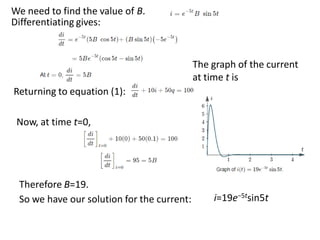
Now, at time t=0,
Therefore B=19.
Returning to equation (1):
Differentiating gives:
We need to find the value of B.
So we have our solution for the current: i=19e−5tsin5t
The graph of the current
at time t is
Natural Response
Example 2:
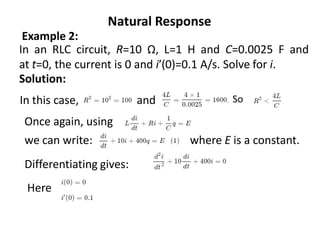
In an RLC circuit, R=10 Ω, L=1 H and C=0.0025 F and
at t=0, the current is 0 and i′(0)=0.1 A/s. Solve for i.
Solution:
and So
Once again, using
we can write: where E is a constant.
Differentiating gives:
Here
In this case,
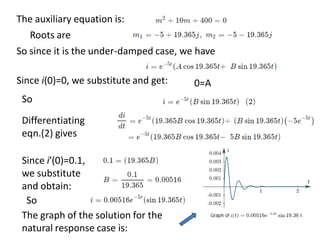
The auxiliary equation is:
Roots are
So since it is the under-damped case, we have
Since i(0)=0, we substitute and get: 0=A
So
Differentiating
eqn.(2) gives
Since i′(0)=0.1,
we substitute
and obtain:
The graph of the solution for the
natural response case is:
So
THANK YOU

NAS-Ch3-Solutions of Equations

  • 1.
    Network Analysis andSynthesis Chapter 3: Solution of Network Equations By Dr. K Hussain Associate Professor and Head Dept. of EE, SITCOE
  • 2.
    •Classification solution offirst, Second order differential equations of series & parallel R-L, R-C, R-L-C circuits, •General & particular solutions, Particular integral & Complimentary functions, Time constant, •Mathematical analysis of circuit transients, initial conditions in network, Procedure of evaluality, Conditions in network problems, •Solution of D.C. resistive network & A. C. sinusoidal steady state networks, •Writing loop equations, Node equations directly in matrices form. Numericals CONTENTS
  • 3.
    The order ofa differential equation is given by the highest derivative used. Examples : The degree of a differential equation is given by the degree of the power of the highest derivative used. Order and Degree of a differential equation
  • 4.
    The differential equationsresulting from analyzing RC and RL circuits are of the first order. Hence, the circuits are collectively known as first-order circuits. A first-order circuit is characterized by a first-order differential equation. In addition to there being two types of first-order circuits (RC and RL), there are two ways to excite the circuits. First Order Circuits Finally, we consider four typical applications of RC and RL circuits: delay and relay circuits, a photoflash unit, and an automobile ignition circuit. The second way of exciting first-order circuits is by independent sources. The first way is by initial conditions of the storage elements in the circuits. In these so called source-free circuits, we assume that energy is initially stored in the capacitive or inductive element.
  • 5.
    Linear Differential Equationsof First Order System If P = P(x) and Q = Q(x) are functions of x only, then is called a linear differential equation of first order system. We can solve these linear DEs using an integrating factor. For linear DEs of order 1, the integrating factor is: The solution for the DE is given by Complementary Function Particular Integral
  • 6.
    In general, thedifferential equation has two solutions: 1. Complementary (or Natural or Homogeneous) solution, yC(x) , and 2. Particular (or Forced or Non-homogeneous) solution, yP(x) Complementary Solution: The complementary solution is found by considering the homogeneous equation. The complementary solution is the system’s natural response or transient response. Particular Solution: The particular solution is found by considering the full (non- homogeneous) differential equation which is also called Steady state response or Forced response.
  • 7.
  • 8.
    SOURCE-FREE RC CIRCUIT Asource-free RC circuit occurs when its dc source is suddenly disconnected. The energy already stored in the capacitor is released to the resistors. Consider a series combination of a resistor and an initially charged capacitor, as shown in Fig. 3.1. Our objective is to determine the circuit response, which, for pedagogic reasons, we assume to be the voltage v(t) across the capacitor. with the corresponding value of the energy stored as (3.1) (3.2) Since the capacitor is initially charged, we can assume that at time t = 0, the initial voltage is
  • 9.
    Applying KCL atthe top node of the circuit in Fig. 3.1 By definition, iC = C (dv/dt) and iR = v/R. Thus, This is a first-order differential equation, since only the first derivative of v is involved. To solve it, we rearrange the terms as Integrating both sides, we get where lnA is the integration constant. (3.5) (3.4b) (3.4a) (3.3) (3.6) Taking powers of e producesThus,
  • 10.
    From the initialconditions, v(0)=A=V0 This shows that the voltage response of the RC circuit is an exponential decay of the initial voltage. Since the response is due to the initial energy stored and the physical characteristics of the circuit and not due to some external voltage or current source, it is called the natural response of the circuit. The natural response of a circuit refers to the behavior (in terms of voltages and currents) of the circuit itself, with no external sources of excitation. The natural response depends on the nature of the circuit alone, with no external sources. In fact, the circuit has a response only because of the energy initially stored in the capacitor. (3.7)Hence
  • 11.
    It is thetime required for the response to decay by a factor of 1/e or 36.8 percent of its initial value. As t increases, the voltage decreases toward zero. The rapidity with which the voltage decreases is expressed in terms of the time constant, denoted by the lower case Greek letter tau, τ . This implies that at t = τ , Eq. (3.7) becomes V0e−τ/RC = V0e−1 = 0.368V0 τ = RC In terms of the time constant, Eq. (3.7) can be written as v(t) = V0e −t/τ (3.8) (3.9) With the voltage v(t) in Eq. (3.9), we can find the current iR(t), (3.10) Time Constant
  • 12.
    The Key toWorking with a Source - free RC Circuit is Finding: 1. The initial voltage v(0) = V0 across the capacitor. 2. The time constant τ . The power dissipated in the resistor is The energy absorbed by the resistor up to time t is Notice that as t →∞, wR(∞) → (1/2) CV0 2 , which is the same as wC(0), the energy initially stored in the capacitor. The energy that was initially stored in the capacitor is eventually dissipated in the resistor. (3.12) (3.11)
  • 13.
    SOURCE-FREE RL CIRCUIT Considerthe series connection of a resistor and an inductor, as shown in Fig. 3.3. with the corresponding energy stored in the inductor as Applying KVL around the loop in Fig. 3.3, vL + vR = 0 (3.13) (3.14) (3.15) (3.16) Fig 3.3 i(0) = I0 At t = 0, we assume that the inductor has an initial current I0 or But vL = Ldi/dt and vR = iR. Thus, Our goal is to determine the circuit response, which we will assume to be the current i(t) through the inductor. We select the inductor current as the response in order to take advantage of the idea that the inductor current cannot change instantaneously.
  • 14.
    Rearranging terms andintegrating gives Taking the powers of e, we have This shows that the natural response of the RL circuit is an exponential decay of the initial current. The current response is shown in Fig. 3.4. τ = L/R (3.18) (3.17) (3.19) Fig 3.4 It is evident from Eq. (3.18) that the time constant for the RL circuit is
  • 15.
    with τ againhaving the unit of seconds. Thus, Eq. (3.18) may be written as With the current in Eq. (3.20), we can find the voltage across the resistor as The power dissipated in the resistor is The energy absorbed by the resistor is (3.23) (3.22) (3.21) (3.20)
  • 16.
    The Key toWorking with a Source - free RL Circuit is Finding: 1. The initial current i(0) = I0 through the inductor. 2. The time constant τ of the circuit. Note that as t →∞, wR(∞) → (1/2)LI0 2, which is the same as wL(0), the initial energy stored in the inductor as in Eq. (3.14). Again, the energy initially stored in the inductor is eventually dissipated in the resistor.
  • 17.
    The transient responseis the circuit’s temporary response that will die out with time. The steady-state response is the behavior of the circuit a long time after an external excitation is applied. Complete Response =Transient Response+ Steady State Response (temporary part) (permanent part) Analysis of RLC Circuits
  • 18.
    RC Circuits: Sucha circuit also finds applications in electric spot welding and the radar transmitter tube. RL Circuits: Relays were used in the earliest digital circuits and are still used for switching high-power circuits. Applications The various devices in which RC and RL circuits find applications include filtering in dc power supplies, smoothing circuits in digital communications, differentiators, integrators, delay circuits, and relay circuits. Some of these applications take advantage of the short or long time constants of the RC or RL circuits.
  • 19.
    Series RL Circuit TheRL circuit shown in fig has a resistor and an inductor connected in series. A constant voltage V is applied when the switch is closed. The voltage across the inductor is given by: The (variable) voltage across the resistor is given by: VR​=iR
  • 20.
    Kirchhoff's voltage lawsays that the directed sum of the voltages around a circuit must be zero. This results in the following differential equation: Once the switch is closed, the current in the circuit is not constant. Instead, it will build up from zero to some steady state. Solving the DE for a Series RL Circuit The solution of the differential equation is
  • 21.
    We start with: SubtractingRi from both sides: Divide both sides by L: Multiply both sides by dt and divide both by (V - Ri): Integrate Now, since i=0 when t=0, we have: Substituting K back into our expression: Rearranging: Multiplying throughout by -R: Collecting the logarithm parts together: Proof:
  • 22.
    Subtracting 1 fromboth sides: Multiplying both sides by −(V/R​): Taking "e to both sides": The plot shows the transition period during which the current adjusts from its initial value of zero to the final value V/R​, which is the steady state.
  • 23.
    Time Constant The timeconstant (TC), known as τ, of the function is the time at which L/R​ is unity ( = 1). At 1 At this time the current is 63.2% of its final value. The current is 86.5% of its final value. Similarly at 2 1−e−2=1−0.135=0.865 After 5 τ the transient is generally regarded as terminated. For convenience, the time constant τ is the unit used to plot the current of the equation. Thus for the RL transient, the time constant τ=L/R​ seconds.
  • 24.
    Example : AnRL circuit with R = 12 Ω has time constant of 5 ms. Find the value of the inductance. Solution: R = 12 Ω; Inductance L = 12 X 5 X 10-3 = 60 mH Time constant, L / R = 5 X 10⁻³ s
  • 25.
    Example 1: AnRL circuit has an emf of 5 V, a resistance of 50 Ω, an inductance of 1 H, and no initial current. Find the current in the circuit at any time t. Distinguish between the transient and steady-state current. Solution:
  • 27.
    Example 2: Aseries RL circuit with R = 50 Ω and L = 10 H has a constant voltage V = 100 V applied at t = 0 by the closing of a switch. Find (a) the equation for i, (b) the current at t = 0.5 s, (c) the expressions for VR and VL and (d) the time at which VR = VL (a) We solve it using the formula: Solution: i=(V/R)​(1−e−(R/L)t) We have: i = (100/50)*​(1−e−5t) = 2(1−e−5t) A
  • 30.
  • 31.
    Series RC Circuit AnRC series Circuit In an RC circuit, the capacitor stores energy between a pair of plates. Case 1: Constant Voltage The voltage across the resistor and capacitor are as follows: VR​=Ri and When voltage is applied to the capacitor, the charge builds up in the capacitor and the current drops off to zero.
  • 32.
    Kirchhoff's voltage lawsays the total voltages must be zero. So applying this law to a series RC circuit results in the equation: Proof: This is a first order linear differential equation. One way to solve this equation is to turn it into a differential equation, by differentiating throughout with respect to t: Solving the equation gives us:
  • 33.
    Applying the linearfirst order formula: Since i=V/R​ when t=0: Substituting this back in: Solving for i gives us the required expression: Important note: We are assuming that the circuit has a constant voltage source, V. This equation does not apply if the voltage source is variable. The time constant in the case of an RC circuit is:
  • 34.
    The function hasan exponential decay shape as shown in the graph. The current stops flowing as the capacitor becomes fully charged. Applying our expressions from above, we have the following expressions for the voltage across the resistor and the capacitor: While the voltage over the resistor drops, the voltage over the capacitor rises as it is charged:
  • 35.
    Example 1: Aseries RC circuit with R = 5  and C = 0.02 F is connected with a battery of E = 100 V. At t = 0, the voltage across the capacitor is zero. (a) Obtain the subsequent voltage across the capacitor. (b) As t → ∞, find the charge in the capacitor. Method 1: Solving the DE in q From the formula: On substituting, we have: We can solve this DE 2 ways, since it is variables separable or we could do it as a linear DE. The algebra is easier if we do it as a linear DE.
  • 36.
    Solving this differentialequation as a linear DE, we have: So Now, since q(0)=0, (that is, when t=0, q=0) this gives: K=−2. As t→∞, q→2C
  • 37.
    For comparison, hereis the solution of the DE using variables separable: Since t=0, q=0, we have K=−ln2.
  • 38.
    From here, weuse q(0)=0 and obtain: K1​=2. So q=2(1−e−10t), as before. Also, as t→∞, q→2 C. Now We use the formulae So: Now Method 2:
  • 39.
    Example 2: Findthe time constant of the RC circuit shown in below. Thevenin’s equivalent across the capacitor, is shown below. Solution: Referring to Fig. (b) above, RTh = 44 + (20││80) = 60 Ω Time constant τ = RC = 60 x 0.5 x 10-3 s = 30 ms
  • 40.
    Example 1: Aseries RC circuit has a constant voltage of E, applied at time t = 0 as shown in Fig. below. The capacitor has no initial charge. Find the equations for i, VR and VC. Sketch the wave shapes. Solution: Since there is no initial charge, VC(0+) = VC(0-) = 0 VC(t) = E (1 – e-t/RC) Thus, VC(t) = 100 (1-e-10 t) V Wave shapes of i, vR(t) and vC(t) are shown. For t ˃ 0, capacitor is charged to final voltage of 100 V. Time constant RC = 5000 x 20 x 10-6 = 0.1 sec. i(t) = C dVc/dt C = 20 X 10-6 X100 x 10e-10 t = 0.02 e-10 t A Voltage across the resistor is VR(t) = R i(t) = 100 e-10 t V
  • 41.
    Example 2: Inthe RC circuit shown below, the switch is closed on position 1 at t=0 and after 1τ is moved to position 2. Find the complete current transient. At t = 0, the switch is at Position 1. We note that q(0)=0. Solution is By differentiating, this gives us: We need to find τ: Solution:
  • 42.
    Now, at t=0.00025,the charge will be: Position 2 At t=τ, switch at Position 2: Applying the formula
  • 43.
    This expression assumesthat time starts at t=0. However, we moved the switch to Position 2 at t=0.00025, so we need: So the complete current transient is:
  • 44.
    Second Order HomogeneousLinear DEs With Constant Coefficients The general form of the second order differential equation with constant coefficients is where a, b, c are constants with a > 0 and Q(x) is a function of x only. Homogeneous Equation Homogeneous 2nd order linear DEs (i.e., with Q(x) = 0): where a, b, c are constants.
  • 45.
    Method of Solution Theequation is called the Auxiliary Equation (A.E.) The general solution of the differential equation depends on the solution of the A.E. To find the general solution, we must determine the roots of the A.E. The roots of the A.E. are given by the well-known quadratic formula: Summary: Differential Equation: Associated auxiliary equation:
  • 46.
    Damping and theNatural Response in RLC Circuits Consider a series RLC circuit (one that has a resistor, an inductor and a capacitor) with a constant driving electro-motive force (emf) E. Differentiating, we have The current equation for the circuit is This is a second order linear homogeneous equation.
  • 47.
    is called thedamping coefficient of the circuit is the resonant frequency of the circuit. m1 and m2 are called the natural frequencies of the circuit. Its corresponding auxiliary equation is with roots: Now The nature of the current will depend on the relationship between R, L and C.
  • 48.
    Case 1: R2> 4L/C (Over-Damped) Here both m1 and m2 are real, distinct and negative. The general solution is given by The motion (current) is not oscillatory, and the vibration returns to equilibrium. Case 2: R2 = 4L/C (Critically Damped) Here the roots are negative, real and equal, The general solution is given by The vibration (current) returns to equilibrium in the minimum time and there is just enough damping to prevent oscillation.
  • 49.
    Case 3: R2< 4L/C (Under-Damped) Here the roots are complex where The general solution is given by where is called the damping coefficient and ω is given by: In this case, the motion (current) is oscillatory and the amplitude decreases exponentially, bounded by When R = 0, the circuit displays its natural or resonant frequency, ω0
  • 50.
    Example: In aseries RCL circuit driven by a constant emf, the natural response of the circuit is given by for which the initial conditions are State the nature of response of the current and hence solve for i. Solution: A.E. : m2+4m+4=0 Roots are real, negative and equal: m1​=−2, m2​=−2 The response is critically damped, since the roots are equal. Therefore, Differentiating gives
  • 51.
    The Forced Response- Second Order Linear DEs As in first order circuits, the forced response has the form of the driving function. For a constant driving source, it results in a constant forced response. Complete response of a circuit is the sum of a natural response and a forced response. Constant Forced Response Example 1: In a RLC series circuit, R=10 Ω, C=0.02F, L=1 H and the voltage source is E=100 V. Solve for the current i(t) in the circuit given that at time t=0, the current in the circuit is zero and the charge in the capacitor is 0.1 C.
  • 52.
    we can writethe DE in i and q as follows: Differentiating gives a 2nd order DE in i: Auxiliary equation: Solution is: UsingSolution: Now So
  • 53.
    Now, at timet=0, Therefore B=19. Returning to equation (1): Differentiating gives: We need to find the value of B. So we have our solution for the current: i=19e−5tsin5t The graph of the current at time t is
  • 54.
    Natural Response Example 2: Inan RLC circuit, R=10 Ω, L=1 H and C=0.0025 F and at t=0, the current is 0 and i′(0)=0.1 A/s. Solve for i. Solution: and So Once again, using we can write: where E is a constant. Differentiating gives: Here In this case,
  • 55.
    The auxiliary equationis: Roots are So since it is the under-damped case, we have Since i(0)=0, we substitute and get: 0=A So Differentiating eqn.(2) gives Since i′(0)=0.1, we substitute and obtain: The graph of the solution for the natural response case is: So
  • 56.