PHY351

CHAPTER

1
Gas and Condensed Matter
What are Materials?
Materials may be defined as substance of which something
is composed or made.
We obtain materials from earth crust and atmosphere.
Examples : Silicon and Iron constitute 27.72 and 5.00 percentage of
weight of earths crust respectively.
 Nitrogen and Oxygen constitute 78.08 and 20.95
percentage of dry air by volume respectively.
Why the Study of Materials is
Important?
Production and processing of materials constitute a large part
of our economy.
Engineers choose materials to suite design.
New materials might be needed for some new applications.
Example :- High temperature resistant materials.
- Space station and Mars Rovers should sustain conditions in space.
(* High speed, low temperature, strong but light.)

Modification of properties might be needed for some
applications.
Example :- Heat treatment to modify properties.
Materials Science and Engineering
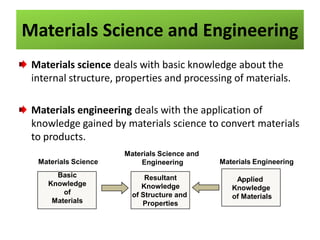
Materials science deals with basic knowledge about the
internal structure, properties and processing of materials.
Materials engineering deals with the application of
knowledge gained by materials science to convert materials
to products.
Materials Science
Basic
Knowledge
of
Materials

Materials Science and
Engineering
Resultant
Knowledge
of Structure and
Properties

Materials Engineering
Applied
Knowledge
of Materials
Type of Material
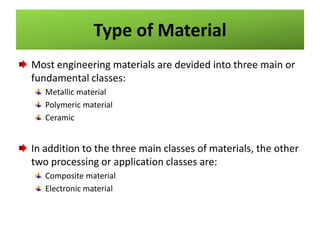
Most engineering materials are devided into three main or
fundamental classes:
Metallic material
Polymeric material
Ceramic

In addition to the three main classes of materials, the other
two processing or application classes are:
Composite material
Electronic material
Metallic Materials
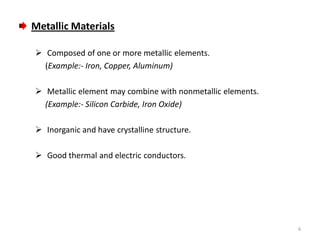
 Composed of one or more metallic elements.
(Example:- Iron, Copper, Aluminum)
 Metallic element may combine with nonmetallic elements.
(Example:- Silicon Carbide, Iron Oxide)
 Inorganic and have crystalline structure.
 Good thermal and electric conductors.

6
Metallic Materials (cont..)

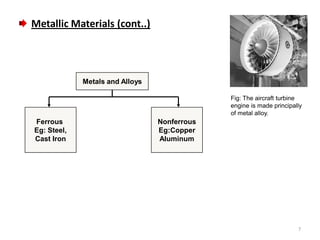
Metals and Alloys
Fig: The aircraft turbine
engine is made principally
of metal alloy.

Ferrous
Eg: Steel,
Cast Iron

Nonferrous
Eg:Copper
Aluminum

7
Polymeric (Plastic) Materials






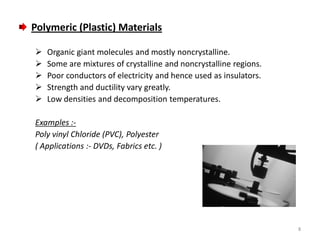
Organic giant molecules and mostly noncrystalline.
Some are mixtures of crystalline and noncrystalline regions.
Poor conductors of electricity and hence used as insulators.
Strength and ductility vary greatly.
Low densities and decomposition temperatures.

Examples :Poly vinyl Chloride (PVC), Polyester
( Applications :- DVDs, Fabrics etc. )

8
Ceramic Materials
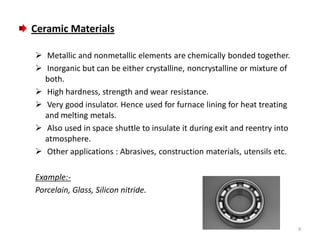
 Metallic and nonmetallic elements are chemically bonded together.
 Inorganic but can be either crystalline, noncrystalline or mixture of
both.
 High hardness, strength and wear resistance.
 Very good insulator. Hence used for furnace lining for heat treating
and melting metals.
 Also used in space shuttle to insulate it during exit and reentry into
atmosphere.
 Other applications : Abrasives, construction materials, utensils etc.
Example:Porcelain, Glass, Silicon nitride.

9
Composite Materials (cont..)





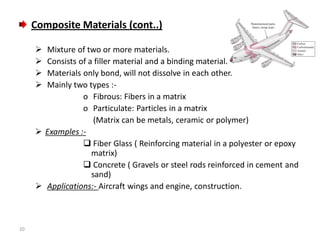
Mixture of two or more materials.
Consists of a filler material and a binding material.
Materials only bond, will not dissolve in each other.
Mainly two types :o Fibrous: Fibers in a matrix
o Particulate: Particles in a matrix
(Matrix can be metals, ceramic or polymer)
 Examples : Fiber Glass ( Reinforcing material in a polyester or epoxy
matrix)
 Concrete ( Gravels or steel rods reinforced in cement and
sand)
 Applications:- Aircraft wings and engine, construction.

10
Electronic Materials
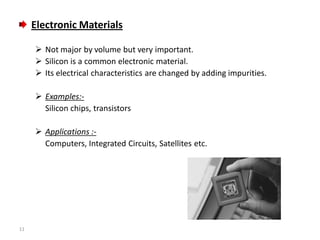
 Not major by volume but very important.
 Silicon is a common electronic material.
 Its electrical characteristics are changed by adding impurities.
 Examples:Silicon chips, transistors
 Applications :Computers, Integrated Circuits, Satellites etc.

11
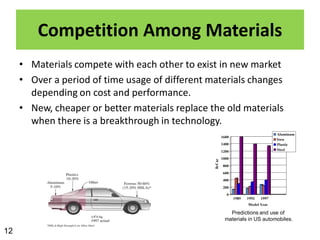
Competition Among Materials
• Materials compete with each other to exist in new market
• Over a period of time usage of different materials changes
depending on cost and performance.
• New, cheaper or better materials replace the old materials
when there is a breakthrough in technology.
Aluminum
Iron
Plastic
Steel

1600
1400

lb/Car

1200
1000
800
600
400
200
0
1985

1992

1997

Model Year

Predictions and use of
materials in US automobiles.

12
Recent Advances and Future
Trends
Smart Materials
 React to environment Stimuli (temperature, strees, light,
humidity and electric and magnetic field).
 Change their properties by sensing external stimulus.
 Examples: Shape memory alloys – used in the artery stents.
 Microelectromechanical systems (MEMS) devices.

13
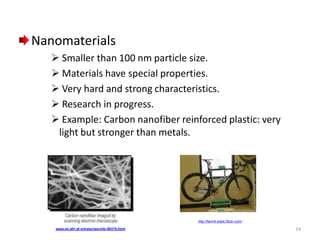
Nanomaterials
 Smaller than 100 nm particle size.
 Materials have special properties.
 Very hard and strong characteristics.
 Research in progress.
 Example: Carbon nanofiber reinforced plastic: very
light but stronger than metals.

http://farm4.static.flickr.com/
www.ml.afrl.af.mil/stories/mlb-00378.html

14
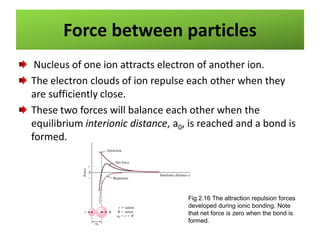
Force between particles
Nucleus of one ion attracts electron of another ion.
The electron clouds of ion repulse each other when they
are sufficiently close.
These two forces will balance each other when the
equilibrium interionic distance, a0, is reached and a bond is
formed.

Fig 2.16 The attraction repulsion forces
developed during ionic bonding. Note
that net force is zero when the bond is
formed.
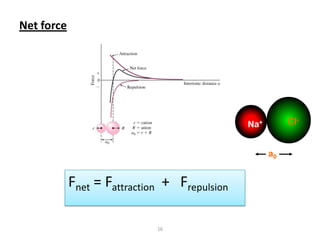
Net force

Cl-

Na+

a0

Fnet = Fattraction + Frepulsion
16
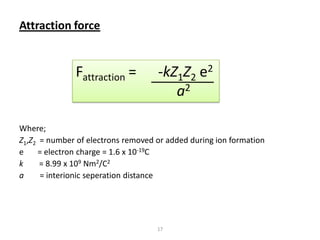
Attraction force

Fattraction =

-kZ1Z2 e2
a2

Where;
Z1,Z2 = number of electrons removed or added during ion formation
e
= electron charge = 1.6 x 10⁻¹⁹C
k
= 8.99 x 10⁹ Nm2/C2
a
= interionic seperation distance

17
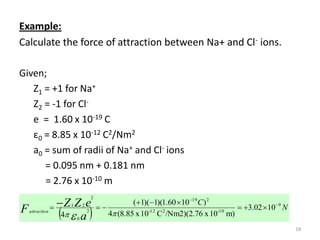
Example:
Calculate the force of attraction between Na+ and Cl- ions.
Given;
Z1 = +1 for Na+
Z2 = -1 for Cle = 1.60 x 10⁻¹⁹ C
ε0 = 8.85 x 10⁻¹² C2/Nm2
a0 = sum of radii of Na+ and Cl- ions
= 0.095 nm + 0.181 nm
= 2.76 x 10⁻¹⁰ m
(1)(1)(1.60 10 C )
 Z Z e  
4  a  4 (8.85 x 10 C /Nm2)(2.76 x 10
2

F

1

attraction

19

2

2

2

0

-12

2

-10

m)

 3.02 109 N
18
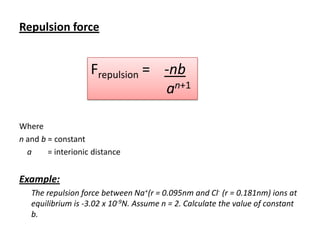
Repulsion force

Frepulsion = -nb
an+1
Where
n and b = constant
a
= interionic distance

Example:
The repulsion force between Na+(r = 0.095nm and Cl- (r = 0.181nm) ions at
equilibrium is -3.02 x 10⁻⁹N. Assume n = 2. Calculate the value of constant
b.
References
 A.G. Guy (1972) Introduction to Material Science, McGraw
Hill.
 J.F. Shackelford (2000). Introduction to Material Science for
Engineers, (5th Edition), Prentice Hall.
 W.F. Smith (1996). Priciple to Material Science and
Engineering, (3rd Edition), McGraw Hill.
 W.D. Callister Jr. (1997) Material Science and Engineering: An
Introduction, (4th Edition) John Wiley.

Phy351 ch 1

  • 1.
  • 2.
    What are Materials? Materialsmay be defined as substance of which something is composed or made. We obtain materials from earth crust and atmosphere. Examples : Silicon and Iron constitute 27.72 and 5.00 percentage of weight of earths crust respectively.  Nitrogen and Oxygen constitute 78.08 and 20.95 percentage of dry air by volume respectively.
  • 3.
    Why the Studyof Materials is Important? Production and processing of materials constitute a large part of our economy. Engineers choose materials to suite design. New materials might be needed for some new applications. Example :- High temperature resistant materials. - Space station and Mars Rovers should sustain conditions in space. (* High speed, low temperature, strong but light.) Modification of properties might be needed for some applications. Example :- Heat treatment to modify properties.
  • 4.
    Materials Science andEngineering Materials science deals with basic knowledge about the internal structure, properties and processing of materials. Materials engineering deals with the application of knowledge gained by materials science to convert materials to products. Materials Science Basic Knowledge of Materials Materials Science and Engineering Resultant Knowledge of Structure and Properties Materials Engineering Applied Knowledge of Materials
  • 5.
    Type of Material Mostengineering materials are devided into three main or fundamental classes: Metallic material Polymeric material Ceramic In addition to the three main classes of materials, the other two processing or application classes are: Composite material Electronic material
  • 6.
    Metallic Materials  Composedof one or more metallic elements. (Example:- Iron, Copper, Aluminum)  Metallic element may combine with nonmetallic elements. (Example:- Silicon Carbide, Iron Oxide)  Inorganic and have crystalline structure.  Good thermal and electric conductors. 6
  • 7.
    Metallic Materials (cont..) Metalsand Alloys Fig: The aircraft turbine engine is made principally of metal alloy. Ferrous Eg: Steel, Cast Iron Nonferrous Eg:Copper Aluminum 7
  • 8.
    Polymeric (Plastic) Materials      Organicgiant molecules and mostly noncrystalline. Some are mixtures of crystalline and noncrystalline regions. Poor conductors of electricity and hence used as insulators. Strength and ductility vary greatly. Low densities and decomposition temperatures. Examples :Poly vinyl Chloride (PVC), Polyester ( Applications :- DVDs, Fabrics etc. ) 8
  • 9.
    Ceramic Materials  Metallicand nonmetallic elements are chemically bonded together.  Inorganic but can be either crystalline, noncrystalline or mixture of both.  High hardness, strength and wear resistance.  Very good insulator. Hence used for furnace lining for heat treating and melting metals.  Also used in space shuttle to insulate it during exit and reentry into atmosphere.  Other applications : Abrasives, construction materials, utensils etc. Example:Porcelain, Glass, Silicon nitride. 9
  • 10.
    Composite Materials (cont..)     Mixtureof two or more materials. Consists of a filler material and a binding material. Materials only bond, will not dissolve in each other. Mainly two types :o Fibrous: Fibers in a matrix o Particulate: Particles in a matrix (Matrix can be metals, ceramic or polymer)  Examples : Fiber Glass ( Reinforcing material in a polyester or epoxy matrix)  Concrete ( Gravels or steel rods reinforced in cement and sand)  Applications:- Aircraft wings and engine, construction. 10
  • 11.
    Electronic Materials  Notmajor by volume but very important.  Silicon is a common electronic material.  Its electrical characteristics are changed by adding impurities.  Examples:Silicon chips, transistors  Applications :Computers, Integrated Circuits, Satellites etc. 11
  • 12.
    Competition Among Materials •Materials compete with each other to exist in new market • Over a period of time usage of different materials changes depending on cost and performance. • New, cheaper or better materials replace the old materials when there is a breakthrough in technology. Aluminum Iron Plastic Steel 1600 1400 lb/Car 1200 1000 800 600 400 200 0 1985 1992 1997 Model Year Predictions and use of materials in US automobiles. 12
  • 13.
    Recent Advances andFuture Trends Smart Materials  React to environment Stimuli (temperature, strees, light, humidity and electric and magnetic field).  Change their properties by sensing external stimulus.  Examples: Shape memory alloys – used in the artery stents.  Microelectromechanical systems (MEMS) devices. 13
  • 14.
    Nanomaterials  Smaller than100 nm particle size.  Materials have special properties.  Very hard and strong characteristics.  Research in progress.  Example: Carbon nanofiber reinforced plastic: very light but stronger than metals. http://farm4.static.flickr.com/ www.ml.afrl.af.mil/stories/mlb-00378.html 14
  • 15.
    Force between particles Nucleusof one ion attracts electron of another ion. The electron clouds of ion repulse each other when they are sufficiently close. These two forces will balance each other when the equilibrium interionic distance, a0, is reached and a bond is formed. Fig 2.16 The attraction repulsion forces developed during ionic bonding. Note that net force is zero when the bond is formed.
  • 16.
    Net force Cl- Na+ a0 Fnet =Fattraction + Frepulsion 16
  • 17.
    Attraction force Fattraction = -kZ1Z2e2 a2 Where; Z1,Z2 = number of electrons removed or added during ion formation e = electron charge = 1.6 x 10⁻¹⁹C k = 8.99 x 10⁹ Nm2/C2 a = interionic seperation distance 17
  • 18.
    Example: Calculate the forceof attraction between Na+ and Cl- ions. Given; Z1 = +1 for Na+ Z2 = -1 for Cle = 1.60 x 10⁻¹⁹ C ε0 = 8.85 x 10⁻¹² C2/Nm2 a0 = sum of radii of Na+ and Cl- ions = 0.095 nm + 0.181 nm = 2.76 x 10⁻¹⁰ m (1)(1)(1.60 10 C )  Z Z e   4  a  4 (8.85 x 10 C /Nm2)(2.76 x 10 2 F 1 attraction 19 2 2 2 0 -12 2 -10 m)  3.02 109 N 18
  • 19.
    Repulsion force Frepulsion =-nb an+1 Where n and b = constant a = interionic distance Example: The repulsion force between Na+(r = 0.095nm and Cl- (r = 0.181nm) ions at equilibrium is -3.02 x 10⁻⁹N. Assume n = 2. Calculate the value of constant b.
  • 20.
    References  A.G. Guy(1972) Introduction to Material Science, McGraw Hill.  J.F. Shackelford (2000). Introduction to Material Science for Engineers, (5th Edition), Prentice Hall.  W.F. Smith (1996). Priciple to Material Science and Engineering, (3rd Edition), McGraw Hill.  W.D. Callister Jr. (1997) Material Science and Engineering: An Introduction, (4th Edition) John Wiley.