Metallurgy &
Material Science

Dr.S.Jose
Professor, Dept of Mechanical Engg.,
TKM College of Engineering, Kollam
Module II








Diffusion in crystals
Theory of Alloys
Equilibrium Diagrams
Iron Carbon Phase diagram
TTT Diagram
Heat Treatment
Recovery, Recrystallisation & Grain
Growth
2
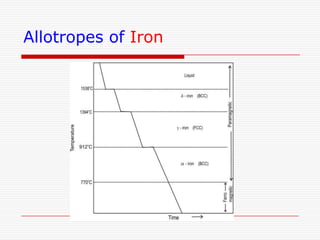
Allotropes of Iron
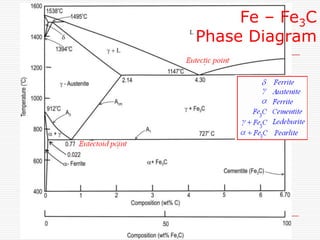
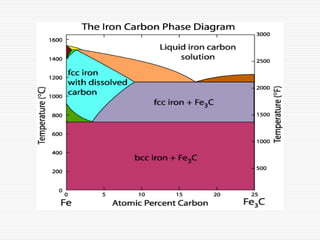
Fe – Fe3C
Phase Diagram
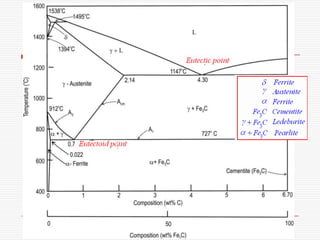
Five individual phases
 a–ferrite (BCC) Fe-C solid solution
 g-austenite (FCC) Fe-C solid solution
 d-ferrite (BCC) Fe-C solid solution

 Fe3C (Iron Carbide) or cementite –
an inter-metallic compound
 Liquid Fe-C solution
Three invariant reactions
A horizontal line always indicates an invariant
reaction in binary phase diagrams
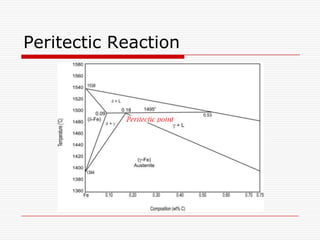
 Peritectic reaction at 1495˚C and 0.18%C,
 d-ferrite + L↔ g-iron (austenite)
 Eutectic reaction at 1147˚C and 4.3 %C,
 L ↔ g-iron + Fe3C (cementite) [ledeburite]
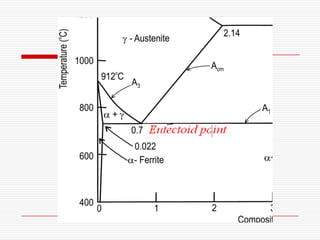
 Eutectoid reaction at 727˚C and 0.77%C,
 g-iron ↔ a–ferrite+Fe3C (cementite) [pearlite]
Peritectic Reaction
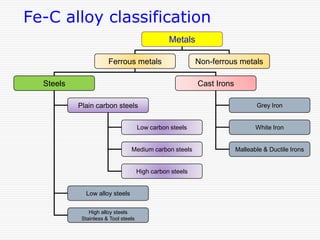
Fe-C alloy classification
Metals
Ferrous metals
Steels

Non-ferrous metals
Cast Irons

Plain carbon steels

Grey Iron

Low carbon steels

White Iron

Medium carbon steels

Malleable & Ductile Irons

High carbon steels

Low alloy steels
High alloy steels
Stainless & Tool steels
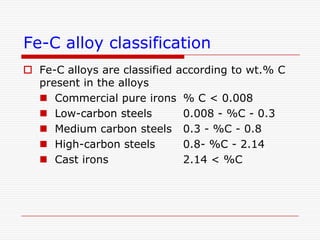
Fe-C alloy classification
 Fe-C alloys are classified according to wt.% C
present in the alloys
 Commercial pure irons % C < 0.008
 Low-carbon steels
0.008 - %C - 0.3
 Medium carbon steels 0.3 - %C - 0.8
 High-carbon steels
0.8- %C - 2.14
 Cast irons
2.14 < %C
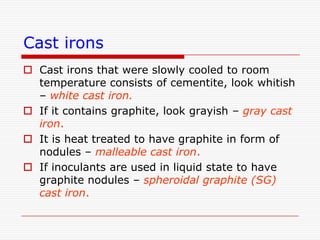
Cast irons
 Cast irons that were slowly cooled to room
temperature consists of cementite, look whitish
– white cast iron.
 If it contains graphite, look grayish – gray cast
iron.
 It is heat treated to have graphite in form of
nodules – malleable cast iron.
 If inoculants are used in liquid state to have
graphite nodules – spheroidal graphite (SG)
cast iron.
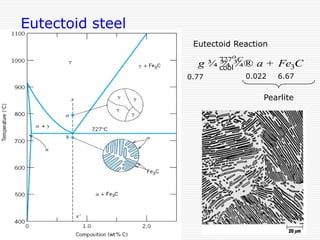
Eutectoid steel
Eutectoid Reaction
727o C
g ¾ cool¾® a + Fe3C
¾
0.022
6.67
0.77

Pearlite
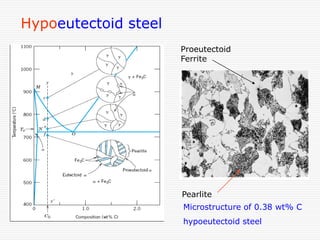
Hypoeutectoid steel
Proeutectoid
Ferrite

Pearlite

Microstructure of 0.38 wt% C
hypoeutectoid steel
Hypereutectoid steel

Pearlite

Proeutectoid
cementite

Microstructure of 1.4 wt% C
hypereutectoid steel
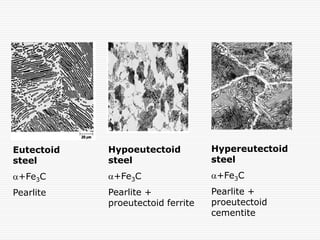
Eutectoid
steel

Hypoeutectoid
steel

Hypereutectoid
steel

a+Fe3C

a+Fe3C

a+Fe3C

Pearlite

Pearlite +
proeutectoid ferrite

Pearlite +
proeutectoid
cementite
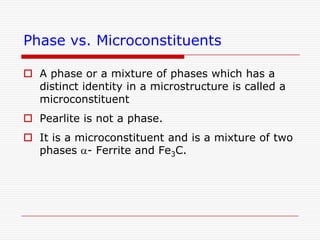
Phase vs. Microconstituents
 A phase or a mixture of phases which has a
distinct identity in a microstructure is called a
microconstituent
 Pearlite is not a phase.
 It is a microconstituent and is a mixture of two
phases a- Ferrite and Fe3C.
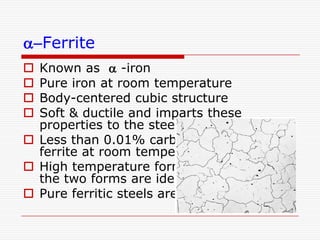
a-Ferrite
Known as a -iron
Pure iron at room temperature
Body-centered cubic structure
Soft & ductile and imparts these
properties to the steel.
 Less than 0.01% carbon will dissolve in
ferrite at room temperature
 High temperature form is d ferrite, but
the two forms are identical.
 Pure ferritic steels are rare




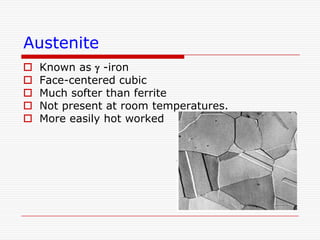
Austenite






Known as g -iron
Face-centered cubic
Much softer than ferrite
Not present at room temperatures.
More easily hot worked
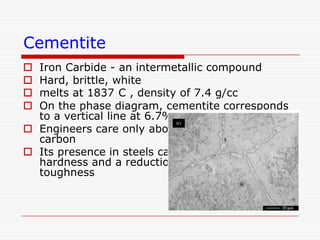
Cementite
Iron Carbide - an intermetallic compound
Hard, brittle, white
melts at 1837 C , density of 7.4 g/cc
On the phase diagram, cementite corresponds
to a vertical line at 6.7% C
 Engineers care only about compounds with less
carbon
 Its presence in steels causes an increase in
hardness and a reduction in ductility and
toughness




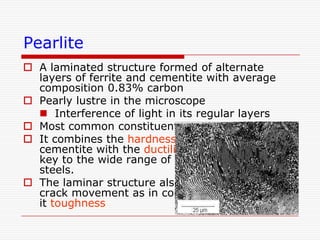
Pearlite
 A laminated structure formed of alternate
layers of ferrite and cementite with average
composition 0.83% carbon
 Pearly lustre in the microscope
 Interference of light in its regular layers
 Most common constituent of steel
 It combines the hardness and strength of
cementite with the ductility of ferrite and is the
key to the wide range of the properties of
steels.
 The laminar structure also acts as a barrier to
crack movement as in composites. This gives
it toughness
Phase Transformations
 Involve some alteration of microstructure
1. No change in number or composition of the
phases present, diffusion- dependent.
Solidification of pure metals, allotropic
transformation.
2. Some alteration in composition and no of
phases, diffusion – dependent. Eutectoid
reaction
3. A metastable phase is produced,
diffusionless. Martensitic transformation.
Phase Transformations
 At least one new phase is formed
 Do not occur instantaneously
 Begin by the formation of small particles
of new phase – nucleation
 Homogenous – occurs uniformly throughout
the parent phase.
 Hetrogenous – preferentially at grain
boundaries, impurities, dislocations

 Size of these particles increase in size
until completion - growth
Phase Transformations
 Dependent on
 Temperature
 Time
 Composition

 Require some finite time for completion
 Equilibrium is rarely achieved in solids
 Metastable – intermediate between
initial and equilibrium states.
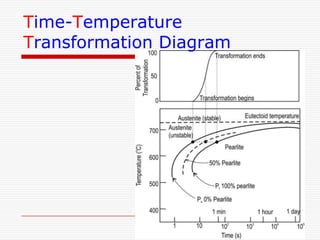
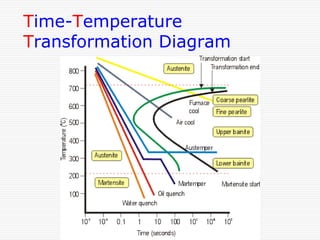
Time-Temperature
Transformation Diagram
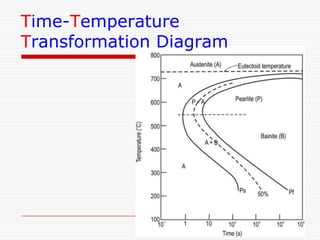
Time-Temperature
Transformation Diagram
Time-Temperature
Transformation Diagram
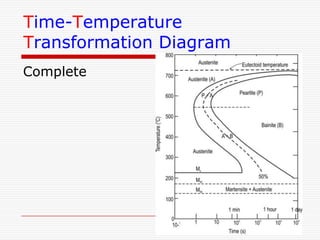
Complete
Time-Temperature
Transformation Diagram
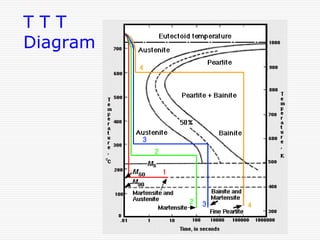
TTT
Diagram
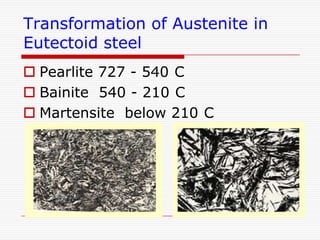
Transformation of Austenite in
Eutectoid steel
 Pearlite 727 - 540 C
 Bainite 540 - 210 C
 Martensite below 210 C
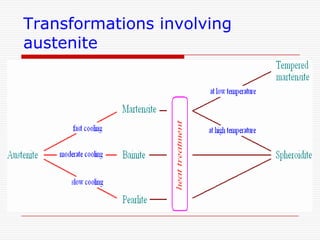
Transformations involving
austenite
CCT diagram
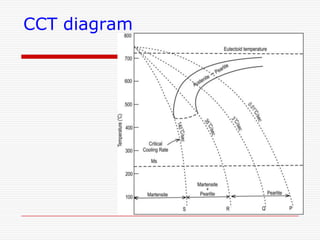
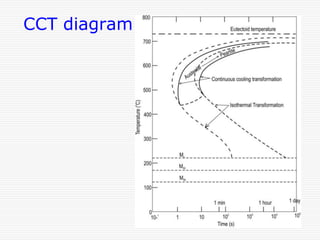
 Usually materials are cooled continuously, thus
Continuous Cooling Transformation diagrams
are appropriate than TTT diagrams
 For continuous cooling, the time required for a
reaction to begin and end is delayed, thus the
isothermal curves are shifted to longer times
and lower temperatures.
 Main difference between TTT and CCT
diagrams: no space for bainite in CCT diagram
as continuous cooling always results in
formation of pearlite.
CCT diagram
CCT diagram

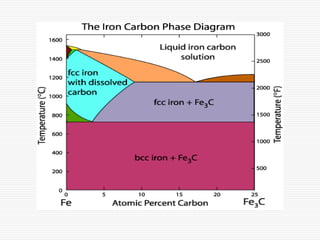
Iron Carbon Phase Diagram

  • 1.
    Metallurgy & Material Science Dr.S.Jose Professor,Dept of Mechanical Engg., TKM College of Engineering, Kollam
  • 2.
    Module II        Diffusion incrystals Theory of Alloys Equilibrium Diagrams Iron Carbon Phase diagram TTT Diagram Heat Treatment Recovery, Recrystallisation & Grain Growth 2
  • 3.
  • 4.
  • 5.
    Five individual phases a–ferrite (BCC) Fe-C solid solution  g-austenite (FCC) Fe-C solid solution  d-ferrite (BCC) Fe-C solid solution  Fe3C (Iron Carbide) or cementite – an inter-metallic compound  Liquid Fe-C solution
  • 6.
    Three invariant reactions Ahorizontal line always indicates an invariant reaction in binary phase diagrams  Peritectic reaction at 1495˚C and 0.18%C,  d-ferrite + L↔ g-iron (austenite)  Eutectic reaction at 1147˚C and 4.3 %C,  L ↔ g-iron + Fe3C (cementite) [ledeburite]  Eutectoid reaction at 727˚C and 0.77%C,  g-iron ↔ a–ferrite+Fe3C (cementite) [pearlite]
  • 7.
  • 9.
    Fe-C alloy classification Metals Ferrousmetals Steels Non-ferrous metals Cast Irons Plain carbon steels Grey Iron Low carbon steels White Iron Medium carbon steels Malleable & Ductile Irons High carbon steels Low alloy steels High alloy steels Stainless & Tool steels
  • 10.
    Fe-C alloy classification Fe-C alloys are classified according to wt.% C present in the alloys  Commercial pure irons % C < 0.008  Low-carbon steels 0.008 - %C - 0.3  Medium carbon steels 0.3 - %C - 0.8  High-carbon steels 0.8- %C - 2.14  Cast irons 2.14 < %C
  • 11.
    Cast irons  Castirons that were slowly cooled to room temperature consists of cementite, look whitish – white cast iron.  If it contains graphite, look grayish – gray cast iron.  It is heat treated to have graphite in form of nodules – malleable cast iron.  If inoculants are used in liquid state to have graphite nodules – spheroidal graphite (SG) cast iron.
  • 14.
    Eutectoid steel Eutectoid Reaction 727oC g ¾ cool¾® a + Fe3C ¾ 0.022 6.67 0.77 Pearlite
  • 15.
  • 16.
  • 17.
  • 18.
    Phase vs. Microconstituents A phase or a mixture of phases which has a distinct identity in a microstructure is called a microconstituent  Pearlite is not a phase.  It is a microconstituent and is a mixture of two phases a- Ferrite and Fe3C.
  • 19.
    a-Ferrite Known as a-iron Pure iron at room temperature Body-centered cubic structure Soft & ductile and imparts these properties to the steel.  Less than 0.01% carbon will dissolve in ferrite at room temperature  High temperature form is d ferrite, but the two forms are identical.  Pure ferritic steels are rare    
  • 20.
    Austenite      Known as g-iron Face-centered cubic Much softer than ferrite Not present at room temperatures. More easily hot worked
  • 21.
    Cementite Iron Carbide -an intermetallic compound Hard, brittle, white melts at 1837 C , density of 7.4 g/cc On the phase diagram, cementite corresponds to a vertical line at 6.7% C  Engineers care only about compounds with less carbon  Its presence in steels causes an increase in hardness and a reduction in ductility and toughness    
  • 22.
    Pearlite  A laminatedstructure formed of alternate layers of ferrite and cementite with average composition 0.83% carbon  Pearly lustre in the microscope  Interference of light in its regular layers  Most common constituent of steel  It combines the hardness and strength of cementite with the ductility of ferrite and is the key to the wide range of the properties of steels.  The laminar structure also acts as a barrier to crack movement as in composites. This gives it toughness
  • 24.
    Phase Transformations  Involvesome alteration of microstructure 1. No change in number or composition of the phases present, diffusion- dependent. Solidification of pure metals, allotropic transformation. 2. Some alteration in composition and no of phases, diffusion – dependent. Eutectoid reaction 3. A metastable phase is produced, diffusionless. Martensitic transformation.
  • 25.
    Phase Transformations  Atleast one new phase is formed  Do not occur instantaneously  Begin by the formation of small particles of new phase – nucleation  Homogenous – occurs uniformly throughout the parent phase.  Hetrogenous – preferentially at grain boundaries, impurities, dislocations  Size of these particles increase in size until completion - growth
  • 26.
    Phase Transformations  Dependenton  Temperature  Time  Composition  Require some finite time for completion  Equilibrium is rarely achieved in solids  Metastable – intermediate between initial and equilibrium states.
  • 27.
  • 28.
  • 29.
  • 30.
  • 31.
  • 32.
    Transformation of Austenitein Eutectoid steel  Pearlite 727 - 540 C  Bainite 540 - 210 C  Martensite below 210 C
  • 33.
  • 34.
    CCT diagram  Usuallymaterials are cooled continuously, thus Continuous Cooling Transformation diagrams are appropriate than TTT diagrams  For continuous cooling, the time required for a reaction to begin and end is delayed, thus the isothermal curves are shifted to longer times and lower temperatures.  Main difference between TTT and CCT diagrams: no space for bainite in CCT diagram as continuous cooling always results in formation of pearlite.
  • 35.
  • 36.