MP Advanced metallic materials
Diffusionless Martensitic Steels
Hitesh Sharma
Awais Qadir
Supervisor: Igor S. Golovin
MP Advanced metallic materials
Phase Transformation
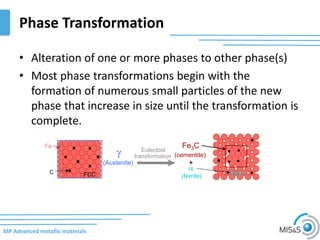
• Alteration of one or more phases to other phase(s)
• Most phase transformations begin with the
formation of numerous small particles of the new
phase that increase in size until the transformation is
complete.
Fe
g
(Austenite)
Eutectoid
transformation
C FCC
Fe3C
(cementite)
a
(ferrite)
+
(BCC)
MP Advanced metallic materials
Types of Phase Transformation
 Diffusion-independent with no change in composition or
number of phases present
(melting/solidification of pure metal,
allotropic transformations, recrystallization)
 Diffusion-dependent but changes in composition or
number of phase
( eutectoid transformations)
 Diffusionless  metastable phase by small displacements
of atoms in structure
(martensitic transformation discussed later)
MP Advanced metallic materials
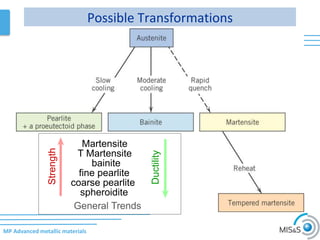
Strength
Ductility
Martensite
T Martensite
bainite
fine pearlite
coarse pearlite
spheroidite
General Trends
Possible Transformations
MP Advanced metallic materials
Diffusionless Transformation
• A diffusionless transformation is a phase change that
occurs without the long-range diffusion of atoms but
rather by some form of cooperative, homogeneous
movement of many atoms that results in a change in
crystal structure.
• These movements are small, usually less than the
interatomic distances, and the atoms maintain their
relative relationships.
• The ordered movement of large numbers of atoms lead
some to refer to these as military transformations in
contrast to civilian diffusion-based phase changes.
MP Advanced metallic materials
Martensitic Transformation
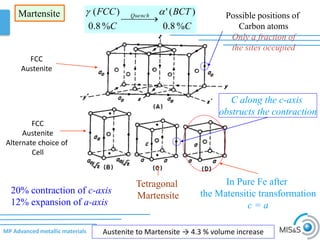
• Martensite: austenite quenched to room T
• Austenite martensite does not involve diffusion  no activation: athermal
transformation
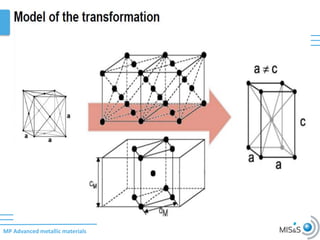
• Each atom displaces small (sub-atomic) distance to transform FCC g-Fe (austenite) to
martensite, a Body Centered Tetragonal (BCT) unit cell (like BCC, but one unit cell axis
longer than other two).
• Martensite is metastable - persists indefinitely at room T: transforms to equilibrium
phases on at elevated temperature
• Since martensite is a metastable phase, it does not appear in phase Fe-C phase
diagram.
• The amount of martensite formed is a function of the temperature to
which the sample is quenched and not of time.
• The shear changes the shape of the transforming region:
→ results in considerable amount of shear energy
→ plate-like shape of Martensite
MP Advanced metallic materials 7
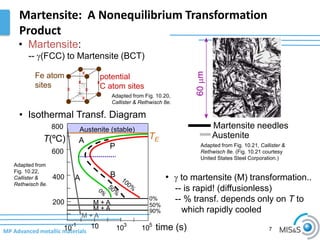
• Martensite:
-- g(FCC) to Martensite (BCT)
Adapted from Fig. 10.21, Callister &
Rethwisch 8e. (Fig. 10.21 courtesy
United States Steel Corporation.)
Adapted from Fig. 10.20,
Callister & Rethwisch 8e.
Martensite: A Nonequilibrium Transformation
Product
Martensite needles
Austenite
60m
x
x x
x
x
x
potential
C atom sites
Fe atom
sites
Adapted from
Fig. 10.22,
Callister &
Rethwisch 8e.
• Isothermal Transf. Diagram
• g to martensite (M) transformation..
-- is rapid! (diffusionless)
-- % transf. depends only on T to
which rapidly cooled
10 103
105
time (s)10-1
400
600
800
T(ºC)
Austenite (stable)
200
P
B
TEA
A
M + A
M + A
M + A
0%
50%
90%
MP Advanced metallic materials
Martensite
FCC
Austenite
FCC
Austenite
Alternate choice of
Cell
Tetragonal
Martensite
Austenite to Martensite → 4.3 % volume increase
Possible positions of
Carbon atoms
Only a fraction of
the sites occupied
20% contraction of c-axis
12% expansion of a-axis
In Pure Fe after
the Matensitic transformation
c = a
C along the c-axis
obstructs the contraction
C
BCT
C
FCC Quench
%8.0
)('
%8.0
)( ag
 
MP Advanced metallic materials
MP Advanced metallic materials10
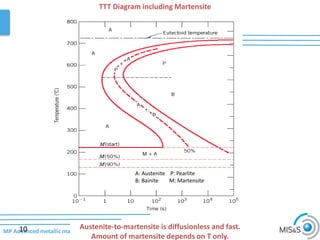
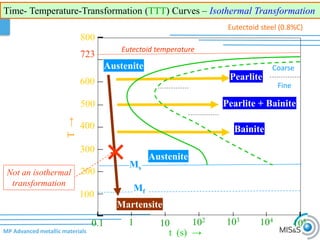
TTT Diagram including Martensite
Austenite-to-martensite is diffusionless and fast.
Amount of martensite depends on T only.
A: Austenite P: Pearlite
B: Bainite M: Martensite
MP Advanced metallic materials
Austenite
Austenite
Pearlite
Pearlite + Bainite
Bainite
Martensite
100
200
300
400
600
500
800
723
0.1 1 10 102 103 104
105
Eutectoid temperature

Not an isothermal
transformation
Ms
Mf
Coarse
Fine
t (s) →
T→
Time- Temperature-Transformation (TTT) Curves – Isothermal Transformation
Eutectoid steel (0.8%C)
MP Advanced metallic materials12
Tempered Martensite
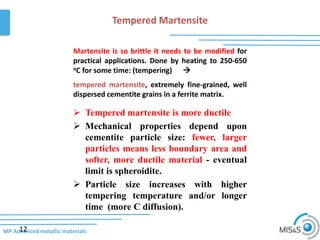
Martensite is so brittle it needs to be modified for
practical applications. Done by heating to 250-650
oC for some time: (tempering) 
tempered martensite, extremely fine-grained, well
dispersed cementite grains in a ferrite matrix.
 Tempered martensite is more ductile
 Mechanical properties depend upon
cementite particle size: fewer, larger
particles means less boundary area and
softer, more ductile material - eventual
limit is spheroidite.
 Particle size increases with higher
tempering temperature and/or longer
time (more C diffusion).
MP Advanced metallic materials
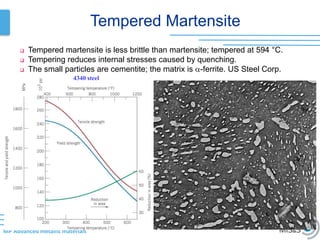
 Tempered martensite is less brittle than martensite; tempered at 594 °C.
 Tempering reduces internal stresses caused by quenching.
 The small particles are cementite; the matrix is a-ferrite. US Steel Corp.
Tempered Martensite
4340 steel
MP Advanced metallic materials
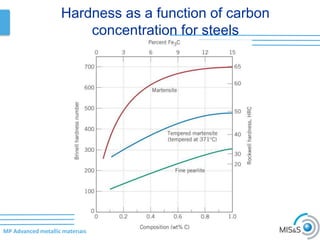
Hardness as a function of carbon
concentration for steels
MP Advanced metallic materials
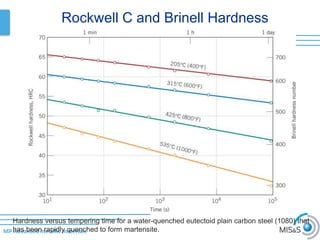
Hardness versus tempering time for a water-quenched eutectoid plain carbon steel (1080) that
has been rapidly quenched to form martensite.
Rockwell C and Brinell Hardness
MP Advanced metallic materials
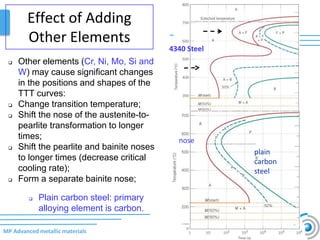
 Other elements (Cr, Ni, Mo, Si and
W) may cause significant changes
in the positions and shapes of the
TTT curves:
 Change transition temperature;
 Shift the nose of the austenite-to-
pearlite transformation to longer
times;
 Shift the pearlite and bainite noses
to longer times (decrease critical
cooling rate);
 Form a separate bainite nose;
Effect of Adding
Other Elements
4340 Steel
plain
carbon
steel
nose
 Plain carbon steel: primary
alloying element is carbon.
MP Advanced metallic materials
Effect of Alloying Elements
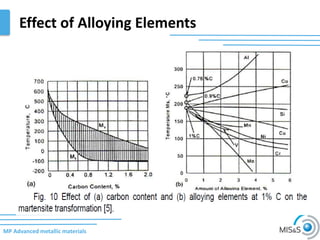
• Most alloying elements which enter into solid
solution in austenite lower the martensite start
temperature (Ms), with the exception of Co and Al.
MP Advanced metallic materials
Effect of Alloying Elements
MP Advanced metallic materials
Thanks
Спасибо
धन्यवाद
‫شکریہ‬