HARDENABILITY
Hardenability
• The ability of an alloy to be hardened by the
formation of martensite as a results of a given
heat treatment. It is a qualitative measure of the
rate at which hardness drops off with distance
into the interior of a specimen as a result of
diminished martensite content. Steels with high
hardenabilityform martensite even on slow
cooling. It can be tested experimentally bythe
Jominy End-Quench
Heat Treatment of Steels: Hardenability
• Hardenability is the capability of an alloy steel to form
martensite as a result of a given heat treatment
• NOTE: hardness  hardenabilty.
• High hardenability in a steel means that the steel
forms martensite not only at surface but to a large
degree throughout the interior.
• Hardenability more related to depth of hardness of a
steel upon heat treat.
• The depth of hardening in a plain carbon steel may be
2-3 mm vs 50 mm in an alloy steel
3
Heat Treatment of Steels: Hardenability
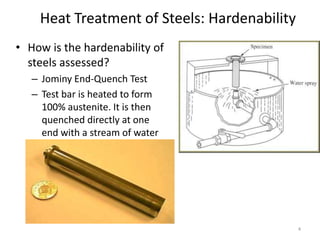
• How is the hardenability of
steels assessed?
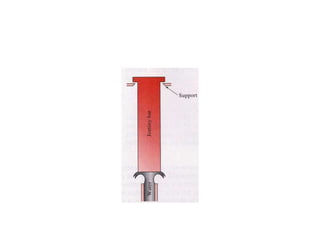
– Jominy End-Quench Test
– Test bar is heated to form
100% austenite. It is then
quenched directly at one
end with a stream of water

4
Jominy Test
Generally, the faster steel cools, the harder it will be.
The Jominy bar measures the hardenbility of a steel

Softest

Hardest
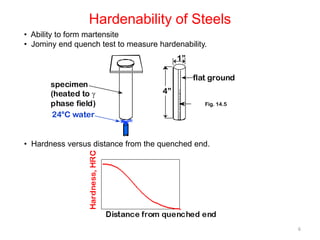
Hardenability of Steels
• Ability to form martensite
• Jominy end quench test to measure hardenability.
1”
specimen
(heated to 
phase field)
24°C water

flat ground
4”
Fig. 14.5

• Hardness versus distance from the quenched end.

6
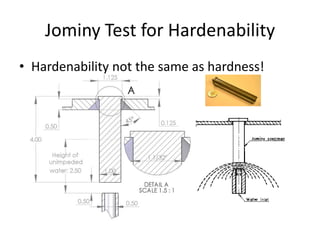
Jominy Test for Hardenability
• Hardenability not the same as hardness!
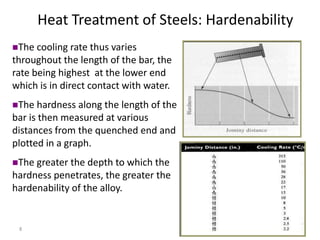
Heat Treatment of Steels: Hardenability
The

cooling rate thus varies
throughout the length of the bar, the
rate being highest at the lower end
which is in direct contact with water.
The

hardness along the length of the
bar is then measured at various
distances from the quenched end and
plotted in a graph.
The

greater the depth to which the
hardness penetrates, the greater the
hardenability of the alloy.

8
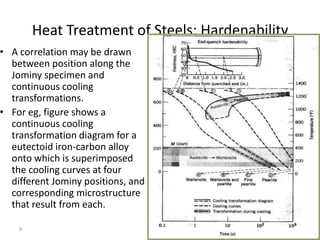
Heat Treatment of Steels: Hardenability

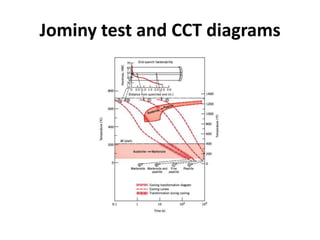
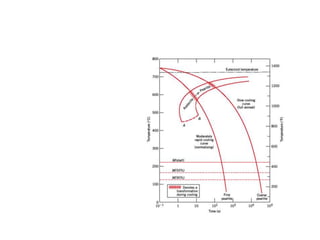
• A correlation may be drawn
between position along the
Jominy specimen and
continuous cooling
transformations.
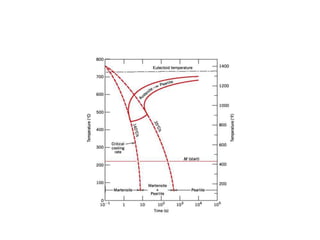
• For eg, figure shows a
continuous cooling
transformation diagram for a
eutectoid iron-carbon alloy
onto which is superimposed
the cooling curves at four
different Jominy positions, and
corresponding microstructure
that result from each.
9
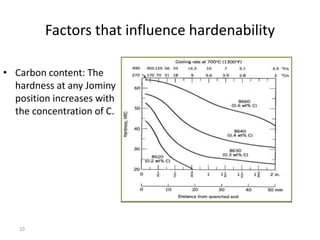
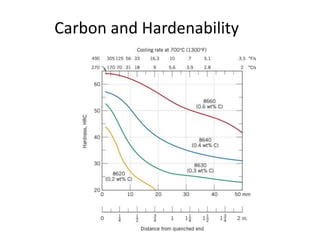
Factors that influence hardenability
• Carbon content: The
hardness at any Jominy
position increases with
the concentration of C.

10
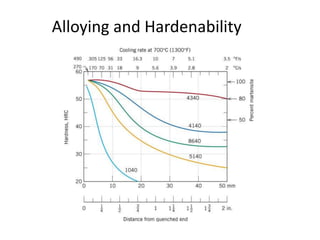
Alloying and Hardenability
Carbon and Hardenability
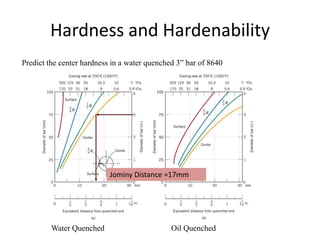
Hardness and Hardenability
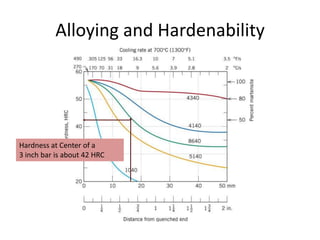
Predict the center hardness in a water quenched 3” bar of 8640

Jominy Distance =17mm

Water Quenched

Oil Quenched
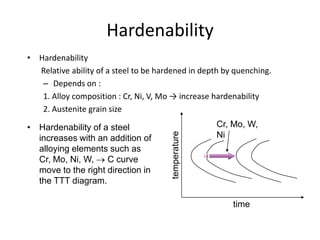
Hardenability

• Hardenability of a steel
increases with an addition of
alloying elements such as
Cr, Mo, Ni, W,  C curve
move to the right direction in
the TTT diagram.

temperature

• Hardenability
Relative ability of a steel to be hardened in depth by quenching.
– Depends on :
1. Alloy composition : Cr, Ni, V, Mo → increase hardenability
2. Austenite grain size
Cr, Mo, W,
Ni

time
Alloying and Hardenability

Hardness at Center of a
3 inch bar is about 42 HRC
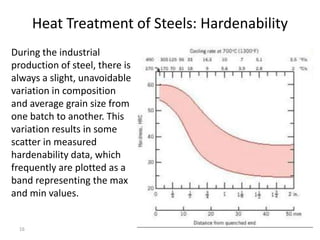
Heat Treatment of Steels: Hardenability
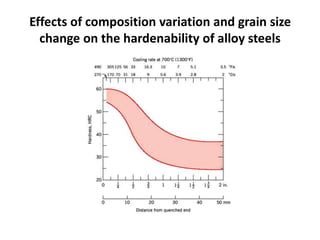
During the industrial
production of steel, there is
always a slight, unavoidable
variation in composition
and average grain size from
one batch to another. This
variation results in some
scatter in measured
hardenability data, which
frequently are plotted as a
band representing the max
and min values.

16
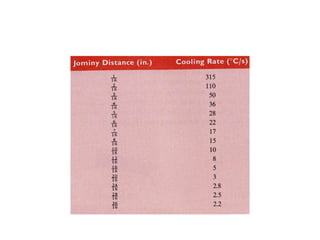
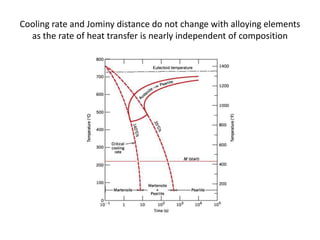
Cooling rate and Jominy distance do not change with alloying elements
as the rate of heat transfer is nearly independent of composition
Jominy test and CCT diagrams
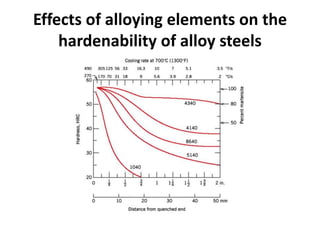
Effects of alloying elements on the
hardenability of alloy steels
• Example: Next slide, all alloys have 0.4wt% C, but
with different alloying elements.(1)At the quenched
end all alloys have thesame hardness, which is a
function of carbon content only.(2)The hardenability
of the 1040 is low because the hardness of the alloy
drops rapidly with Jominy distance. The drop of
hardness with Jominy distance for the other alloys is
more gradual.(3)The alloying elements delay the
austenite􀃆pearlite and/or bainite reactions, which
permits more martensite to form for a particular
cooling rate, yielding a greater hardness.
Effects of alloying elements on the
hardenability of alloy steels
Effects of carbon content on the
hardenability of alloy steels
Effects of composition variation and grain size change
on the hardenability of alloy steels

• The industrial products of steels may change
composition and average grain size from
batch to batch, there fore, the measured
hardenability of a given type of steel should
be presented as a band rather than a single
line, as demonstrated by the Figure at right.
Effects of composition variation and grain size
change on the hardenability of alloy steels
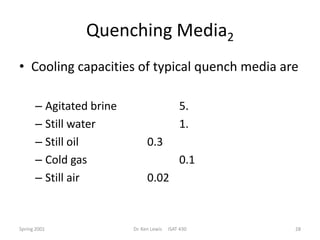
Quenching Media
• The fluid used for quenching the heated alloy
effects the hardenability.
– Each fluid has its own thermal properties
• Thermal conductivity
• Specific heat
• Heat of vaporization

– These cause rate of cooling differences

Spring 2001

Dr. Ken Lewis

ISAT 430

27
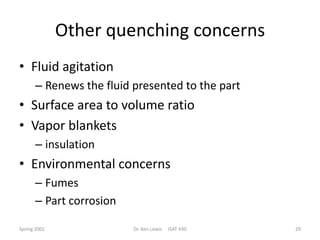
Quenching Media2
• Cooling capacities of typical quench media are
– Agitated brine
– Still water
– Still oil
– Cold gas
– Still air

Spring 2001

5.
1.

0.3
0.1
0.02

Dr. Ken Lewis

ISAT 430

28
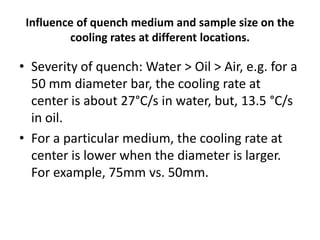
Other quenching concerns
• Fluid agitation
– Renews the fluid presented to the part

• Surface area to volume ratio
• Vapor blankets
– insulation

• Environmental concerns
– Fumes

– Part corrosion
Spring 2001

Dr. Ken Lewis

ISAT 430

29
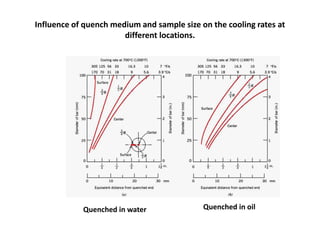
Influence of quench medium and sample size on the
cooling rates at different locations.

• Severity of quench: Water > Oil > Air, e.g. for a
50 mm diameter bar, the cooling rate at
center is about 27°C/s in water, but, 13.5 °C/s
in oil.
• For a particular medium, the cooling rate at
center is lower when the diameter is larger.
For example, 75mm vs. 50mm.
Influence of quench medium and sample size on the cooling rates at
different locations.

Quenched in water

Quenched in oil
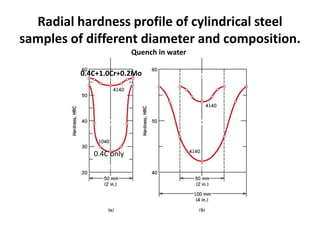
Radial hardness profile of cylindrical steel
samples of different diameter and composition.
Quench in water
0.4C+1.0Cr+0.2Mo

0.4C only
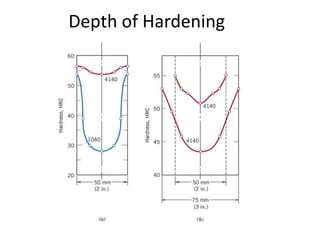
Depth of Hardening
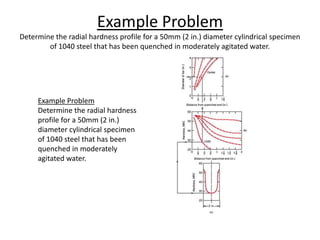
Example Problem
Determine the radial hardness profile for a 50mm (2 in.) diameter cylindrical specimen
of 1040 steel that has been quenched in moderately agitated water.

Example Problem
Determine the radial hardness
profile for a 50mm (2 in.)
diameter cylindrical specimen
of 1040 steel that has been
quenched in moderately
agitated water.
Thanks

hardenability

  • 1.
  • 2.
    Hardenability • The abilityof an alloy to be hardened by the formation of martensite as a results of a given heat treatment. It is a qualitative measure of the rate at which hardness drops off with distance into the interior of a specimen as a result of diminished martensite content. Steels with high hardenabilityform martensite even on slow cooling. It can be tested experimentally bythe Jominy End-Quench
  • 3.
    Heat Treatment ofSteels: Hardenability • Hardenability is the capability of an alloy steel to form martensite as a result of a given heat treatment • NOTE: hardness  hardenabilty. • High hardenability in a steel means that the steel forms martensite not only at surface but to a large degree throughout the interior. • Hardenability more related to depth of hardness of a steel upon heat treat. • The depth of hardening in a plain carbon steel may be 2-3 mm vs 50 mm in an alloy steel 3
  • 4.
    Heat Treatment ofSteels: Hardenability • How is the hardenability of steels assessed? – Jominy End-Quench Test – Test bar is heated to form 100% austenite. It is then quenched directly at one end with a stream of water 4
  • 5.
    Jominy Test Generally, thefaster steel cools, the harder it will be. The Jominy bar measures the hardenbility of a steel Softest Hardest
  • 6.
    Hardenability of Steels •Ability to form martensite • Jominy end quench test to measure hardenability. 1” specimen (heated to  phase field) 24°C water flat ground 4” Fig. 14.5 • Hardness versus distance from the quenched end. 6
  • 7.
    Jominy Test forHardenability • Hardenability not the same as hardness!
  • 8.
    Heat Treatment ofSteels: Hardenability The cooling rate thus varies throughout the length of the bar, the rate being highest at the lower end which is in direct contact with water. The hardness along the length of the bar is then measured at various distances from the quenched end and plotted in a graph. The greater the depth to which the hardness penetrates, the greater the hardenability of the alloy. 8
  • 9.
    Heat Treatment ofSteels: Hardenability • A correlation may be drawn between position along the Jominy specimen and continuous cooling transformations. • For eg, figure shows a continuous cooling transformation diagram for a eutectoid iron-carbon alloy onto which is superimposed the cooling curves at four different Jominy positions, and corresponding microstructure that result from each. 9
  • 10.
    Factors that influencehardenability • Carbon content: The hardness at any Jominy position increases with the concentration of C. 10
  • 11.
  • 12.
  • 13.
    Hardness and Hardenability Predictthe center hardness in a water quenched 3” bar of 8640 Jominy Distance =17mm Water Quenched Oil Quenched
  • 14.
    Hardenability • Hardenability ofa steel increases with an addition of alloying elements such as Cr, Mo, Ni, W,  C curve move to the right direction in the TTT diagram. temperature • Hardenability Relative ability of a steel to be hardened in depth by quenching. – Depends on : 1. Alloy composition : Cr, Ni, V, Mo → increase hardenability 2. Austenite grain size Cr, Mo, W, Ni time
  • 15.
    Alloying and Hardenability Hardnessat Center of a 3 inch bar is about 42 HRC
  • 16.
    Heat Treatment ofSteels: Hardenability During the industrial production of steel, there is always a slight, unavoidable variation in composition and average grain size from one batch to another. This variation results in some scatter in measured hardenability data, which frequently are plotted as a band representing the max and min values. 16
  • 20.
    Cooling rate andJominy distance do not change with alloying elements as the rate of heat transfer is nearly independent of composition
  • 21.
    Jominy test andCCT diagrams
  • 22.
    Effects of alloyingelements on the hardenability of alloy steels • Example: Next slide, all alloys have 0.4wt% C, but with different alloying elements.(1)At the quenched end all alloys have thesame hardness, which is a function of carbon content only.(2)The hardenability of the 1040 is low because the hardness of the alloy drops rapidly with Jominy distance. The drop of hardness with Jominy distance for the other alloys is more gradual.(3)The alloying elements delay the austenite􀃆pearlite and/or bainite reactions, which permits more martensite to form for a particular cooling rate, yielding a greater hardness.
  • 23.
    Effects of alloyingelements on the hardenability of alloy steels
  • 24.
    Effects of carboncontent on the hardenability of alloy steels
  • 25.
    Effects of compositionvariation and grain size change on the hardenability of alloy steels • The industrial products of steels may change composition and average grain size from batch to batch, there fore, the measured hardenability of a given type of steel should be presented as a band rather than a single line, as demonstrated by the Figure at right.
  • 26.
    Effects of compositionvariation and grain size change on the hardenability of alloy steels
  • 27.
    Quenching Media • Thefluid used for quenching the heated alloy effects the hardenability. – Each fluid has its own thermal properties • Thermal conductivity • Specific heat • Heat of vaporization – These cause rate of cooling differences Spring 2001 Dr. Ken Lewis ISAT 430 27
  • 28.
    Quenching Media2 • Coolingcapacities of typical quench media are – Agitated brine – Still water – Still oil – Cold gas – Still air Spring 2001 5. 1. 0.3 0.1 0.02 Dr. Ken Lewis ISAT 430 28
  • 29.
    Other quenching concerns •Fluid agitation – Renews the fluid presented to the part • Surface area to volume ratio • Vapor blankets – insulation • Environmental concerns – Fumes – Part corrosion Spring 2001 Dr. Ken Lewis ISAT 430 29
  • 30.
    Influence of quenchmedium and sample size on the cooling rates at different locations. • Severity of quench: Water > Oil > Air, e.g. for a 50 mm diameter bar, the cooling rate at center is about 27°C/s in water, but, 13.5 °C/s in oil. • For a particular medium, the cooling rate at center is lower when the diameter is larger. For example, 75mm vs. 50mm.
  • 31.
    Influence of quenchmedium and sample size on the cooling rates at different locations. Quenched in water Quenched in oil
  • 32.
    Radial hardness profileof cylindrical steel samples of different diameter and composition. Quench in water 0.4C+1.0Cr+0.2Mo 0.4C only
  • 33.
  • 34.
    Example Problem Determine theradial hardness profile for a 50mm (2 in.) diameter cylindrical specimen of 1040 steel that has been quenched in moderately agitated water. Example Problem Determine the radial hardness profile for a 50mm (2 in.) diameter cylindrical specimen of 1040 steel that has been quenched in moderately agitated water.
  • 36.