CLASSIFICATION OF ELEMENTS & PERIODICITYIN PROPERTIES


          BY :- VIVEK KUMAR
            :- BS-MS ( 1ST YEAR)
            :- SCHOOL OF BASIC SCIENCES & RESEARCHES
Content
   Mendeleev’s Periodic Table
   Modern’s Periodic Table

   Periodicity & Cause of Periodicty
   Atomic Radius
o   Co-valent Radius
o   Vander Wall’s Radius
o   Metallic Radius
   Ionic Radius
o   Cation
o   Anion
   Ionization Enthalpy / Energy
   Electron Gain Enthalpy
ELECTRONEGATIVITY
VALENCY
Mendeleev’s Periodic Table
 Mendeleev’s arrange them known 63 elements in order of
  their increasing atomic mass and observed regularity in
  properties of elements .
 Among chemical properties mainly considered Oxides &
  Hydrides
 Mendeleev’s Periodic Law

o “Physical & Chemical properties of elements are periodic
  function of their atomic masses’’
  Achievements
 More systematic and easy approached .

 Correction of atomic mass of few elements on the basis of
  position of elements in periodic table Mendeleev corrected
  atomic masses of few elements.
 Production of few elements
Predicted eka-Boron eka-Aluminium eks-silicon
Later           Scandium          Gallium               Germanium
Discovered
  Limitations
o Position of hydrogen was not justified as it represents to both
  alkali metals (1st group) (Li, Na, K….etc) & halogens (Cl , Br,
  F).
o Position of Isotopes could not be justified as these are the
  atoms of same elements having same atomic no. but
  different atomic mass.
o Some of the elements with dissimilar properties where put together.

Eg:- Coinage metal like Cu,Ag & Au where arreanged with alkali metals .
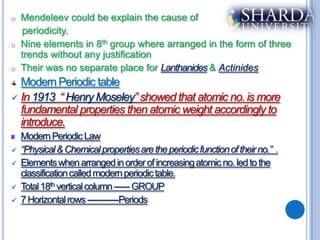
o   Mendeleev could be explain the cause of
    periodicity.
o   Nine elements in 8th group where arranged in the form of three
    trends without any justification
o   Their was no separate place for Lanthanides & Actinides
  Modern Periodic table
 In 1913 “ Henry Moseley” showed that atomic no. is more
  fundamental properties then atomic weight accordingly to
  introduce.
    Modern Periodic Law
   “Physical & Chemical properties are the periodic function of their no.” .
   Elements when arranged in order of increasing atomic no. led to the
    classification called modern periodic table.
   Total 18th vertical column ------ GROUP
   7 Horizontal rows ------------Periods
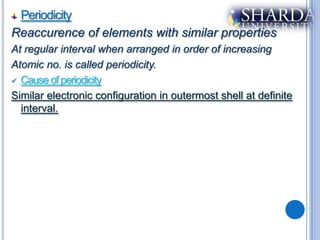
Periodicity
Reaccurence of elements with similar properties
At regular interval when arranged in order of increasing
Atomic no. is called periodicity.
 Cause of periodicity

Similar electronic configuration in outermost shell at definite
  interval.
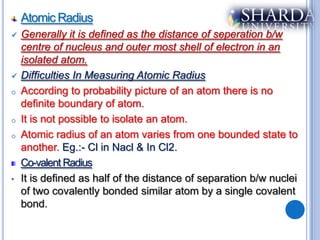
Atomic Radius
   Generally it is defined as the distance of seperation b/w
    centre of nucleus and outer most shell of electron in an
    isolated atom.
   Difficulties In Measuring Atomic Radius
o   According to probability picture of an atom there is no
    definite boundary of atom.
o   It is not possible to isolate an atom.
o   Atomic radius of an atom varies from one bounded state to
    another. Eg.:- Cl in Nacl & In Cl2.
    Co-valent Radius
•   It is defined as half of the distance of separation b/w nuclei
    of two covalently bonded similar atom by a single covalent
    bond.
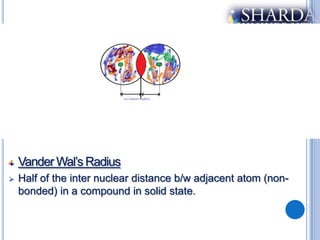
Vander Wal’s Radius
   Half of the inter nuclear distance b/w adjacent atom (non-
    bonded) in a compound in solid state.
 It is also known as inert gas radii because
   radius of nobel gases is always measured in term of Rvw
Because they are generally not involved in bond formation.
(except Xe , Kr).
  Metallic Radius
  Half of the inter nuclear distance separating metal
  cores in a metallic crystals.
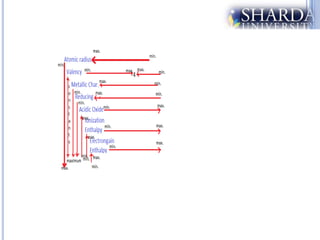
  General trends
o Across period L to R

 ( Atomic radius decreases due to increases in
  effective nuclear charge which tends to pull electron
  cloud closer.
o Down the group atomic radius increases due
To increases in no. of shells and decreases in effective
Nuclear charge.
 Shielding Effects

The inner electron screen the outer electron from nuclear
 attraction.
    Ionic Radius
    It is defined as the distance from centre of nucleus
    up to which it interfaces the ionic bond (e- cloud).
    Cation
    Cation is always smaller than parent atom ( due to decreases in no. of
    electron nuclear attraction per electron increases)
Anion
    Anion is greater than parent atom ( due to increases in no. of
    electron per e- nuclear attraction decreases and hence e-
    cloud moves furthers.
    Ionization Enthalpy / Energy
    The amount of energy required to remove an electron from
    outer most shell of isolated gases atom . So as to convert it
    into gases +ve ions.
    Endothermic always +ve
    Factors effecting Ionization Enthalpy
o   Ionization Enthalpy is directly proportional to Nuclear charge
o   Ionization Enthalpy is inversely proportional to size
o   Ionization Enthalpy is inversely proportional to shielding
    effect.
o   Electronic Arrangement
o   Half field and fully field orbital shows extra stability and hence
    have higher Ionization Energy.
  Successive Ionization Energy
Ionization Energy is always higher ( energy required to
  remove subsequent electron.
 Mg--Mg+Mg2+
      IE1     IE2
    Electron gain Enthalpy
    The amount of energy released when an extra electron is
    added to isolated neutral gases atom . So as to convert it in to
    gases –ve ions .
    Depending upon the process is exo or endothermic .
     O+e-  O- + e-
    ( released energy) (provide energy)
   Higher the magnitude of electron gain
    Enthalpy more is the tendency of an atom to gain an e-
    and besides this it is also important to retain an e- . The
    highest –ve values are Halogens .
    Factors Effecting of Electron gain Enthalpy
    Electron gain Enthalpy is inversely proportional to atomic
    sizes .
    Electron gain Enthalpy is directly proportional to Nuclear
    charge.
    Electronic Arrangement
    Atoms of element having half field & fully field orbital have
    very low magnitude of Electron gain Enthalpy.
    Successive Electron gain Enthalpy
    O + e-  O- (-ve) ( exothermic)
    O- + e-  O2-(+ve) (endothermic)
Repulsion  overcome + energy is required
Electro negativity
The tendency of an atom to attract shared paired of
electron towards itself is called electro negativity.
Classification of elements & periodicity in properties

Classification of elements & periodicity in properties

  • 1.
    CLASSIFICATION OF ELEMENTS& PERIODICITYIN PROPERTIES BY :- VIVEK KUMAR :- BS-MS ( 1ST YEAR) :- SCHOOL OF BASIC SCIENCES & RESEARCHES
  • 2.
    Content  Mendeleev’s Periodic Table  Modern’s Periodic Table  Periodicity & Cause of Periodicty  Atomic Radius o Co-valent Radius o Vander Wall’s Radius o Metallic Radius  Ionic Radius o Cation o Anion  Ionization Enthalpy / Energy  Electron Gain Enthalpy
  • 3.
  • 4.
    Mendeleev’s Periodic Table Mendeleev’s arrange them known 63 elements in order of their increasing atomic mass and observed regularity in properties of elements .  Among chemical properties mainly considered Oxides & Hydrides  Mendeleev’s Periodic Law o “Physical & Chemical properties of elements are periodic function of their atomic masses’’ Achievements  More systematic and easy approached .  Correction of atomic mass of few elements on the basis of position of elements in periodic table Mendeleev corrected atomic masses of few elements.
  • 5.
     Production offew elements Predicted eka-Boron eka-Aluminium eks-silicon Later Scandium Gallium Germanium Discovered Limitations o Position of hydrogen was not justified as it represents to both alkali metals (1st group) (Li, Na, K….etc) & halogens (Cl , Br, F). o Position of Isotopes could not be justified as these are the atoms of same elements having same atomic no. but different atomic mass. o Some of the elements with dissimilar properties where put together. Eg:- Coinage metal like Cu,Ag & Au where arreanged with alkali metals .
  • 6.
    o Mendeleev could be explain the cause of periodicity. o Nine elements in 8th group where arranged in the form of three trends without any justification o Their was no separate place for Lanthanides & Actinides Modern Periodic table  In 1913 “ Henry Moseley” showed that atomic no. is more fundamental properties then atomic weight accordingly to introduce. Modern Periodic Law  “Physical & Chemical properties are the periodic function of their no.” .  Elements when arranged in order of increasing atomic no. led to the classification called modern periodic table.  Total 18th vertical column ------ GROUP  7 Horizontal rows ------------Periods
  • 7.
    Periodicity Reaccurence of elementswith similar properties At regular interval when arranged in order of increasing Atomic no. is called periodicity.  Cause of periodicity Similar electronic configuration in outermost shell at definite interval.
  • 9.
    Atomic Radius  Generally it is defined as the distance of seperation b/w centre of nucleus and outer most shell of electron in an isolated atom.  Difficulties In Measuring Atomic Radius o According to probability picture of an atom there is no definite boundary of atom. o It is not possible to isolate an atom. o Atomic radius of an atom varies from one bounded state to another. Eg.:- Cl in Nacl & In Cl2. Co-valent Radius • It is defined as half of the distance of separation b/w nuclei of two covalently bonded similar atom by a single covalent bond.
  • 10.
    Vander Wal’s Radius  Half of the inter nuclear distance b/w adjacent atom (non- bonded) in a compound in solid state.
  • 11.
     It isalso known as inert gas radii because radius of nobel gases is always measured in term of Rvw Because they are generally not involved in bond formation. (except Xe , Kr). Metallic Radius Half of the inter nuclear distance separating metal cores in a metallic crystals. General trends o Across period L to R ( Atomic radius decreases due to increases in effective nuclear charge which tends to pull electron cloud closer.
  • 12.
    o Down thegroup atomic radius increases due To increases in no. of shells and decreases in effective Nuclear charge.  Shielding Effects The inner electron screen the outer electron from nuclear attraction. Ionic Radius It is defined as the distance from centre of nucleus up to which it interfaces the ionic bond (e- cloud). Cation Cation is always smaller than parent atom ( due to decreases in no. of electron nuclear attraction per electron increases)
  • 13.
    Anion Anion is greater than parent atom ( due to increases in no. of electron per e- nuclear attraction decreases and hence e- cloud moves furthers. Ionization Enthalpy / Energy The amount of energy required to remove an electron from outer most shell of isolated gases atom . So as to convert it into gases +ve ions. Endothermic always +ve Factors effecting Ionization Enthalpy o Ionization Enthalpy is directly proportional to Nuclear charge o Ionization Enthalpy is inversely proportional to size o Ionization Enthalpy is inversely proportional to shielding effect.
  • 14.
    o Electronic Arrangement o Half field and fully field orbital shows extra stability and hence have higher Ionization Energy. Successive Ionization Energy Ionization Energy is always higher ( energy required to remove subsequent electron. Mg--Mg+Mg2+ IE1 IE2 Electron gain Enthalpy The amount of energy released when an extra electron is added to isolated neutral gases atom . So as to convert it in to gases –ve ions . Depending upon the process is exo or endothermic . O+e-  O- + e- ( released energy) (provide energy)
  • 15.
    Higher the magnitude of electron gain Enthalpy more is the tendency of an atom to gain an e- and besides this it is also important to retain an e- . The highest –ve values are Halogens . Factors Effecting of Electron gain Enthalpy Electron gain Enthalpy is inversely proportional to atomic sizes . Electron gain Enthalpy is directly proportional to Nuclear charge. Electronic Arrangement Atoms of element having half field & fully field orbital have very low magnitude of Electron gain Enthalpy. Successive Electron gain Enthalpy O + e-  O- (-ve) ( exothermic) O- + e-  O2-(+ve) (endothermic) Repulsion  overcome + energy is required
  • 16.
    Electro negativity The tendencyof an atom to attract shared paired of electron towards itself is called electro negativity.