CONTINUOSLY
COOLING
TRANFORMATION (CCT)
 Introduction
 CCT Diagram for Fe – C
 Carbon Contain and Its Effect On Mechanical
Properties
 Factors Affecting CCT Curve
 Reference
There are two types of CCT diagrams
 Plot of (for each type of transformation)
transformation start, specific fraction of transformation
and transformation finish temperature against
transformation time on each cooling curve
 Plot of (for each type of transformation)
transformation start, specific fraction of transformation
and transformation finish temperature against cooling
rate or bar diameter for each type of cooling medium
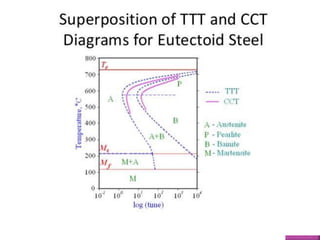
 It measure the extent of transformation as a function
of time for a continuously decreasing temperature.
 Usually materials are cooled continuously, thus
Continuous Cooling Transformation diagrams are
appropriate.
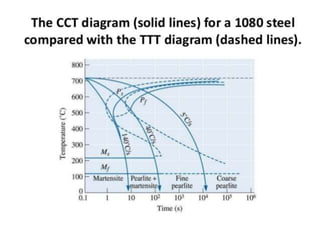
 For continuous cooling, the time required for a reaction
to begin and end is delayed, thus the isothermal curves are
shifted to longer times and lower temperatures
 Main difference between TTT and CCT diagrams: no space
for bainite in CCT diagram as continuous cooling always results in
formation of pearlite.
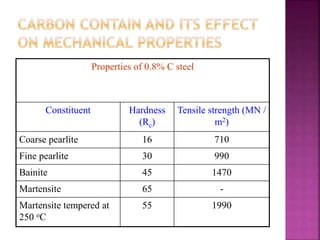
Properties of 0.8% C steel
Constituent Hardness
(Rc)
Tensile strength (MN /
m2)
Coarse pearlite 16 710
Fine pearlite 30 990
Bainite 45 1470
Martensite 65 -
Martensite tempered at
250 oC
55 1990
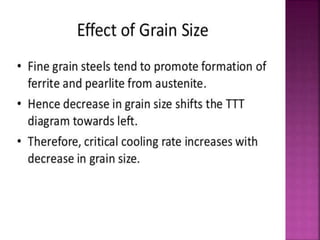
 Grain size
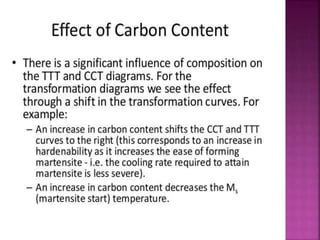
 Carbon content
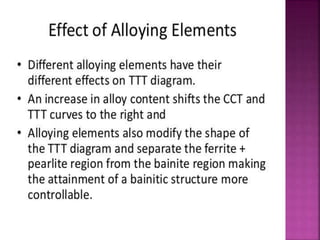
 Alloying elements
 www.msm.cam.ac.uk/phase-
trans/2012/Manna/Part3.ppt
 www.dss.nitc.ac.in/.../32%20TTT%20AND%20
CCT%20DIAGRAMS.ppt
 nptel.ac.in/courses/Webcourse-
contents/IISc.../PPTs/MTS_07_m.pdf
 www.csun.edu/~bavarian/Courses/.../Lectur
es.../ch11_Phase_Transf.ppt
COOLING CURVE TRANSFORMATION DIAGRAM

COOLING CURVE TRANSFORMATION DIAGRAM

  • 1.
  • 2.
     Introduction  CCTDiagram for Fe – C  Carbon Contain and Its Effect On Mechanical Properties  Factors Affecting CCT Curve  Reference
  • 3.
    There are twotypes of CCT diagrams  Plot of (for each type of transformation) transformation start, specific fraction of transformation and transformation finish temperature against transformation time on each cooling curve  Plot of (for each type of transformation) transformation start, specific fraction of transformation and transformation finish temperature against cooling rate or bar diameter for each type of cooling medium
  • 4.
     It measurethe extent of transformation as a function of time for a continuously decreasing temperature.  Usually materials are cooled continuously, thus Continuous Cooling Transformation diagrams are appropriate.  For continuous cooling, the time required for a reaction to begin and end is delayed, thus the isothermal curves are shifted to longer times and lower temperatures  Main difference between TTT and CCT diagrams: no space for bainite in CCT diagram as continuous cooling always results in formation of pearlite.
  • 6.
    Properties of 0.8%C steel Constituent Hardness (Rc) Tensile strength (MN / m2) Coarse pearlite 16 710 Fine pearlite 30 990 Bainite 45 1470 Martensite 65 - Martensite tempered at 250 oC 55 1990
  • 8.
     Grain size Carbon content  Alloying elements
  • 12.
     www.msm.cam.ac.uk/phase- trans/2012/Manna/Part3.ppt  www.dss.nitc.ac.in/.../32%20TTT%20AND%20 CCT%20DIAGRAMS.ppt nptel.ac.in/courses/Webcourse- contents/IISc.../PPTs/MTS_07_m.pdf  www.csun.edu/~bavarian/Courses/.../Lectur es.../ch11_Phase_Transf.ppt