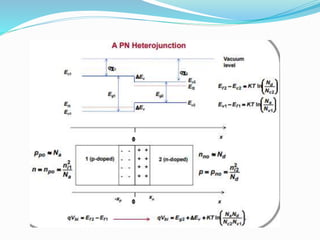
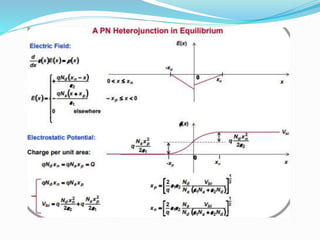
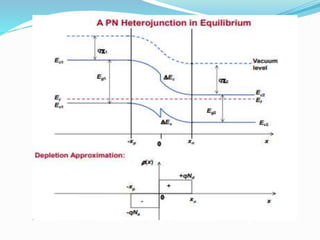
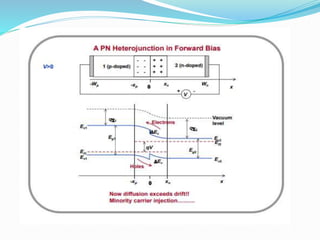
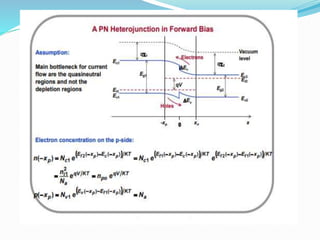
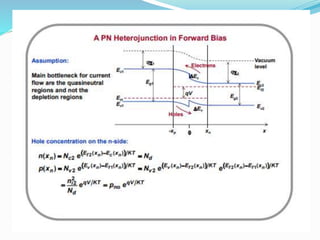
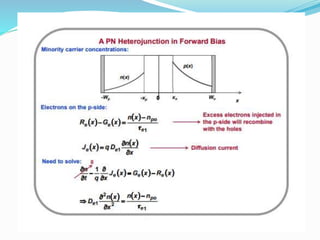
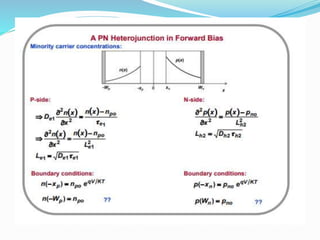
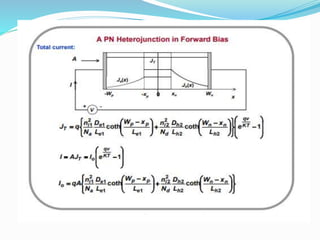
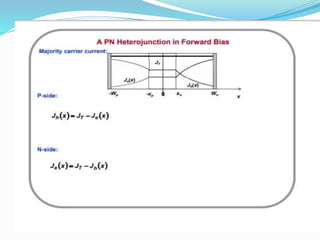
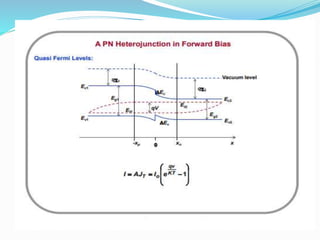
Energy band diagrams of a Hetero-junction under
equilibrium and a p-n junction under High forward bias
J.YOGAPRABHA
HETERO-JUNCTION
 A heterojunction is the interface that occurs between
two layers or regions of dissimilar crystalline semiconductors.
These semiconducting materials have unequal band gaps as
opposed to a homojunction.
 The combination of multiple heterojunctions together in a
device is called a heterostructure, although the two terms are
commonly used interchangeably. The requirement that each
material be a semiconductor with unequal band gaps is
somewhat loose, especially on small length scales, where
electronic properties depend on spatial properties.
 A more modern definition of heterojunction is the interface
between any two solid-state materials, including crystalline and
amorphous structures of metallic, insulating, fast ion
conductor and semiconducting materials.
ENERGY BAND ALIGNMENT
 The behaviour of a semiconductor junction depends
crucially on the alignment of the energy bands at the
interface. Semiconductor interfaces can be organized
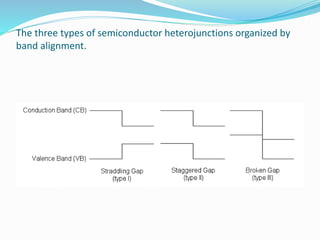
into three types of heterojunctions: straddling gap
(type I), staggered gap (type II) or broken gap (type
III) as seen in the figure[9]. Away from the junction,
the band bending can be computed based on the
usual procedure of solving Poisson's equation.
The three types of semiconductor heterojunctions organized by
band alignment.
Introduction:
Most interesting semiconductor devices usually have two or more
different kinds of semiconductorsThere are four different kinds of commonly
encountered heterostructures:
a) pn heterojunction diode
b) nn heterojunctions
c) pp heterojunctions
d) Quantum wells, quantum wires, and quantum dots
A pn Heterojunction Diode:
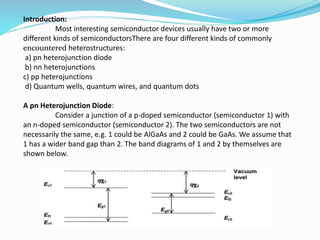
Consider a junction of a p-doped semiconductor (semiconductor 1) with
an n-doped semiconductor (semiconductor 2). The two semiconductors are not
necessarily the same, e.g. 1 could be AlGaAs and 2 could be GaAs. We assume that
1 has a wider band gap than 2. The band diagrams of 1 and 2 by themselves are
shown below.
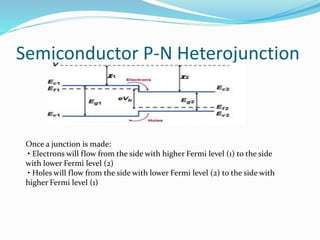
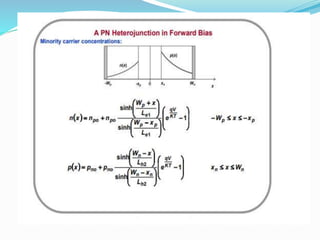
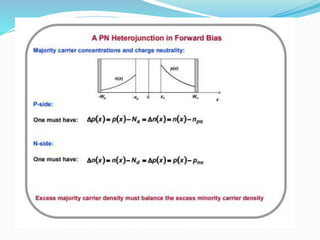
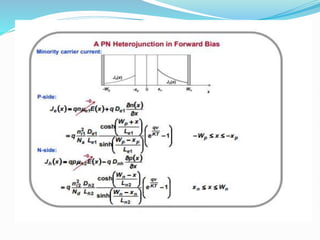
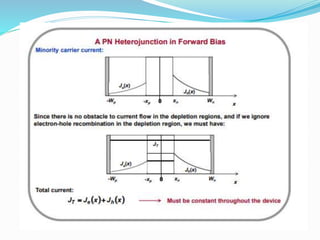
Semiconductor P-N Heterojunction
Once a junction is made:
• Electrons will flow from the side with higher Fermi level (1) to the side
with lower Fermi level (2)
• Holes will flow from the side with lower Fermi level (2) to the side with
higher Fermi level (1)
Hetero junction
Hetero junction
Hetero junction
Hetero junction
Hetero junction
Hetero junction
Hetero junction
Hetero junction
Hetero junction
Hetero junction
Hetero junction
Hetero junction
Hetero junction
Hetero junction
Hetero junction

Hetero junction

  • 1.
    Energy band diagramsof a Hetero-junction under equilibrium and a p-n junction under High forward bias J.YOGAPRABHA
  • 2.
    HETERO-JUNCTION  A heterojunctionis the interface that occurs between two layers or regions of dissimilar crystalline semiconductors. These semiconducting materials have unequal band gaps as opposed to a homojunction.  The combination of multiple heterojunctions together in a device is called a heterostructure, although the two terms are commonly used interchangeably. The requirement that each material be a semiconductor with unequal band gaps is somewhat loose, especially on small length scales, where electronic properties depend on spatial properties.  A more modern definition of heterojunction is the interface between any two solid-state materials, including crystalline and amorphous structures of metallic, insulating, fast ion conductor and semiconducting materials.
  • 3.
    ENERGY BAND ALIGNMENT The behaviour of a semiconductor junction depends crucially on the alignment of the energy bands at the interface. Semiconductor interfaces can be organized into three types of heterojunctions: straddling gap (type I), staggered gap (type II) or broken gap (type III) as seen in the figure[9]. Away from the junction, the band bending can be computed based on the usual procedure of solving Poisson's equation.
  • 4.
    The three typesof semiconductor heterojunctions organized by band alignment.
  • 5.
    Introduction: Most interesting semiconductordevices usually have two or more different kinds of semiconductorsThere are four different kinds of commonly encountered heterostructures: a) pn heterojunction diode b) nn heterojunctions c) pp heterojunctions d) Quantum wells, quantum wires, and quantum dots A pn Heterojunction Diode: Consider a junction of a p-doped semiconductor (semiconductor 1) with an n-doped semiconductor (semiconductor 2). The two semiconductors are not necessarily the same, e.g. 1 could be AlGaAs and 2 could be GaAs. We assume that 1 has a wider band gap than 2. The band diagrams of 1 and 2 by themselves are shown below.
  • 6.
    Semiconductor P-N Heterojunction Oncea junction is made: • Electrons will flow from the side with higher Fermi level (1) to the side with lower Fermi level (2) • Holes will flow from the side with lower Fermi level (2) to the side with higher Fermi level (1)