Presented By:-
AMIT
3PD14LCS01
CONTENTS
 INTRODUCTION
 DISPERSION CATEGORIES
 DISPERSIONTECHNIQUES
 APPLICATIONS
 ADVANTAGES
 DRAWBACKS
 CONCLUSION
INTRODUCTION
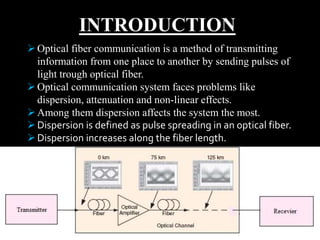
Optical fiber communication is a method of transmitting
information from one place to another by sending pulses of
light trough optical fiber.
Optical communication system faces problems like
dispersion, attenuation and non-linear effects.
Among them dispersion affects the system the most.
Dispersion is defined as pulse spreading in an optical fiber.
Dispersion increases along the fiber length.
Dispersion Categories
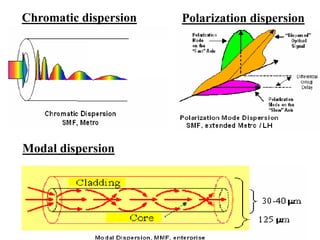
 Modal dispersion- Pulse spreading caused by time delay.
 Chromatic dispersion-Pulse spreading caused by different
wavelength of light propagate by different velocities.
• Material dispersion-Wavelength dependency on
index of refracting of glass.
• Waveguide dispersion-Due to physical structure of
the waveguide.
 Polarization mode dispersion- Dispersion occurs due to
Birefringence.
Modal dispersion
Chromatic dispersion Polarization dispersion
Dispersion Techniques
 Dispersion Compensating Fibers
 Fiber Bragg Grating
 Electronic dispersion compensation
 Digital Filters
 Optical Phase Conjugation Techniques
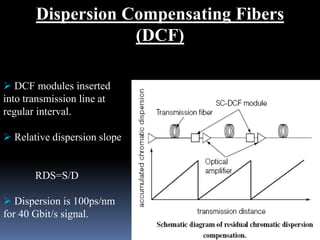
 DCF modules inserted
into transmission line at
regular interval.
 Relative dispersion slope
RDS=S/D
 Dispersion is 100ps/nm
for 40 Gbit/s signal.
Dispersion Compensating Fibers
(DCF)
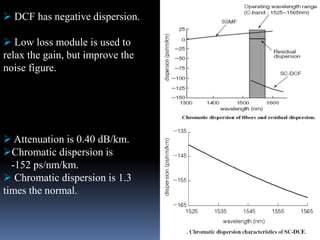
 DCF has negative dispersion.
 Low loss module is used to
relax the gain, but improve the
noise figure.
 Attenuation is 0.40 dB/km.
Chromatic dispersion is
-152 ps/nm/km.
 Chromatic dispersion is 1.3
times the normal.
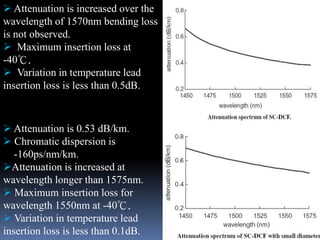
 Attenuation is increased over the
wavelength of 1570nm bending loss
is not observed.
 Maximum insertion loss at
-40℃.
 Variation in temperature lead
insertion loss is less than 0.5dB.
 Attenuation is 0.53 dB/km.
 Chromatic dispersion is
-160ps/nm/km.
Attenuation is increased at
wavelength longer than 1575nm.
 Maximum insertion loss for
wavelength 1550nm at -40℃.
 Variation in temperature lead
insertion loss is less than 0.1dB.
Fiber Bragg Grating
(FBG)
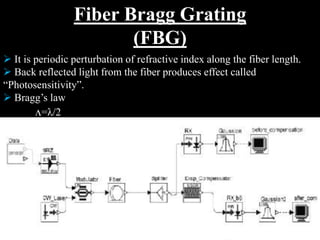
 It is periodic perturbation of refractive index along the fiber length.
 Back reflected light from the fiber produces effect called
“Photosensitivity”.
 Bragg’s law
ᴧ=λ/2
Electronic dispersion compensation
(EDC)
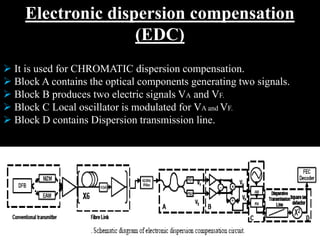
 It is used for CHROMATIC dispersion compensation.
 Block A contains the optical components generating two signals.
 Block B produces two electric signals VA and VF.
 Block C Local oscillator is modulated for VA and VF.
 Block D contains Dispersion transmission line.
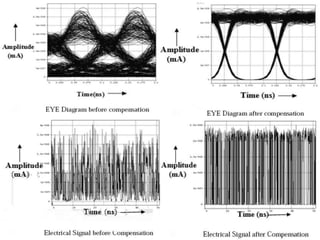
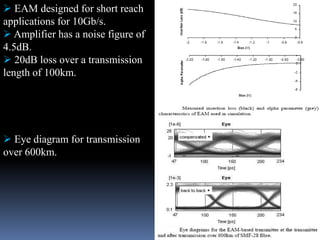
 EAM designed for short reach
applications for 10Gb/s.
 Amplifier has a noise figure of
4.5dB.
 20dB loss over a transmission
length of 100km.
 Eye diagram for transmission
over 600km.
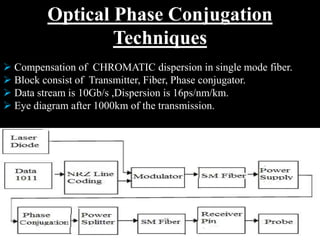
Optical Phase Conjugation
Techniques
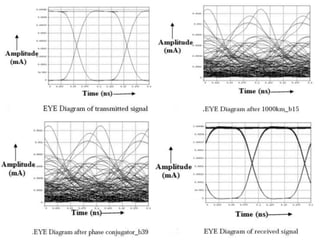
 Compensation of CHROMATIC dispersion in single mode fiber.
 Block consist of Transmitter, Fiber, Phase conjugator.
 Data stream is 10Gb/s ,Dispersion is 16ps/nm/km.
 Eye diagram after 1000km of the transmission.
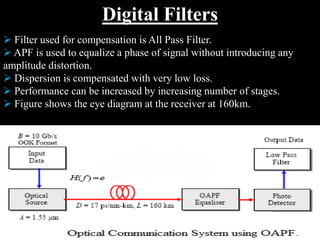
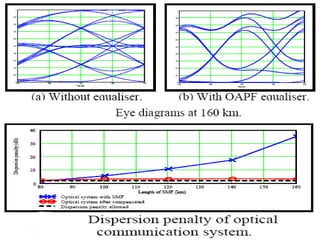
Digital Filters
 Filter used for compensation is All Pass Filter.
 APF is used to equalize a phase of signal without introducing any
amplitude distortion.
 Dispersion is compensated with very low loss.
 Performance can be increased by increasing number of stages.
 Figure shows the eye diagram at the receiver at 160km.
ADVANTAGES
 Low insertion loss and higher performance in Dispersion
compensating fiber.
 Improvement in average Bit error rate and error vector magnitude in
Electronic dispersion compensation.
 Small footprint, low insertion loss, dispersion slope compensation in
Fiber grating.
Phase conjugation technique is more reliable to high frequency signals.
 All pass filters can be designed to compensate optical fiber dispersion
for large bandwidth with low loss and ripple.
DISADVANTAGES
 Dispersion compensating fibers gives large foot print and insertion
losses at very low temperature.
 Electronic dispersion compensation slows down the speed of
communication since it slows down the digital to analog conversion.
 Architectures using Fiber Bragg grating is complex.
 In all pass filter at lower amplitude of the pulse, the filter results in a
larger spread.
 The increased pulse width at lower amplitude will affect the bit error
rate and introduce ISI.
 Phase conjugation is more complex and costly.
APPLICATIONS
 Compensation of dispersion-broadening in long-haul communication
in FBG.
 Microwave and millimeter wave frequency application in APF.
 Application in LAN, MAN, 10G-Ethernet in EDC.
Applications are in the fields of light wave communications and optical
fiber sensors which are based on the existence of photosensitivity in
silica optical fibers and optical waveguide in DCF.
 Application areas: such as high-brightness laser oscillator/amplifier
systems, cavity-less lasing devices, laser target-aiming systems,
aberration correction for coherent-light transmission and reflection
through disturbing media, long distance optical fiber communications
with ultra-high bit-rate, optical phase locking and coupling systems, and
novel optical data storage and processing systems in Optical Phase
Conjugation.
CONCLUSION
 Fiber-optic communication because of its advantages over electrical
transmission, have largely replaced copper wire communications in core
networks in the developed world. But it is also marred by many
drawbacks: dispersion, attenuation and non linear effect.
From this study it is clear that different researchers have used different
techniques for dispersion compensation in optical system.
We consider five techniques in our consideration, but Phase
conjugation technique is the best technique to reduce the dispersion.

Dispersion Compensation Techniques for Optical Fiber Communication

  • 1.
  • 2.
    CONTENTS  INTRODUCTION  DISPERSIONCATEGORIES  DISPERSIONTECHNIQUES  APPLICATIONS  ADVANTAGES  DRAWBACKS  CONCLUSION
  • 3.
    INTRODUCTION Optical fiber communicationis a method of transmitting information from one place to another by sending pulses of light trough optical fiber. Optical communication system faces problems like dispersion, attenuation and non-linear effects. Among them dispersion affects the system the most. Dispersion is defined as pulse spreading in an optical fiber. Dispersion increases along the fiber length.
  • 4.
    Dispersion Categories  Modaldispersion- Pulse spreading caused by time delay.  Chromatic dispersion-Pulse spreading caused by different wavelength of light propagate by different velocities. • Material dispersion-Wavelength dependency on index of refracting of glass. • Waveguide dispersion-Due to physical structure of the waveguide.  Polarization mode dispersion- Dispersion occurs due to Birefringence.
  • 5.
  • 6.
    Dispersion Techniques  DispersionCompensating Fibers  Fiber Bragg Grating  Electronic dispersion compensation  Digital Filters  Optical Phase Conjugation Techniques
  • 7.
     DCF modulesinserted into transmission line at regular interval.  Relative dispersion slope RDS=S/D  Dispersion is 100ps/nm for 40 Gbit/s signal. Dispersion Compensating Fibers (DCF)
  • 8.
     DCF hasnegative dispersion.  Low loss module is used to relax the gain, but improve the noise figure.  Attenuation is 0.40 dB/km. Chromatic dispersion is -152 ps/nm/km.  Chromatic dispersion is 1.3 times the normal.
  • 9.
     Attenuation isincreased over the wavelength of 1570nm bending loss is not observed.  Maximum insertion loss at -40℃.  Variation in temperature lead insertion loss is less than 0.5dB.  Attenuation is 0.53 dB/km.  Chromatic dispersion is -160ps/nm/km. Attenuation is increased at wavelength longer than 1575nm.  Maximum insertion loss for wavelength 1550nm at -40℃.  Variation in temperature lead insertion loss is less than 0.1dB.
  • 10.
    Fiber Bragg Grating (FBG) It is periodic perturbation of refractive index along the fiber length.  Back reflected light from the fiber produces effect called “Photosensitivity”.  Bragg’s law ᴧ=λ/2
  • 12.
    Electronic dispersion compensation (EDC) It is used for CHROMATIC dispersion compensation.  Block A contains the optical components generating two signals.  Block B produces two electric signals VA and VF.  Block C Local oscillator is modulated for VA and VF.  Block D contains Dispersion transmission line.
  • 13.
     EAM designedfor short reach applications for 10Gb/s.  Amplifier has a noise figure of 4.5dB.  20dB loss over a transmission length of 100km.  Eye diagram for transmission over 600km.
  • 14.
    Optical Phase Conjugation Techniques Compensation of CHROMATIC dispersion in single mode fiber.  Block consist of Transmitter, Fiber, Phase conjugator.  Data stream is 10Gb/s ,Dispersion is 16ps/nm/km.  Eye diagram after 1000km of the transmission.
  • 16.
    Digital Filters  Filterused for compensation is All Pass Filter.  APF is used to equalize a phase of signal without introducing any amplitude distortion.  Dispersion is compensated with very low loss.  Performance can be increased by increasing number of stages.  Figure shows the eye diagram at the receiver at 160km.
  • 18.
    ADVANTAGES  Low insertionloss and higher performance in Dispersion compensating fiber.  Improvement in average Bit error rate and error vector magnitude in Electronic dispersion compensation.  Small footprint, low insertion loss, dispersion slope compensation in Fiber grating. Phase conjugation technique is more reliable to high frequency signals.  All pass filters can be designed to compensate optical fiber dispersion for large bandwidth with low loss and ripple.
  • 19.
    DISADVANTAGES  Dispersion compensatingfibers gives large foot print and insertion losses at very low temperature.  Electronic dispersion compensation slows down the speed of communication since it slows down the digital to analog conversion.  Architectures using Fiber Bragg grating is complex.  In all pass filter at lower amplitude of the pulse, the filter results in a larger spread.  The increased pulse width at lower amplitude will affect the bit error rate and introduce ISI.  Phase conjugation is more complex and costly.
  • 20.
    APPLICATIONS  Compensation ofdispersion-broadening in long-haul communication in FBG.  Microwave and millimeter wave frequency application in APF.  Application in LAN, MAN, 10G-Ethernet in EDC. Applications are in the fields of light wave communications and optical fiber sensors which are based on the existence of photosensitivity in silica optical fibers and optical waveguide in DCF.  Application areas: such as high-brightness laser oscillator/amplifier systems, cavity-less lasing devices, laser target-aiming systems, aberration correction for coherent-light transmission and reflection through disturbing media, long distance optical fiber communications with ultra-high bit-rate, optical phase locking and coupling systems, and novel optical data storage and processing systems in Optical Phase Conjugation.
  • 21.
    CONCLUSION  Fiber-optic communicationbecause of its advantages over electrical transmission, have largely replaced copper wire communications in core networks in the developed world. But it is also marred by many drawbacks: dispersion, attenuation and non linear effect. From this study it is clear that different researchers have used different techniques for dispersion compensation in optical system. We consider five techniques in our consideration, but Phase conjugation technique is the best technique to reduce the dispersion.