Digital Image Fundamentals
Kalyan Acharjya
kalyan5.blogspot.in
Lecture 6-7
Unit 2
1
Unit 2
• Image Perception in Eye
• Light and Electromagnetic Spectrum
• Image Sensing and Acquisition using Sensor array.
• Image Sampling and Quantization
• Representation of Digital Image
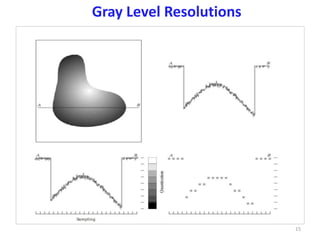
• Spatial and Grey Level Resolutions
• Alising and Moire Pattern
• Zooming and Shrinking Digital Image
• Relationship Between Pixels
2
Disclaimer
This PPT is prepared for Academic use only.
Most of the Images and Contents are copied
from Image Processing Book (Gonzalez) and
Internet.
3
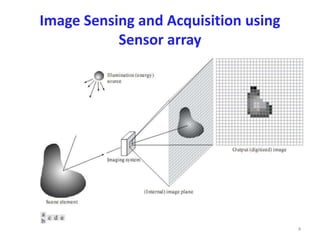
Image Sensing and Acquisition using
Sensor array
4
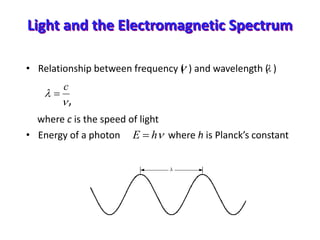
Light and the Electromagnetic Spectrum
• Relationship between frequency ( ) and wavelength ( )
,
where c is the speed of light
• Energy of a photon where h is Planck’s constant



c

hE 
Light and the Electromagnetic Spectrum
• Three basic quantities described the quality of
a chromatic light source:
– Radiance: the total amount energy that flow from
the light source (can be measured)
– Luminance: the amount of energy an observer
perceives from a light source (can be measured)
– Brightness: A subjective descriptor of light
perception; perceived quantity of light emitted
(cannot be measured)
6
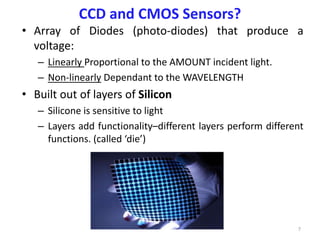
CCD and CMOS Sensors?
• Array of Diodes (photo-diodes) that produce a
voltage:
– Linearly Proportional to the AMOUNT incident light.
– Non-linearly Dependant to the WAVELENGTH
• Built out of layers of Silicon
– Silicone is sensitive to light
– Layers add functionality–different layers perform different
functions. (called ‘die’)
7
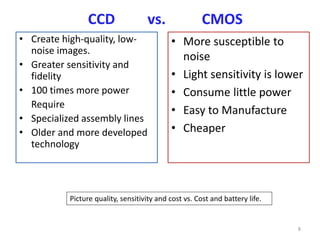
CCD vs. CMOS
• Create high-quality, low-
noise images.
• Greater sensitivity and
fidelity
• 100 times more power
Require
• Specialized assembly lines
• Older and more developed
technology
• More susceptible to
noise
• Light sensitivity is lower
• Consume little power
• Easy to Manufacture
• Cheaper
Picture quality, sensitivity and cost vs. Cost and battery life.
8
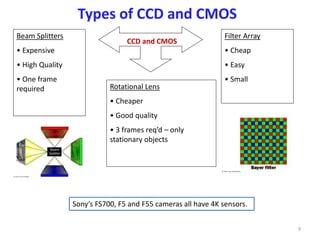
Types of CCD and CMOS
CCD and CMOS
Rotational Lens
• Cheaper
• Good quality
• 3 frames req’d – only
stationary objects
Filter Array
• Cheap
• Easy
• Small
Beam Splitters
• Expensive
• High Quality
• One frame
required
Sony’s FS700, F5 and F55 cameras all have 4K sensors.
9
Sampling–Analog Signal
• Periodic sampling, the process of representing a
continuous signal with a sequence of discrete data values,
uses in the field of digital signal processing.
• In practice, sampling is performed by applying a
continuous signal to an analog-to-digital (A/D) converter
whose output is a series of digital values.
• With regard to sampling, the primary concern is how fast
must the given continuous signal be sampled in order to
preserve its information content.
10
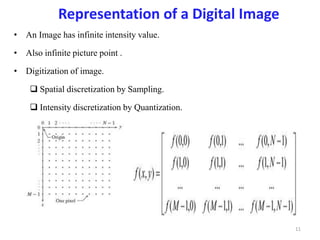
Representation of a Digital Image
• An Image has infinite intensity value.
• Also infinite picture point .
• Digitization of image.
 Spatial discretization by Sampling.
 Intensity discretization by Quantization.
11
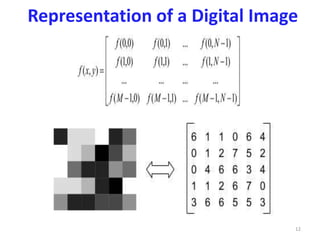
Representation of a Digital Image
12
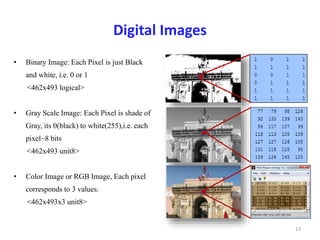
Digital Images
• Binary Image: Each Pixel is just Black
and white, i.e. 0 or 1
<462x493 logical>
• Gray Scale Image: Each Pixel is shade of
Gray, its 0(black) to white(255),i.e. each
pixel~8 bits
<462x493 unit8>
• Color Image or RGB Image, Each pixel
corresponds to 3 values.
<462x493x3 unit8>
13
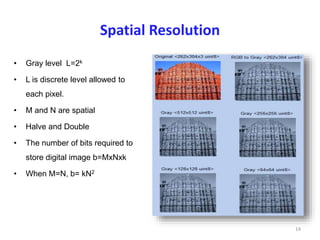
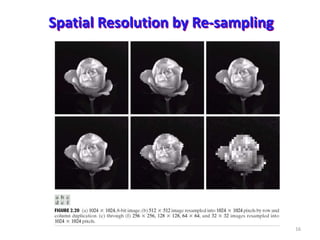
Spatial Resolution
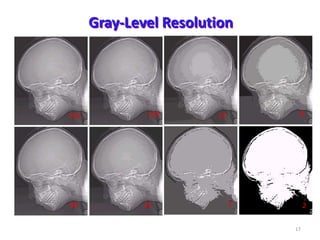
• Gray level L=2k
• L is discrete level allowed to
each pixel.
• M and N are spatial
• Halve and Double
• The number of bits required to
store digital image b=MxNxk
• When M=N, b= kN2
14
Gray Level Resolutions
15
Spatial Resolution by Re-sampling
16
Gray-Level Resolution
24
816128
3264
256
17
Bit Planes of Grey Scale image
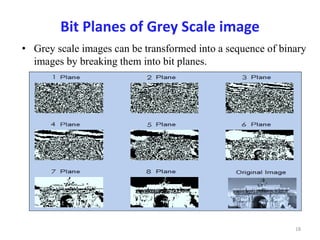
• Grey scale images can be transformed into a sequence of binary
images by breaking them into bit planes.
18
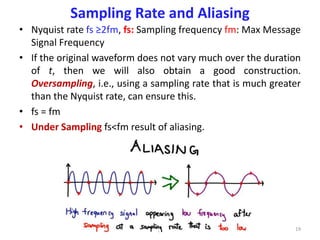
Sampling Rate and Aliasing
• Nyquist rate fs ≥2fm, fs: Sampling frequency fm: Max Message
Signal Frequency
• If the original waveform does not vary much over the duration
of t, then we will also obtain a good construction.
Oversampling, i.e., using a sampling rate that is much greater
than the Nyquist rate, can ensure this.
• fs = fm
• Under Sampling fs<fm result of aliasing.
19
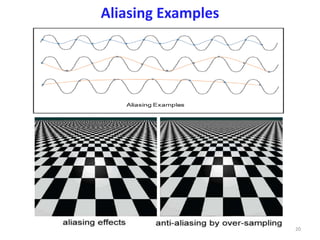
Aliasing Examples
20
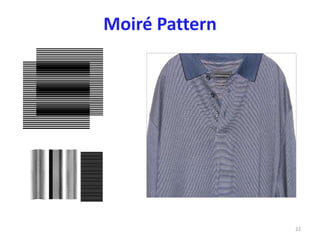
Aliasing and Moiré Pattern
• All signals (functions) can be shown to be made up of a linear
combination sinusoidal signals (sines and cosines) of different
frequencies. (Chapter 4)
• For physical reasons, there is a highest frequency component
in all real world signals.
• Theoretically,
– if a signal is sampled at more than twice its highest frequency
component, then it can be reconstructed exactly from its samples.
– But, if it is sampled at less than that frequency (called under sampling),
then aliasing will result.
– This causes frequencies to appear in the sampled signal that were not
in the original signal.
– The Moiré pattern shown the vertical low frequency pattern is a new
frequency not in the original patterns.
21
Moiré Pattern
22
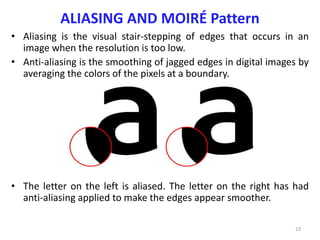
ALIASING AND MOIRÉ Pattern
• Aliasing is the visual stair-stepping of edges that occurs in an
image when the resolution is too low.
• Anti-aliasing is the smoothing of jagged edges in digital images by
averaging the colors of the pixels at a boundary.
• The letter on the left is aliased. The letter on the right has had
anti-aliasing applied to make the edges appear smoother.
23
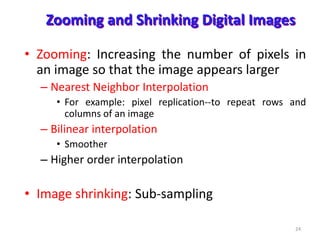
Zooming and Shrinking Digital Images
• Zooming: Increasing the number of pixels in
an image so that the image appears larger
– Nearest Neighbor Interpolation
• For example: pixel replication--to repeat rows and
columns of an image
– Bilinear interpolation
• Smoother
– Higher order interpolation
• Image shrinking: Sub-sampling
24
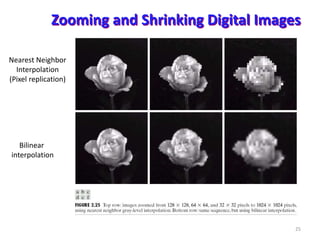
Zooming and Shrinking Digital Images
Nearest Neighbor
Interpolation
(Pixel replication)
Bilinear
interpolation
25
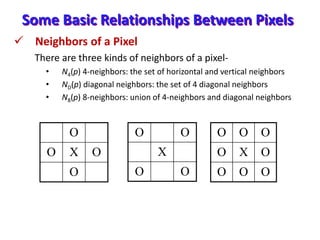
Some Basic Relationships Between Pixels
 Neighbors of a Pixel
There are three kinds of neighbors of a pixel-
• N4(p) 4-neighbors: the set of horizontal and vertical neighbors
• ND(p) diagonal neighbors: the set of 4 diagonal neighbors
• N8(p) 8-neighbors: union of 4-neighbors and diagonal neighbors
O O O
O X O
O O O
O O
X
O O
O
O X O
O
Some Basic Relationships Between Pixels
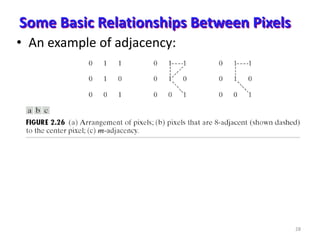
 Adjacency:
– Two pixels that are neighbors and have the same grey-level
(or some other specified similarity criterion) are adjacent
– Pixels can be 4-adjacent, diagonally adjacent, 8-adjacent, or
m-adjacent.
 m-adjacency (mixed adjacency):
– Two pixels p and q of the same value (or specified similarity)
are m-adjacent if either
• (i) q and p are 4-adjacent, or
• (ii) p and q are diagonally adjacent and do not have any common 4-
adjacent neighbors.
• They cannot be both (i) and (ii).
Some Basic Relationships Between Pixels
• An example of adjacency:
28
Some Basic Relationships Between Pixels
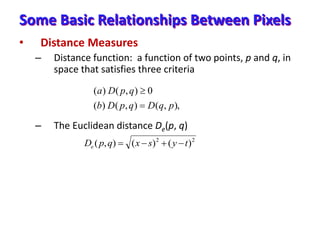
• Distance Measures
– Distance function: a function of two points, p and q, in
space that satisfies three criteria
– The Euclidean distance De(p, q)
),,(),()(
0),()(
pqDqpDb
qpDa


22
)()(),( tysxqpDe 
Hello 7CS
Your Choice!
30
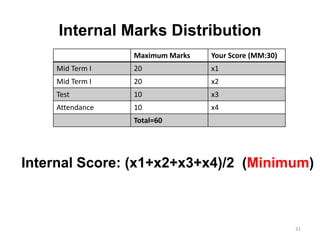
Internal Marks Distribution
31
Maximum Marks Your Score (MM:30)
Mid Term I 20 x1
Mid Term I 20 x2
Test 10 x3
Attendance 10 x4
Total=60
Internal Score: (x1+x2+x3+x4)/2 (Minimum)
Thank You for
Your Attention
This PPT is available at kalyan5.blogspot.in
For Feedback Kindly visit
https://goo.gl/iPviBm
Contact E-mail: kalyan.acharjya@gmail.com
Good Luck
For Your
Mid Term I Examination
32

Digital Image Fundamentals

  • 1.
    Digital Image Fundamentals KalyanAcharjya kalyan5.blogspot.in Lecture 6-7 Unit 2 1
  • 2.
    Unit 2 • ImagePerception in Eye • Light and Electromagnetic Spectrum • Image Sensing and Acquisition using Sensor array. • Image Sampling and Quantization • Representation of Digital Image • Spatial and Grey Level Resolutions • Alising and Moire Pattern • Zooming and Shrinking Digital Image • Relationship Between Pixels 2
  • 3.
    Disclaimer This PPT isprepared for Academic use only. Most of the Images and Contents are copied from Image Processing Book (Gonzalez) and Internet. 3
  • 4.
    Image Sensing andAcquisition using Sensor array 4
  • 5.
    Light and theElectromagnetic Spectrum • Relationship between frequency ( ) and wavelength ( ) , where c is the speed of light • Energy of a photon where h is Planck’s constant    c  hE 
  • 6.
    Light and theElectromagnetic Spectrum • Three basic quantities described the quality of a chromatic light source: – Radiance: the total amount energy that flow from the light source (can be measured) – Luminance: the amount of energy an observer perceives from a light source (can be measured) – Brightness: A subjective descriptor of light perception; perceived quantity of light emitted (cannot be measured) 6
  • 7.
    CCD and CMOSSensors? • Array of Diodes (photo-diodes) that produce a voltage: – Linearly Proportional to the AMOUNT incident light. – Non-linearly Dependant to the WAVELENGTH • Built out of layers of Silicon – Silicone is sensitive to light – Layers add functionality–different layers perform different functions. (called ‘die’) 7
  • 8.
    CCD vs. CMOS •Create high-quality, low- noise images. • Greater sensitivity and fidelity • 100 times more power Require • Specialized assembly lines • Older and more developed technology • More susceptible to noise • Light sensitivity is lower • Consume little power • Easy to Manufacture • Cheaper Picture quality, sensitivity and cost vs. Cost and battery life. 8
  • 9.
    Types of CCDand CMOS CCD and CMOS Rotational Lens • Cheaper • Good quality • 3 frames req’d – only stationary objects Filter Array • Cheap • Easy • Small Beam Splitters • Expensive • High Quality • One frame required Sony’s FS700, F5 and F55 cameras all have 4K sensors. 9
  • 10.
    Sampling–Analog Signal • Periodicsampling, the process of representing a continuous signal with a sequence of discrete data values, uses in the field of digital signal processing. • In practice, sampling is performed by applying a continuous signal to an analog-to-digital (A/D) converter whose output is a series of digital values. • With regard to sampling, the primary concern is how fast must the given continuous signal be sampled in order to preserve its information content. 10
  • 11.
    Representation of aDigital Image • An Image has infinite intensity value. • Also infinite picture point . • Digitization of image.  Spatial discretization by Sampling.  Intensity discretization by Quantization. 11
  • 12.
    Representation of aDigital Image 12
  • 13.
    Digital Images • BinaryImage: Each Pixel is just Black and white, i.e. 0 or 1 <462x493 logical> • Gray Scale Image: Each Pixel is shade of Gray, its 0(black) to white(255),i.e. each pixel~8 bits <462x493 unit8> • Color Image or RGB Image, Each pixel corresponds to 3 values. <462x493x3 unit8> 13
  • 14.
    Spatial Resolution • Graylevel L=2k • L is discrete level allowed to each pixel. • M and N are spatial • Halve and Double • The number of bits required to store digital image b=MxNxk • When M=N, b= kN2 14
  • 15.
  • 16.
    Spatial Resolution byRe-sampling 16
  • 17.
  • 18.
    Bit Planes ofGrey Scale image • Grey scale images can be transformed into a sequence of binary images by breaking them into bit planes. 18
  • 19.
    Sampling Rate andAliasing • Nyquist rate fs ≥2fm, fs: Sampling frequency fm: Max Message Signal Frequency • If the original waveform does not vary much over the duration of t, then we will also obtain a good construction. Oversampling, i.e., using a sampling rate that is much greater than the Nyquist rate, can ensure this. • fs = fm • Under Sampling fs<fm result of aliasing. 19
  • 20.
  • 21.
    Aliasing and MoiréPattern • All signals (functions) can be shown to be made up of a linear combination sinusoidal signals (sines and cosines) of different frequencies. (Chapter 4) • For physical reasons, there is a highest frequency component in all real world signals. • Theoretically, – if a signal is sampled at more than twice its highest frequency component, then it can be reconstructed exactly from its samples. – But, if it is sampled at less than that frequency (called under sampling), then aliasing will result. – This causes frequencies to appear in the sampled signal that were not in the original signal. – The Moiré pattern shown the vertical low frequency pattern is a new frequency not in the original patterns. 21
  • 22.
  • 23.
    ALIASING AND MOIRÉPattern • Aliasing is the visual stair-stepping of edges that occurs in an image when the resolution is too low. • Anti-aliasing is the smoothing of jagged edges in digital images by averaging the colors of the pixels at a boundary. • The letter on the left is aliased. The letter on the right has had anti-aliasing applied to make the edges appear smoother. 23
  • 24.
    Zooming and ShrinkingDigital Images • Zooming: Increasing the number of pixels in an image so that the image appears larger – Nearest Neighbor Interpolation • For example: pixel replication--to repeat rows and columns of an image – Bilinear interpolation • Smoother – Higher order interpolation • Image shrinking: Sub-sampling 24
  • 25.
    Zooming and ShrinkingDigital Images Nearest Neighbor Interpolation (Pixel replication) Bilinear interpolation 25
  • 26.
    Some Basic RelationshipsBetween Pixels  Neighbors of a Pixel There are three kinds of neighbors of a pixel- • N4(p) 4-neighbors: the set of horizontal and vertical neighbors • ND(p) diagonal neighbors: the set of 4 diagonal neighbors • N8(p) 8-neighbors: union of 4-neighbors and diagonal neighbors O O O O X O O O O O O X O O O O X O O
  • 27.
    Some Basic RelationshipsBetween Pixels  Adjacency: – Two pixels that are neighbors and have the same grey-level (or some other specified similarity criterion) are adjacent – Pixels can be 4-adjacent, diagonally adjacent, 8-adjacent, or m-adjacent.  m-adjacency (mixed adjacency): – Two pixels p and q of the same value (or specified similarity) are m-adjacent if either • (i) q and p are 4-adjacent, or • (ii) p and q are diagonally adjacent and do not have any common 4- adjacent neighbors. • They cannot be both (i) and (ii).
  • 28.
    Some Basic RelationshipsBetween Pixels • An example of adjacency: 28
  • 29.
    Some Basic RelationshipsBetween Pixels • Distance Measures – Distance function: a function of two points, p and q, in space that satisfies three criteria – The Euclidean distance De(p, q) ),,(),()( 0),()( pqDqpDb qpDa   22 )()(),( tysxqpDe 
  • 30.
  • 31.
    Internal Marks Distribution 31 MaximumMarks Your Score (MM:30) Mid Term I 20 x1 Mid Term I 20 x2 Test 10 x3 Attendance 10 x4 Total=60 Internal Score: (x1+x2+x3+x4)/2 (Minimum)
  • 32.
    Thank You for YourAttention This PPT is available at kalyan5.blogspot.in For Feedback Kindly visit https://goo.gl/iPviBm Contact E-mail: kalyan.acharjya@gmail.com Good Luck For Your Mid Term I Examination 32