A Lecture onIntroduction toImage Restoration 
10/22/2014 
1 
Presented By 
KalyanAcharjya 
Assistant Professor, Dept. of ECE 
Jaipur National University
Lecture on Image Restoration 
2 
By Kalyan Acharjya,JNUJaipur,India 
Contact :kalyan.acharjya@gmail.com 
10/22/2014
10/22/2014 
3 
Objective of Two Hour Presentation 
“TointroducethebasicconceptofImageRestorationinDigitalImageProcessing”
10/22/2014 
4 
Sorry,shamelesslyIopenedthelockwithoutpriorpermissiontakenfromtheoriginalowner.SomeimagesusedinthispresentationcontentsarecopiedfromBook’swithoutpermission. OnlyOriginalOwnerhasfullrightsreservedforcopiedimages. ThisPPTisonlyforfairacademicuse. 
KalyanAcharjya
10/22/2014 
5 
Acknowledgement 
•Gonzalez & Woods-DIP Books 
•Prof. P.K. Biswas, IIT Kharagpur 
•Dr. ir.AleksandraPizurika, UniversiteitHent. 
•GlebV. Teheslavski. 
•Yu Hen Yu. 
•Zhou Wang, University of Texas. 
The PPT was designed with the help of materials of following authors.
Outlines 
10/22/2014 
6 
What is Image Restoration. 
Image Enhancement vs. Image Restoration. 
Image Degradation Model. 
Noise Models. 
Estimation of Degradation Model. 
Restoration Techniques. 
Some Basics Filter 
Advanced Image Restoration. 
Conclusions. 
Tools for DIP. 
Applications.
Lets start 
10/22/2014 
7 
What is Image Restoration. 
Image Enhancement vs. Image Restoration. 
Image Degradation Model. 
Noise Models. 
Estimation of Degradation Model. 
Restoration Techniques. 
Some Basics Filter 
Advanced Image Restoration. 
Conclusions. 
Tools for DIP. 
Applications.
10/22/2014 
8 
What is Image Restoration.
What is Image Restoration? 
10/22/2014 
9 
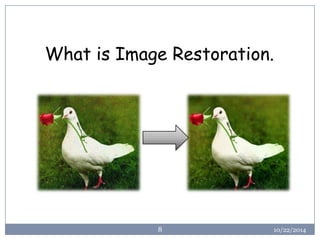
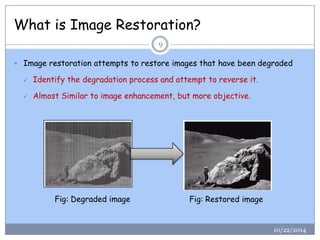
Image restoration attempts to restore images that have been degraded 
Identify the degradation process and attempt to reverse it. 
Almost Similar to image enhancement, but more objective. 
Fig: Degraded image 
Fig: Restored image
Where we reached? 
10/22/2014 
10 
What is Image Restoration. 
Image Enhancement vs. Image Restoration. 
Image Degradation Model. 
Noise Models. 
Estimation of Degradation Model. 
Restoration Techniques. 
Some Basics Filter 
Advanced Image Restoration. 
Conclusions. 
Tools for DIP. 
Applications.
Image enhancement vs. Image Restoration 
10/22/2014 
11 
•Imagerestorationassumesadegradationmodelthatisknownorcanbeestimated. 
•OriginalcontentandqualitydoesnotmeanGoodlookingorappearance. 
•ImageEnhancementissubjective,whereasimagerestorationisobjectiveprocess. 
•Imagerestorationtrytorecoveroriginalimagefromdegradedwithpriorknowledgeofdegradationprocess. 
•Restorationinvolvesmodelingofdegradationandapplyingtheinverseprocessinordertorecovertheoriginalimage. 
•Althoughtherestoreimageisnottheoriginalimage,itsapproximationofactualimage.
10/22/201412 
What is Image Restoration. 
Image Enhancement vs. Image Restoration. 
Image Degradation Model. 
Noise Models. 
Estimation of Degradation Model. 
Restoration Techniques. 
Some Basics Filter 
Advanced Image Restoration. 
Conclusions. 
Tools for DIP. 
Applications. 
Where we reached?
Degradation Model? 
10/22/2014 
13 
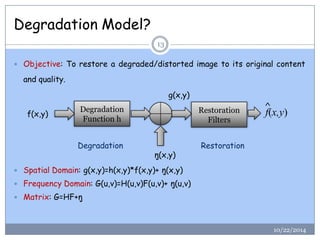
Objective:Torestoreadegraded/distortedimagetoitsoriginalcontentandquality. 
Spatial Domain: g(x,y)=h(x,y)*f(x,y)+ŋ(x,y) 
Frequency Domain: G(u,v)=H(u,v)F(u,v)+ ŋ(u,v) 
Matrix: G=HF+ŋDegradation Function hRestoration Filters 
g(x,y) 
f(x,y) 
ŋ(x,y) 
f(x,y) 
^ 
Degradation 
Restoration
Going On….! 
10/22/2014 
14 
What is Image Restoration. 
Image Enhancement vs. Image Restoration. 
Image Degradation Model. 
Noise Models. 
Estimation of Degradation Model. 
Restoration Techniques. 
Some Basics Filter 
Advanced Image Restoration. 
Conclusions. 
Tools for DIP. 
Applications.
Noise Models and Their PDF 
10/22/2014 
15 
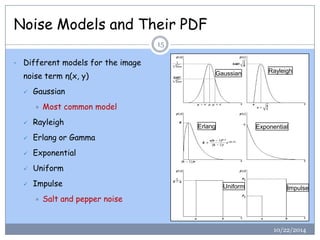
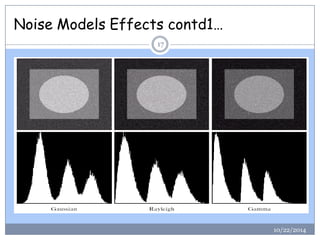
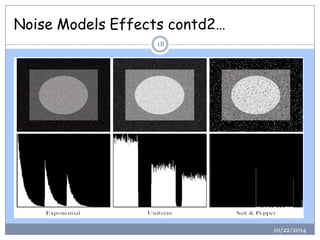
•Different models for the image noise term η(x, y) 
Gaussian 
Most common model 
Rayleigh 
Erlangor Gamma 
Exponential 
Uniform 
Impulse 
Salt and pepper noise 
GaussianRayleighErlang 
Exponential 
Uniform 
Impulse
Noise Models Effects 
10/22/2014 
16 
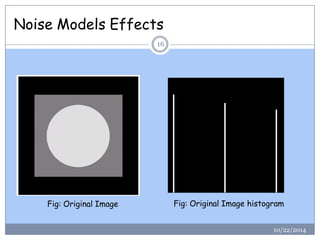
Histogram to go here 
Fig: Original Image 
Fig: Original Image histogram
Noise Models Effects contd1… 
10/22/2014 
17
Noise Models Effects contd2… 
10/22/2014 
18
Going On….! 
10/22/2014 
19 
What is Image Restoration. 
Image Enhancement vs. Image Restoration. 
Image Degradation Model. 
Noise Models. 
Estimation of Degradation Model. 
Restoration Techniques. 
Some Basics Filter 
Advanced Image Restoration. 
Conclusions. 
Tools for DIP. 
Applications.
Estimation of Degradation Model. 
10/22/2014 
20 
Weather the spatial or frequency domain or Matrix, in all cases knowledge of degradation function is important. 
Estimation of H is important in image restoration. 
There are mainly three ways to estimate the H as follows- 
By Observation 
By Experimentation. 
Mathematical Modeling 
•Afterapproximationthedegradationfunction,weapplytheBLINDCONVOLUTIONtorestoretheoriginalimage.
Observation 
10/22/201421 
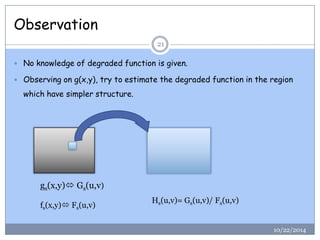
Noknowledgeofdegradedfunctionisgiven. 
Observingong(x,y),trytoestimatethedegradedfunctionintheregionwhichhavesimplerstructure. 
gs(x,y)Gs(u,v) 
fs(x,y)Fs(u,v) 
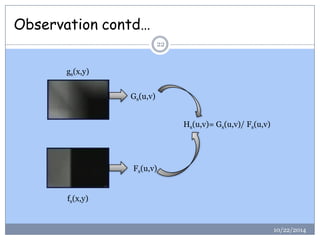
Hs(u,v)=Gs(u,v)/Fs(u,v)
Observation contd… 
10/22/2014 
22gs(x,y) fs(x,y) 
Gs(u,v) 
Fs(u,v) 
Hs(u,v)= Gs(u,v)/ Fs(u,v)
Experimentation 
10/22/201423 
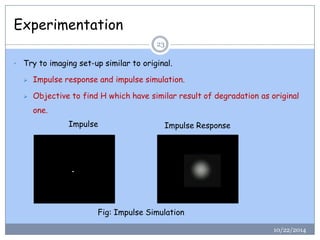
•Try to imaging set-up similar to original. 
Impulse response and impulse simulation. 
Objective to find H which have similar result of degradation as original one. 
Fig: Impulse Simulation 
Impulse 
Impulse Response
Experimentation contd… 
10/22/201424 
Here f(x,y) is impulse. 
F(u,v)=>A (a constant). 
G(u,v)=H(u,v)F(u,v). 
H(u,v)=G(u,v)/A. 
Objective is training and testing. 
Never testing on training data. 
Note:The intensity of impulse is very high, otherwise noise can dominate to impulse.
Mathematical Modeling 
10/22/2014 
25 
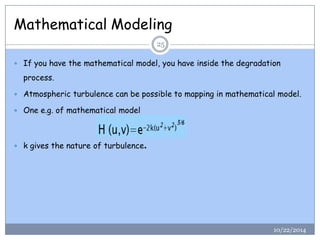
If you have the mathematical model, you have inside the degradation process. 
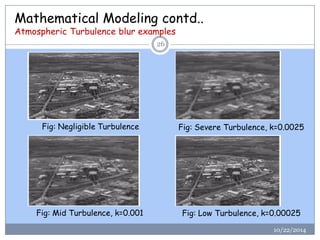
Atmospheric turbulence can be possible to mapping in mathematical model. 
One e.g. of mathematical model 
k gives the nature of turbulence.
Mathematical Modeling contd.. Atmospheric Turbulence blur examples 
10/22/2014 
26 
Fig: Negligible Turbulence 
Fig: Severe Turbulence, k=0.0025 
Fig: Mid Turbulence, k=0.001 
Fig: Low Turbulence, k=0.00025
Present Position 
10/22/2014 
27 
What is Image Restoration. 
Image Enhancement vs. Image Restoration. 
Image Degradation Model. 
Noise Models. 
Estimation of Degradation Model. 
Restoration Techniques. 
Some Basics Filter 
Advanced Image Restoration. 
Conclusions. 
Tools for DIP. 
Applications.
Restoration Techniques. 
28 
Inverse Filtering. 
Minimum Mean Squares Errors. 
Weiner Filtering. 
Constrained Least Square Filter. 
Non linear filtering 
Advanced Restoration Technique. 
10/22/2014
Filter used for Restoration Process 
Mean filters 
Arithmetic mean filter 
Geometric mean filter 
Harmonic mean filter 
Contra-harmonic mean filter 
Order statistics filters 
Median filter 
Max and min filters 
Mid-point filter 
alpha-trimmed filters 
Adaptive filters 
Adaptive local noise reduction filter. 
Adaptive median filter 
29 
10/22/2014
Filtering to Remove Noise-AMF 
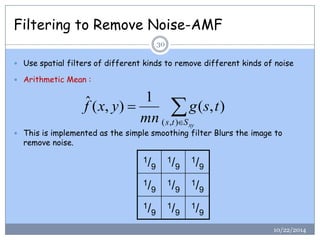
 Use spatial filters of different kinds to remove different kinds of noise 
 Arithmetic Mean : 
 This is implemented as the simple smoothing filter Blurs the image to 
remove noise. 
 
 
s t Sxy 
g s t 
mn 
f x y 
( , ) 
( , ) 
1 
ˆ ( , ) 
1/9 
1/9 
1/9 
1/9 
1/9 
1/9 
1/9 
1/9 
1/9 
30 
10/22/2014
Filtering to Remove Noise-GMF 
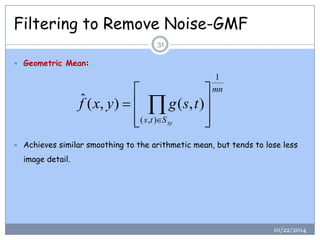
 Geometric Mean: 
 Achieves similar smoothing to the arithmetic mean, but tends to lose less 
image detail. 
mn 
s t Sxy 
f x y g s t 
1 
( , ) 
ˆ ( , ) ( , ) 
 
 
 
 
 
 
 
 
  
31 
10/22/2014
Filtering to Remove Noise-HMF 
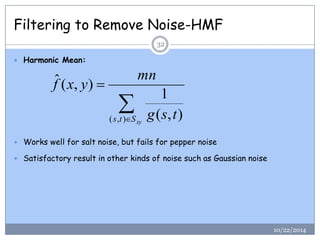
 Harmonic Mean: 
 Works well for salt noise, but fails for pepper noise 
 Satisfactory result in other kinds of noise such as Gaussian noise 
 
 
s t Sxy g s t 
mn 
f x y 
( , ) ( , ) 
1 
ˆ ( , ) 
32 
10/22/2014
Filtering to Remove Noise-CHMF 
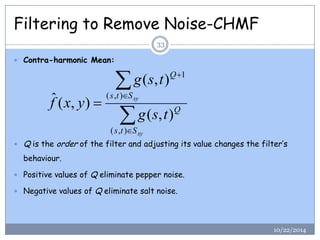
 Contra-harmonic Mean: 
 Q is the order of the filter and adjusting its value changes the filter’s 
behaviour. 
 Positive values of Q eliminate pepper noise. 
 Negative values of Q eliminate salt noise. 
 
 
 
 
 
 
xy 
xy 
s t S 
Q 
s t S 
Q 
g s t 
g s t 
f x y 
( , ) 
( , ) 
1 
( , ) 
( , ) 
ˆ ( , ) 
33 
10/22/2014
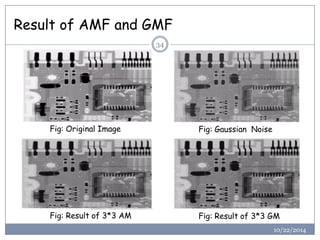
Result of AMF and GMF 
34 
Fig: Original Image 
Fig: Gaussian Noise 
Fig: Result of 3*3 AM 
Fig: Result of 3*3 GM 
10/22/2014
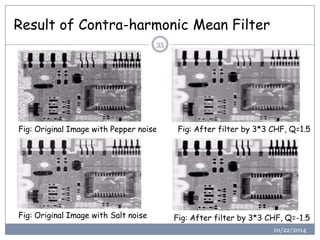
Result of Contra-harmonic Mean Filter 
35 
Fig: Original Image with Pepper noise 
Fig: Original Image with Salt noise 
Fig: After filter by 3*3 CHF, Q=1.5 
Fig: After filter by 3*3 CHF, Q=-1.5 
10/22/2014
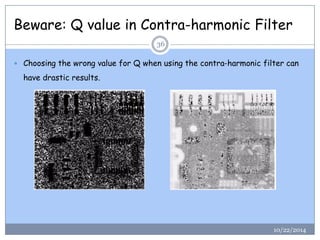
Beware: Q value in Contra-harmonic Filter 
Choosing the wrong value for Q when using the contra-harmonic filter can have drastic results. 
36 
10/22/2014
Order Statistics Filters 
Spatial filters that are based on ordering the pixel values that make up the neighbourhood operated on by the filter 
Useful spatial filters include 
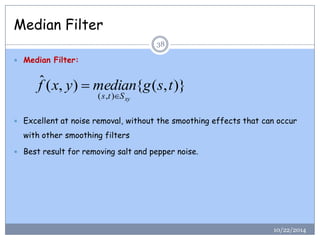
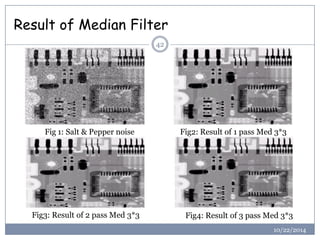
Median filter. 
Maximum and Minimum filter. 
Midpoint filter. 
Alpha trimmed mean filter. 
37 
10/22/2014
Median Filter 
 Median Filter: 
 Excellent at noise removal, without the smoothing effects that can occur 
with other smoothing filters 
 Best result for removing salt and pepper noise. 
ˆ ( , ) { ( , )} 
( , ) 
f x y median g s t 
s t Sxy 
 
38 
10/22/2014
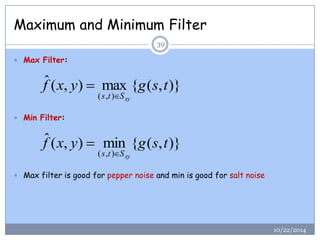
Maximum and Minimum Filter 
 Max Filter: 
 Min Filter: 
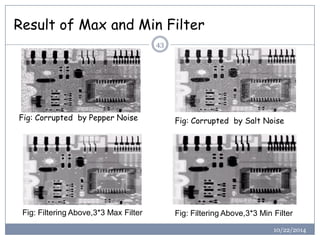
 Max filter is good for pepper noise and min is good for salt noise 
ˆ ( , ) max { ( , )} 
( , ) 
f x y g s t 
s t Sxy 
 
ˆ ( , ) min { ( , )} 
( , ) 
f x y g s t 
s t Sxy 
 
39 
10/22/2014
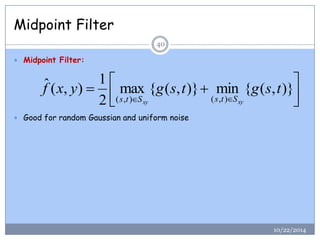
Midpoint Filter 
 Midpoint Filter: 
 Good for random Gaussian and uniform noise 
 
 
 
 
  
  
max { ( , )} min { ( , )} 
2 
1 
ˆ ( , ) 
( , ) ( , ) 
f x y g s t g s t 
xy xy s t S s t S 
40 
10/22/2014
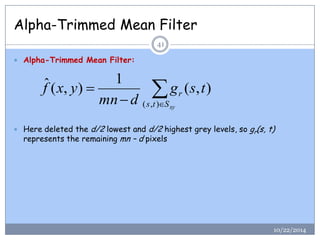
Alpha-Trimmed Mean Filter 
 Alpha-Trimmed Mean Filter: 
 Here deleted the d/2 lowest and d/2 highest grey levels, so gr(s, t) 
represents the remaining mn – d pixels 
 
 
 
s t Sxy 
r g s t 
mn d 
f x y 
( , ) 
( , ) 
1 
ˆ ( , ) 
41 
10/22/2014
Result of Median Filter 
42 
Fig 1: Salt & Pepper noise 
Fig2: Result of 1 pass Med 3*3 
Fig3: Result of 2 pass Med 3*3 
Fig4: Result of 3 pass Med 3*3 
10/22/2014
Result of Max and Min Filter 
Fig: Corrupted by Pepper Noise 
Fig: Filtering Above,3*3 Max Filter 
43Fig: Corrupted by Salt Noise 
Fig: Filtering Above,3*3 Min Filter 
10/22/2014
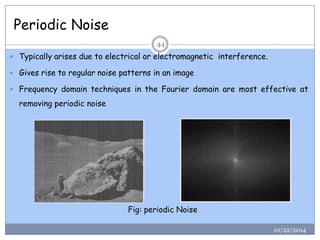
Periodic Noise 
Typicallyarisesduetoelectricalorelectromagneticinterference. 
Givesrisetoregularnoisepatternsinanimage 
FrequencydomaintechniquesintheFourierdomainaremosteffectiveatremovingperiodicnoise 
44 
Fig: periodic Noise 
10/22/2014
Band Reject Filters 
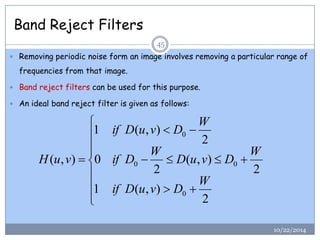
 Removing periodic noise form an image involves removing a particular range of 
frequencies from that image. 
 Band reject filters can be used for this purpose. 
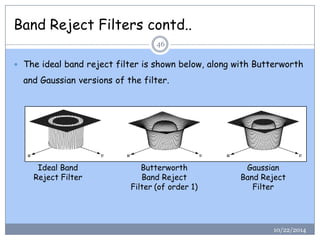
 An ideal band reject filter is given as follows: 
  
 
 
  
 
 
 
  
    
  
 
2 
1 ( , ) 
2 
( , ) 
2 
0 
2 
1 ( , ) 
( , ) 
0 
0 0 
0 
W 
if D u v D 
W 
D u v D 
W 
if D 
W 
if D u v D 
H u v 
45 
10/22/2014
Band Reject Filters contd.. 
The ideal band reject filter is shown below, along with Butterworth and Gaussian versions of the filter. Ideal BandReject Filter 
ButterworthBand RejectFilter (of order 1) 
GaussianBand RejectFilter 
46 
10/22/2014
Result of Band Reject Filter 
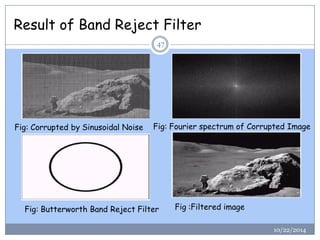
Fig: Corrupted by Sinusoidal NoiseFig: Fourier spectrum of Corrupted Image 
Fig: Butterworth Band Reject Filter 
Fig :Filtered image 
4710/22/2014
Conclusions-What we learnt… 
Restore the original image from degraded image, if u have clue about degradation function, is called image restoration. 
The main objective should be estimate the degradation function. 
If you are able to estimate the H, then follow the inverse of degradation process of an image. 
Weather spatial or frequency domain. 
Spatial domain techniques are particularly useful for removing random noise. 
Frequency domain techniques are particularly useful for removing periodic noise. 
48 
10/22/2014
•AdaptiveProcessing 
Spatialadaptive 
Frequencyadaptive 
•NonlinearProcessing 
Thresholding,coring… 
Iterativerestoration 
•AdvancedTransformation/Modeling 
Advancedimagetransforms,e.g.,wavelet… 
Statisticalimagemodeling 
•BlindDeblurringorDeconvolution 
Advanced Image Restoration 
10/22/2014
ForadvancedImageRestoration(AdaptiveFilteringorNonlinearFilteringetc.),PleasereferredthebookofGonzalezandWoods,“DigitalImageProcessing”,PearsonEducationoranyotherstandardDigitalImageProcessingBooks. 
OR 
Writemeanemail:kalyan.acharjya@gmail.com 
OR 
10/22/2014
Lets conclude..! 
10/22/2014 
51 
What is Image Restoration. 
Image Enhancement vs. Image Restoration. 
Image Degradation Model. 
Noise Models. 
Estimation of Degradation Model. 
Restoration Techniques. 
Some Basics Filter 
Advanced Image Restoration. 
Conclusions. 
Tools for DIP. 
Applications.
Conclusions-What we learnt… 
10/22/2014 
52 
Restore the original image from degraded image, if u have clue about degradation function is called image restoration. 
The main objective should be estimate the degradation function. 
If you are able to estimate the H, then follow the inverse of degradation process of an image. 
Weather spatial or frequency domain. 
Spatial domain techniques are particularly useful for removing random noise. 
Frequency domain techniques are particularly useful for removing periodic noise.
10/22/2014 
53 
Where you start ? 
Digital Image Processing !
Popular Image Processing Software Tools 
10/22/2014 
54 
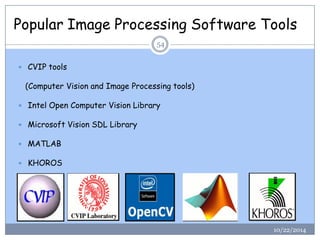
CVIP tools 
(Computer Vision and Image Processing tools) 
Intel Open Computer Vision Library 
Microsoft Vision SDL Library 
MATLAB 
KHOROS
10/22/2014 
55 
Applications of 
Digital Image Processing?
Applications of Digital Image Processing 
10/22/2014 
56 
Identification. 
Computer Vision or Robot vision. 
Steganography. 
Image Enhancement. 
Image Analysis in Medical. 
Morphological Image Analysis. 
Space Image Analysis. 
Bottling and IC Industry……….etc.
10/22/2014 
57 
Email-kalyan.acharjya@gmail.com
10/22/2014 
58 
https://twitter.com/Kalyan_online 
Email-kalyan.acharjya@gmail.com
10/22/2014 
59

Image Restoration (Digital Image Processing)

  • 1.
    A Lecture onIntroductiontoImage Restoration 10/22/2014 1 Presented By KalyanAcharjya Assistant Professor, Dept. of ECE Jaipur National University
  • 2.
    Lecture on ImageRestoration 2 By Kalyan Acharjya,JNUJaipur,India Contact :kalyan.acharjya@gmail.com 10/22/2014
  • 3.
    10/22/2014 3 Objectiveof Two Hour Presentation “TointroducethebasicconceptofImageRestorationinDigitalImageProcessing”
  • 4.
  • 5.
    10/22/2014 5 Acknowledgement •Gonzalez & Woods-DIP Books •Prof. P.K. Biswas, IIT Kharagpur •Dr. ir.AleksandraPizurika, UniversiteitHent. •GlebV. Teheslavski. •Yu Hen Yu. •Zhou Wang, University of Texas. The PPT was designed with the help of materials of following authors.
  • 6.
    Outlines 10/22/2014 6 What is Image Restoration. Image Enhancement vs. Image Restoration. Image Degradation Model. Noise Models. Estimation of Degradation Model. Restoration Techniques. Some Basics Filter Advanced Image Restoration. Conclusions. Tools for DIP. Applications.
  • 7.
    Lets start 10/22/2014 7 What is Image Restoration. Image Enhancement vs. Image Restoration. Image Degradation Model. Noise Models. Estimation of Degradation Model. Restoration Techniques. Some Basics Filter Advanced Image Restoration. Conclusions. Tools for DIP. Applications.
  • 8.
    10/22/2014 8 Whatis Image Restoration.
  • 9.
    What is ImageRestoration? 10/22/2014 9 Image restoration attempts to restore images that have been degraded Identify the degradation process and attempt to reverse it. Almost Similar to image enhancement, but more objective. Fig: Degraded image Fig: Restored image
  • 10.
    Where we reached? 10/22/2014 10 What is Image Restoration. Image Enhancement vs. Image Restoration. Image Degradation Model. Noise Models. Estimation of Degradation Model. Restoration Techniques. Some Basics Filter Advanced Image Restoration. Conclusions. Tools for DIP. Applications.
  • 11.
    Image enhancement vs.Image Restoration 10/22/2014 11 •Imagerestorationassumesadegradationmodelthatisknownorcanbeestimated. •OriginalcontentandqualitydoesnotmeanGoodlookingorappearance. •ImageEnhancementissubjective,whereasimagerestorationisobjectiveprocess. •Imagerestorationtrytorecoveroriginalimagefromdegradedwithpriorknowledgeofdegradationprocess. •Restorationinvolvesmodelingofdegradationandapplyingtheinverseprocessinordertorecovertheoriginalimage. •Althoughtherestoreimageisnottheoriginalimage,itsapproximationofactualimage.
  • 12.
    10/22/201412 What isImage Restoration. Image Enhancement vs. Image Restoration. Image Degradation Model. Noise Models. Estimation of Degradation Model. Restoration Techniques. Some Basics Filter Advanced Image Restoration. Conclusions. Tools for DIP. Applications. Where we reached?
  • 13.
    Degradation Model? 10/22/2014 13 Objective:Torestoreadegraded/distortedimagetoitsoriginalcontentandquality. Spatial Domain: g(x,y)=h(x,y)*f(x,y)+ŋ(x,y) Frequency Domain: G(u,v)=H(u,v)F(u,v)+ ŋ(u,v) Matrix: G=HF+ŋDegradation Function hRestoration Filters g(x,y) f(x,y) ŋ(x,y) f(x,y) ^ Degradation Restoration
  • 14.
    Going On….! 10/22/2014 14 What is Image Restoration. Image Enhancement vs. Image Restoration. Image Degradation Model. Noise Models. Estimation of Degradation Model. Restoration Techniques. Some Basics Filter Advanced Image Restoration. Conclusions. Tools for DIP. Applications.
  • 15.
    Noise Models andTheir PDF 10/22/2014 15 •Different models for the image noise term η(x, y) Gaussian Most common model Rayleigh Erlangor Gamma Exponential Uniform Impulse Salt and pepper noise GaussianRayleighErlang Exponential Uniform Impulse
  • 16.
    Noise Models Effects 10/22/2014 16 Histogram to go here Fig: Original Image Fig: Original Image histogram
  • 17.
    Noise Models Effectscontd1… 10/22/2014 17
  • 18.
    Noise Models Effectscontd2… 10/22/2014 18
  • 19.
    Going On….! 10/22/2014 19 What is Image Restoration. Image Enhancement vs. Image Restoration. Image Degradation Model. Noise Models. Estimation of Degradation Model. Restoration Techniques. Some Basics Filter Advanced Image Restoration. Conclusions. Tools for DIP. Applications.
  • 20.
    Estimation of DegradationModel. 10/22/2014 20 Weather the spatial or frequency domain or Matrix, in all cases knowledge of degradation function is important. Estimation of H is important in image restoration. There are mainly three ways to estimate the H as follows- By Observation By Experimentation. Mathematical Modeling •Afterapproximationthedegradationfunction,weapplytheBLINDCONVOLUTIONtorestoretheoriginalimage.
  • 21.
    Observation 10/22/201421 Noknowledgeofdegradedfunctionisgiven. Observingong(x,y),trytoestimatethedegradedfunctionintheregionwhichhavesimplerstructure. gs(x,y)Gs(u,v) fs(x,y)Fs(u,v) Hs(u,v)=Gs(u,v)/Fs(u,v)
  • 22.
    Observation contd… 10/22/2014 22gs(x,y) fs(x,y) Gs(u,v) Fs(u,v) Hs(u,v)= Gs(u,v)/ Fs(u,v)
  • 23.
    Experimentation 10/22/201423 •Tryto imaging set-up similar to original. Impulse response and impulse simulation. Objective to find H which have similar result of degradation as original one. Fig: Impulse Simulation Impulse Impulse Response
  • 24.
    Experimentation contd… 10/22/201424 Here f(x,y) is impulse. F(u,v)=>A (a constant). G(u,v)=H(u,v)F(u,v). H(u,v)=G(u,v)/A. Objective is training and testing. Never testing on training data. Note:The intensity of impulse is very high, otherwise noise can dominate to impulse.
  • 25.
    Mathematical Modeling 10/22/2014 25 If you have the mathematical model, you have inside the degradation process. Atmospheric turbulence can be possible to mapping in mathematical model. One e.g. of mathematical model k gives the nature of turbulence.
  • 26.
    Mathematical Modeling contd..Atmospheric Turbulence blur examples 10/22/2014 26 Fig: Negligible Turbulence Fig: Severe Turbulence, k=0.0025 Fig: Mid Turbulence, k=0.001 Fig: Low Turbulence, k=0.00025
  • 27.
    Present Position 10/22/2014 27 What is Image Restoration. Image Enhancement vs. Image Restoration. Image Degradation Model. Noise Models. Estimation of Degradation Model. Restoration Techniques. Some Basics Filter Advanced Image Restoration. Conclusions. Tools for DIP. Applications.
  • 28.
    Restoration Techniques. 28 Inverse Filtering. Minimum Mean Squares Errors. Weiner Filtering. Constrained Least Square Filter. Non linear filtering Advanced Restoration Technique. 10/22/2014
  • 29.
    Filter used forRestoration Process Mean filters Arithmetic mean filter Geometric mean filter Harmonic mean filter Contra-harmonic mean filter Order statistics filters Median filter Max and min filters Mid-point filter alpha-trimmed filters Adaptive filters Adaptive local noise reduction filter. Adaptive median filter 29 10/22/2014
  • 30.
    Filtering to RemoveNoise-AMF  Use spatial filters of different kinds to remove different kinds of noise  Arithmetic Mean :  This is implemented as the simple smoothing filter Blurs the image to remove noise.   s t Sxy g s t mn f x y ( , ) ( , ) 1 ˆ ( , ) 1/9 1/9 1/9 1/9 1/9 1/9 1/9 1/9 1/9 30 10/22/2014
  • 31.
    Filtering to RemoveNoise-GMF  Geometric Mean:  Achieves similar smoothing to the arithmetic mean, but tends to lose less image detail. mn s t Sxy f x y g s t 1 ( , ) ˆ ( , ) ( , )           31 10/22/2014
  • 32.
    Filtering to RemoveNoise-HMF  Harmonic Mean:  Works well for salt noise, but fails for pepper noise  Satisfactory result in other kinds of noise such as Gaussian noise   s t Sxy g s t mn f x y ( , ) ( , ) 1 ˆ ( , ) 32 10/22/2014
  • 33.
    Filtering to RemoveNoise-CHMF  Contra-harmonic Mean:  Q is the order of the filter and adjusting its value changes the filter’s behaviour.  Positive values of Q eliminate pepper noise.  Negative values of Q eliminate salt noise.       xy xy s t S Q s t S Q g s t g s t f x y ( , ) ( , ) 1 ( , ) ( , ) ˆ ( , ) 33 10/22/2014
  • 34.
    Result of AMFand GMF 34 Fig: Original Image Fig: Gaussian Noise Fig: Result of 3*3 AM Fig: Result of 3*3 GM 10/22/2014
  • 35.
    Result of Contra-harmonicMean Filter 35 Fig: Original Image with Pepper noise Fig: Original Image with Salt noise Fig: After filter by 3*3 CHF, Q=1.5 Fig: After filter by 3*3 CHF, Q=-1.5 10/22/2014
  • 36.
    Beware: Q valuein Contra-harmonic Filter Choosing the wrong value for Q when using the contra-harmonic filter can have drastic results. 36 10/22/2014
  • 37.
    Order Statistics Filters Spatial filters that are based on ordering the pixel values that make up the neighbourhood operated on by the filter Useful spatial filters include Median filter. Maximum and Minimum filter. Midpoint filter. Alpha trimmed mean filter. 37 10/22/2014
  • 38.
    Median Filter Median Filter:  Excellent at noise removal, without the smoothing effects that can occur with other smoothing filters  Best result for removing salt and pepper noise. ˆ ( , ) { ( , )} ( , ) f x y median g s t s t Sxy  38 10/22/2014
  • 39.
    Maximum and MinimumFilter  Max Filter:  Min Filter:  Max filter is good for pepper noise and min is good for salt noise ˆ ( , ) max { ( , )} ( , ) f x y g s t s t Sxy  ˆ ( , ) min { ( , )} ( , ) f x y g s t s t Sxy  39 10/22/2014
  • 40.
    Midpoint Filter Midpoint Filter:  Good for random Gaussian and uniform noise         max { ( , )} min { ( , )} 2 1 ˆ ( , ) ( , ) ( , ) f x y g s t g s t xy xy s t S s t S 40 10/22/2014
  • 41.
    Alpha-Trimmed Mean Filter  Alpha-Trimmed Mean Filter:  Here deleted the d/2 lowest and d/2 highest grey levels, so gr(s, t) represents the remaining mn – d pixels    s t Sxy r g s t mn d f x y ( , ) ( , ) 1 ˆ ( , ) 41 10/22/2014
  • 42.
    Result of MedianFilter 42 Fig 1: Salt & Pepper noise Fig2: Result of 1 pass Med 3*3 Fig3: Result of 2 pass Med 3*3 Fig4: Result of 3 pass Med 3*3 10/22/2014
  • 43.
    Result of Maxand Min Filter Fig: Corrupted by Pepper Noise Fig: Filtering Above,3*3 Max Filter 43Fig: Corrupted by Salt Noise Fig: Filtering Above,3*3 Min Filter 10/22/2014
  • 44.
    Periodic Noise Typicallyarisesduetoelectricalorelectromagneticinterference. Givesrisetoregularnoisepatternsinanimage FrequencydomaintechniquesintheFourierdomainaremosteffectiveatremovingperiodicnoise 44 Fig: periodic Noise 10/22/2014
  • 45.
    Band Reject Filters  Removing periodic noise form an image involves removing a particular range of frequencies from that image.  Band reject filters can be used for this purpose.  An ideal band reject filter is given as follows:                   2 1 ( , ) 2 ( , ) 2 0 2 1 ( , ) ( , ) 0 0 0 0 W if D u v D W D u v D W if D W if D u v D H u v 45 10/22/2014
  • 46.
    Band Reject Filterscontd.. The ideal band reject filter is shown below, along with Butterworth and Gaussian versions of the filter. Ideal BandReject Filter ButterworthBand RejectFilter (of order 1) GaussianBand RejectFilter 46 10/22/2014
  • 47.
    Result of BandReject Filter Fig: Corrupted by Sinusoidal NoiseFig: Fourier spectrum of Corrupted Image Fig: Butterworth Band Reject Filter Fig :Filtered image 4710/22/2014
  • 48.
    Conclusions-What we learnt… Restore the original image from degraded image, if u have clue about degradation function, is called image restoration. The main objective should be estimate the degradation function. If you are able to estimate the H, then follow the inverse of degradation process of an image. Weather spatial or frequency domain. Spatial domain techniques are particularly useful for removing random noise. Frequency domain techniques are particularly useful for removing periodic noise. 48 10/22/2014
  • 49.
    •AdaptiveProcessing Spatialadaptive Frequencyadaptive •NonlinearProcessing Thresholding,coring… Iterativerestoration •AdvancedTransformation/Modeling Advancedimagetransforms,e.g.,wavelet… Statisticalimagemodeling •BlindDeblurringorDeconvolution Advanced Image Restoration 10/22/2014
  • 50.
  • 51.
    Lets conclude..! 10/22/2014 51 What is Image Restoration. Image Enhancement vs. Image Restoration. Image Degradation Model. Noise Models. Estimation of Degradation Model. Restoration Techniques. Some Basics Filter Advanced Image Restoration. Conclusions. Tools for DIP. Applications.
  • 52.
    Conclusions-What we learnt… 10/22/2014 52 Restore the original image from degraded image, if u have clue about degradation function is called image restoration. The main objective should be estimate the degradation function. If you are able to estimate the H, then follow the inverse of degradation process of an image. Weather spatial or frequency domain. Spatial domain techniques are particularly useful for removing random noise. Frequency domain techniques are particularly useful for removing periodic noise.
  • 53.
    10/22/2014 53 Whereyou start ? Digital Image Processing !
  • 54.
    Popular Image ProcessingSoftware Tools 10/22/2014 54 CVIP tools (Computer Vision and Image Processing tools) Intel Open Computer Vision Library Microsoft Vision SDL Library MATLAB KHOROS
  • 55.
    10/22/2014 55 Applicationsof Digital Image Processing?
  • 56.
    Applications of DigitalImage Processing 10/22/2014 56 Identification. Computer Vision or Robot vision. Steganography. Image Enhancement. Image Analysis in Medical. Morphological Image Analysis. Space Image Analysis. Bottling and IC Industry……….etc.
  • 57.
  • 58.
    10/22/2014 58 https://twitter.com/Kalyan_online Email-kalyan.acharjya@gmail.com
  • 59.