NAME :
SYED KAMRAN HAIDER
PRESENTATION:
OPTICAL DETECTORS
FOUNDATION UNIVERSITY RAWALPINDI CAMPUS
OPTICAL COMMUNICATION SYSTEMS
 Communication systems with light as the carrier and optical
fiber as communication medium
 Optical fiber is used to contain and guide light waves
 Typically made of glass or plastic
 Propagation of light in atmosphere is impractical
 This is similar to cable guiding electromagnetic waves
 Capacity comparison
 Microwave at 10 GHz
 Light at 100 Tera Hz (1014 )
2
HISTORY
 1880 Alexander G. Bell
 Photo phone, transmit sound waves over beam of light
 1930: TV image through uncoated fiber cables
 Few years later image through a single glass fiber
 1951: Flexible fiberscope: Medical applications
 1956: The term “fiber optics” used for the first time
 1958: Paper on Laser & Maser
3
HISTORY CONT’D
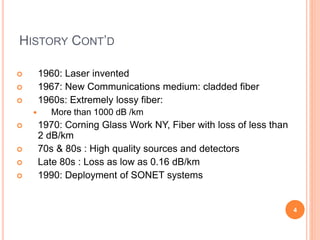
 1960: Laser invented
 1967: New Communications medium: cladded fiber
 1960s: Extremely lossy fiber:
 More than 1000 dB /km
 1970: Corning Glass Work NY, Fiber with loss of less than
2 dB/km
 70s & 80s : High quality sources and detectors
 Late 80s : Loss as low as 0.16 dB/km
 1990: Deployment of SONET systems
4
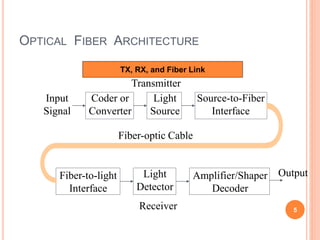
OPTICAL FIBER ARCHITECTURE
Transmitter
Input
Signal
Coder or
Converter
Light
Source
Source-to-Fiber
Interface
Fiber-to-light
Interface
Light
Detector
Amplifier/Shaper
Decoder
Output
Fiber-optic Cable
Receiver
TX, RX, and Fiber Link
5
OPTICAL FIBER ARCHITECTURE –
COMPONENTS
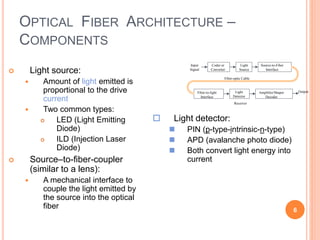
 Light source:
 Amount of light emitted is
proportional to the drive
current
 Two common types:
 LED (Light Emitting
Diode)
 ILD (Injection Laser
Diode)
 Source–to-fiber-coupler
(similar to a lens):
 A mechanical interface to
couple the light emitted by
the source into the optical
fiber
Input
Signal
Coder or
Converter
Light
Source
Source-to-Fiber
Interface
Fiber-to-light
Interface
Light
Detector
Amplifier/Shaper
Decoder
Output
Fiber-optic Cable
Receiver
 Light detector:
 PIN (p-type-intrinsic-n-type)
 APD (avalanche photo diode)
 Both convert light energy into
current
6
LIGHT DETECTORS
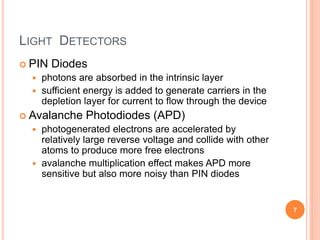
 PIN Diodes
 photons are absorbed in the intrinsic layer
 sufficient energy is added to generate carriers in the
depletion layer for current to flow through the device
 Avalanche Photodiodes (APD)
 photogenerated electrons are accelerated by
relatively large reverse voltage and collide with other
atoms to produce more free electrons
 avalanche multiplication effect makes APD more
sensitive but also more noisy than PIN diodes
7
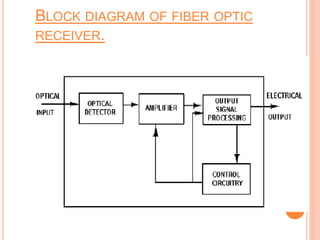
BLOCK DIAGRAM OF FIBER OPTIC
RECEIVER.
8
OPTICAL DETECTORS.
 These are transducers that convert optical
signals into electrical signals.
 Transducers are devices that convert input
energy of one form into output energy of
another.
 An optical detector does so by generating
an electrical current proportional to the
intensity of the incident optical light.
9
OPTICAL DETECTOR REQUIREMENTS.
 Compatible in size to low-pass optical fibers
for efficient coupling and packaging.
 High sensitivity at the operating wavelength
of the source.
 Low noise contribution.
 Maintain stable operation in changing
environmental conditions.
10
11
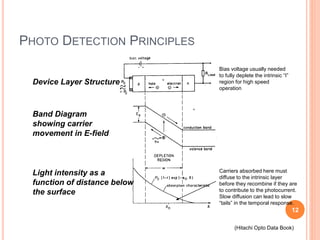
PHOTO DETECTION PRINCIPLES
(Hitachi Opto Data Book)
Device Layer Structure
Band Diagram
showing carrier
movement in E-field
Light intensity as a
function of distance below
the surface
Carriers absorbed here must
diffuse to the intrinsic layer
before they recombine if they are
to contribute to the photocurrent.
Slow diffusion can lead to slow
“tails” in the temporal response.
Bias voltage usually needed
to fully deplete the intrinsic “I”
region for high speed
operation
12
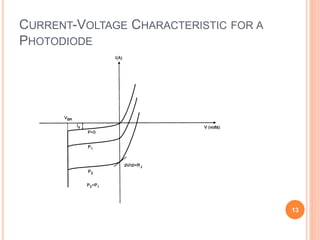
CURRENT-VOLTAGE CHARACTERISTIC FOR A
PHOTODIODE
13
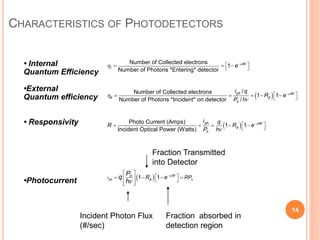
CHARACTERISTICS OF PHOTODETECTORS
 







 
 
 
 
  
    

Number of Collected electrons
1
Number of Photons *Entering* detector
/Number of Collected electrons
1 1
Number of Photons *Incident* on detector /
Photo Current (Amps)
W
i
ph W
e p
o
e
i q
R e
P h
R  
 






 
 
 
     
  
   
 
1 1
Incident Optical Power (Watts)
1 1ph o
ph W
p
o
W
p
oi RP
i q
R e
P h
R e
P
q
h
• Internal
Quantum Efficiency
•External
Quantum efficiency
• Responsivity
•Photocurrent
Incident Photon Flux
(#/sec)
Fraction Transmitted
into Detector
Fraction absorbed in
detection region
14
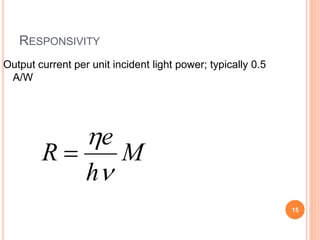
RESPONSIVITY
M
h
e
R



Output current per unit incident light power; typically 0.5
A/W
15
OPTICAL DETECTOR MATERIALS.
 Si,GaAs, GaAlAs – 850nm
 Ge, InP, InGaAs -1300nm and 1550nm.
 Materials determine the responsivity of the
detector which is the ratio of the output
photocurrent to the incident optical power.
 It’s a function of the wavelength and
efficiency of the device.
16
PIN PHOTODIODE.
 Semiconductor positive-negative structure
with an intrinsic region sandwiched between
the other two regions.
 Normally operated by applying a reverse-
bias voltage.
 Dark current can also be produced which is
a leakage current that flows when a reverse
bias is applied without incident light.
17
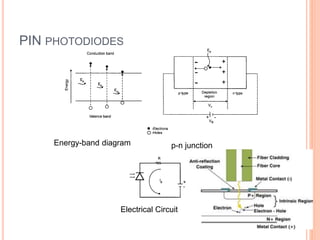
PIN PHOTODIODES
Energy-band diagram p-n junction
Electrical Circuit 18
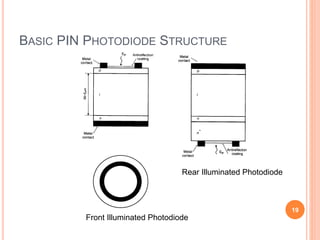
BASIC PIN PHOTODIODE STRUCTURE
Front Illuminated Photodiode
Rear Illuminated Photodiode
19
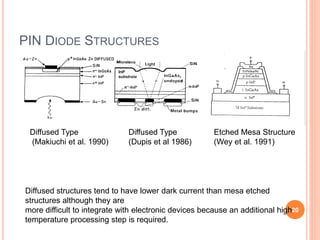
PIN DIODE STRUCTURES
Diffused Type
(Makiuchi et al. 1990)
Etched Mesa Structure
(Wey et al. 1991)
Diffused Type
(Dupis et al 1986)
Diffused structures tend to have lower dark current than mesa etched
structures although they are
more difficult to integrate with electronic devices because an additional high
temperature processing step is required.
20
RESPONSE TIME FACTORS.
 Thickness of the active area.
-Related to the amount of time required for
the electrons generated to flow out of the
detector active area.
 Detector RC time constant.
-Depends on the capacitance of the
photodiode and the resistance of the load.
21
ADVANTAGE OF PIN PHOTODIODES.
 The output electrical current is linearly proportional
to the input optical power making it a highly linear
device.
 Low bias voltage(<4v).
 Low noise
 Low dark current
 High-speed response
22
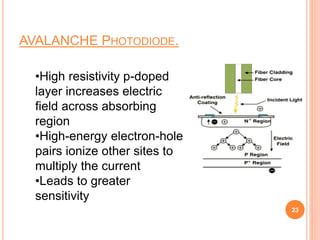
AVALANCHE PHOTODIODE.
•High resistivity p-doped
layer increases electric
field across absorbing
region
•High-energy electron-hole
pairs ionize other sites to
multiply the current
•Leads to greater
sensitivity
23
AVALANCHE PHOTODIODES.
 An APD internally amplifies the photocurrent by an
avalanche process when a large reverse-bias voltage is
applied across the active region.
 The gain of the APD can be changed by changing the
reverse-bias voltage.
24
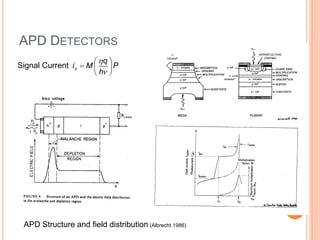
APD DETECTORS
Signal Current


 
  
 
s
q
i M P
h
APD Structure and field distribution (Albrecht 1986)
25
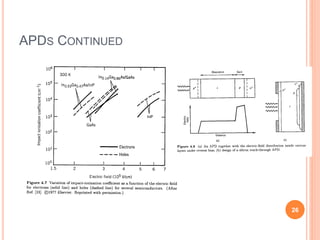
APDS CONTINUED
26
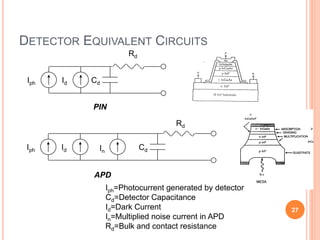
DETECTOR EQUIVALENT CIRCUITS
Iph
Rd
Id Cd
PIN
Iph
Rd
Id Cd
APD
In
Iph=Photocurrent generated by detector
Cd=Detector Capacitance
Id=Dark Current
In=Multiplied noise current in APD
Rd=Bulk and contact resistance
27
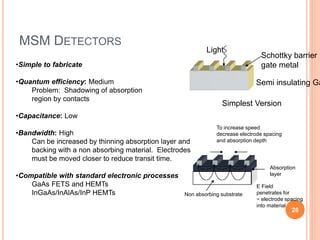
MSM DETECTORS
Semi insulating Ga
•Simple to fabricate
•Quantum efficiency: Medium
Problem: Shadowing of absorption
region by contacts
•Capacitance: Low
•Bandwidth: High
Can be increased by thinning absorption layer and
backing with a non absorbing material. Electrodes
must be moved closer to reduce transit time.
•Compatible with standard electronic processes
GaAs FETS and HEMTs
InGaAs/InAlAs/InP HEMTs
To increase speed
decrease electrode spacing
and absorption depth
Absorption
layer
Non absorbing substrate
E Field
penetrates for
~ electrode spacing
into material
Simplest Version
Schottky barrier
gate metal
Light
28
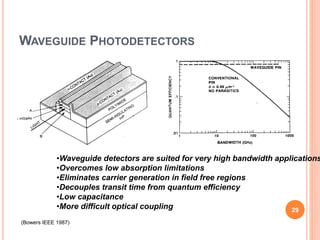
WAVEGUIDE PHOTODETECTORS
(Bowers IEEE 1987)
•Waveguide detectors are suited for very high bandwidth applications
•Overcomes low absorption limitations
•Eliminates carrier generation in field free regions
•Decouples transit time from quantum efficiency
•Low capacitance
•More difficult optical coupling 29
CARRIER TRANSIT TIME
Transit time is a function of depletion width and
carrier drift velocity
td= w/vd
30
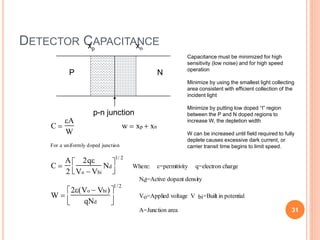
DETECTOR CAPACITANCE
p-n junction
xp xn
For a uniformly doped junction
Where: =permitivity q=electron charge
Nd=Active dopant density
Vo=Applied voltage V bi=Built in potential
A=Junction area
C 
A
W
w  xp  xn
C 
A
2
2q
Vo  Vbi
Nd




1/ 2
W 
2(Vo  Vbi)
qNd




1/2
P N
Capacitance must be minimized for high
sensitivity (low noise) and for high speed
operation
Minimize by using the smallest light collecting
area consistent with efficient collection of the
incident light
Minimize by putting low doped “I” region
between the P and N doped regions to
increase W, the depletion width
W can be increased until field required to fully
deplete causes excessive dark current, or
carrier transit time begins to limit speed.
31
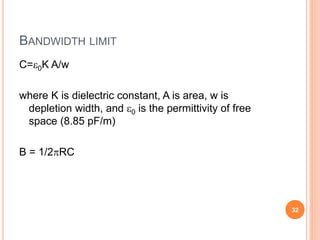
BANDWIDTH LIMIT
C=0K A/w
where K is dielectric constant, A is area, w is
depletion width, and 0 is the permittivity of free
space (8.85 pF/m)
B = 1/2RC
32
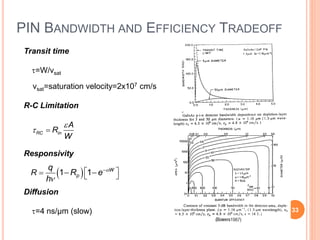
PIN BANDWIDTH AND EFFICIENCY TRADEOFF
Transit time
=W/vsat
vsat=saturation velocity=2x107 cm/s
R-C Limitation
Responsivity
Diffusion
=4 ns/µm (slow)

 RC in
A
R
W
  


    1 1 W
pR
q
R e
h
33
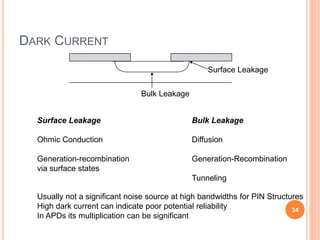
DARK CURRENT
Surface Leakage
Bulk Leakage
Surface Leakage
Ohmic Conduction
Generation-recombination
via surface states
Bulk Leakage
Diffusion
Generation-Recombination
Tunneling
Usually not a significant noise source at high bandwidths for PIN Structures
High dark current can indicate poor potential reliability
In APDs its multiplication can be significant
34
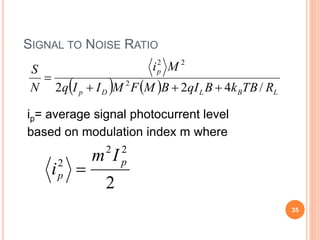
SIGNAL TO NOISE RATIO
ip= average signal photocurrent level
based on modulation index m where
2
22
2 p
p
Im
i 
    LBLDp
p
RTBkBqIBMFMIIq
Mi
N
S
/422 2
22


35
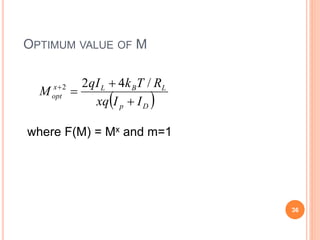
OPTIMUM VALUE OF M
where F(M) = Mx and m=1
 Dp
LBLx
opt
IIxq
RTkqI
M


 /422
36
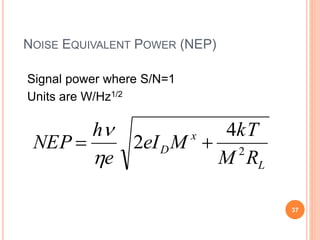
NOISE EQUIVALENT POWER (NEP)
Signal power where S/N=1
Units are W/Hz1/2
L
x
D
RM
kT
MeI
e
h
NEP 2
4
2 


37
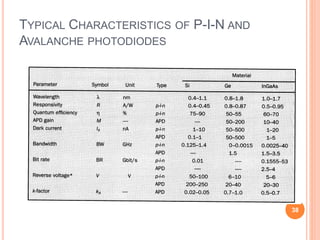
TYPICAL CHARACTERISTICS OF P-I-N AND
AVALANCHE PHOTODIODES
38
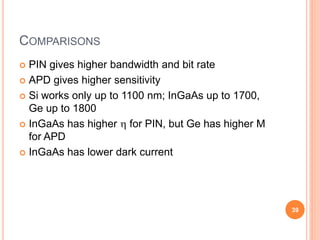
COMPARISONS
 PIN gives higher bandwidth and bit rate
 APD gives higher sensitivity
 Si works only up to 1100 nm; InGaAs up to 1700,
Ge up to 1800
 InGaAs has higher  for PIN, but Ge has higher M
for APD
 InGaAs has lower dark current
39

Optical detectors details and technologies with formulas

  • 1.
    NAME : SYED KAMRANHAIDER PRESENTATION: OPTICAL DETECTORS FOUNDATION UNIVERSITY RAWALPINDI CAMPUS
  • 2.
    OPTICAL COMMUNICATION SYSTEMS Communication systems with light as the carrier and optical fiber as communication medium  Optical fiber is used to contain and guide light waves  Typically made of glass or plastic  Propagation of light in atmosphere is impractical  This is similar to cable guiding electromagnetic waves  Capacity comparison  Microwave at 10 GHz  Light at 100 Tera Hz (1014 ) 2
  • 3.
    HISTORY  1880 AlexanderG. Bell  Photo phone, transmit sound waves over beam of light  1930: TV image through uncoated fiber cables  Few years later image through a single glass fiber  1951: Flexible fiberscope: Medical applications  1956: The term “fiber optics” used for the first time  1958: Paper on Laser & Maser 3
  • 4.
    HISTORY CONT’D  1960:Laser invented  1967: New Communications medium: cladded fiber  1960s: Extremely lossy fiber:  More than 1000 dB /km  1970: Corning Glass Work NY, Fiber with loss of less than 2 dB/km  70s & 80s : High quality sources and detectors  Late 80s : Loss as low as 0.16 dB/km  1990: Deployment of SONET systems 4
  • 5.
    OPTICAL FIBER ARCHITECTURE Transmitter Input Signal Coderor Converter Light Source Source-to-Fiber Interface Fiber-to-light Interface Light Detector Amplifier/Shaper Decoder Output Fiber-optic Cable Receiver TX, RX, and Fiber Link 5
  • 6.
    OPTICAL FIBER ARCHITECTURE– COMPONENTS  Light source:  Amount of light emitted is proportional to the drive current  Two common types:  LED (Light Emitting Diode)  ILD (Injection Laser Diode)  Source–to-fiber-coupler (similar to a lens):  A mechanical interface to couple the light emitted by the source into the optical fiber Input Signal Coder or Converter Light Source Source-to-Fiber Interface Fiber-to-light Interface Light Detector Amplifier/Shaper Decoder Output Fiber-optic Cable Receiver  Light detector:  PIN (p-type-intrinsic-n-type)  APD (avalanche photo diode)  Both convert light energy into current 6
  • 7.
    LIGHT DETECTORS  PINDiodes  photons are absorbed in the intrinsic layer  sufficient energy is added to generate carriers in the depletion layer for current to flow through the device  Avalanche Photodiodes (APD)  photogenerated electrons are accelerated by relatively large reverse voltage and collide with other atoms to produce more free electrons  avalanche multiplication effect makes APD more sensitive but also more noisy than PIN diodes 7
  • 8.
    BLOCK DIAGRAM OFFIBER OPTIC RECEIVER. 8
  • 9.
    OPTICAL DETECTORS.  Theseare transducers that convert optical signals into electrical signals.  Transducers are devices that convert input energy of one form into output energy of another.  An optical detector does so by generating an electrical current proportional to the intensity of the incident optical light. 9
  • 10.
    OPTICAL DETECTOR REQUIREMENTS. Compatible in size to low-pass optical fibers for efficient coupling and packaging.  High sensitivity at the operating wavelength of the source.  Low noise contribution.  Maintain stable operation in changing environmental conditions. 10
  • 11.
  • 12.
    PHOTO DETECTION PRINCIPLES (HitachiOpto Data Book) Device Layer Structure Band Diagram showing carrier movement in E-field Light intensity as a function of distance below the surface Carriers absorbed here must diffuse to the intrinsic layer before they recombine if they are to contribute to the photocurrent. Slow diffusion can lead to slow “tails” in the temporal response. Bias voltage usually needed to fully deplete the intrinsic “I” region for high speed operation 12
  • 13.
  • 14.
    CHARACTERISTICS OF PHOTODETECTORS                          Number of Collected electrons 1 Number of Photons *Entering* detector /Number of Collected electrons 1 1 Number of Photons *Incident* on detector / Photo Current (Amps) W i ph W e p o e i q R e P h R                                1 1 Incident Optical Power (Watts) 1 1ph o ph W p o W p oi RP i q R e P h R e P q h • Internal Quantum Efficiency •External Quantum efficiency • Responsivity •Photocurrent Incident Photon Flux (#/sec) Fraction Transmitted into Detector Fraction absorbed in detection region 14
  • 15.
    RESPONSIVITY M h e R    Output current perunit incident light power; typically 0.5 A/W 15
  • 16.
    OPTICAL DETECTOR MATERIALS. Si,GaAs, GaAlAs – 850nm  Ge, InP, InGaAs -1300nm and 1550nm.  Materials determine the responsivity of the detector which is the ratio of the output photocurrent to the incident optical power.  It’s a function of the wavelength and efficiency of the device. 16
  • 17.
    PIN PHOTODIODE.  Semiconductorpositive-negative structure with an intrinsic region sandwiched between the other two regions.  Normally operated by applying a reverse- bias voltage.  Dark current can also be produced which is a leakage current that flows when a reverse bias is applied without incident light. 17
  • 18.
    PIN PHOTODIODES Energy-band diagramp-n junction Electrical Circuit 18
  • 19.
    BASIC PIN PHOTODIODESTRUCTURE Front Illuminated Photodiode Rear Illuminated Photodiode 19
  • 20.
    PIN DIODE STRUCTURES DiffusedType (Makiuchi et al. 1990) Etched Mesa Structure (Wey et al. 1991) Diffused Type (Dupis et al 1986) Diffused structures tend to have lower dark current than mesa etched structures although they are more difficult to integrate with electronic devices because an additional high temperature processing step is required. 20
  • 21.
    RESPONSE TIME FACTORS. Thickness of the active area. -Related to the amount of time required for the electrons generated to flow out of the detector active area.  Detector RC time constant. -Depends on the capacitance of the photodiode and the resistance of the load. 21
  • 22.
    ADVANTAGE OF PINPHOTODIODES.  The output electrical current is linearly proportional to the input optical power making it a highly linear device.  Low bias voltage(<4v).  Low noise  Low dark current  High-speed response 22
  • 23.
    AVALANCHE PHOTODIODE. •High resistivityp-doped layer increases electric field across absorbing region •High-energy electron-hole pairs ionize other sites to multiply the current •Leads to greater sensitivity 23
  • 24.
    AVALANCHE PHOTODIODES.  AnAPD internally amplifies the photocurrent by an avalanche process when a large reverse-bias voltage is applied across the active region.  The gain of the APD can be changed by changing the reverse-bias voltage. 24
  • 25.
    APD DETECTORS Signal Current         s q i M P h APD Structure and field distribution (Albrecht 1986) 25
  • 26.
  • 27.
    DETECTOR EQUIVALENT CIRCUITS Iph Rd IdCd PIN Iph Rd Id Cd APD In Iph=Photocurrent generated by detector Cd=Detector Capacitance Id=Dark Current In=Multiplied noise current in APD Rd=Bulk and contact resistance 27
  • 28.
    MSM DETECTORS Semi insulatingGa •Simple to fabricate •Quantum efficiency: Medium Problem: Shadowing of absorption region by contacts •Capacitance: Low •Bandwidth: High Can be increased by thinning absorption layer and backing with a non absorbing material. Electrodes must be moved closer to reduce transit time. •Compatible with standard electronic processes GaAs FETS and HEMTs InGaAs/InAlAs/InP HEMTs To increase speed decrease electrode spacing and absorption depth Absorption layer Non absorbing substrate E Field penetrates for ~ electrode spacing into material Simplest Version Schottky barrier gate metal Light 28
  • 29.
    WAVEGUIDE PHOTODETECTORS (Bowers IEEE1987) •Waveguide detectors are suited for very high bandwidth applications •Overcomes low absorption limitations •Eliminates carrier generation in field free regions •Decouples transit time from quantum efficiency •Low capacitance •More difficult optical coupling 29
  • 30.
    CARRIER TRANSIT TIME Transittime is a function of depletion width and carrier drift velocity td= w/vd 30
  • 31.
    DETECTOR CAPACITANCE p-n junction xpxn For a uniformly doped junction Where: =permitivity q=electron charge Nd=Active dopant density Vo=Applied voltage V bi=Built in potential A=Junction area C  A W w  xp  xn C  A 2 2q Vo  Vbi Nd     1/ 2 W  2(Vo  Vbi) qNd     1/2 P N Capacitance must be minimized for high sensitivity (low noise) and for high speed operation Minimize by using the smallest light collecting area consistent with efficient collection of the incident light Minimize by putting low doped “I” region between the P and N doped regions to increase W, the depletion width W can be increased until field required to fully deplete causes excessive dark current, or carrier transit time begins to limit speed. 31
  • 32.
    BANDWIDTH LIMIT C=0K A/w whereK is dielectric constant, A is area, w is depletion width, and 0 is the permittivity of free space (8.85 pF/m) B = 1/2RC 32
  • 33.
    PIN BANDWIDTH ANDEFFICIENCY TRADEOFF Transit time =W/vsat vsat=saturation velocity=2x107 cm/s R-C Limitation Responsivity Diffusion =4 ns/µm (slow)   RC in A R W          1 1 W pR q R e h 33
  • 34.
    DARK CURRENT Surface Leakage BulkLeakage Surface Leakage Ohmic Conduction Generation-recombination via surface states Bulk Leakage Diffusion Generation-Recombination Tunneling Usually not a significant noise source at high bandwidths for PIN Structures High dark current can indicate poor potential reliability In APDs its multiplication can be significant 34
  • 35.
    SIGNAL TO NOISERATIO ip= average signal photocurrent level based on modulation index m where 2 22 2 p p Im i      LBLDp p RTBkBqIBMFMIIq Mi N S /422 2 22   35
  • 36.
    OPTIMUM VALUE OFM where F(M) = Mx and m=1  Dp LBLx opt IIxq RTkqI M    /422 36
  • 37.
    NOISE EQUIVALENT POWER(NEP) Signal power where S/N=1 Units are W/Hz1/2 L x D RM kT MeI e h NEP 2 4 2    37
  • 38.
    TYPICAL CHARACTERISTICS OFP-I-N AND AVALANCHE PHOTODIODES 38
  • 39.
    COMPARISONS  PIN giveshigher bandwidth and bit rate  APD gives higher sensitivity  Si works only up to 1100 nm; InGaAs up to 1700, Ge up to 1800  InGaAs has higher  for PIN, but Ge has higher M for APD  InGaAs has lower dark current 39