Unit 3
Image Enhancement
Image Histogram Equalization
Lecture By
Kalyan Acharjya
kalyan5.blogspot.in
Lecture No 11
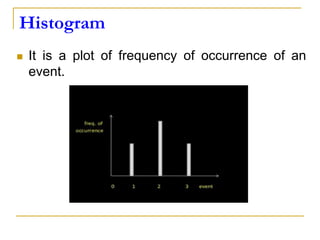
Histogram
 It is a plot of frequency of occurrence of an
event.
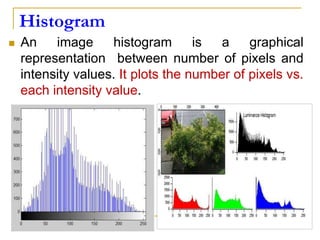
Histogram
 An image histogram is a graphical
representation between number of pixels and
intensity values. It plots the number of pixels vs.
each intensity value.
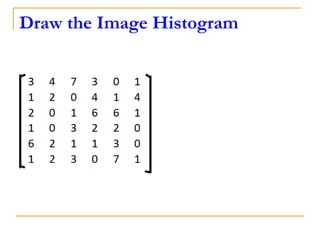
Draw the Image Histogram
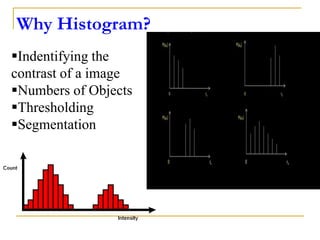
Why Histogram?
Indentifying the
contrast of a image
Numbers of Objects
Thresholding
Segmentation
Histogram Processing
 Types of processing:
 Histogram equalization
 Histogram matching (specification)
 Local enhancement
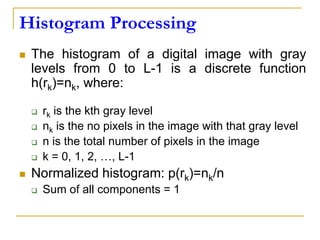
Histogram Processing
 The histogram of a digital image with gray
levels from 0 to L-1 is a discrete function
h(rk)=nk, where:
 rk is the kth gray level
 nk is the no pixels in the image with that gray level
 n is the total number of pixels in the image
 k = 0, 1, 2, …, L-1
 Normalized histogram: p(rk)=nk/n
 Sum of all components = 1
Histogram Equalization
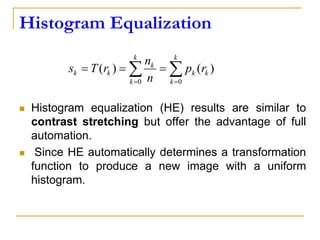
 Histogram equalization (HE) results are similar to
contrast stretching but offer the advantage of full
automation.
 Since HE automatically determines a transformation
function to produce a new image with a uniform
histogram.
)()(
0 0
k
k
k
k
k
k
k
kk rp
n
n
rTs   

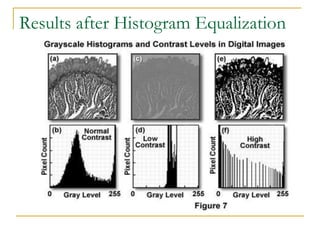
Results after Histogram Equalization
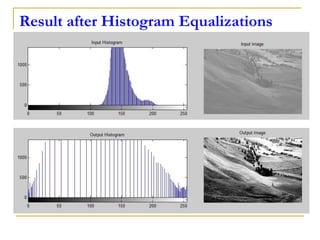
Result after Histogram Equalizations
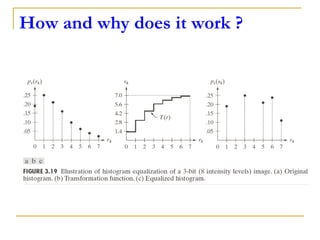
How and why does it work ?
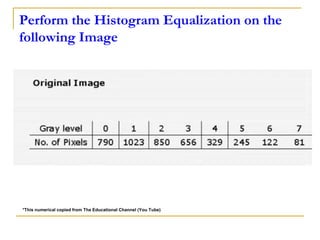
Perform the Histogram Equalization on the
following Image
*This numerical copied from The Educational Channel (You Tube)
Histogram Equalization
Assignment
Online Submission Due Date 30 Sept 2018
1. Comments on Role of Digital Image Processing in
Modern Imaging Based Medical Treatments.
2. Explain your view on Importance of Image
Understanding in Recent Computer Vision Applications
Mid Term 1 Marks and Assignment Submission links are available at
kalyan5.blogspot.in
OR
You can directly visit at http://bit.do/dipr_jnu
Any Questions?
Thank You

Histogram Equalization

  • 1.
    Unit 3 Image Enhancement ImageHistogram Equalization Lecture By Kalyan Acharjya kalyan5.blogspot.in Lecture No 11
  • 2.
    Histogram  It isa plot of frequency of occurrence of an event.
  • 3.
    Histogram  An imagehistogram is a graphical representation between number of pixels and intensity values. It plots the number of pixels vs. each intensity value.
  • 4.
    Draw the ImageHistogram
  • 5.
    Why Histogram? Indentifying the contrastof a image Numbers of Objects Thresholding Segmentation
  • 6.
    Histogram Processing  Typesof processing:  Histogram equalization  Histogram matching (specification)  Local enhancement
  • 7.
    Histogram Processing  Thehistogram of a digital image with gray levels from 0 to L-1 is a discrete function h(rk)=nk, where:  rk is the kth gray level  nk is the no pixels in the image with that gray level  n is the total number of pixels in the image  k = 0, 1, 2, …, L-1  Normalized histogram: p(rk)=nk/n  Sum of all components = 1
  • 8.
    Histogram Equalization  Histogramequalization (HE) results are similar to contrast stretching but offer the advantage of full automation.  Since HE automatically determines a transformation function to produce a new image with a uniform histogram. )()( 0 0 k k k k k k k kk rp n n rTs    
  • 9.
  • 10.
  • 11.
    How and whydoes it work ?
  • 12.
    Perform the HistogramEqualization on the following Image *This numerical copied from The Educational Channel (You Tube)
  • 13.
  • 14.
    Assignment Online Submission DueDate 30 Sept 2018 1. Comments on Role of Digital Image Processing in Modern Imaging Based Medical Treatments. 2. Explain your view on Importance of Image Understanding in Recent Computer Vision Applications Mid Term 1 Marks and Assignment Submission links are available at kalyan5.blogspot.in OR You can directly visit at http://bit.do/dipr_jnu
  • 15.