ELECTRO-OPTIC MODULATOR

        Final Project


     Başak Esin Köktürk
         120206021
OPTİC MODULATOR TYPES

         Electro-optic modulator
         Acousto-optic modulator
         Magneto-optic modulator
WHAT IS ELECTRO-OPTİC
MODULATOR

    An electro-optic modulator (EOM) is a device
     which can be used for controlling the power,
     phase or polarization of a laser beam with an
     electrical control signal.
    Electro-optic effect is the modificatiın of
     refractive index of a nonlinear crystal by an
     external voltage.
POCKELS EFFECT AND KERR EFFECT

   The Pockels effect is the linear electro-optic effect,
    where the refractive index of a medium is modified
    in proportion to the applied electric field strength.


   The Kerr Effect or quadratic electro-optic effect is
    a change in refractive index of metarial refractive
    index with an electric field.


   The difference between Pockels effect and Kerr
    effect; Pockels effect refractive index is changed
    proportionally with the square of electric field but in
    Kerr effect it changes with magnitude of the field.
POCKELS CELLS
   A Pockels cell is a device consisting of an
    electro-optic crystal through which a light beam
    can propagate. The phase delay in the crystal can
    be modulated by applying a variable electric
    voltage.

   Half-wave voltage (Vπ) is very important
    parameter for Pockels cells, half-wave voltage is
    the voltage value for requiring π phase shift.
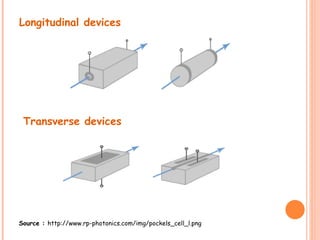
Longitudinal devices


 Transverse devices


Source : http://www.rp-photonics.com/img/pockels_cell_l.png
ELECTRO-OPTİC MODULATOR TYPES
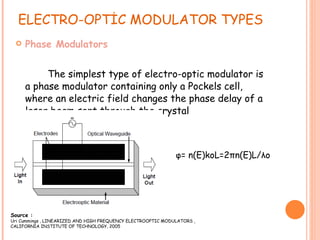
    Phase Modulators


          The simplest type of electro-optic modulator is
     a phase modulator containing only a Pockels cell,
     where an electric field changes the phase delay of a
     laser beam sent through the crystal


                                                              φ= n(E)koL=2πn(E)L/λo


Source :
Uri Cummings , LINEARIZED AND HIGH FREQUENCY ELECTROOPTIC MODULATORS ,
CALIFORNIA INSTITUTE OF TECHNOLOGY, 2005
INTENSİTY MODULATORS
             Amplitude modulation with Pockels cell and
    polarizers is based on Pockels cell modify the
    polarization state and polarizer convert this into
    change in transmitted optical amplitude and
    power                                 Using phase modulation in
                                          optical communication isn’t
                                          easy. Because
                                          photodetectors are only
                                          sensetive to intensity.
                                          Because of this phase
                                          modulation must be
                                          convert to intensity
                                          modulation. This can be
Source : http://www.rp-                   made by using
photonics.com/img/amplitude_modulator.png
                                          interferometer.
MACH­ZEHNDER 
 INTERFEROMETERS

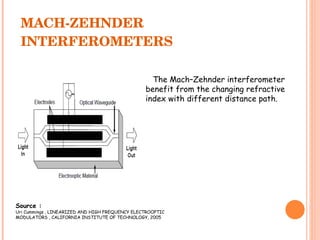
                                                   The Mach–Zehnder interferometer
                                                 benefit from the changing refractive
                                                 index with different distance path.


Source :
Uri Cummings , LINEARIZED AND HIGH FREQUENCY ELECTROOPTIC
MODULATORS , CALIFORNIA INSTITUTE OF TECHNOLOGY, 2005
USAGE AREA OF ELECTRO-OPTIC
MODULATORS


   Modulating a laser beam ; e.g. laser printing,high-
    speed digital data recording,high-speed optical
    communication
   In laser frequency stabilization shemes
   Q switching of solid-state lasers
   Active-mode locking
   Switching pulses in pulse pickers
IMPORTANT PROPERTIES OF ELECTRO-OPTIC
MODULATORS BEFORE PURCHASING
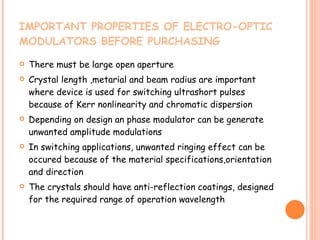
   There must be large open aperture
   Crystal length ,metarial and beam radius are important
    where device is used for switching ultrashort pulses
    because of Kerr nonlinearity and chromatic dispersion
   Depending on design an phase modulator can be generate
    unwanted amplitude modulations
   In switching applications, unwanted ringing effect can be
    occured because of the material specifications,orientation
    and direction
   The crystals should have anti-reflection coatings, designed
    for the required range of operation wavelength
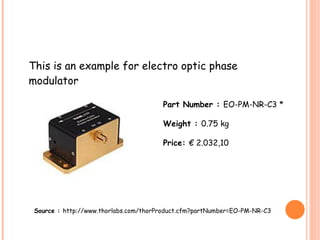
This is an example for electro optic phase
modulator

                                       Part Number : EO-PM-NR-C3 *

                                       Weight : 0.75 kg

                                       Price: € 2.032,10


 Source : http://www.thorlabs.com/thorProduct.cfm?partNumber=EO-PM-NR-C3
OVERVIEW OF REFERENCE STUDIES
 STUDY  
  
    “Polarization­insensitive strip­loaded 
   waveguide for electro­optic modulators and 
   switches” by Jie Sun,Changming Chen, Lei Gao, 
   Xiaoqiang Sun,Weinan Gao,Chunsheng Ma and 
   Daming Zhang pressed on Optics Communication 
   282(2009) 2255­2258.
A GLANCE TO STUDY
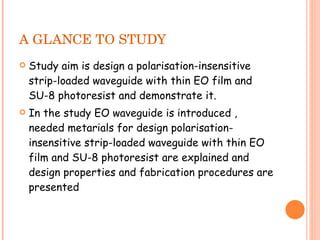
   Study aim is design a polarisation-insensitive
    strip-loaded waveguide with thin EO film and
    SU-8 photoresist and demonstrate it.
   In the study EO waveguide is introduced ,
    needed metarials for design polarisation-
    insensitive strip-loaded waveguide with thin EO
    film and SU-8 photoresist are explained and
    design properties and fabrication procedures are
    presented
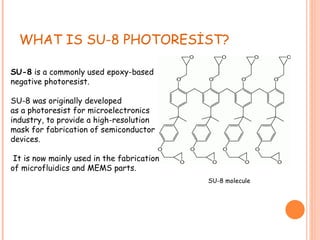
WHAT IS SU-8 PHOTORESİST?

SU-8 is a commonly used epoxy-based
negative photoresist.

SU-8 was originally developed
as a photoresist for microelectronics
industry, to provide a high-resolution
mask for fabrication of semiconductor
devices.

 It is now mainly used in the fabrication
of microfluidics and MEMS parts.
                                            SU-8 molecule
METARIALS AND THEIR PRODUCING
STEPS

   Organic and inorganic hybrid material is synthesized by
    sol-gel method.Sol-gel method is prefered because film
    fabrication is easy and it has high stability


   The sol-gel TiO2 / SiO2 hybrid film is processed.
    However, fabricating this sol–gel TiO2/SiO2 film into a
    single-mode waveguide is difficult, because the material is
    too rigid to form thick film which is more than 2 lm.
    Cracks will appear if the thickness increases. To overcome
    this material limitation, the strip-loaded waveguide
    structure is devised.


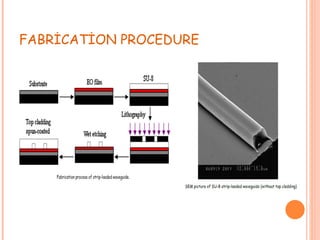
   SU-8 is purchased from MicroChem Corp. Choosen SU-8
    has high sidewall quality,low curing temprature, simple
DESİGN PROCEDURE
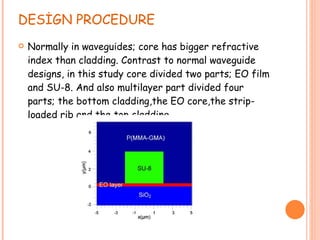
   Normally in waveguides; core has bigger refractive
    index than cladding. Contrast to normal waveguide
    designs, in this study core divided two parts; EO film
    and SU-8. And also multilayer part divided four
    parts; the bottom cladding,the EO core,the strip-
    loaded rib and the top cladding.
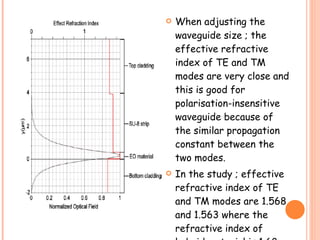
   When adjusting the
    waveguide size ; the
    effective refractive
    index of TE and TM
    modes are very close and
    this is good for
    polarisation-insensitive
    waveguide because of
    the similar propagation
    constant between the
    two modes.
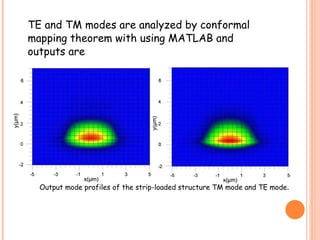
   In the study ; effective
    refractive index of TE
    and TM modes are 1.568
    and 1.563 where the
    refractive index of
TE and TM modes are analyzed by conformal
mapping theorem with using MATLAB and
outputs are


  Output mode profiles of the strip-loaded structure TM mode and TE mode. 
FABRİCATİON PROCEDURE
MEASUREMENT
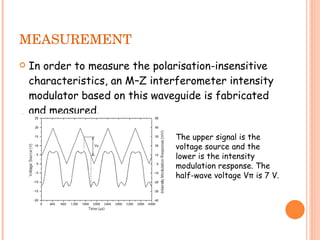
   In order to measure the polarisation-insensitive
    characteristics, an M–Z interferometer intensity
    modulator based on this waveguide is fabricated
    and measured.

                                The upper signal is the
                                voltage source and the
                                lower is the intensity
                                modulation response. The
                                half-wave voltage Vπ is 7 V.


          Thank You!

Electro-optic modulators

  • 1.
    ELECTRO-OPTIC MODULATOR Final Project Başak Esin Köktürk 120206021
  • 2.
    OPTİC MODULATOR TYPES  Electro-optic modulator  Acousto-optic modulator  Magneto-optic modulator
  • 3.
    WHAT IS ELECTRO-OPTİC MODULATOR  An electro-optic modulator (EOM) is a device which can be used for controlling the power, phase or polarization of a laser beam with an electrical control signal.  Electro-optic effect is the modificatiın of refractive index of a nonlinear crystal by an external voltage.
  • 4.
    POCKELS EFFECT ANDKERR EFFECT  The Pockels effect is the linear electro-optic effect, where the refractive index of a medium is modified in proportion to the applied electric field strength.  The Kerr Effect or quadratic electro-optic effect is a change in refractive index of metarial refractive index with an electric field.  The difference between Pockels effect and Kerr effect; Pockels effect refractive index is changed proportionally with the square of electric field but in Kerr effect it changes with magnitude of the field.
  • 5.
    POCKELS CELLS  A Pockels cell is a device consisting of an electro-optic crystal through which a light beam can propagate. The phase delay in the crystal can be modulated by applying a variable electric voltage.  Half-wave voltage (Vπ) is very important parameter for Pockels cells, half-wave voltage is the voltage value for requiring π phase shift.
  • 6.
    Longitudinal devices Transversedevices Source : http://www.rp-photonics.com/img/pockels_cell_l.png
  • 7.
    ELECTRO-OPTİC MODULATOR TYPES  Phase Modulators The simplest type of electro-optic modulator is a phase modulator containing only a Pockels cell, where an electric field changes the phase delay of a laser beam sent through the crystal φ= n(E)koL=2πn(E)L/λo Source : Uri Cummings , LINEARIZED AND HIGH FREQUENCY ELECTROOPTIC MODULATORS , CALIFORNIA INSTITUTE OF TECHNOLOGY, 2005
  • 8.
    INTENSİTY MODULATORS Amplitude modulation with Pockels cell and polarizers is based on Pockels cell modify the polarization state and polarizer convert this into change in transmitted optical amplitude and power Using phase modulation in optical communication isn’t easy. Because photodetectors are only sensetive to intensity. Because of this phase modulation must be convert to intensity modulation. This can be Source : http://www.rp- made by using photonics.com/img/amplitude_modulator.png interferometer.
  • 9.
    MACH­ZEHNDER  INTERFEROMETERS The Mach–Zehnder interferometer benefit from the changing refractive index with different distance path. Source : Uri Cummings , LINEARIZED AND HIGH FREQUENCY ELECTROOPTIC MODULATORS , CALIFORNIA INSTITUTE OF TECHNOLOGY, 2005
  • 10.
    USAGE AREA OFELECTRO-OPTIC MODULATORS  Modulating a laser beam ; e.g. laser printing,high- speed digital data recording,high-speed optical communication  In laser frequency stabilization shemes  Q switching of solid-state lasers  Active-mode locking  Switching pulses in pulse pickers
  • 11.
    IMPORTANT PROPERTIES OFELECTRO-OPTIC MODULATORS BEFORE PURCHASING  There must be large open aperture  Crystal length ,metarial and beam radius are important where device is used for switching ultrashort pulses because of Kerr nonlinearity and chromatic dispersion  Depending on design an phase modulator can be generate unwanted amplitude modulations  In switching applications, unwanted ringing effect can be occured because of the material specifications,orientation and direction  The crystals should have anti-reflection coatings, designed for the required range of operation wavelength
  • 12.
    This is anexample for electro optic phase modulator Part Number : EO-PM-NR-C3 * Weight : 0.75 kg Price: € 2.032,10 Source : http://www.thorlabs.com/thorProduct.cfm?partNumber=EO-PM-NR-C3
  • 13.
    OVERVIEW OF REFERENCESTUDIES  STUDY          “Polarization­insensitive strip­loaded  waveguide for electro­optic modulators and  switches” by Jie Sun,Changming Chen, Lei Gao,  Xiaoqiang Sun,Weinan Gao,Chunsheng Ma and  Daming Zhang pressed on Optics Communication  282(2009) 2255­2258.
  • 14.
    A GLANCE TO STUDY  Study aim is design a polarisation-insensitive strip-loaded waveguide with thin EO film and SU-8 photoresist and demonstrate it.  In the study EO waveguide is introduced , needed metarials for design polarisation- insensitive strip-loaded waveguide with thin EO film and SU-8 photoresist are explained and design properties and fabrication procedures are presented
  • 15.
    WHAT IS SU-8PHOTORESİST? SU-8 is a commonly used epoxy-based negative photoresist. SU-8 was originally developed as a photoresist for microelectronics industry, to provide a high-resolution mask for fabrication of semiconductor devices. It is now mainly used in the fabrication of microfluidics and MEMS parts. SU-8 molecule
  • 16.
    METARIALS AND THEIRPRODUCING STEPS  Organic and inorganic hybrid material is synthesized by sol-gel method.Sol-gel method is prefered because film fabrication is easy and it has high stability  The sol-gel TiO2 / SiO2 hybrid film is processed. However, fabricating this sol–gel TiO2/SiO2 film into a single-mode waveguide is difficult, because the material is too rigid to form thick film which is more than 2 lm. Cracks will appear if the thickness increases. To overcome this material limitation, the strip-loaded waveguide structure is devised.  SU-8 is purchased from MicroChem Corp. Choosen SU-8 has high sidewall quality,low curing temprature, simple
  • 17.
    DESİGN PROCEDURE  Normally in waveguides; core has bigger refractive index than cladding. Contrast to normal waveguide designs, in this study core divided two parts; EO film and SU-8. And also multilayer part divided four parts; the bottom cladding,the EO core,the strip- loaded rib and the top cladding.
  • 18.
    When adjusting the waveguide size ; the effective refractive index of TE and TM modes are very close and this is good for polarisation-insensitive waveguide because of the similar propagation constant between the two modes.  In the study ; effective refractive index of TE and TM modes are 1.568 and 1.563 where the refractive index of
  • 19.
    TE and TMmodes are analyzed by conformal mapping theorem with using MATLAB and outputs are Output mode profiles of the strip-loaded structure TM mode and TE mode. 
  • 20.
  • 21.
    MEASUREMENT  In order to measure the polarisation-insensitive characteristics, an M–Z interferometer intensity modulator based on this waveguide is fabricated and measured. The upper signal is the voltage source and the lower is the intensity modulation response. The half-wave voltage Vπ is 7 V.
  • 22.
            Thank You!