FABRICATION OF
OPTICAL FIBERS
BY:
1) ARNAB
GHOSH ‘03’
2) BITAN
MONDAL ‘04
3) SUKANTA
SAHA ‘14’
CONTENTS
1. INTRODUCTION.
2. ACKNOWLEDGEMENT.
3. TYPES OF FIBRES .
4. FIBRES PROPERTIES.
5. FABRICATION METHODS.
6. REFRENCES.
OPTICAL FIBER FABRICATION TECHNOLOGY
Optical fiber is used worldwide for transmission of voice, data, and
content because of its ability to transmit at speeds in excess of 10
GB/second over very long distances.
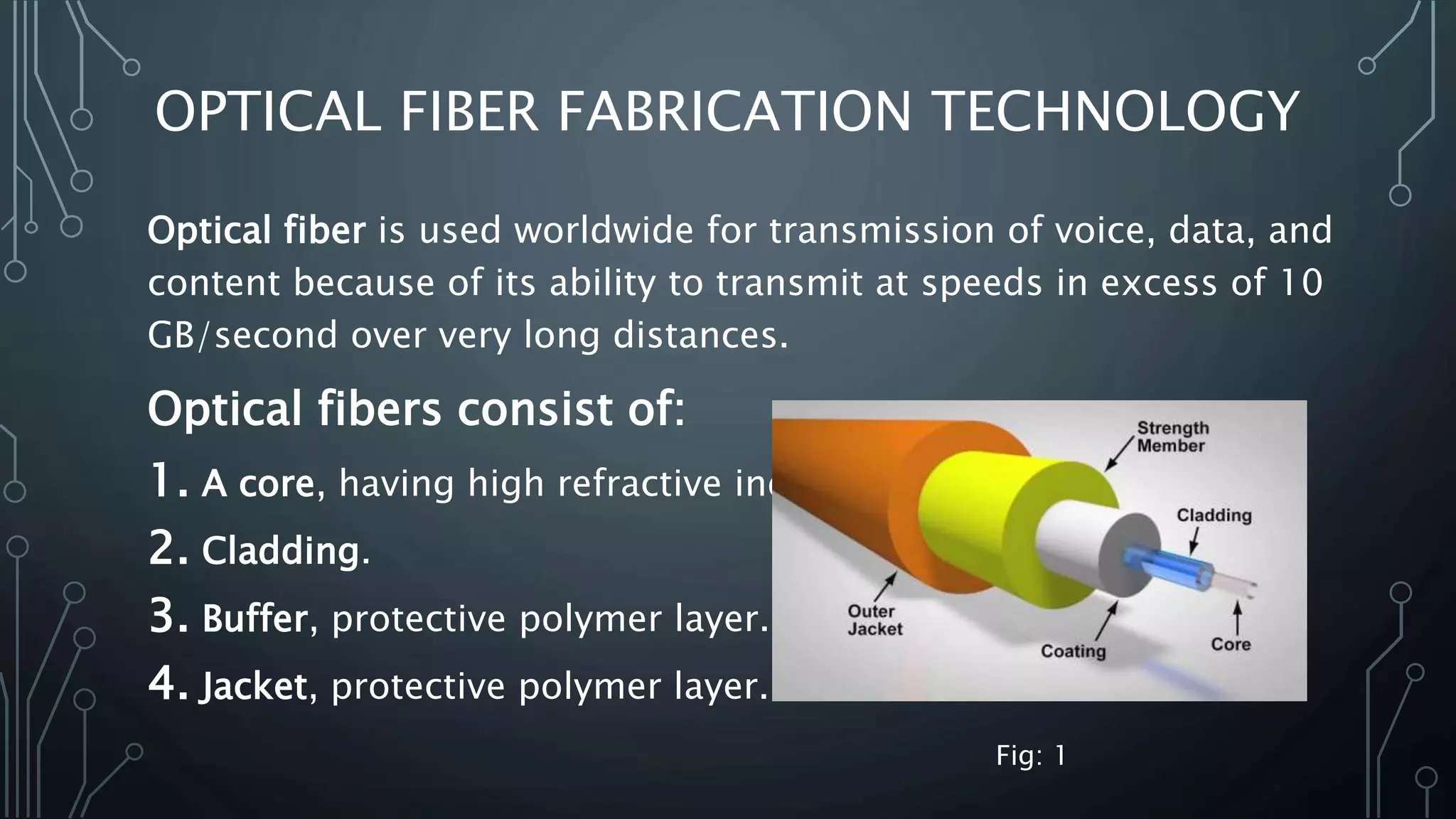
Optical fibers consist of:
1. A core, having high refractive index.
2. Cladding.
3. Buffer, protective polymer layer.
4. Jacket, protective polymer layer.
Fig: 1
TYPES OF FIBERS (BASED ON MATERIALS)
1. Glass Fibers. 2. Plastic Fibers 3. Photonic
Crystal Fibers
•Glass Fibers:
Glass Is Made by Fusing Mixtures of
Metal Oxides, Sulfides or Selenite.
Fig: 2
GLASS FIBERS PROPERTIES
• Glass fiber is a dimensionally stable engineering material. Glass
fiber does not stretch or shrink after exposure to extremely
high or low temperatures.
• Glass fibers do not absorb moisture or change physically or
chemically when exposed to water.
• Glass fiber is an inorganic material and will not burn or support
combustion. It retains approximately 25% of its initial strength
at 1000°F (540°C).
PLASTIC OPTICAL FIBERS
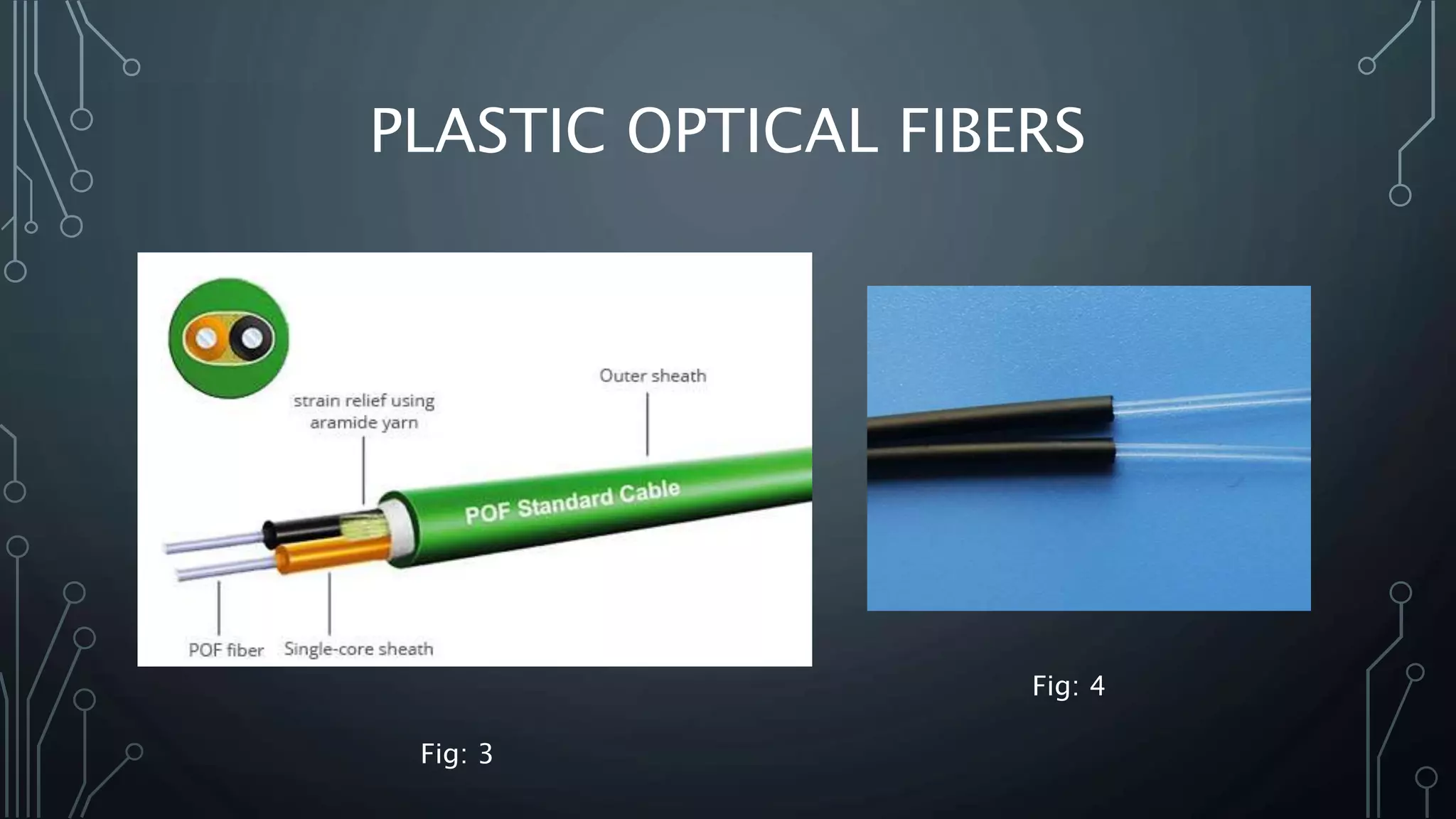
Plastic optical fiber (POF) (or Polymer optical fiber) is an optical
fiber which is made out of Plastic.
Properties of Plastic Optical Fibers (POF) :
• POF standard is based on multilevel PAM modulation a frame
structure, Tomlinson- Harashima Precoding and Multilevel coset
coding modulation.
• For telecommunications, the more difficult-to-use glass optical fiber
is more common.
• Although the actual cost of glass fibers are similar to the plastic
fiber, their installed cost is much higher due to the special handling
and installation techniques required.
PLASTIC OPTICAL FIBERS
Fig: 3
Fig: 4
PHOTONIC CRYSTAL FIBERS
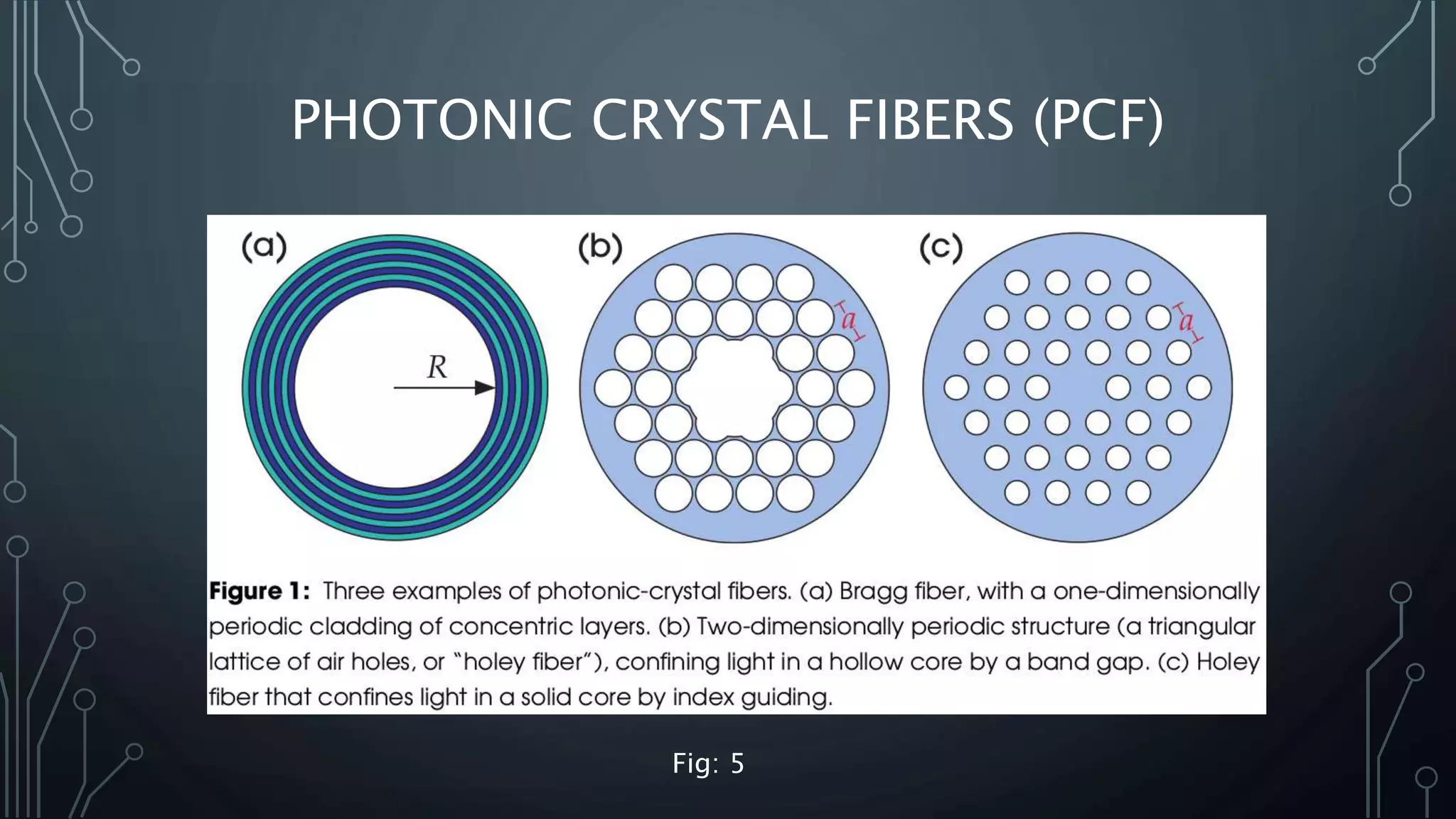
Photonic-crystal fiber (PCF) is a new class of optical fiber based on the
properties of photonic crystals.
Properties of Photonic-crystal fiber (PCF) :
• PCF is now finding applications in fiber-optic communications, fiber
lasers, nonlinear devices, high-power transmission, highly sensitive
gas sensors, and other areas
• PCFs guiding light by a conventional higher-index core modified by
the presence of air holes.
• Photonic crystal fibers may be considered a subgroup of a more
general class of micro structured optical fibers, where light is guided
by structural modifications, and not only by refractive index
differences.
PHOTONIC CRYSTAL FIBERS (PCF)
Fig: 5
PROCESS OF FABRICATION
PREFORM DRAWING COATIN
G
• Preform is
the
primary
process of
making
optical
fiber and
made by
chemical
vapor
deposition.
• Drawing
is the
process
of
extractin
g optical
fiber
from its
preform.
• After
drawing
coating
is done
by a
lower
refractiv
e index
optical
cladding
.
TYPES OF FIBER FABRICATION
• Outside Vapor-Phase Oxidation (OVPO)
• Vapor-Phase Axial Deposition (VAD)
• Modified Chemical Vapor Deposition (MCVD)
• Plasma-Activated Chemical Vapor Deposition (PCDV)
• General Fiber Fabrication.
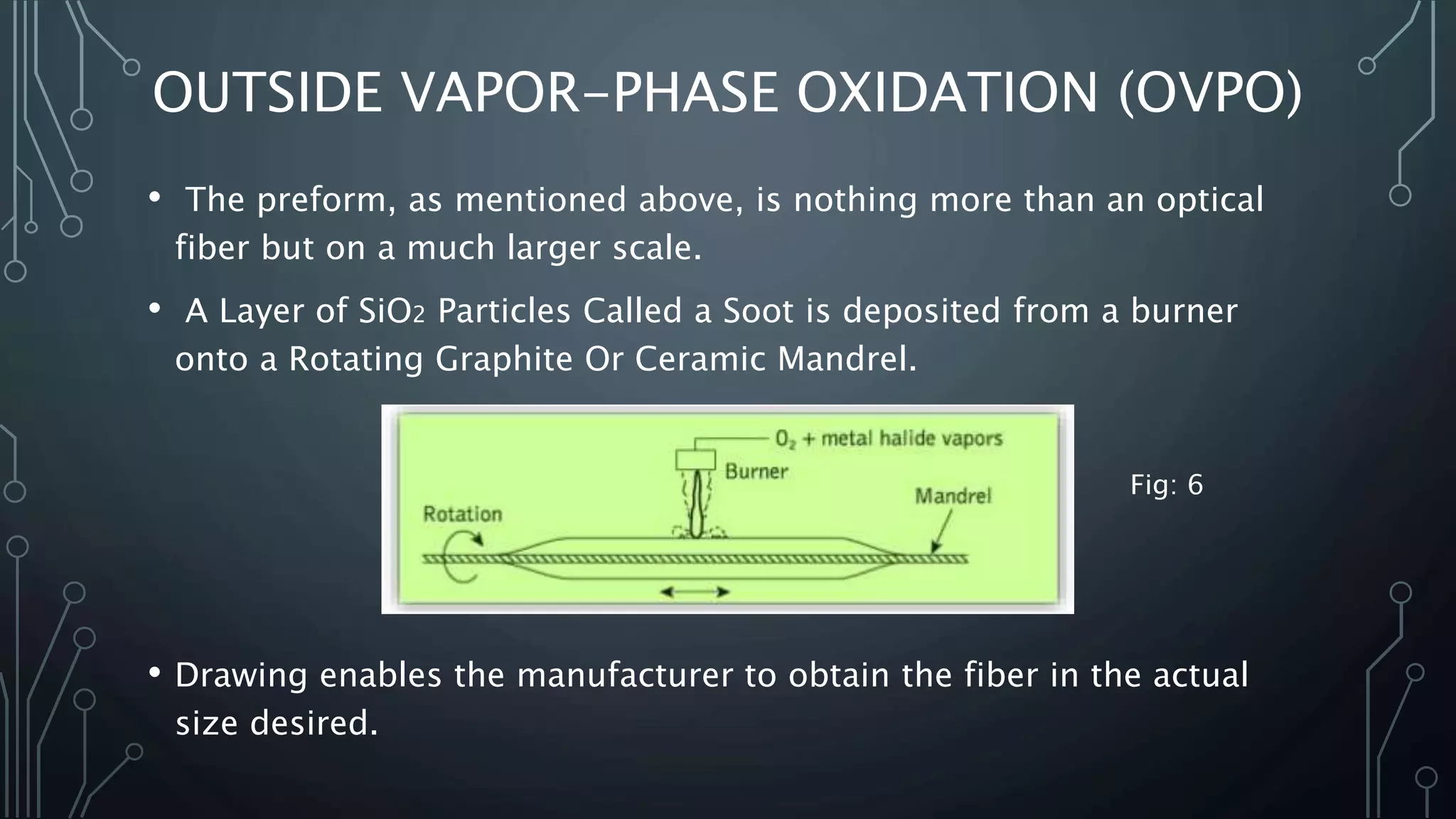
OUTSIDE VAPOR-PHASE OXIDATION (OVPO)
• The preform, as mentioned above, is nothing more than an optical
fiber but on a much larger scale.
• A Layer of SiO2 Particles Called a Soot is deposited from a burner
onto a Rotating Graphite Or Ceramic Mandrel.
• Drawing enables the manufacturer to obtain the fiber in the actual
size desired.
Fig: 6
VAPOR-PHASE AXIAL DEPOSITION (VAD)
• This was the first successful mass-fabrication process.
It was developed by Corning in 1972. In fact, the
first optical fiber with attenuation less than 20 dB/km
was manufactured by Corning using this process.
• The process consists of four phases:
laydown, consolidation, drawing, and measurement .
Fig: 7
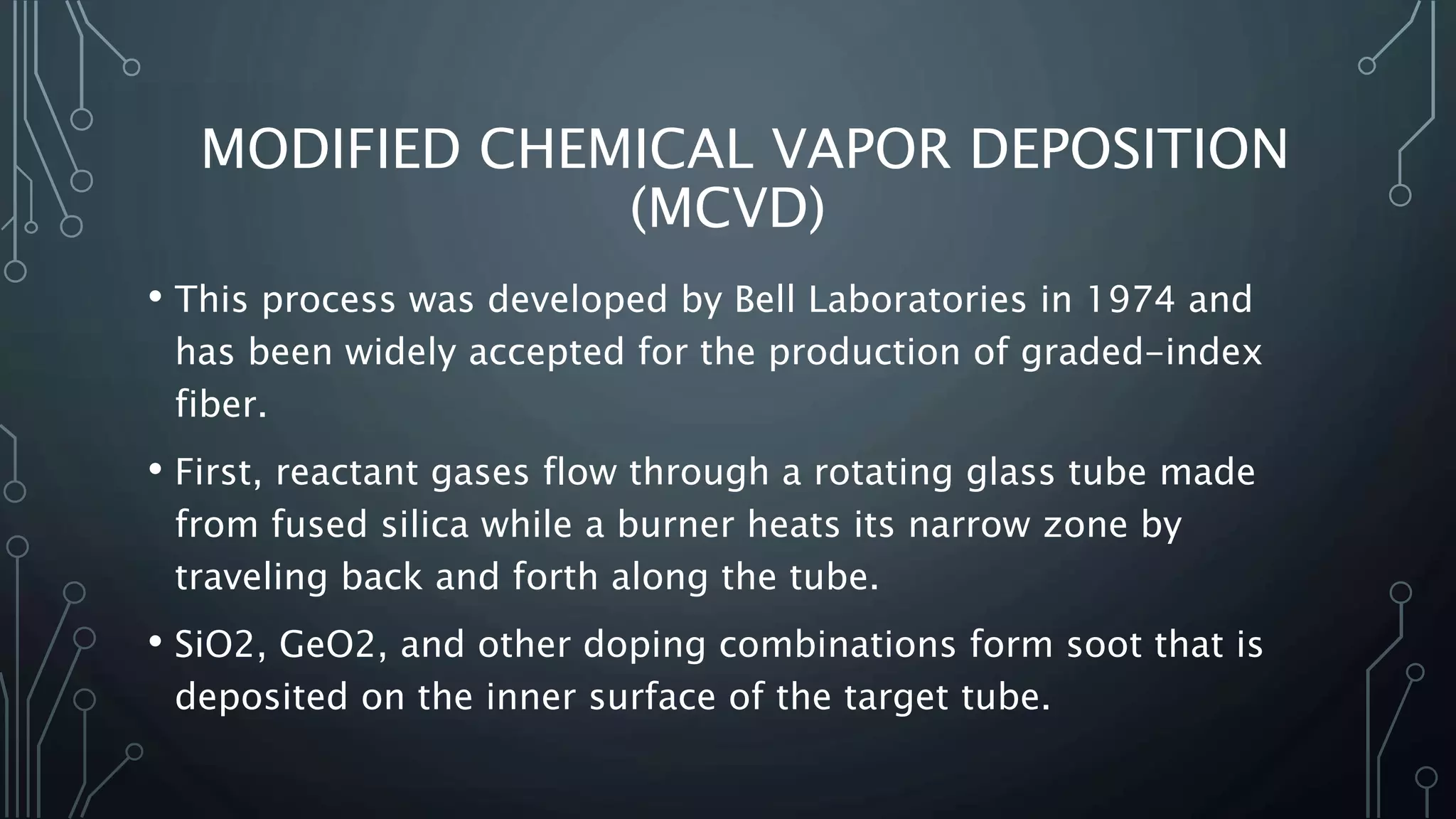
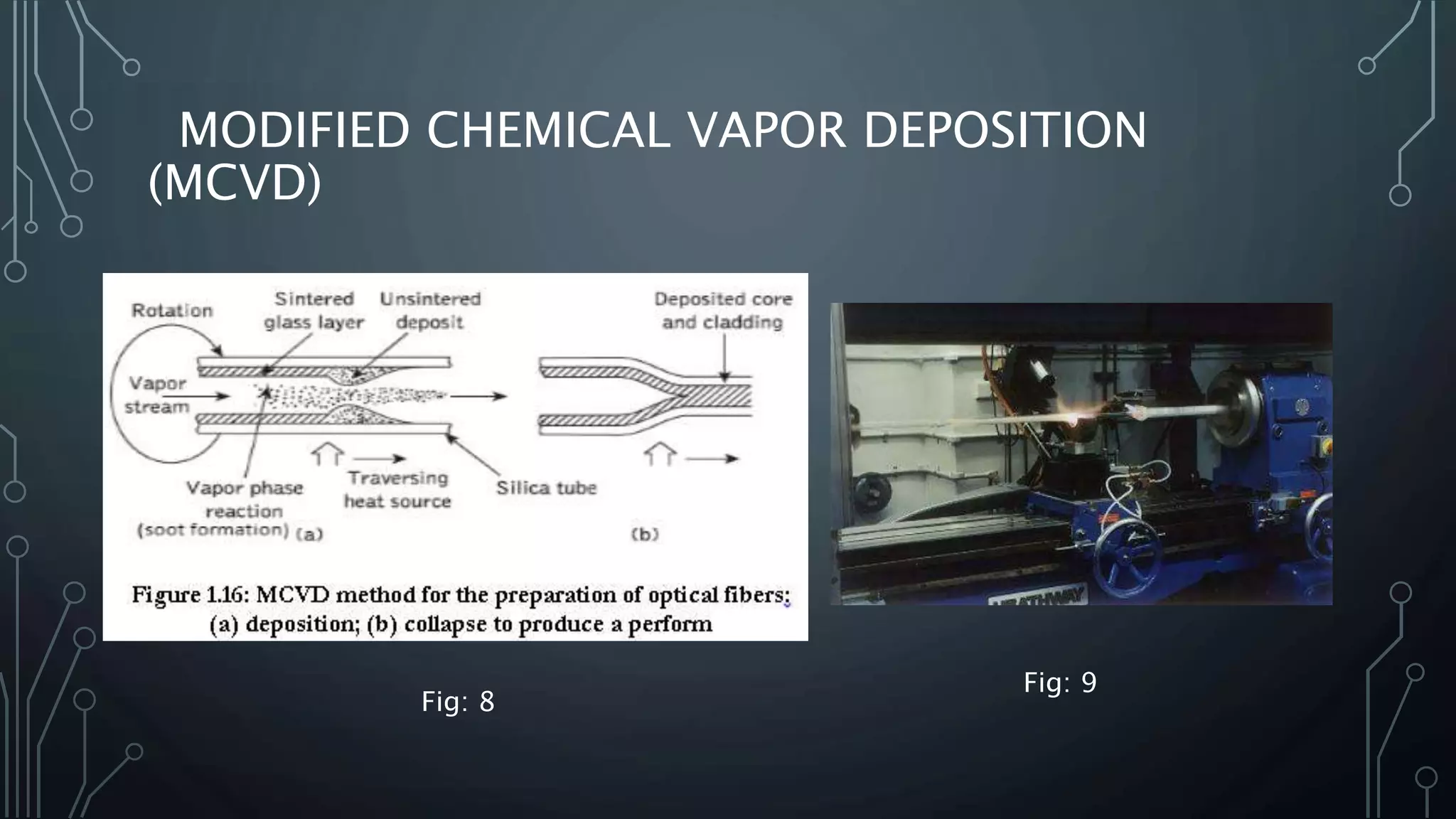
MODIFIED CHEMICAL VAPOR DEPOSITION
(MCVD)
• This process was developed by Bell Laboratories in 1974 and
has been widely accepted for the production of graded-index
fiber.
• First, reactant gases flow through a rotating glass tube made
from fused silica while a burner heats its narrow zone by
traveling back and forth along the tube.
• SiO2, GeO2, and other doping combinations form soot that is
deposited on the inner surface of the target tube.
MODIFIED CHEMICAL VAPOR DEPOSITION
(MCVD)
Fig: 8
Fig: 9
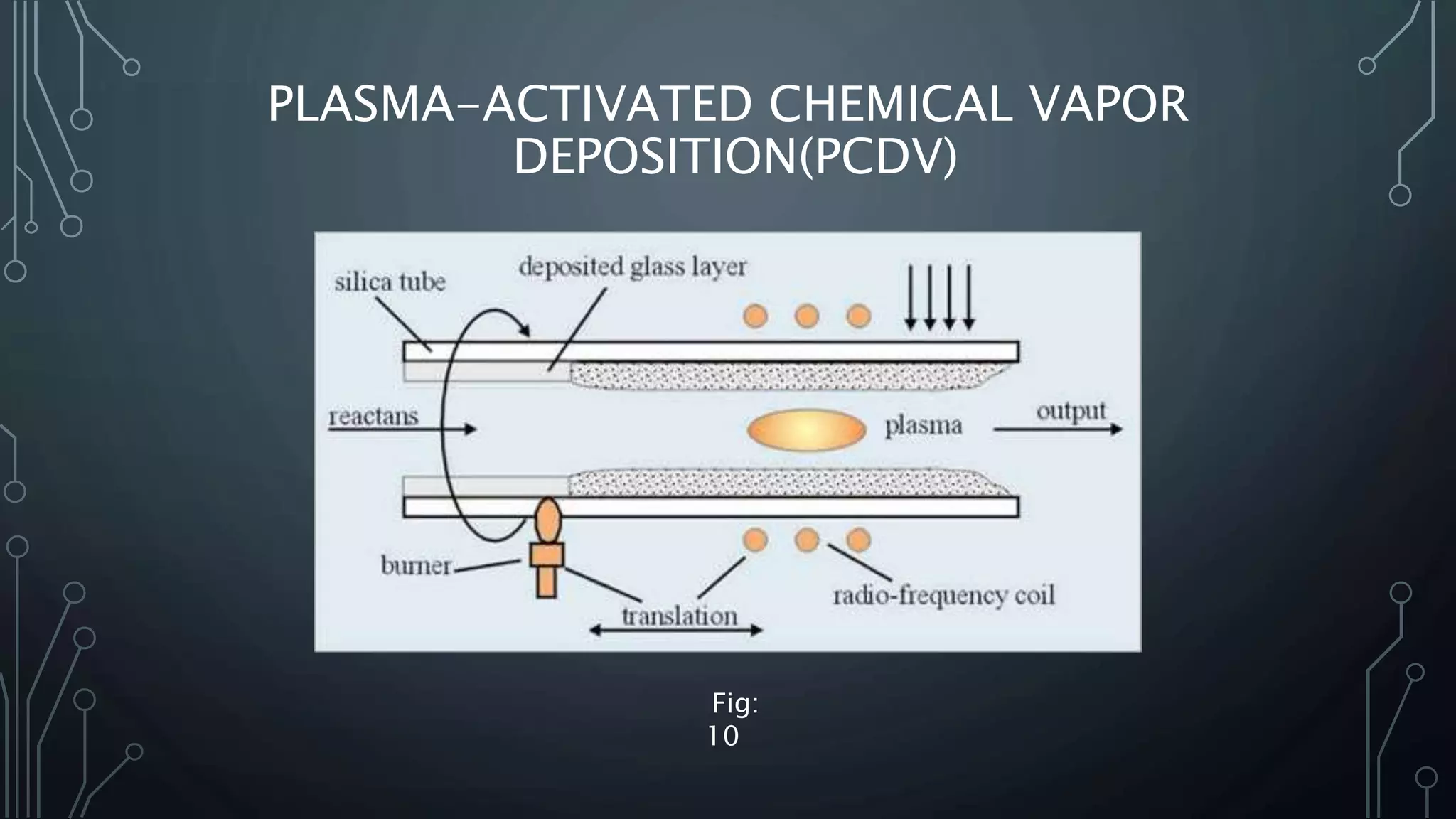
PLASMA-ACTIVATED CHEMICAL VAPOR
DEPOSITION(PCDV)
• This process was developed in 1975 by Phillips, a Dutch
consumer electronics and telecommunications company.
• The process differs from MCVD in its method of heating the
reaction zone: Instead of delivering heat from the outside
through a burner, PCVD uses microwaves to form ionized gas—
plasma—inside the silica tube.
• The capacity of this preform is about 30 km of fiber.
PLASMA-ACTIVATED CHEMICAL VAPOR
DEPOSITION(PCDV)
Fig:
10
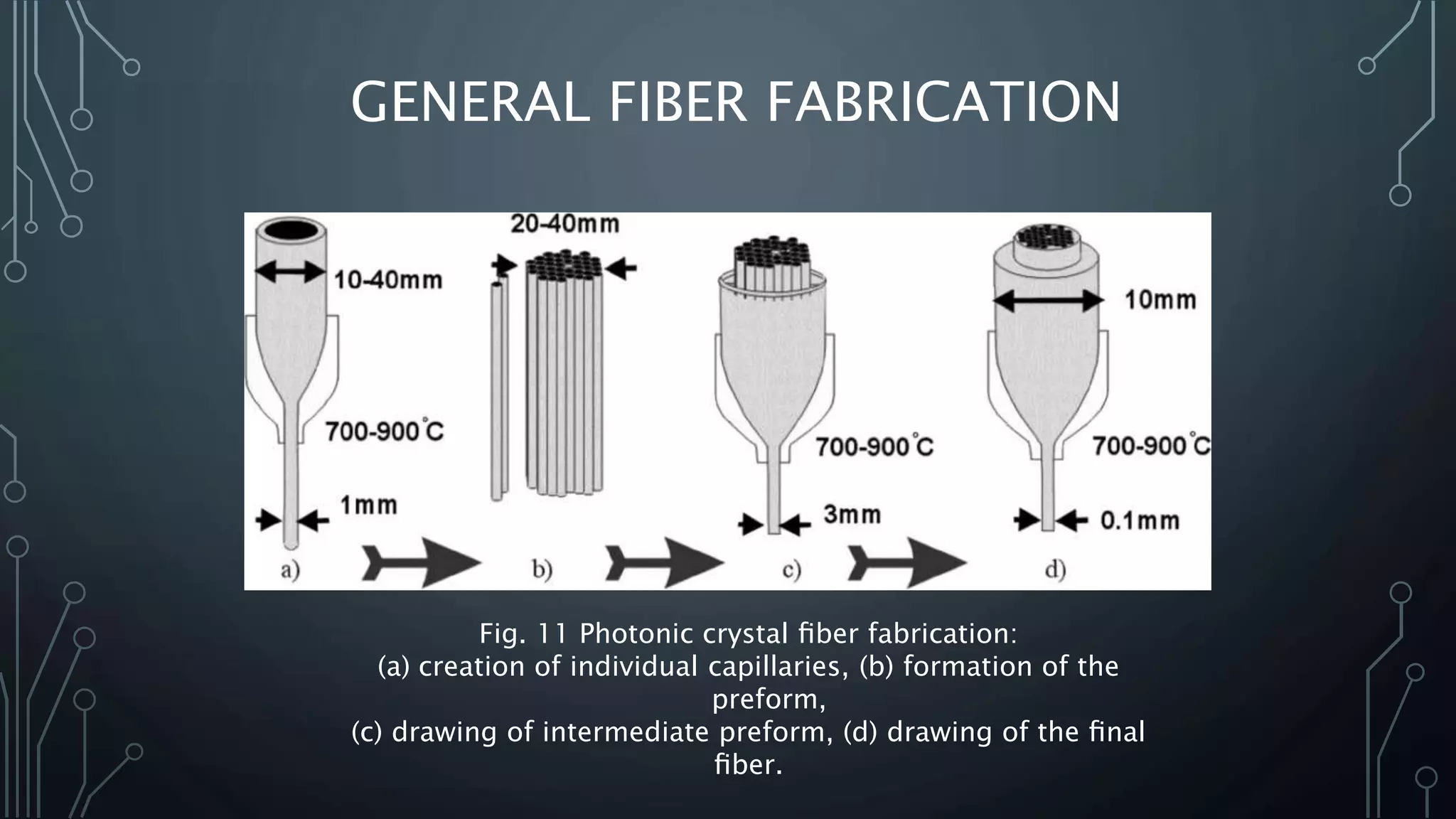
GENERAL FIBER FABRICATION
Fig. 11 Photonic crystal fiber fabrication:
(a) creation of individual capillaries, (b) formation of the
preform,
(c) drawing of intermediate preform, (d) drawing of the final
fiber.
REFRENCES
• Fiber-optic communication systems
Book by Govind Agrawal .
• Fundamentals of optical fibers
Book by John Buck.
• Fiber optics through experiments
Book by Ajoy Ghatak.
• fundamentals of optical fibre communication
Book by Mr. sathish kumar

Fabrication of fibers

  • 1.
    FABRICATION OF OPTICAL FIBERS BY: 1)ARNAB GHOSH ‘03’ 2) BITAN MONDAL ‘04 3) SUKANTA SAHA ‘14’
  • 2.
    CONTENTS 1. INTRODUCTION. 2. ACKNOWLEDGEMENT. 3.TYPES OF FIBRES . 4. FIBRES PROPERTIES. 5. FABRICATION METHODS. 6. REFRENCES.
  • 3.
    OPTICAL FIBER FABRICATIONTECHNOLOGY Optical fiber is used worldwide for transmission of voice, data, and content because of its ability to transmit at speeds in excess of 10 GB/second over very long distances. Optical fibers consist of: 1. A core, having high refractive index. 2. Cladding. 3. Buffer, protective polymer layer. 4. Jacket, protective polymer layer. Fig: 1
  • 4.
    TYPES OF FIBERS(BASED ON MATERIALS) 1. Glass Fibers. 2. Plastic Fibers 3. Photonic Crystal Fibers •Glass Fibers: Glass Is Made by Fusing Mixtures of Metal Oxides, Sulfides or Selenite. Fig: 2
  • 5.
    GLASS FIBERS PROPERTIES •Glass fiber is a dimensionally stable engineering material. Glass fiber does not stretch or shrink after exposure to extremely high or low temperatures. • Glass fibers do not absorb moisture or change physically or chemically when exposed to water. • Glass fiber is an inorganic material and will not burn or support combustion. It retains approximately 25% of its initial strength at 1000°F (540°C).
  • 6.
    PLASTIC OPTICAL FIBERS Plasticoptical fiber (POF) (or Polymer optical fiber) is an optical fiber which is made out of Plastic. Properties of Plastic Optical Fibers (POF) : • POF standard is based on multilevel PAM modulation a frame structure, Tomlinson- Harashima Precoding and Multilevel coset coding modulation. • For telecommunications, the more difficult-to-use glass optical fiber is more common. • Although the actual cost of glass fibers are similar to the plastic fiber, their installed cost is much higher due to the special handling and installation techniques required.
  • 7.
  • 8.
    PHOTONIC CRYSTAL FIBERS Photonic-crystalfiber (PCF) is a new class of optical fiber based on the properties of photonic crystals. Properties of Photonic-crystal fiber (PCF) : • PCF is now finding applications in fiber-optic communications, fiber lasers, nonlinear devices, high-power transmission, highly sensitive gas sensors, and other areas • PCFs guiding light by a conventional higher-index core modified by the presence of air holes. • Photonic crystal fibers may be considered a subgroup of a more general class of micro structured optical fibers, where light is guided by structural modifications, and not only by refractive index differences.
  • 9.
  • 10.
    PROCESS OF FABRICATION PREFORMDRAWING COATIN G • Preform is the primary process of making optical fiber and made by chemical vapor deposition. • Drawing is the process of extractin g optical fiber from its preform. • After drawing coating is done by a lower refractiv e index optical cladding .
  • 11.
    TYPES OF FIBERFABRICATION • Outside Vapor-Phase Oxidation (OVPO) • Vapor-Phase Axial Deposition (VAD) • Modified Chemical Vapor Deposition (MCVD) • Plasma-Activated Chemical Vapor Deposition (PCDV) • General Fiber Fabrication.
  • 12.
    OUTSIDE VAPOR-PHASE OXIDATION(OVPO) • The preform, as mentioned above, is nothing more than an optical fiber but on a much larger scale. • A Layer of SiO2 Particles Called a Soot is deposited from a burner onto a Rotating Graphite Or Ceramic Mandrel. • Drawing enables the manufacturer to obtain the fiber in the actual size desired. Fig: 6
  • 13.
    VAPOR-PHASE AXIAL DEPOSITION(VAD) • This was the first successful mass-fabrication process. It was developed by Corning in 1972. In fact, the first optical fiber with attenuation less than 20 dB/km was manufactured by Corning using this process. • The process consists of four phases: laydown, consolidation, drawing, and measurement . Fig: 7
  • 14.
    MODIFIED CHEMICAL VAPORDEPOSITION (MCVD) • This process was developed by Bell Laboratories in 1974 and has been widely accepted for the production of graded-index fiber. • First, reactant gases flow through a rotating glass tube made from fused silica while a burner heats its narrow zone by traveling back and forth along the tube. • SiO2, GeO2, and other doping combinations form soot that is deposited on the inner surface of the target tube.
  • 15.
    MODIFIED CHEMICAL VAPORDEPOSITION (MCVD) Fig: 8 Fig: 9
  • 16.
    PLASMA-ACTIVATED CHEMICAL VAPOR DEPOSITION(PCDV) •This process was developed in 1975 by Phillips, a Dutch consumer electronics and telecommunications company. • The process differs from MCVD in its method of heating the reaction zone: Instead of delivering heat from the outside through a burner, PCVD uses microwaves to form ionized gas— plasma—inside the silica tube. • The capacity of this preform is about 30 km of fiber.
  • 17.
  • 18.
    GENERAL FIBER FABRICATION Fig.11 Photonic crystal fiber fabrication: (a) creation of individual capillaries, (b) formation of the preform, (c) drawing of intermediate preform, (d) drawing of the final fiber.
  • 19.
    REFRENCES • Fiber-optic communicationsystems Book by Govind Agrawal . • Fundamentals of optical fibers Book by John Buck. • Fiber optics through experiments Book by Ajoy Ghatak. • fundamentals of optical fibre communication Book by Mr. sathish kumar