COMMUNICATION NETWORKS
Department of Electronics & Communication Engineering
Jaipur National University, Jaipur
An Industrial Summer Internship Presentation on
Training Carried out at
United Telecom Limited, Ranchi Jharkhand
Presented by : .......... ( Roll No 5EC...)
8/23/20152
There are some images and contents used within this presentation are
copied from public domain and Books without prior permission from
original owner, which may be listed in references section.
Only Original Owner has full rights reserved for copied images and data
contents.
This PPT is only for fair academic use (Not Commercial).
Kalyan Acharjya
kalyan.acharjya@gmail.com
www.factsaboutuniversity.com
Disclosure
Outlines
 Introduction to Organization Profile.
 UTL Services in Jharkhand.
 Basic of Data Communication Networks.
 Communication Networks Components.
 IP Addressing.
 Applications of UTL Services.
 Conclusion and References.
Kalyan Acharjya
UTL Profile
 United Telecoms e-Services Pvt. Ltd., Ranchi,
Jharkhand is a UTL group of companies, looking after the
CSC Project in Jharkhand.
 United Telecoms Limited (UTL) Group is a Bangalore based,
ICT Solutions Company with wide experience in setting up
telecom networks, e-governance.
Powering Ideas into Communication
Kalyan Acharjya
UTL Profile…
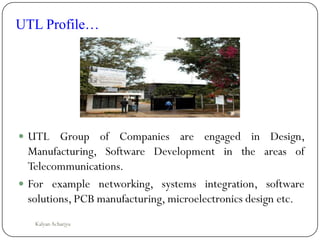
 UTL Group of Companies are engaged in Design,
Manufacturing, Software Development in the areas of
Telecommunications.
 For example networking, systems integration, software
solutions, PCB manufacturing, microelectronics design etc.
Kalyan Acharjya
UTL Services
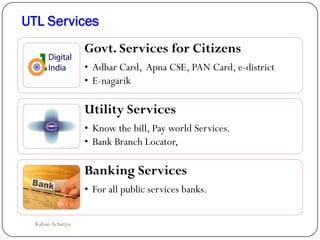
Govt. Services for Citizens
• Adhar Card, Apna CSE, PAN Card, e-district
• E-nagarik
Utility Services
• Know the bill, Pay world Services.
• Bank Branch Locator,
Banking Services
• For all public services banks.
Kalyan Acharjya
Basics of Communication Network
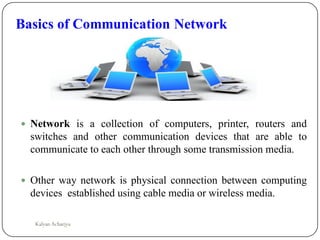
 Network is a collection of computers, printer, routers and
switches and other communication devices that are able to
communicate to each other through some transmission media.
 Other way network is physical connection between computing
devices established using cable media or wireless media.
Kalyan Acharjya
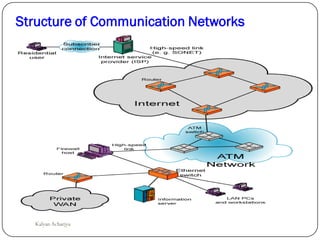
Structure of Communication Networks
Kalyan Acharjya
Some Communication Networks Component
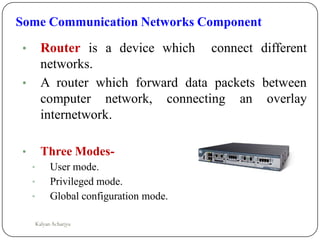
• Router is a device which connect different
networks.
• A router which forward data packets between
computer network, connecting an overlay
internetwork.
• Three Modes-
• User mode.
• Privileged mode.
• Global configuration mode.
Kalyan Acharjya
Modes of Router
User mode:
• Only some basic monitoring.
• Limited show commands ping ,trace etc
• Router>
Privileged Mode:
• Monitoring and some troubleshooting.
• All show commands, ping trace, copy and erase
• Router#
Global Configuration Mode:
• To make any change that affect the router like hostname, routing
configuration.
• Router (config)#
Kalyan Acharjya
Basic Commands
User Mode:
• Router>
• Router>enable
Global Configuration Mode:
•Router#Configure Terminal
•Router(config)#Hostname R-1
•R-1(config)#Show IP route
•R-1(config)enable password<password>
•R-1(config)enable secret <password>
Privileged Mode:
•Router#Show running-config
•Router#Show start-config
•Router#Show flash
•Router#Show version
•Router#Show ip interface brief
Kalyan Acharjya
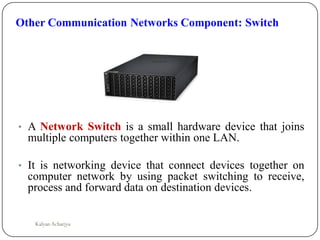
• A Network Switch is a small hardware device that joins
multiple computers together within one LAN.
• It is networking device that connect devices together on
computer network by using packet switching to receive,
process and forward data on destination devices.
Other Communication Networks Component: Switch
Kalyan Acharjya
Idea about IPAddress
• Internet Protocol address is numerical label assigned to each
device participating in a computer network that uses the internet
protocol for communication .
• An IP address has 32 bits divided into four octets.
• To make the address easier to read, people use decimal numbers to
represent the binary digits e.g. 192.168.1.1
• IP Address Classes-
• Class A
• Class B
• Class C
• Class D
Kalyan Acharjya
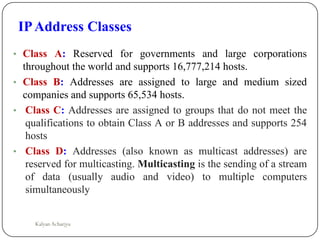
• Class A: Reserved for governments and large corporations
throughout the world and supports 16,777,214 hosts.
• Class B: Addresses are assigned to large and medium sized
companies and supports 65,534 hosts.
• Class C: Addresses are assigned to groups that do not meet the
qualifications to obtain Class A or B addresses and supports 254
hosts
• Class D: Addresses (also known as multicast addresses) are
reserved for multicasting. Multicasting is the sending of a stream
of data (usually audio and video) to multiple computers
simultaneously
IPAddress Classes
Kalyan Acharjya
IPAddressing
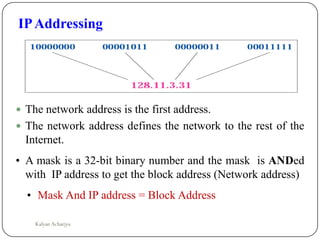
 The network address is the first address.
 The network address defines the network to the rest of the
Internet.
• A mask is a 32-bit binary number and the mask is ANDed
with IP address to get the block address (Network address)
• Mask And IP address = Block Address
Kalyan Acharjya
IP Addressing: Basic Idea of Sub netting
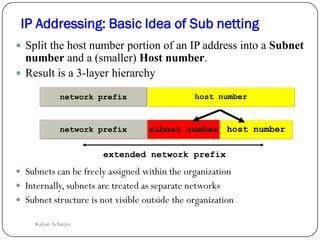
 Split the host number portion of an IP address into a Subnet
number and a (smaller) Host number.
 Result is a 3-layer hierarchy
 Subnets can be freely assigned within the organization
 Internally, subnets are treated as separate networks
 Subnet structure is not visible outside the organization
network prefix host number
subnet numbernetwork prefix host number
extended network prefix
Kalyan Acharjya
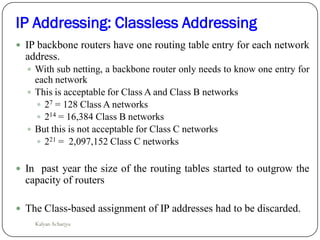
 IP backbone routers have one routing table entry for each network
address.
 With sub netting, a backbone router only needs to know one entry for
each network
 This is acceptable for Class A and Class B networks
 27 = 128 Class A networks
 214 = 16,384 Class B networks
 But this is not acceptable for Class C networks
 221 = 2,097,152 Class C networks
 In past year the size of the routing tables started to outgrow the
capacity of routers
 The Class-based assignment of IP addresses had to be discarded.
IP Addressing: Classless Addressing
Kalyan Acharjya
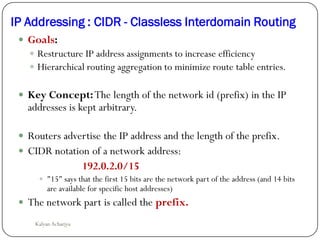
IP Addressing : CIDR - Classless Interdomain Routing
 Goals:
 Restructure IP address assignments to increase efficiency
 Hierarchical routing aggregation to minimize route table entries.
 Key Concept:The length of the network id (prefix) in the IP
addresses is kept arbitrary.
 Routers advertise the IP address and the length of the prefix.
 CIDR notation of a network address:
192.0.2.0/15
 "15" says that the first 15 bits are the network part of the address (and 14 bits
are available for specific host addresses)
 The network part is called the prefix.
Kalyan Acharjya
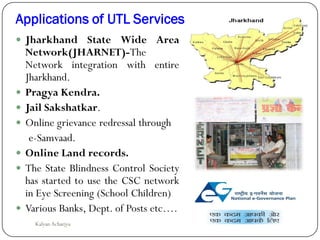
Applications of UTL Services
 Jharkhand State Wide Area
Network(JHARNET)-The
Network integration with entire
Jharkhand.
 Pragya Kendra.
 Jail Sakshatkar.
 Online grievance redressal through
e-Samvaad.
 Online Land records.
 The State Blindness Control Society
has started to use the CSC network
in Eye Screening (School Children)
 Various Banks, Dept. of Posts etc….
Kalyan Acharjya
Conclusions:
 During the internship, I have practically gained the knowledge of
communication networks.
 Practically felt the experienced that how data communication
networks devices (e.g. router, switches etc) are configured and this
was enhanced my industrial knowledge in this field.
 There was another interesting part to do the work in teamwork and
also understood that working way in industry.
 Data Communication networks is a vast area, though I have covered
the IP addressing part during my summer internship.
 This internship was most amazing that I have ever experienced and I
would like to visit UTL again in near future to learn the other
system and software skill in computer networks domain.
Kalyan Acharjya
References :
Books:
[1] Book Forouzan,“ Data Communication Networks”,Tata
McGraw Hall, Fourth Edition.
[2]Andrew S.Tanenbaum,“Computer Networks”, Prentice
Hall of India,Third Edition.
Websites:
[3] http://www.utlindia.com/
[4] http://csc.gov.in/
[5] http://jharkhand.gov.in/jail/
[6] https://en.wikipedia.org/wiki/IP_address
Kalyan Acharjya
Any Questions?
ThankYou !
Kalyan Acharjya
Any Queries Please Contact: kalyan.acharjya@gmail.com

Internship Presentation B.Tech Communication Networks

  • 1.
    COMMUNICATION NETWORKS Department ofElectronics & Communication Engineering Jaipur National University, Jaipur An Industrial Summer Internship Presentation on Training Carried out at United Telecom Limited, Ranchi Jharkhand Presented by : .......... ( Roll No 5EC...)
  • 2.
    8/23/20152 There are someimages and contents used within this presentation are copied from public domain and Books without prior permission from original owner, which may be listed in references section. Only Original Owner has full rights reserved for copied images and data contents. This PPT is only for fair academic use (Not Commercial). Kalyan Acharjya kalyan.acharjya@gmail.com www.factsaboutuniversity.com Disclosure
  • 3.
    Outlines  Introduction toOrganization Profile.  UTL Services in Jharkhand.  Basic of Data Communication Networks.  Communication Networks Components.  IP Addressing.  Applications of UTL Services.  Conclusion and References. Kalyan Acharjya
  • 4.
    UTL Profile  UnitedTelecoms e-Services Pvt. Ltd., Ranchi, Jharkhand is a UTL group of companies, looking after the CSC Project in Jharkhand.  United Telecoms Limited (UTL) Group is a Bangalore based, ICT Solutions Company with wide experience in setting up telecom networks, e-governance. Powering Ideas into Communication Kalyan Acharjya
  • 5.
    UTL Profile…  UTLGroup of Companies are engaged in Design, Manufacturing, Software Development in the areas of Telecommunications.  For example networking, systems integration, software solutions, PCB manufacturing, microelectronics design etc. Kalyan Acharjya
  • 6.
    UTL Services Govt. Servicesfor Citizens • Adhar Card, Apna CSE, PAN Card, e-district • E-nagarik Utility Services • Know the bill, Pay world Services. • Bank Branch Locator, Banking Services • For all public services banks. Kalyan Acharjya
  • 7.
    Basics of CommunicationNetwork  Network is a collection of computers, printer, routers and switches and other communication devices that are able to communicate to each other through some transmission media.  Other way network is physical connection between computing devices established using cable media or wireless media. Kalyan Acharjya
  • 8.
    Structure of CommunicationNetworks Kalyan Acharjya
  • 9.
    Some Communication NetworksComponent • Router is a device which connect different networks. • A router which forward data packets between computer network, connecting an overlay internetwork. • Three Modes- • User mode. • Privileged mode. • Global configuration mode. Kalyan Acharjya
  • 10.
    Modes of Router Usermode: • Only some basic monitoring. • Limited show commands ping ,trace etc • Router> Privileged Mode: • Monitoring and some troubleshooting. • All show commands, ping trace, copy and erase • Router# Global Configuration Mode: • To make any change that affect the router like hostname, routing configuration. • Router (config)# Kalyan Acharjya
  • 11.
    Basic Commands User Mode: •Router> • Router>enable Global Configuration Mode: •Router#Configure Terminal •Router(config)#Hostname R-1 •R-1(config)#Show IP route •R-1(config)enable password<password> •R-1(config)enable secret <password> Privileged Mode: •Router#Show running-config •Router#Show start-config •Router#Show flash •Router#Show version •Router#Show ip interface brief Kalyan Acharjya
  • 12.
    • A NetworkSwitch is a small hardware device that joins multiple computers together within one LAN. • It is networking device that connect devices together on computer network by using packet switching to receive, process and forward data on destination devices. Other Communication Networks Component: Switch Kalyan Acharjya
  • 13.
    Idea about IPAddress •Internet Protocol address is numerical label assigned to each device participating in a computer network that uses the internet protocol for communication . • An IP address has 32 bits divided into four octets. • To make the address easier to read, people use decimal numbers to represent the binary digits e.g. 192.168.1.1 • IP Address Classes- • Class A • Class B • Class C • Class D Kalyan Acharjya
  • 14.
    • Class A:Reserved for governments and large corporations throughout the world and supports 16,777,214 hosts. • Class B: Addresses are assigned to large and medium sized companies and supports 65,534 hosts. • Class C: Addresses are assigned to groups that do not meet the qualifications to obtain Class A or B addresses and supports 254 hosts • Class D: Addresses (also known as multicast addresses) are reserved for multicasting. Multicasting is the sending of a stream of data (usually audio and video) to multiple computers simultaneously IPAddress Classes Kalyan Acharjya
  • 15.
    IPAddressing  The networkaddress is the first address.  The network address defines the network to the rest of the Internet. • A mask is a 32-bit binary number and the mask is ANDed with IP address to get the block address (Network address) • Mask And IP address = Block Address Kalyan Acharjya
  • 16.
    IP Addressing: BasicIdea of Sub netting  Split the host number portion of an IP address into a Subnet number and a (smaller) Host number.  Result is a 3-layer hierarchy  Subnets can be freely assigned within the organization  Internally, subnets are treated as separate networks  Subnet structure is not visible outside the organization network prefix host number subnet numbernetwork prefix host number extended network prefix Kalyan Acharjya
  • 17.
     IP backbonerouters have one routing table entry for each network address.  With sub netting, a backbone router only needs to know one entry for each network  This is acceptable for Class A and Class B networks  27 = 128 Class A networks  214 = 16,384 Class B networks  But this is not acceptable for Class C networks  221 = 2,097,152 Class C networks  In past year the size of the routing tables started to outgrow the capacity of routers  The Class-based assignment of IP addresses had to be discarded. IP Addressing: Classless Addressing Kalyan Acharjya
  • 18.
    IP Addressing :CIDR - Classless Interdomain Routing  Goals:  Restructure IP address assignments to increase efficiency  Hierarchical routing aggregation to minimize route table entries.  Key Concept:The length of the network id (prefix) in the IP addresses is kept arbitrary.  Routers advertise the IP address and the length of the prefix.  CIDR notation of a network address: 192.0.2.0/15  "15" says that the first 15 bits are the network part of the address (and 14 bits are available for specific host addresses)  The network part is called the prefix. Kalyan Acharjya
  • 19.
    Applications of UTLServices  Jharkhand State Wide Area Network(JHARNET)-The Network integration with entire Jharkhand.  Pragya Kendra.  Jail Sakshatkar.  Online grievance redressal through e-Samvaad.  Online Land records.  The State Blindness Control Society has started to use the CSC network in Eye Screening (School Children)  Various Banks, Dept. of Posts etc…. Kalyan Acharjya
  • 20.
    Conclusions:  During theinternship, I have practically gained the knowledge of communication networks.  Practically felt the experienced that how data communication networks devices (e.g. router, switches etc) are configured and this was enhanced my industrial knowledge in this field.  There was another interesting part to do the work in teamwork and also understood that working way in industry.  Data Communication networks is a vast area, though I have covered the IP addressing part during my summer internship.  This internship was most amazing that I have ever experienced and I would like to visit UTL again in near future to learn the other system and software skill in computer networks domain. Kalyan Acharjya
  • 21.
    References : Books: [1] BookForouzan,“ Data Communication Networks”,Tata McGraw Hall, Fourth Edition. [2]Andrew S.Tanenbaum,“Computer Networks”, Prentice Hall of India,Third Edition. Websites: [3] http://www.utlindia.com/ [4] http://csc.gov.in/ [5] http://jharkhand.gov.in/jail/ [6] https://en.wikipedia.org/wiki/IP_address Kalyan Acharjya
  • 22.
    Any Questions? ThankYou ! KalyanAcharjya Any Queries Please Contact: kalyan.acharjya@gmail.com