PROPOSED WORK ON
FACE RECOGNITION
Presented By
Kalyan Acharjya
A Presentation on Initial stage of M.Tech Dissertation Work
Department of…………………………
University of………..
2
There are some images (slide No 8) used within this presentation were
copied from internet without prior permission from original owner.
Only Original Owner has full rights reserved for copied images.
This PPT is only for fair academic use (Not Commercial).
Kalyan Acharjya
kalyan.acharjya@gmail.com
www.factsaboutuniversity.com
Disclosure
CONTENTS
 Introduction to Digital Image Processing.
 Face Recognition.
 Why Face Recognition.
 How Face Recognition.
 Literature Survey [Going On].
 Problem Statement.
 Challenges for Real Time Applications.
 Standard Face Images Database.
 Conclusions and Future Work.
 References.
3
Kalyan Acharjya, India
INTRODUCTION : DIGITAL IMAGE PROCESSING
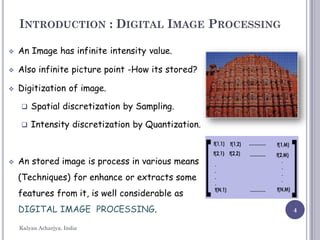
 An Image has infinite intensity value.
 Also infinite picture point -How its stored?
 Digitization of image.
 Spatial discretization by Sampling.
 Intensity discretization by Quantization.
 An stored image is process in various means
(Techniques) for enhance or extracts some
features from it, is well considerable as
DIGITAL IMAGE PROCESSING. 4
Kalyan Acharjya, India
FACE RECOGNITION
 How computer or systems is identify any person by comparison its
FACE with its previous stored database. Its also a part of
COMPUTER VISION.
 FACE RECOGNITION is the part of Digital Image Measurement.
 Its High Level Processing involved making sense of an ensemble of
recognize FACE with analysis of unknown FACE.
 Its almost similar to Human being, who identify any person, if
he/she have already met. Although it(Human) fails sometimes (rare
case).
5
Kalyan Acharjya, India
WHY FACE RECOGNITION ?
 The world is urged for more and accurate face recognition rate.
 How COMPUTER VISITON is possible, as human being are?
 Automatic person identification.
 FACE RECOGNISITION have lots of real world applications.
 Automatic Attendance System.
 Security Purposes.
 Computer Interaction etc.
 Crowd Surveillance. [US (MIT) invested $ 100 million for perfect recognition
system-Times of India, Oct 2013 ].
 In 2011, London riots many suspects of partial face images were not
recognized by COTS FR system[15].
6
Kalyan Acharjya, India
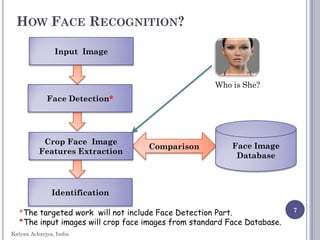
Comparison
HOW FACE RECOGNITION?
7
Input Image
Face Detection*
Crop Face Image
Features Extraction
Identification
Face Image
Database
*The targeted work will not include Face Detection Part.
*The input images will crop face images from standard Face Database.
Who is She?
Kalyan Acharjya, India
LITERATURE SURVEY [1]
 Title : Li, Liao and Jain, “Partial Face Recognition,
Alignment free Approach”, IEEE, May, 2013.
 Technique Used: Authors proposed an alignment free
face recognition method based on multi-key point
descriptors. (MKD).
 Conclusion: Authors concluded that MKD method is
superior than leading commercial FR systems like
Pitpatt and faceVACS SDK.
8
Kalyan Acharjya, India
9
LITERATURE SURVEY CONTD..[2]
 Title : Mersico, Nappi and Wechsler, “Robust Face
Recognition fro Uncontrolled Pose and Illumination ”,
IEEE, January, 2013.
 Technique Used: Authors proposed a novel frame work
based on normalization strategies and Face Analysis
for Commercial Entities (FACE).

 Conclusion: The result showed the significant increase
in recognition rate [95% in FERET fa Database] in
accuracy, whether comparison with other available
algorithms.
Kalyan Acharjya, India
10
LITERATURE SURVEY CONTD.. [3]
 Title : Park and Savvides , “Individual Kernal Tensor
Subspaces for Robust Face Recognition: A Computationally
Efficient Tensor Framework without requiring Mode
Factorization ”, IEEE, Oct, 2007.
 Technique Used: The work based on high order tensor to
construct a multi linear structure and model the multiple
factors of face variations.
 Conclusion: The paper introduced the new concept that
appearance factor, the factor of person’s identity modeled
by a tensor structure can be used for better face
recognition system specially for difference types of
appearance of same faces.
Kalyan Acharjya, India
11
LITERATURE SURVEY CONTD.. [4]
 Title: Karim, Lipu, Rahman and Sultana , “Face Recognition
using PCA based Method”, IEEE, 2010.
 Technique Used: The work based on Principle Component
Analysis (PCA).
 Conclusion: The paper concluded the Principle Component
Analysis is better then their predecessor, where recognition
rate 84.1 % (Male Face) and 95.45 % (Female Face) in case
of Indian face database.
 Also recognition rate 92.5 % (Male Face) and 85 % (Female
Face) in case of University of Essex, UK face database.
Kalyan Acharjya, India
12
LITERATURE SURVEY CONTD..[5] MANY MORE…..!
 Title : Meade, Kumar and Phillips, “Comparative
performance of Principle Component Analysis , Gabor
Wavelets and Discrete Gabor Wavelets”, Canadian
Journal of Electronics and Computer Engg., Spring,
2005.
 Technique Used: Comparative performance analysis of
PCA with Gabor Wavelets and Discrete Gabor
Wavelets.
 Conclusion: Gabor Wavelets showed the best
performance on FERET database, as Gabor Wavelets is
least affected by illumination levels.
Kalyan Acharjya, India
13
PROBLEM STATEMENT
 Maximum works were proposed the Face Recognition system in
particular case (Either Pose or Illumination or specific Face
Database).
 Till date there is not single face recognition system for fulfilling
the all (or Maximum factors) in real time application.
 Every method have its pros and cons.
 The presenter motivated by the unsatisfactory scenario of Face
Recognition system to enhance the performance of it.
Kalyan Acharjya, India
14
AVAILABLE FACE RECOGNITION ALGORITHMS
BASED ON [4]
 Principle Component Analysis (PCA).
 Normalization of Histogram Analysis (NHA).
 Independent Component Analysis (ICA).
 Normalized Cross Correlation (NCC).
 Sum of Absolute Difference (SAD).
 Linear Discernment Analysis (LDA).
 Discrete Wavelets Transform (DWT).
 Gabor Wavelet Transform(GWT).
 Multilayer Appearance-Tensor based (MAT).
 Multiple Descriptor Key point (MDK-SDK).(Partial Face Also) etc.
Kalyan Acharjya, India
15
CHALLENGE FOR FACE RECOGNITION [1]
External Occlusion
By other face
Self Occlusion
By non frontal pose
Facial Accessories
By Sunglass
Not Proper
Illumination
Sensor saturation
By under exposure or
over exposure
Limited Field of View
(FOV) By out of camera.
Kalyan Acharjya, India
STANDARD FACE RECOGNITION DATABASE [4]
 The Choice of appropriate database to be used based
on targeted work.
 Color FERET Database
 Yale Face Database.
 PIE Database.
 FIA Video Database.
 CBCL Face Recognition Database.
 Expression Image Database.
 Mugs hot Identification Database.
 Identification Database.
 Indian Face Database.
 Face Recognition Data, University of Essex, UK 16
Kalyan Acharjya, India
17
CONCLUSIONS AND FUTURE WORK
 The presenter in initial phase of project work, so exact algorithms
yet to be finalized.
 The presenter aware to follow any based paper should have same
face database.
 Modify the any previous mentioned face recognition algorithms to
enhance the recognition rate of identification.
 The proposed work may also target for fusion between two
algorithms.
 When available algorithms will modified or develop, the result will
be compare with based paper or predecessor method result .
Kalyan Acharjya, India
18
REFERENCES
[1] Li, Liao and Jain, “Partial Face Recognition, Alignment free Approach”, IEEE
Transaction on Pattern Analysis and Machine Intelligence, VOL 35, No 5, May,
2013.
[2] Mersico, Nappi and Wechsler, “Robust Face Recognition fro Uncontrolled Pose
and Illumination ”, IEEE Transaction on Systems, man and Cybernetics:
systems, VOL. 43, NO. 1, January, 2013.
[3] Park and Savvides , “Individual Kernal Tensor Subspaces for Robust Face
Recognition: A Computationally Efficient Tensor Framework without requiring
Mode Factorization ”, IEEE on Systems, man and Cybernetics: systems, VOL. 37,
NO. 5 , Oct, 2007.
[4] Karim, Lipu, Rahman and Sultana ,“Face Recognition using PCA based
Method”, IEEE, 2010.
[5] Meade, Kumar and Phillips, “Comparative performance of Principle
Component Analysis , Gabor Wavelets and Discrete Gabor Wavelets”, Canadian
Journal of Electronics and Computer Engg., VOL. 30, NO. 2, Spring, 2005.
Kalyan Acharjya, India
REFERENCES CONTD..
[6]Kar, Debbarma, Saha and Pal, "Study of Implementing Automated
Attendance System using Face Recognition Technique” International Journal of
Computer and Communication Engineering, VOL. 1, No. 2, July 2012.
[7] Balcoh, Yousaf, Waqar and Baig,”Algorithm for Efficient Attendance
Management: Face Recognition based Approach”, IJCSI (Online), Vol.9, No.1,
July 2012.
[8] Jiang, Sadka and Crooks, "Technical Correspondence-Multimodal Biometric
Human Recognition for Perceptual Human-Computer Interaction ” IEEE
Transaction on Systems, man and Cybernetics-Part C:Applications and Review,
VOL. 40, NO. 6, November, 2010.
[9]Jyoti, Chadha, Vaidya and Roja,”A robust, low-cost approach to Face
Detection and Face Recognition”, CiiT International Journal of Digital Image
Processing, ISSN 0974-9586(Online), Vol. 15, No 10, October 2011.
[10] Lu and Tan,”Cost-Sensitive Subspace Analysis and Extensions For Face
Recognition”,IEE transactions on Information forensics and Security, Vol. 8, No
3, March 2013.
19
Kalyan Acharjya, India
REFERENCES CONTD..
[11] Toole, Philips, Jiang and Abdi,”Face Recognition Algorithms Surpass
Human Matching Faces over changes in Illumination”, IEEE
Transactions on Pattern Analysis and Machine Intelligence, VOL. 29, No.
9, September 2007.
[12]Zhang, Shan, Chen and Gao,”Local Gabor Binary Patterns Based on
Kullback-Leibler Divergence for Partially Occluded Face Recognition”,
IEEE Signal Processing Letters, Vol. 14, No.11, November 2007.
[13] Liu and Liu, “A hybrid Color and Frequency Features Method for
Face Recognition”,IEEE transactions on Image Processing, Vol. 17, No.
10. October 2008.
[14] Mohanty, Sarkar, Kasturi and Phillips, "Subspace Approximation of
Face Recognition Algorithms: An Empirical Study”, IEEE Transactions
on Information Forensics and Security”, Vol. 3, No. 4, December 2008.
[15] “Police use Facial recognition Technology to Nab Rioters”,
http://www.msnbc.msn.com/id/44110353/ns
20
Kalyan Acharjya, India
21
Any Question ?
Thank You Watching This PPT.
Kalyan Acharjya, India
For Academic Graduates / Post- Graduates/
PhD Scholars Presentation Design
Please Contact
kalyan.acharjya@gmail.com
The PPT is Brought you By
22
KalyanAcharjya,India

Face recognition Face Identification

  • 1.
    PROPOSED WORK ON FACERECOGNITION Presented By Kalyan Acharjya A Presentation on Initial stage of M.Tech Dissertation Work Department of………………………… University of………..
  • 2.
    2 There are someimages (slide No 8) used within this presentation were copied from internet without prior permission from original owner. Only Original Owner has full rights reserved for copied images. This PPT is only for fair academic use (Not Commercial). Kalyan Acharjya kalyan.acharjya@gmail.com www.factsaboutuniversity.com Disclosure
  • 3.
    CONTENTS  Introduction toDigital Image Processing.  Face Recognition.  Why Face Recognition.  How Face Recognition.  Literature Survey [Going On].  Problem Statement.  Challenges for Real Time Applications.  Standard Face Images Database.  Conclusions and Future Work.  References. 3 Kalyan Acharjya, India
  • 4.
    INTRODUCTION : DIGITALIMAGE PROCESSING  An Image has infinite intensity value.  Also infinite picture point -How its stored?  Digitization of image.  Spatial discretization by Sampling.  Intensity discretization by Quantization.  An stored image is process in various means (Techniques) for enhance or extracts some features from it, is well considerable as DIGITAL IMAGE PROCESSING. 4 Kalyan Acharjya, India
  • 5.
    FACE RECOGNITION  Howcomputer or systems is identify any person by comparison its FACE with its previous stored database. Its also a part of COMPUTER VISION.  FACE RECOGNITION is the part of Digital Image Measurement.  Its High Level Processing involved making sense of an ensemble of recognize FACE with analysis of unknown FACE.  Its almost similar to Human being, who identify any person, if he/she have already met. Although it(Human) fails sometimes (rare case). 5 Kalyan Acharjya, India
  • 6.
    WHY FACE RECOGNITION?  The world is urged for more and accurate face recognition rate.  How COMPUTER VISITON is possible, as human being are?  Automatic person identification.  FACE RECOGNISITION have lots of real world applications.  Automatic Attendance System.  Security Purposes.  Computer Interaction etc.  Crowd Surveillance. [US (MIT) invested $ 100 million for perfect recognition system-Times of India, Oct 2013 ].  In 2011, London riots many suspects of partial face images were not recognized by COTS FR system[15]. 6 Kalyan Acharjya, India
  • 7.
    Comparison HOW FACE RECOGNITION? 7 InputImage Face Detection* Crop Face Image Features Extraction Identification Face Image Database *The targeted work will not include Face Detection Part. *The input images will crop face images from standard Face Database. Who is She? Kalyan Acharjya, India
  • 8.
    LITERATURE SURVEY [1] Title : Li, Liao and Jain, “Partial Face Recognition, Alignment free Approach”, IEEE, May, 2013.  Technique Used: Authors proposed an alignment free face recognition method based on multi-key point descriptors. (MKD).  Conclusion: Authors concluded that MKD method is superior than leading commercial FR systems like Pitpatt and faceVACS SDK. 8 Kalyan Acharjya, India
  • 9.
    9 LITERATURE SURVEY CONTD..[2] Title : Mersico, Nappi and Wechsler, “Robust Face Recognition fro Uncontrolled Pose and Illumination ”, IEEE, January, 2013.  Technique Used: Authors proposed a novel frame work based on normalization strategies and Face Analysis for Commercial Entities (FACE).   Conclusion: The result showed the significant increase in recognition rate [95% in FERET fa Database] in accuracy, whether comparison with other available algorithms. Kalyan Acharjya, India
  • 10.
    10 LITERATURE SURVEY CONTD..[3]  Title : Park and Savvides , “Individual Kernal Tensor Subspaces for Robust Face Recognition: A Computationally Efficient Tensor Framework without requiring Mode Factorization ”, IEEE, Oct, 2007.  Technique Used: The work based on high order tensor to construct a multi linear structure and model the multiple factors of face variations.  Conclusion: The paper introduced the new concept that appearance factor, the factor of person’s identity modeled by a tensor structure can be used for better face recognition system specially for difference types of appearance of same faces. Kalyan Acharjya, India
  • 11.
    11 LITERATURE SURVEY CONTD..[4]  Title: Karim, Lipu, Rahman and Sultana , “Face Recognition using PCA based Method”, IEEE, 2010.  Technique Used: The work based on Principle Component Analysis (PCA).  Conclusion: The paper concluded the Principle Component Analysis is better then their predecessor, where recognition rate 84.1 % (Male Face) and 95.45 % (Female Face) in case of Indian face database.  Also recognition rate 92.5 % (Male Face) and 85 % (Female Face) in case of University of Essex, UK face database. Kalyan Acharjya, India
  • 12.
    12 LITERATURE SURVEY CONTD..[5]MANY MORE…..!  Title : Meade, Kumar and Phillips, “Comparative performance of Principle Component Analysis , Gabor Wavelets and Discrete Gabor Wavelets”, Canadian Journal of Electronics and Computer Engg., Spring, 2005.  Technique Used: Comparative performance analysis of PCA with Gabor Wavelets and Discrete Gabor Wavelets.  Conclusion: Gabor Wavelets showed the best performance on FERET database, as Gabor Wavelets is least affected by illumination levels. Kalyan Acharjya, India
  • 13.
    13 PROBLEM STATEMENT  Maximumworks were proposed the Face Recognition system in particular case (Either Pose or Illumination or specific Face Database).  Till date there is not single face recognition system for fulfilling the all (or Maximum factors) in real time application.  Every method have its pros and cons.  The presenter motivated by the unsatisfactory scenario of Face Recognition system to enhance the performance of it. Kalyan Acharjya, India
  • 14.
    14 AVAILABLE FACE RECOGNITIONALGORITHMS BASED ON [4]  Principle Component Analysis (PCA).  Normalization of Histogram Analysis (NHA).  Independent Component Analysis (ICA).  Normalized Cross Correlation (NCC).  Sum of Absolute Difference (SAD).  Linear Discernment Analysis (LDA).  Discrete Wavelets Transform (DWT).  Gabor Wavelet Transform(GWT).  Multilayer Appearance-Tensor based (MAT).  Multiple Descriptor Key point (MDK-SDK).(Partial Face Also) etc. Kalyan Acharjya, India
  • 15.
    15 CHALLENGE FOR FACERECOGNITION [1] External Occlusion By other face Self Occlusion By non frontal pose Facial Accessories By Sunglass Not Proper Illumination Sensor saturation By under exposure or over exposure Limited Field of View (FOV) By out of camera. Kalyan Acharjya, India
  • 16.
    STANDARD FACE RECOGNITIONDATABASE [4]  The Choice of appropriate database to be used based on targeted work.  Color FERET Database  Yale Face Database.  PIE Database.  FIA Video Database.  CBCL Face Recognition Database.  Expression Image Database.  Mugs hot Identification Database.  Identification Database.  Indian Face Database.  Face Recognition Data, University of Essex, UK 16 Kalyan Acharjya, India
  • 17.
    17 CONCLUSIONS AND FUTUREWORK  The presenter in initial phase of project work, so exact algorithms yet to be finalized.  The presenter aware to follow any based paper should have same face database.  Modify the any previous mentioned face recognition algorithms to enhance the recognition rate of identification.  The proposed work may also target for fusion between two algorithms.  When available algorithms will modified or develop, the result will be compare with based paper or predecessor method result . Kalyan Acharjya, India
  • 18.
    18 REFERENCES [1] Li, Liaoand Jain, “Partial Face Recognition, Alignment free Approach”, IEEE Transaction on Pattern Analysis and Machine Intelligence, VOL 35, No 5, May, 2013. [2] Mersico, Nappi and Wechsler, “Robust Face Recognition fro Uncontrolled Pose and Illumination ”, IEEE Transaction on Systems, man and Cybernetics: systems, VOL. 43, NO. 1, January, 2013. [3] Park and Savvides , “Individual Kernal Tensor Subspaces for Robust Face Recognition: A Computationally Efficient Tensor Framework without requiring Mode Factorization ”, IEEE on Systems, man and Cybernetics: systems, VOL. 37, NO. 5 , Oct, 2007. [4] Karim, Lipu, Rahman and Sultana ,“Face Recognition using PCA based Method”, IEEE, 2010. [5] Meade, Kumar and Phillips, “Comparative performance of Principle Component Analysis , Gabor Wavelets and Discrete Gabor Wavelets”, Canadian Journal of Electronics and Computer Engg., VOL. 30, NO. 2, Spring, 2005. Kalyan Acharjya, India
  • 19.
    REFERENCES CONTD.. [6]Kar, Debbarma,Saha and Pal, "Study of Implementing Automated Attendance System using Face Recognition Technique” International Journal of Computer and Communication Engineering, VOL. 1, No. 2, July 2012. [7] Balcoh, Yousaf, Waqar and Baig,”Algorithm for Efficient Attendance Management: Face Recognition based Approach”, IJCSI (Online), Vol.9, No.1, July 2012. [8] Jiang, Sadka and Crooks, "Technical Correspondence-Multimodal Biometric Human Recognition for Perceptual Human-Computer Interaction ” IEEE Transaction on Systems, man and Cybernetics-Part C:Applications and Review, VOL. 40, NO. 6, November, 2010. [9]Jyoti, Chadha, Vaidya and Roja,”A robust, low-cost approach to Face Detection and Face Recognition”, CiiT International Journal of Digital Image Processing, ISSN 0974-9586(Online), Vol. 15, No 10, October 2011. [10] Lu and Tan,”Cost-Sensitive Subspace Analysis and Extensions For Face Recognition”,IEE transactions on Information forensics and Security, Vol. 8, No 3, March 2013. 19 Kalyan Acharjya, India
  • 20.
    REFERENCES CONTD.. [11] Toole,Philips, Jiang and Abdi,”Face Recognition Algorithms Surpass Human Matching Faces over changes in Illumination”, IEEE Transactions on Pattern Analysis and Machine Intelligence, VOL. 29, No. 9, September 2007. [12]Zhang, Shan, Chen and Gao,”Local Gabor Binary Patterns Based on Kullback-Leibler Divergence for Partially Occluded Face Recognition”, IEEE Signal Processing Letters, Vol. 14, No.11, November 2007. [13] Liu and Liu, “A hybrid Color and Frequency Features Method for Face Recognition”,IEEE transactions on Image Processing, Vol. 17, No. 10. October 2008. [14] Mohanty, Sarkar, Kasturi and Phillips, "Subspace Approximation of Face Recognition Algorithms: An Empirical Study”, IEEE Transactions on Information Forensics and Security”, Vol. 3, No. 4, December 2008. [15] “Police use Facial recognition Technology to Nab Rioters”, http://www.msnbc.msn.com/id/44110353/ns 20 Kalyan Acharjya, India
  • 21.
    21 Any Question ? ThankYou Watching This PPT. Kalyan Acharjya, India For Academic Graduates / Post- Graduates/ PhD Scholars Presentation Design Please Contact kalyan.acharjya@gmail.com
  • 22.
    The PPT isBrought you By 22 KalyanAcharjya,India