DR NILESH KATE
MBBS,MD
ASSOCIATE PROF
DEPT. OF PHYSIOLOGY
PHOTO CHEMISTRY
OF VISION.
OBJECTIVES.
 Retina , Photoreceptors, & visual pigments
 Photo transduction
 Processing & transmission of visual impulse in
retina
 Processing & transmission of visual impulse in
visual pathway
 Processing & analysis of visual impulse in visual
cortex.
 Visual perception
 Electrophysiological tests
Mechanism for Vision.
 Initiation of vision.(Phototransduction.) – at
rods & cones
 Processing & transmission of visual
sensation. – at Retina & visual pathway.
 Visual perception. – visual cortex &
association Cortex.
Wednesday, June 8, 2016
Retina , Photoreceptors, & visual pigments
 RETINA – innermost
layer of thin transparent
membrane.
Gross anatomy
 Optic disc – circular pink
colour, only nerve fibre layer.
 Macula lutea (yellow
spot) at posterior pole temporal
to optic disc.
 Fovea centralis –(1.5 mm)
Most sensitive part.
 Ora serrata – ant serrated
margin were retina ends.
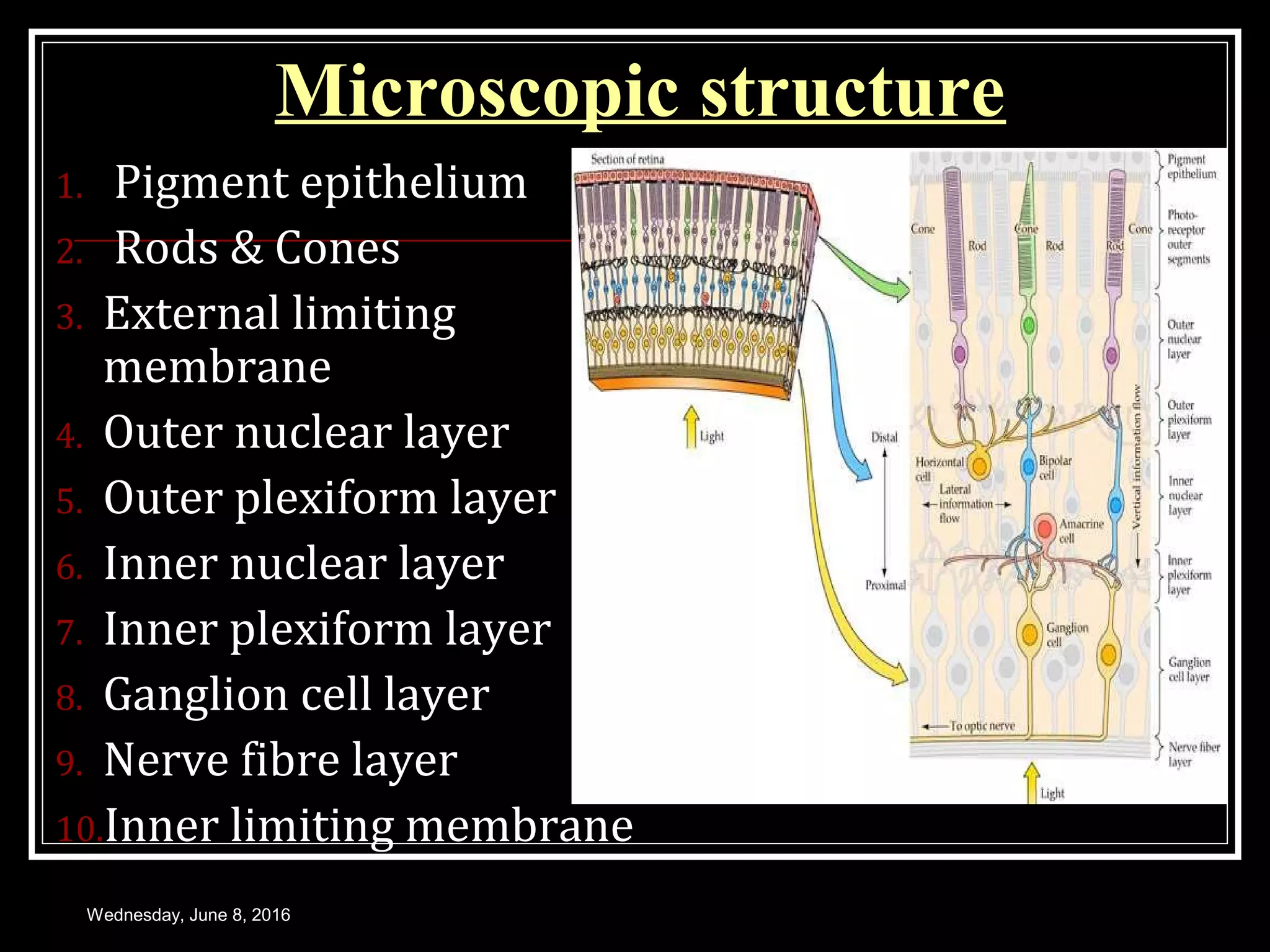
Microscopic structure
1. Pigment epithelium
2. Rods & Cones
3. External limiting
membrane
4. Outer nuclear layer
5. Outer plexiform layer
6. Inner nuclear layer
7. Inner plexiform layer
8. Ganglion cell layer
9. Nerve fibre layer
10.Inner limiting membrane
Wednesday, June 8, 2016
FOVIA CENTRALIS
 Structural characteristics
 Cones – maximum, rods
absent
 Cones – long with thin
outer segment.
 Reduced distortation as
layers push aside.
 No capillaries
 No convergence of cones so
one to one relay of cones
with bipolar cells.
PHOTORECEPTORS - Density & distribution.
Rods
 Pigment – RHODOPSIN.
 Function – Peripheral
vision & scotopic vision.
(vision of low
illumination)
 120 millions.
 Fovea -- rods absent
Cones
 Pigment – IODOPSIN
 Function.– Highly
discriminatory central
vision & colour vision.
 6.5 millions.
 Fovea – cones maximum.
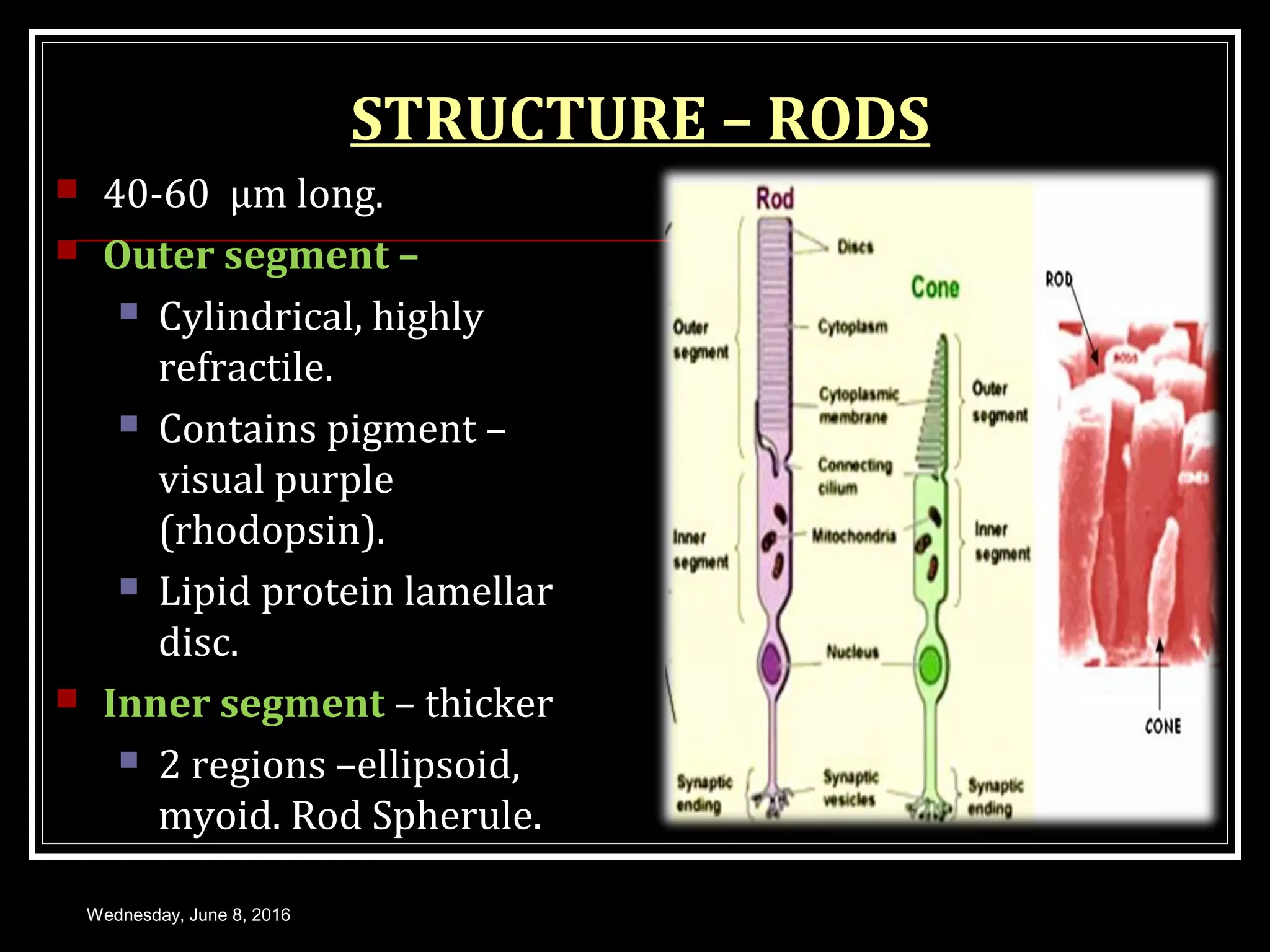
STRUCTURE – RODS
 40-60 μm long.
 Outer segment –
 Cylindrical, highly
refractile.
 Contains pigment –
visual purple
(rhodopsin).
 Lipid protein lamellar
disc.
 Inner segment – thicker
 2 regions –ellipsoid,
myoid. Rod Spherule.
Wednesday, June 8, 2016
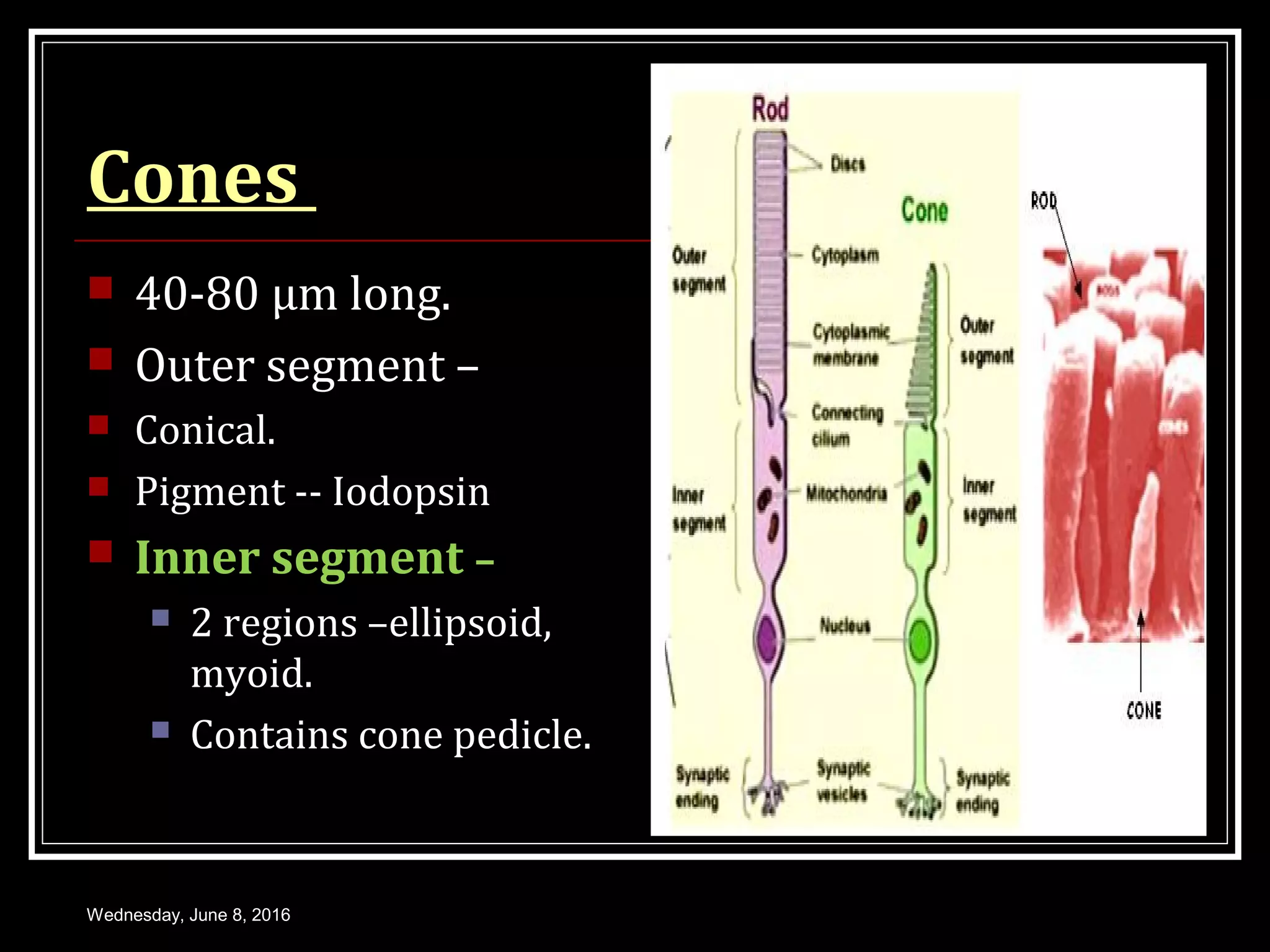
Cones
 40-80 μm long.
 Outer segment –
 Conical.
 Pigment -- Iodopsin
 Inner segment –
 2 regions –ellipsoid,
myoid.
 Contains cone pedicle.
Wednesday, June 8, 2016
VISUAL PIGMENTS
 Rhodopsin (visual purple)
 Protein opsin (scotopsin) &
carotenoid (Retinal –
aldehyde of vitamin A)
 Mole wt – 40,000.
 Absorbs primarily yellow
wavelength light,
transmitting violet & red to
appear purple so called
Visual purple.
 Cone pigments
 3 types.
 Respond to specific
wavelength of light.
 Chromophore 11 cis-
retinal is same .
 Difference in only opsin
portion of molecule.
Light induced changes
 Rhodopsin bleaching
 Rhodopsin regeneration
 Visual cycle
Wednesday, June 8, 2016
Rhodopsin bleaching &
regeneration
Wednesday, June 8, 2016
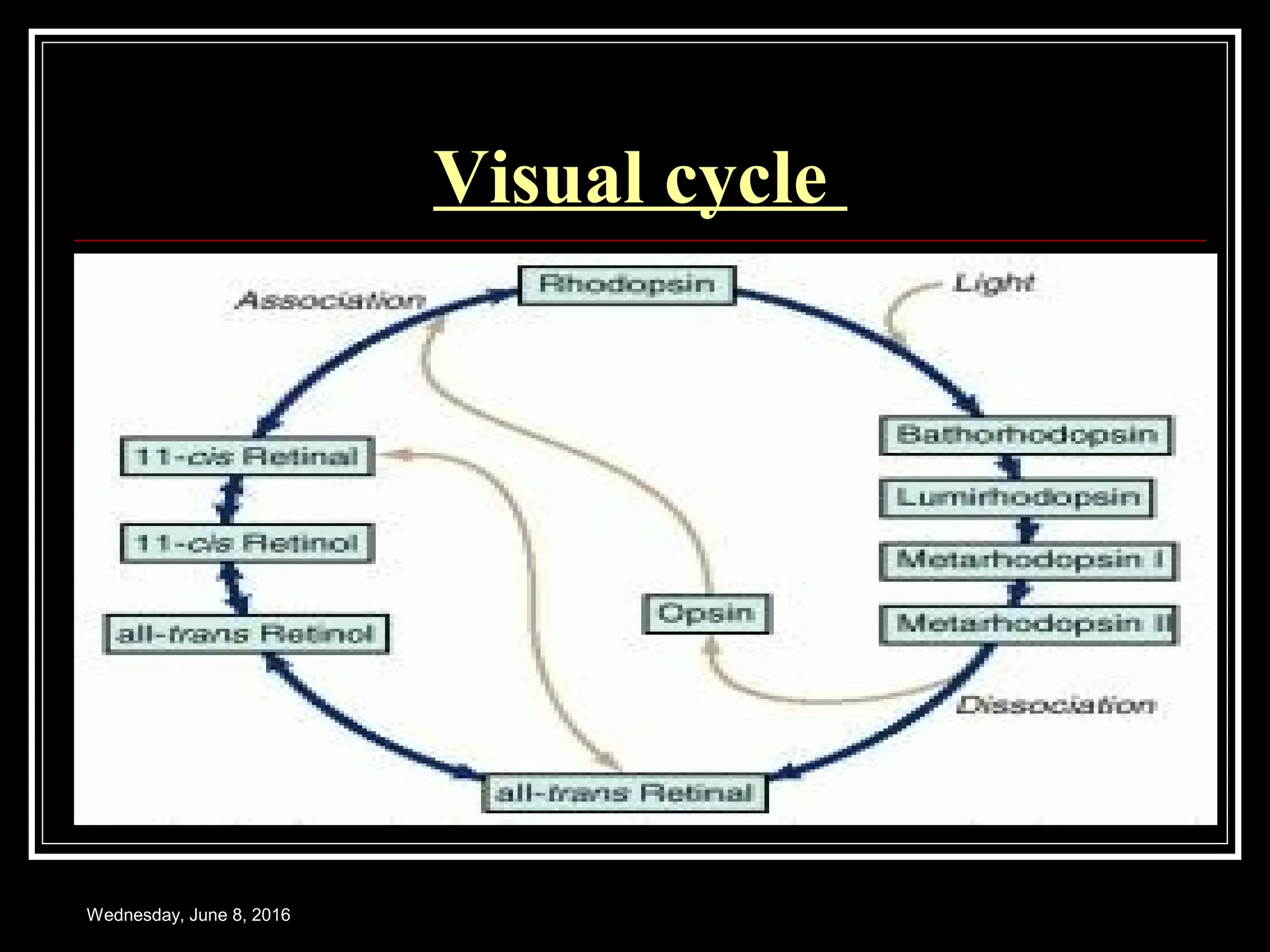
Visual cycle
Wednesday, June 8, 2016
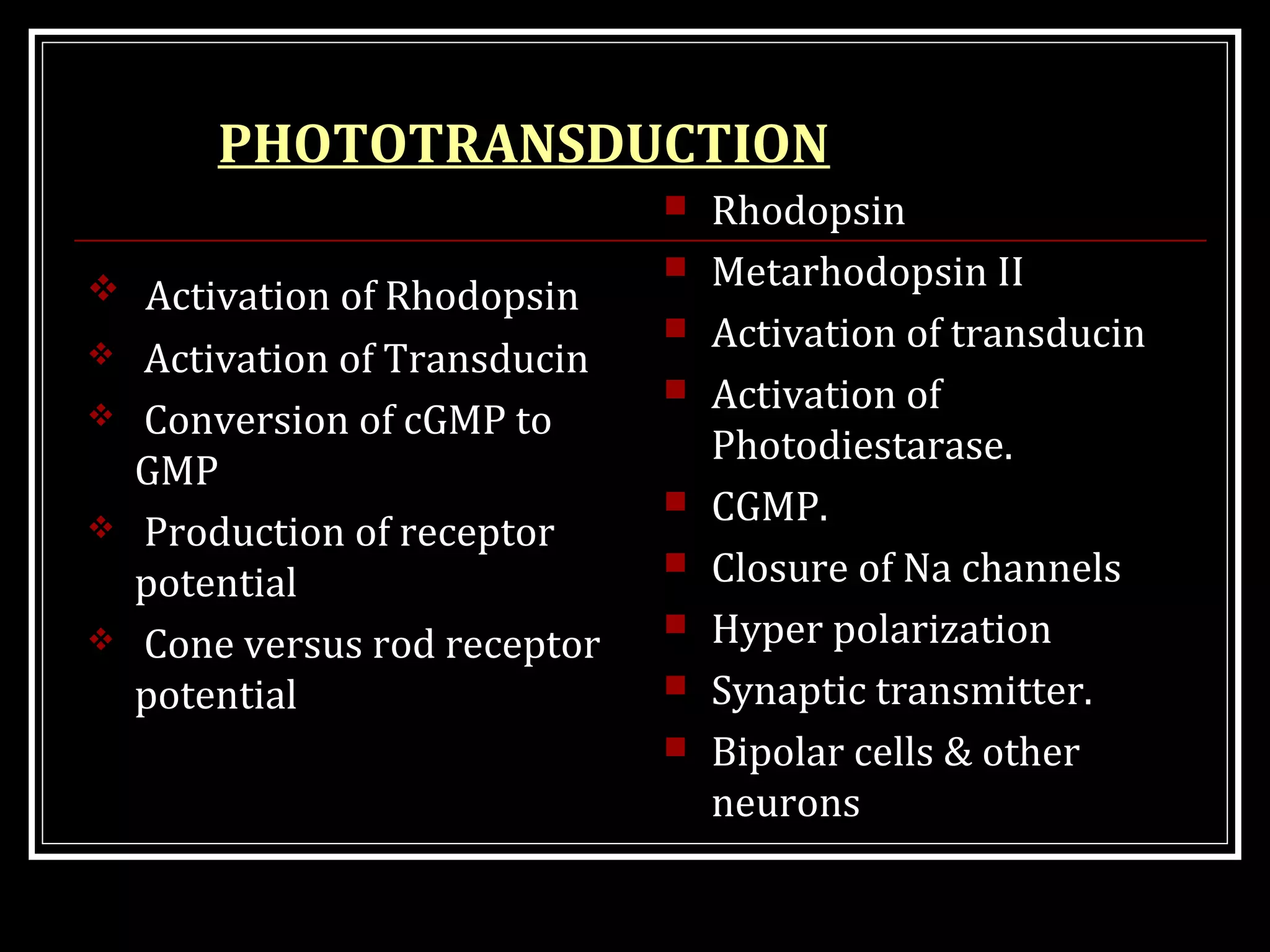
PHOTOTRANSDUCTION.
 Conversion of light energy to nerve impulse
Wednesday, June 8, 2016
PHOTOTRANSDUCTION
 Activation of Rhodopsin
 Activation of Transducin
 Conversion of cGMP to
GMP
 Production of receptor
potential
 Cone versus rod receptor
potential
 Rhodopsin
 Metarhodopsin II
 Activation of transducin
 Activation of
Photodiestarase.
 CGMP.
 Closure of Na channels
 Hyper polarization
 Synaptic transmitter.
 Bipolar cells & other
neurons
PHOTOTRANSDUCTION
Wednesday, June 8, 2016
Processing & transmission of the
visual impulse in retina
 Concept of receptive field
 It is influence area of a sensory neuron.
 Circular in configuration.
 Receptive field of individual
photoreceptor
 In dark –Photoreceptors Depolarized – NT
released.
 In light – Photoreceptors Hyperpolarized – Less
NT is released
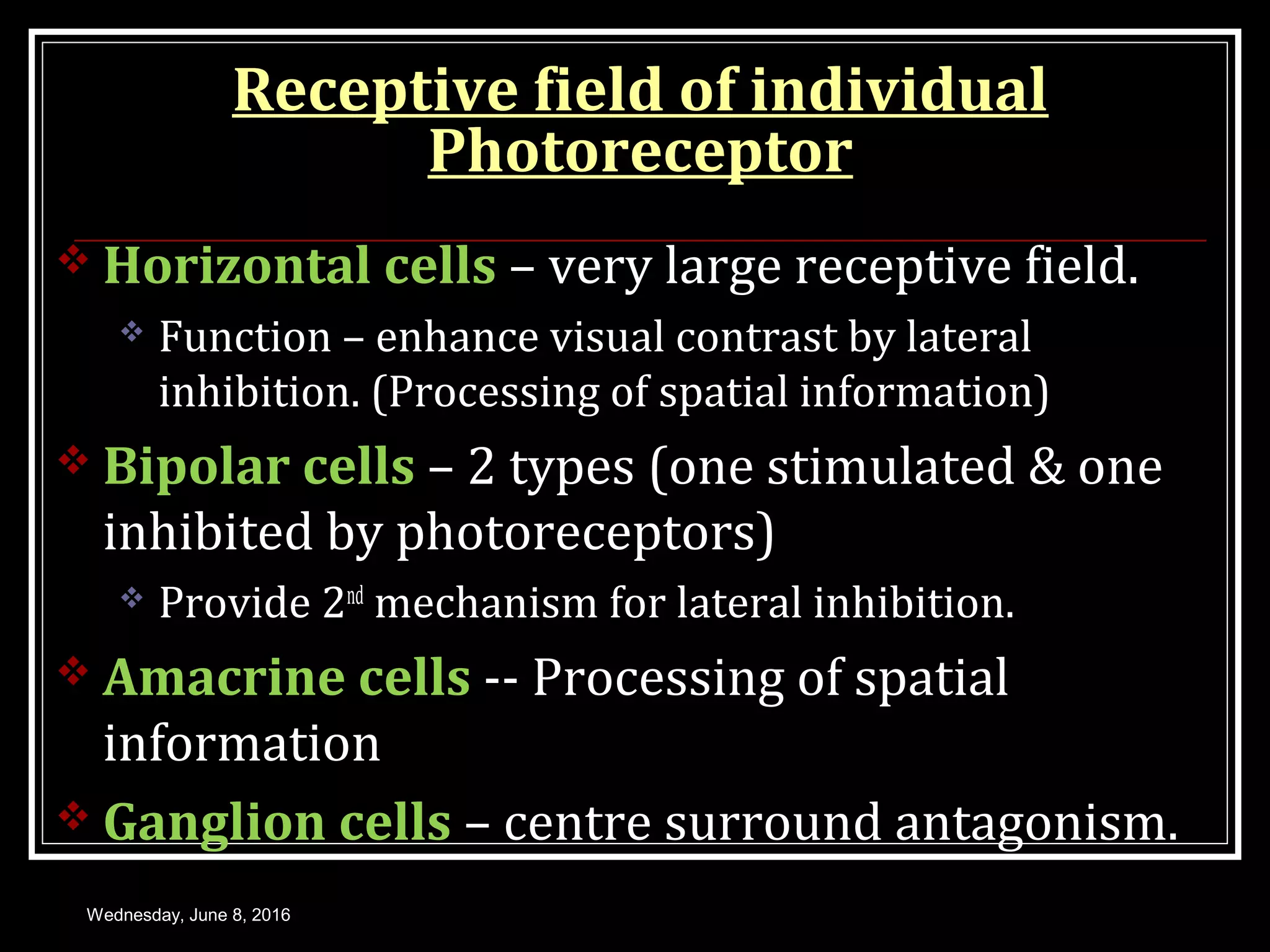
Receptive field of individual
Photoreceptor
 Horizontal cells – very large receptive field.
 Function – enhance visual contrast by lateral
inhibition. (Processing of spatial information)
 Bipolar cells – 2 types (one stimulated & one
inhibited by photoreceptors)
 Provide 2nd
mechanism for lateral inhibition.
 Amacrine cells -- Processing of spatial
information
 Ganglion cells – centre surround antagonism.
Wednesday, June 8, 2016
Ganglion cells – centre
surround antagonism.
Wednesday, June 8, 2016
Processing of Image
 Concept of parallel processing pathway
 Concept of serial processing of image in retina
 Synaptic mediators in the retina
Wednesday, June 8, 2016
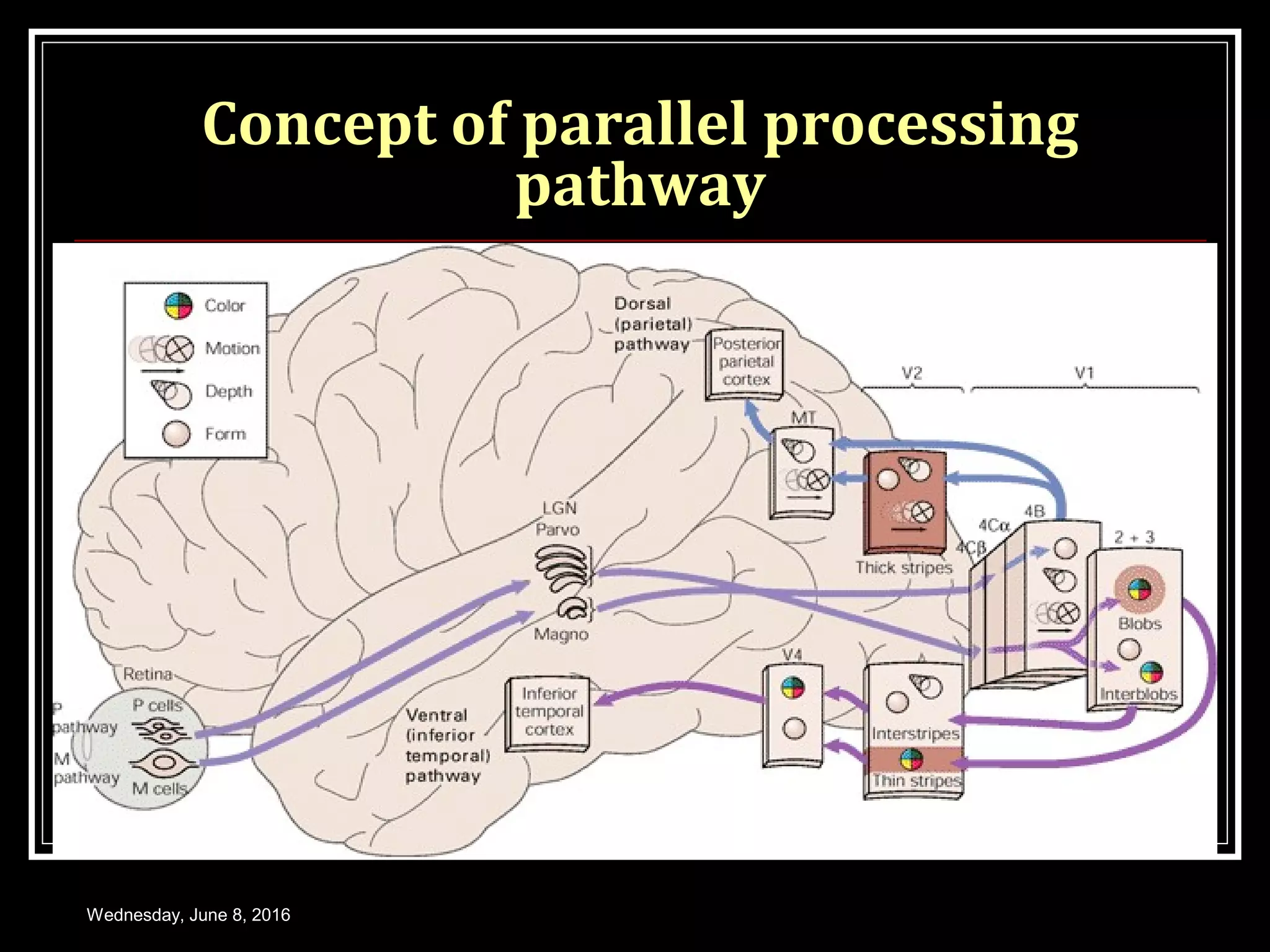
Concept of parallel processing
pathway
Wednesday, June 8, 2016
Concept of Serial processing of image
in retina First image.
 Action of light on photoreceptors.
 Breakup image into small spots of light & darkness.
 Second image.
 By Bipolar cells.
 Spatial summation by lateral inhibition by horizontal
cells
 Third image.
 By Ganglion cells
 Temporal summation by lateral inhibition by amacrine
cells.
Wednesday, June 8, 2016
Processing & transmission of visual
impulse in visual pathway
 Optic nerve
 Optic chiasma
 Optic tracts
 Lateral geniculate bodies
 Optic radiations
THANK
YOU

PHOTOCHEMISTRY OF VISION

  • 1.
    DR NILESH KATE MBBS,MD ASSOCIATEPROF DEPT. OF PHYSIOLOGY PHOTO CHEMISTRY OF VISION.
  • 2.
    OBJECTIVES.  Retina ,Photoreceptors, & visual pigments  Photo transduction  Processing & transmission of visual impulse in retina  Processing & transmission of visual impulse in visual pathway  Processing & analysis of visual impulse in visual cortex.  Visual perception  Electrophysiological tests
  • 3.
    Mechanism for Vision. Initiation of vision.(Phototransduction.) – at rods & cones  Processing & transmission of visual sensation. – at Retina & visual pathway.  Visual perception. – visual cortex & association Cortex. Wednesday, June 8, 2016
  • 4.
    Retina , Photoreceptors,& visual pigments  RETINA – innermost layer of thin transparent membrane. Gross anatomy  Optic disc – circular pink colour, only nerve fibre layer.  Macula lutea (yellow spot) at posterior pole temporal to optic disc.  Fovea centralis –(1.5 mm) Most sensitive part.  Ora serrata – ant serrated margin were retina ends.
  • 5.
    Microscopic structure 1. Pigmentepithelium 2. Rods & Cones 3. External limiting membrane 4. Outer nuclear layer 5. Outer plexiform layer 6. Inner nuclear layer 7. Inner plexiform layer 8. Ganglion cell layer 9. Nerve fibre layer 10.Inner limiting membrane Wednesday, June 8, 2016
  • 6.
    FOVIA CENTRALIS  Structuralcharacteristics  Cones – maximum, rods absent  Cones – long with thin outer segment.  Reduced distortation as layers push aside.  No capillaries  No convergence of cones so one to one relay of cones with bipolar cells.
  • 7.
    PHOTORECEPTORS - Density& distribution. Rods  Pigment – RHODOPSIN.  Function – Peripheral vision & scotopic vision. (vision of low illumination)  120 millions.  Fovea -- rods absent Cones  Pigment – IODOPSIN  Function.– Highly discriminatory central vision & colour vision.  6.5 millions.  Fovea – cones maximum.
  • 8.
    STRUCTURE – RODS 40-60 μm long.  Outer segment –  Cylindrical, highly refractile.  Contains pigment – visual purple (rhodopsin).  Lipid protein lamellar disc.  Inner segment – thicker  2 regions –ellipsoid, myoid. Rod Spherule. Wednesday, June 8, 2016
  • 9.
    Cones  40-80 μmlong.  Outer segment –  Conical.  Pigment -- Iodopsin  Inner segment –  2 regions –ellipsoid, myoid.  Contains cone pedicle. Wednesday, June 8, 2016
  • 10.
    VISUAL PIGMENTS  Rhodopsin(visual purple)  Protein opsin (scotopsin) & carotenoid (Retinal – aldehyde of vitamin A)  Mole wt – 40,000.  Absorbs primarily yellow wavelength light, transmitting violet & red to appear purple so called Visual purple.  Cone pigments  3 types.  Respond to specific wavelength of light.  Chromophore 11 cis- retinal is same .  Difference in only opsin portion of molecule.
  • 11.
    Light induced changes Rhodopsin bleaching  Rhodopsin regeneration  Visual cycle Wednesday, June 8, 2016
  • 12.
  • 13.
  • 14.
    PHOTOTRANSDUCTION.  Conversion oflight energy to nerve impulse Wednesday, June 8, 2016
  • 15.
    PHOTOTRANSDUCTION  Activation ofRhodopsin  Activation of Transducin  Conversion of cGMP to GMP  Production of receptor potential  Cone versus rod receptor potential  Rhodopsin  Metarhodopsin II  Activation of transducin  Activation of Photodiestarase.  CGMP.  Closure of Na channels  Hyper polarization  Synaptic transmitter.  Bipolar cells & other neurons
  • 16.
  • 17.
    Processing & transmissionof the visual impulse in retina  Concept of receptive field  It is influence area of a sensory neuron.  Circular in configuration.  Receptive field of individual photoreceptor  In dark –Photoreceptors Depolarized – NT released.  In light – Photoreceptors Hyperpolarized – Less NT is released
  • 18.
    Receptive field ofindividual Photoreceptor  Horizontal cells – very large receptive field.  Function – enhance visual contrast by lateral inhibition. (Processing of spatial information)  Bipolar cells – 2 types (one stimulated & one inhibited by photoreceptors)  Provide 2nd mechanism for lateral inhibition.  Amacrine cells -- Processing of spatial information  Ganglion cells – centre surround antagonism. Wednesday, June 8, 2016
  • 19.
    Ganglion cells –centre surround antagonism. Wednesday, June 8, 2016
  • 20.
    Processing of Image Concept of parallel processing pathway  Concept of serial processing of image in retina  Synaptic mediators in the retina Wednesday, June 8, 2016
  • 21.
    Concept of parallelprocessing pathway Wednesday, June 8, 2016
  • 22.
  • 23.
    Concept of Serialprocessing of image in retina First image.  Action of light on photoreceptors.  Breakup image into small spots of light & darkness.  Second image.  By Bipolar cells.  Spatial summation by lateral inhibition by horizontal cells  Third image.  By Ganglion cells  Temporal summation by lateral inhibition by amacrine cells. Wednesday, June 8, 2016
  • 24.
    Processing & transmissionof visual impulse in visual pathway  Optic nerve  Optic chiasma  Optic tracts  Lateral geniculate bodies  Optic radiations
  • 25.