DR NILESH KATE
MBBS,MD
ASSOCIATE PROF
DEPT. OF PHYSIOLOGY
CUTANEOUS
CIRCULATION
OBJECTIVES
Cutaneous circulation.
 Cutaneous blood flow- characteristics
features.
 Regulation of Cutaneous blood flow
 Cutaneous vascular response
Thursday, March 31, 2016
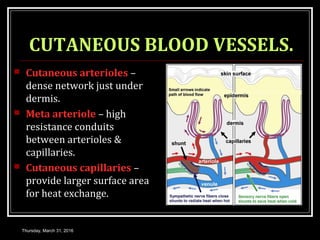
CUTANEOUS BLOOD VESSELS.
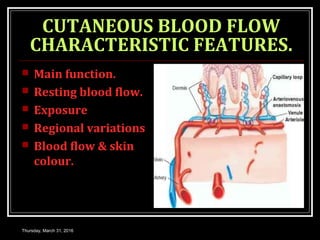
 Cutaneous arterioles –
dense network just under
dermis.
 Meta arteriole – high
resistance conduits
between arterioles &
capillaries.
 Cutaneous capillaries –
provide larger surface area
for heat exchange.
Thursday, March 31, 2016
CUTANEOUS BLOOD VESSELS.
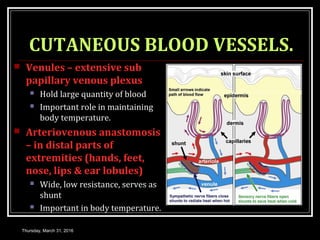
 Venules – extensive sub
papillary venous plexus
 Hold large quantity of blood
 Important role in maintaining
body temperature.
 Arteriovenous anastomosis
– in distal parts of
extremities (hands, feet,
nose, lips & ear lobules)
 Wide, low resistance, serves as
shunt
 Important in body temperature.
Thursday, March 31, 2016
CUTANEOUS BLOOD FLOW
CHARACTERISTIC FEATURES.
 Main function.
 Resting blood flow.
 Exposure
 Regional variations
 Blood flow & skin
colour.
Thursday, March 31, 2016
MAIN FUNCTION.
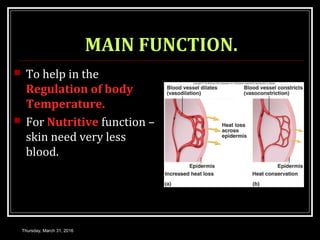
 To help in the
Regulation of body
Temperature.
 For Nutritive function –
skin need very less
blood.
Thursday, March 31, 2016
RESTING BLOOD FLOW.
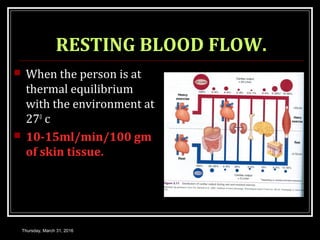
 When the person is at
thermal equilibrium
with the environment at
270
c
 10-15ml/min/100 gm
of skin tissue.
Thursday, March 31, 2016
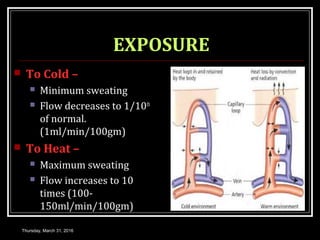
EXPOSURE
 To Cold –
 Minimum sweating
 Flow decreases to 1/10th
of normal.
(1ml/min/100gm)
 To Heat –
 Maximum sweating
 Flow increases to 10
times (100-
150ml/min/100gm)
Thursday, March 31, 2016
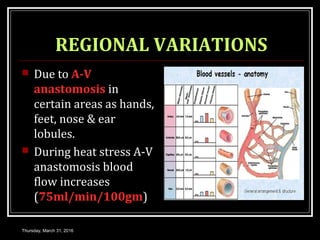
REGIONAL VARIATIONS
 Due to A-V
anastomosis in
certain areas as hands,
feet, nose & ear
lobules.
 During heat stress A-V
anastomosis blood
flow increases
(75ml/min/100gm)
Thursday, March 31, 2016
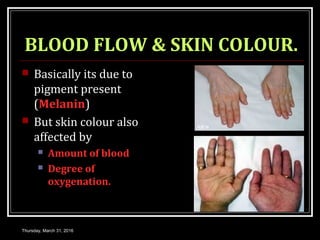
BLOOD FLOW & SKIN COLOUR.
 Basically its due to
pigment present
(Melanin)
 But skin colour also
affected by
 Amount of blood
 Degree of
oxygenation.
Thursday, March 31, 2016
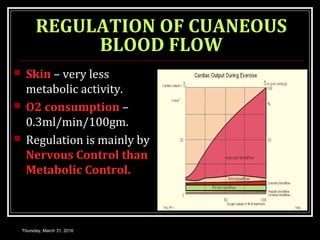
REGULATION OF CUANEOUS
BLOOD FLOW
 Skin – very less
metabolic activity.
 O2 consumption –
0.3ml/min/100gm.
 Regulation is mainly by
Nervous Control than
Metabolic Control.
Thursday, March 31, 2016
NERVE SUPPLY OF
CUTANEOUS VESSELS
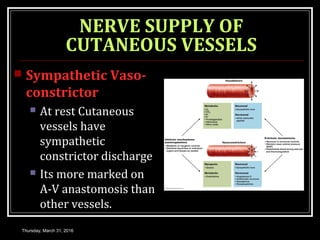
 Sympathetic Vaso-
constrictor
 At rest Cutaneous
vessels have
sympathetic
constrictor discharge
 Its more marked on
A-V anastomosis than
other vessels.
Thursday, March 31, 2016
NERVE SUPPLY OF
CUTANEOUS VESSELS
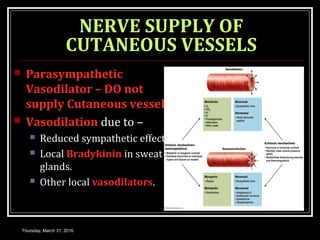
 Parasympathetic
Vasodilator – DO not
supply Cutaneous vessels.
 Vasodilation due to –
 Reduced sympathetic effect.
 Local Bradykinin in sweat
glands.
 Other local vasodilators.
Thursday, March 31, 2016
NEURAL CONTROL
MECHANISMS
 Hypothalamic
Control Mechanism.
 Baroreceptor
mediated reflex.
 Cortical control
mechanism.
Thursday, March 31, 2016
HYPOTHALAMIC CONTROL
MECHANISM.
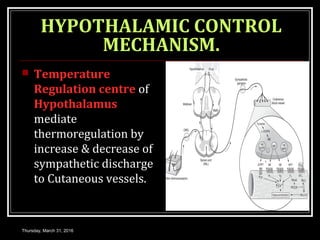
 Temperature
Regulation centre of
Hypothalamus
mediate
thermoregulation by
increase & decrease of
sympathetic discharge
to Cutaneous vessels.
Thursday, March 31, 2016
HYPOTHALAMIC CONTROL
MECHANISM.
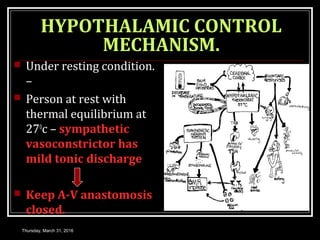
 Under resting condition.
–
 Person at rest with
thermal equilibrium at
270
c – sympathetic
vasoconstrictor has
mild tonic discharge
 Keep A-V anastomosis
closed.
Thursday, March 31, 2016
HYPOTHALAMIC CONTROL
MECHANISM.
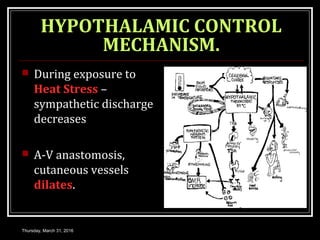
 During exposure to
Heat Stress –
sympathetic discharge
decreases
 A-V anastomosis,
cutaneous vessels
dilates.
Thursday, March 31, 2016
HYPOTHALAMIC CONTROL
MECHANISM.
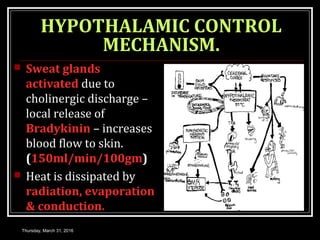
 Sweat glands
activated due to
cholinergic discharge –
local release of
Bradykinin – increases
blood flow to skin.
(150ml/min/100gm)
 Heat is dissipated by
radiation, evaporation
& conduction.
Thursday, March 31, 2016
HYPOTHALAMIC CONTROL
MECHANISM.
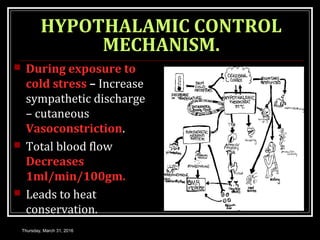
 During exposure to
cold stress – Increase
sympathetic discharge
– cutaneous
Vasoconstriction.
 Total blood flow
Decreases
1ml/min/100gm.
 Leads to heat
conservation.
Thursday, March 31, 2016
BARORECEPTOR MEDIATED
REFLEX.
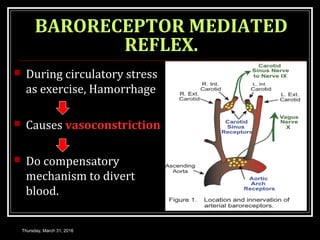
 During circulatory stress
as exercise, Hamorrhage
 Causes vasoconstriction
 Do compensatory
mechanism to divert
blood.
Thursday, March 31, 2016
CORTICAL CONTROL
MECHANISM.
 Through Cortico-
Hypothalamic
pathway.
 Corticohypothalamic
centers
 Thoracolumbar
sympathetic cell
bodies
 Skin vessels.
Thursday, March 31, 2016
CORTICAL CONTROL
MECHANISM.
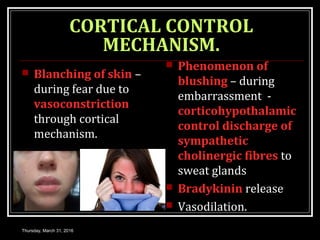
 Blanching of skin –
during fear due to
vasoconstriction
through cortical
mechanism.
 Phenomenon of
blushing – during
embarrassment -
corticohypothalamic
control discharge of
sympathetic
cholinergic fibres to
sweat glands
 Bradykinin release
 Vasodilation.
Thursday, March 31, 2016
CUTANEOUS VASCULAR
RESPONSE.
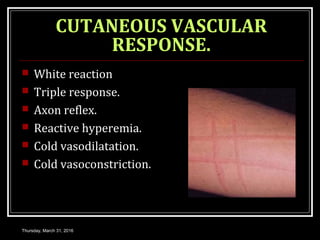
 White reaction
 Triple response.
 Axon reflex.
 Reactive hyperemia.
 Cold vasodilatation.
 Cold vasoconstriction.
Thursday, March 31, 2016
WHITE REACTION
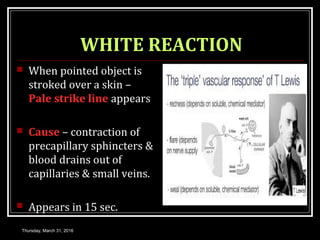
 When pointed object is
stroked over a skin –
Pale strike line appears
 Cause – contraction of
precapillary sphincters &
blood drains out of
capillaries & small veins.
 Appears in 15 sec.
Thursday, March 31, 2016
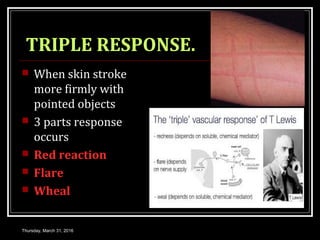
TRIPLE RESPONSE.
 When skin stroke
more firmly with
pointed objects
 3 parts response
occurs
 Red reaction
 Flare
 Wheal
Thursday, March 31, 2016
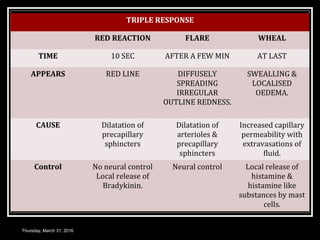
TRIPLE RESPONSE
RED REACTION FLARE WHEAL
TIME 10 SEC AFTER A FEW MIN AT LAST
APPEARS RED LINE DIFFUSELY
SPREADING
IRREGULAR
OUTLINE REDNESS.
SWEALLING &
LOCALISED
OEDEMA.
CAUSE Dilatation of
precapillary
sphincters
Dilatation of
arterioles &
precapillary
sphincters
Increased capillary
permeability with
extravasations of
fluid.
Control No neural control
Local release of
Bradykinin.
Neural control Local release of
histamine &
histamine like
substances by mast
cells.
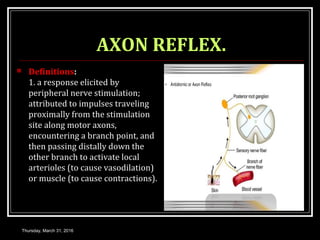
AXON REFLEX.
 Definitions:
1. a response elicited by
peripheral nerve stimulation;
attributed to impulses traveling
proximally from the stimulation
site along motor axons,
encountering a branch point, and
then passing distally down the
other branch to activate local
arterioles (to cause vasodilation)
or muscle (to cause contractions).
Thursday, March 31, 2016
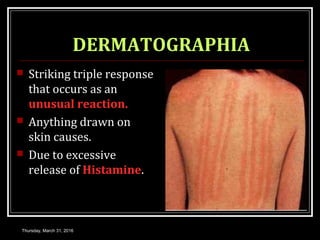
DERMATOGRAPHIA
 Striking triple response
that occurs as an
unusual reaction.
 Anything drawn on
skin causes.
 Due to excessive
release of Histamine.
Thursday, March 31, 2016
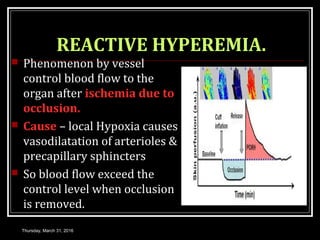
REACTIVE HYPEREMIA.
 Phenomenon by vessel
control blood flow to the
organ after ischemia due to
occlusion.
 Cause – local Hypoxia causes
vasodilatation of arterioles &
precapillary sphincters
 So blood flow exceed the
control level when occlusion
is removed.
Thursday, March 31, 2016
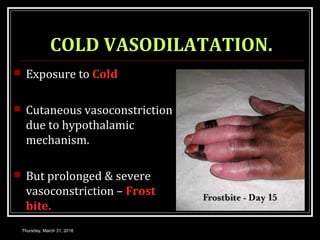
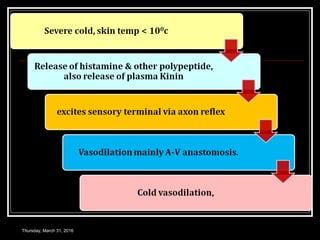
COLD VASODILATATION.
 Exposure to Cold
 Cutaneous vasoconstriction
due to hypothalamic
mechanism.
 But prolonged & severe
vasoconstriction – Frost
bite.
Thursday, March 31, 2016
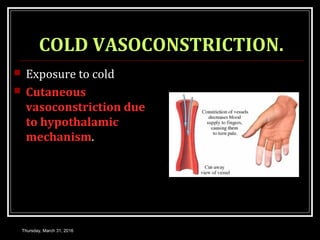
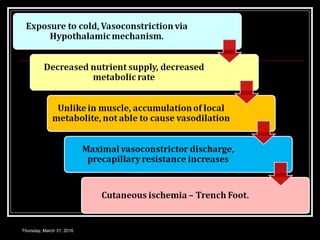
COLD VASOCONSTRICTION.
 Exposure to cold
 Cutaneous
vasoconstriction due
to hypothalamic
mechanism.
Thursday, March 31, 2016
Thank you.
Thursday, March 31, 2016

Cutaneous circulation

  • 1.
    DR NILESH KATE MBBS,MD ASSOCIATEPROF DEPT. OF PHYSIOLOGY CUTANEOUS CIRCULATION
  • 2.
    OBJECTIVES Cutaneous circulation.  Cutaneousblood flow- characteristics features.  Regulation of Cutaneous blood flow  Cutaneous vascular response Thursday, March 31, 2016
  • 3.
    CUTANEOUS BLOOD VESSELS. Cutaneous arterioles – dense network just under dermis.  Meta arteriole – high resistance conduits between arterioles & capillaries.  Cutaneous capillaries – provide larger surface area for heat exchange. Thursday, March 31, 2016
  • 4.
    CUTANEOUS BLOOD VESSELS. Venules – extensive sub papillary venous plexus  Hold large quantity of blood  Important role in maintaining body temperature.  Arteriovenous anastomosis – in distal parts of extremities (hands, feet, nose, lips & ear lobules)  Wide, low resistance, serves as shunt  Important in body temperature. Thursday, March 31, 2016
  • 5.
    CUTANEOUS BLOOD FLOW CHARACTERISTICFEATURES.  Main function.  Resting blood flow.  Exposure  Regional variations  Blood flow & skin colour. Thursday, March 31, 2016
  • 6.
    MAIN FUNCTION.  Tohelp in the Regulation of body Temperature.  For Nutritive function – skin need very less blood. Thursday, March 31, 2016
  • 7.
    RESTING BLOOD FLOW. When the person is at thermal equilibrium with the environment at 270 c  10-15ml/min/100 gm of skin tissue. Thursday, March 31, 2016
  • 8.
    EXPOSURE  To Cold–  Minimum sweating  Flow decreases to 1/10th of normal. (1ml/min/100gm)  To Heat –  Maximum sweating  Flow increases to 10 times (100- 150ml/min/100gm) Thursday, March 31, 2016
  • 9.
    REGIONAL VARIATIONS  Dueto A-V anastomosis in certain areas as hands, feet, nose & ear lobules.  During heat stress A-V anastomosis blood flow increases (75ml/min/100gm) Thursday, March 31, 2016
  • 10.
    BLOOD FLOW &SKIN COLOUR.  Basically its due to pigment present (Melanin)  But skin colour also affected by  Amount of blood  Degree of oxygenation. Thursday, March 31, 2016
  • 11.
    REGULATION OF CUANEOUS BLOODFLOW  Skin – very less metabolic activity.  O2 consumption – 0.3ml/min/100gm.  Regulation is mainly by Nervous Control than Metabolic Control. Thursday, March 31, 2016
  • 12.
    NERVE SUPPLY OF CUTANEOUSVESSELS  Sympathetic Vaso- constrictor  At rest Cutaneous vessels have sympathetic constrictor discharge  Its more marked on A-V anastomosis than other vessels. Thursday, March 31, 2016
  • 13.
    NERVE SUPPLY OF CUTANEOUSVESSELS  Parasympathetic Vasodilator – DO not supply Cutaneous vessels.  Vasodilation due to –  Reduced sympathetic effect.  Local Bradykinin in sweat glands.  Other local vasodilators. Thursday, March 31, 2016
  • 14.
    NEURAL CONTROL MECHANISMS  Hypothalamic ControlMechanism.  Baroreceptor mediated reflex.  Cortical control mechanism. Thursday, March 31, 2016
  • 15.
    HYPOTHALAMIC CONTROL MECHANISM.  Temperature Regulationcentre of Hypothalamus mediate thermoregulation by increase & decrease of sympathetic discharge to Cutaneous vessels. Thursday, March 31, 2016
  • 16.
    HYPOTHALAMIC CONTROL MECHANISM.  Underresting condition. –  Person at rest with thermal equilibrium at 270 c – sympathetic vasoconstrictor has mild tonic discharge  Keep A-V anastomosis closed. Thursday, March 31, 2016
  • 17.
    HYPOTHALAMIC CONTROL MECHANISM.  Duringexposure to Heat Stress – sympathetic discharge decreases  A-V anastomosis, cutaneous vessels dilates. Thursday, March 31, 2016
  • 18.
    HYPOTHALAMIC CONTROL MECHANISM.  Sweatglands activated due to cholinergic discharge – local release of Bradykinin – increases blood flow to skin. (150ml/min/100gm)  Heat is dissipated by radiation, evaporation & conduction. Thursday, March 31, 2016
  • 19.
    HYPOTHALAMIC CONTROL MECHANISM.  Duringexposure to cold stress – Increase sympathetic discharge – cutaneous Vasoconstriction.  Total blood flow Decreases 1ml/min/100gm.  Leads to heat conservation. Thursday, March 31, 2016
  • 20.
    BARORECEPTOR MEDIATED REFLEX.  Duringcirculatory stress as exercise, Hamorrhage  Causes vasoconstriction  Do compensatory mechanism to divert blood. Thursday, March 31, 2016
  • 21.
    CORTICAL CONTROL MECHANISM.  ThroughCortico- Hypothalamic pathway.  Corticohypothalamic centers  Thoracolumbar sympathetic cell bodies  Skin vessels. Thursday, March 31, 2016
  • 22.
    CORTICAL CONTROL MECHANISM.  Blanchingof skin – during fear due to vasoconstriction through cortical mechanism.  Phenomenon of blushing – during embarrassment - corticohypothalamic control discharge of sympathetic cholinergic fibres to sweat glands  Bradykinin release  Vasodilation. Thursday, March 31, 2016
  • 23.
    CUTANEOUS VASCULAR RESPONSE.  Whitereaction  Triple response.  Axon reflex.  Reactive hyperemia.  Cold vasodilatation.  Cold vasoconstriction. Thursday, March 31, 2016
  • 24.
    WHITE REACTION  Whenpointed object is stroked over a skin – Pale strike line appears  Cause – contraction of precapillary sphincters & blood drains out of capillaries & small veins.  Appears in 15 sec. Thursday, March 31, 2016
  • 25.
    TRIPLE RESPONSE.  Whenskin stroke more firmly with pointed objects  3 parts response occurs  Red reaction  Flare  Wheal Thursday, March 31, 2016
  • 26.
    Thursday, March 31,2016 TRIPLE RESPONSE RED REACTION FLARE WHEAL TIME 10 SEC AFTER A FEW MIN AT LAST APPEARS RED LINE DIFFUSELY SPREADING IRREGULAR OUTLINE REDNESS. SWEALLING & LOCALISED OEDEMA. CAUSE Dilatation of precapillary sphincters Dilatation of arterioles & precapillary sphincters Increased capillary permeability with extravasations of fluid. Control No neural control Local release of Bradykinin. Neural control Local release of histamine & histamine like substances by mast cells.
  • 27.
    AXON REFLEX.  Definitions: 1.a response elicited by peripheral nerve stimulation; attributed to impulses traveling proximally from the stimulation site along motor axons, encountering a branch point, and then passing distally down the other branch to activate local arterioles (to cause vasodilation) or muscle (to cause contractions). Thursday, March 31, 2016
  • 28.
    DERMATOGRAPHIA  Striking tripleresponse that occurs as an unusual reaction.  Anything drawn on skin causes.  Due to excessive release of Histamine. Thursday, March 31, 2016
  • 29.
    REACTIVE HYPEREMIA.  Phenomenonby vessel control blood flow to the organ after ischemia due to occlusion.  Cause – local Hypoxia causes vasodilatation of arterioles & precapillary sphincters  So blood flow exceed the control level when occlusion is removed. Thursday, March 31, 2016
  • 30.
    COLD VASODILATATION.  Exposureto Cold  Cutaneous vasoconstriction due to hypothalamic mechanism.  But prolonged & severe vasoconstriction – Frost bite. Thursday, March 31, 2016
  • 31.
  • 32.
    COLD VASOCONSTRICTION.  Exposureto cold  Cutaneous vasoconstriction due to hypothalamic mechanism. Thursday, March 31, 2016
  • 33.
  • 34.