BY
SREEJITH T
Introduction
Retina is a multilayered sensory tissue that lines the
back of the eye.
It contains millions of light receptors that captures
light rays and convert them into electrical impulses.
These impulses travel along the optic nerve to the
brain where they are turned to images.
Gross Anatomy
Retina extends from the optic disc to the ora serrata.
Ora serrata is the last region where the retina ends
and ciliary body starts; it consists of tooth like
projections.
Retina is divided into two distinct regions:
posterior pole and peripheral retina separated by
retinal equator.
Posterior pole
It refers to the area of the retina posterior to the
retinal equator.
The posterior pole of the retina includes 2 distinct
regions:
 Optic disc
 Macula lutea
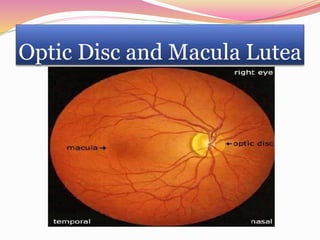
Optic Disc and Macula Lutea
Optic Disc
It is pink coloured, well defined circular area of 1.5
mm diameter.
Photoreceptors are absent here; hence known as
blind spot.
At the optic disc all the retinal layers terminate
except the nerve fibers, which pass through the
lamina cribrosa to run into the optic nerve.
A depression seen on the disc is called physiological
cup. The central retinal artery and vein emerge
through the centre of this cup.
Macula lutea
It is also called yellow spot
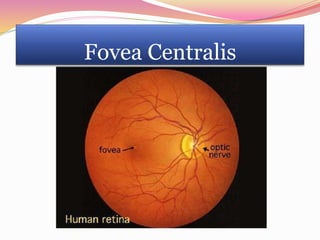
 Fovea centralis is the central depressed part of
macula. It is about 1.5 mm in diameter.
An area about 0.8 mm in diameter(including foveola
and some surrounding area) does not contain any
retinal capillaries and is called foveal avascular
zone(FAZ)
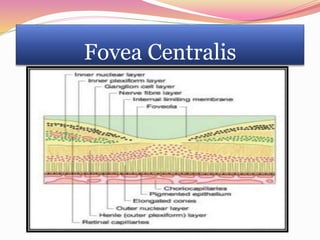
Structure of Fovea Centralis
In this area, there are no rods.
Cones are tightly packed and it is the most sensitive
part of retina.
It’s central part is called foveola.
All other retinal layers are absent in this region.
Fovea Centralis
Fovea Centralis
Peripheral Retina
It refers to the area bounded posteriorly by the
retinal equator and anteriorly by the ora serrata.
Layers of Retina
1) Pigment Epithelium
2) Photoreceptor layer
3) External Limiting Membrane
4) Outer Nuclear layer
5) Outer Plexiform Layer
6) Inner Nuclear Layer
7) Inner Plexiform Layer
8) Ganglion Cell Layer
9) Nerve Fiber Layer
10) Internal Limiting Membrane
Mnemonics for Layers of Retina
 In New Generation It Is Only Ophthalmologists
Examining Patients’ Retina
“RPE, 2 Outer, 2 Inner, GNI”
1) Pigment Epithelium
It is the outermost layer of the retina.
It consist of a single layer of cells containing the
pigment melanin.
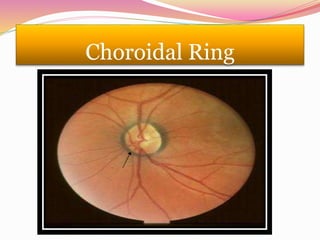
Around the optic disc, they are heaped up as
choroidal ring.
It is firmly adherent to the underlying basal lamina
(Bruch’s membrane) of the choroid.
Choroidal Ring
2) Photoreceptor Layer
Rods and Cones are the end organs of vision and are
also known as photoreceptors.
 Rods(120 million) contain a photosensitive
substance rhodopsin(visual purple) and helps in
peripheral vision and vision of low illumination
(scotopic vision)
 Cones (6.5 million) also contain a photosensitive
substance and helps in highly discriminatory central
vision(photopic vision) and colour vision.
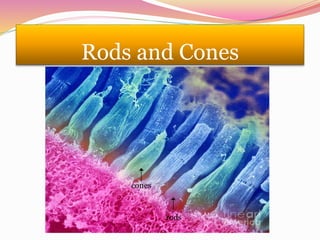
Rods and Cones
cones
rods
3) External Limiting Membrane
It is a fenestrated membrane, on which rods and
cones rest and their processes pierce.
4) Outer Nuclear Layer
It consists of nuclei of the rods and cones.
Cone nuclei are larger and more oval and carry a
layer of cytoplasm.
5) Outer Plexiform Layer
The innermost portion of each rod and cone cell is
swollen with lateral processes known as spherules
and pedicles respectively.
This layer consist of connections of rod spherules
and cone pedicles with the dendrites of bipolar cells
and horizontal cells.
6) Inner Nuclear Layer
It mainly consists of nuclei of bipolar cells.
It also contains nuclei of Amacrine and Muller’s
cells.
The bipolar cells constitute the first order neurons in
visual pathway.
7) Inner Plexiform Layer
It essentially consists of connections of bipolar cells
with the ganglion cells and amacrine cells.
8) Ganglion Cell Layer
It mainly contains cell bodies of ganglion cells(the
second order neurons of visual pathway)
There are 2 types of ganglion cells
 The midget ganglion-cells present in the macular
region, each such cell synapse with single bipolar cell
 The polysynaptic ganglion-cells lie predominantly
in the peripheral retina, each such cell may synapse
with up to a hundred bipolar cells.
9) Nerve Fiber Layer
(Stratum Opticum)
It consists of axons of ganglion cells, running parallel
to the retinal surface.
The layer increases in depth as it converges to optic
disc.
It passes through the lamina cribrosa to form the
optic nerve.
10) Internal Limiting Membrane
It is the innermost layer and separates the retina
from the vitreous.
It is formed by the union of terminal fibers of the
Muller’s fibers.
It is essentially a basement membrane.
Blood Supply
Outer 4 layers of the retina- Choroidal vessels
Inner 6 layers- Central retinal artery which is a branch of
Ophthalmic artery.
Fovea is avascular but partially gets blood supply from
choroidal vessels
Macula- Central retinal artery and cilioretinal artery.
Central retinal artery emerges from the centre of the
physiological cup of optic disc and divides into 4
branches
These are end arteries i.e., they do not anastomose with
each other.
Photochemistry of Vision
What Happens in Retina
The light rays are focused directly onto the retina,
the light sensitive tissue lining the back of the eye.
Light energy is converted into neural signal
Through visual pathway, these signals reach brain.
Physiology of vision
The main mechanisms are
[ ]Initiation of vision (Phototransduction)
[ ]Processing and transmission of visual sensations
[ ]Visual perception
Phototransduction
(Initiation of Vision)
The whole phenomenon of conversion of light energy
into nerve impulse is known as phototransduction.
Light falling upon retina cause photochemical
changes( ) which trigger a cascade of biochemical
reactions that result in generation of electrical
changes( ).
( )Photochemical Changes
RHODOPSIN BLEACHING
Rhodopsin refers to the visual pigment present in the
rods-the receptors for night(scotopic) vision.
Its maximum absorption spectrum is around 500 nm.
Rhodopsin consists of a colourless protein called opsin
coupled with a carotenoid called retinine(Vit A or 11-cis-
retinal)
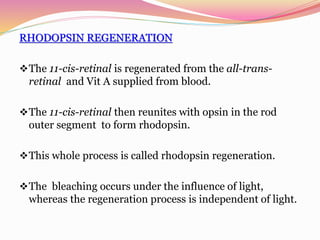
Light falling on the rods converts 11-cis-retinal into
all-trans-retinal through various stages.
The all-trans-retinal so formed is soon separated
from the opsin.
This process of separation is called
photodecomposition.
Rhodopsin is said to be bleached by the action of
light.
Visual Cycle
RHODOPSIN REGENERATION
The 11-cis-retinal is regenerated from the all-trans-
retinal and Vit A supplied from blood.
The 11-cis-retinal then reunites with opsin in the rod
outer segment to form rhodopsin.
This whole process is called rhodopsin regeneration.
The bleaching occurs under the influence of light,
whereas the regeneration process is independent of light.
VISUAL CYCLE
In the retina of living animals , under constant lght
stimulation, a steady state must exist under which
the rate at which the photochemicals are bleached is
equal to the rate at which they are regenerated.
This equilibrium between the photo-decomposition
and regeneration of visual pigments is referred to as
visual cycle.
( )Electrical Changes
Activated rhodopsin cascade of biochemical
reactions generation of receptor potential
Thus light energy is converted to electrical energy
Dark Adaptation
Ability of the eye to adapt to decreasing illumination.
When one goes from bright sunshine into a dimly-lit
room, one cannot perceive the objects in the room
until some time has elapsed.
This is called dark adaptation time.
It is the time taken for regeneration of rhodopsin
pigment which was bleached by the bright light.

Retina 3rd mbbs ophthalmology

  • 1.
  • 2.
    Introduction Retina is amultilayered sensory tissue that lines the back of the eye. It contains millions of light receptors that captures light rays and convert them into electrical impulses. These impulses travel along the optic nerve to the brain where they are turned to images.
  • 3.
    Gross Anatomy Retina extendsfrom the optic disc to the ora serrata. Ora serrata is the last region where the retina ends and ciliary body starts; it consists of tooth like projections. Retina is divided into two distinct regions: posterior pole and peripheral retina separated by retinal equator.
  • 4.
    Posterior pole It refersto the area of the retina posterior to the retinal equator. The posterior pole of the retina includes 2 distinct regions:  Optic disc  Macula lutea
  • 5.
    Optic Disc andMacula Lutea
  • 6.
    Optic Disc It ispink coloured, well defined circular area of 1.5 mm diameter. Photoreceptors are absent here; hence known as blind spot. At the optic disc all the retinal layers terminate except the nerve fibers, which pass through the lamina cribrosa to run into the optic nerve. A depression seen on the disc is called physiological cup. The central retinal artery and vein emerge through the centre of this cup.
  • 7.
    Macula lutea It isalso called yellow spot  Fovea centralis is the central depressed part of macula. It is about 1.5 mm in diameter. An area about 0.8 mm in diameter(including foveola and some surrounding area) does not contain any retinal capillaries and is called foveal avascular zone(FAZ)
  • 8.
    Structure of FoveaCentralis In this area, there are no rods. Cones are tightly packed and it is the most sensitive part of retina. It’s central part is called foveola. All other retinal layers are absent in this region.
  • 9.
  • 10.
  • 11.
    Peripheral Retina It refersto the area bounded posteriorly by the retinal equator and anteriorly by the ora serrata.
  • 12.
    Layers of Retina 1)Pigment Epithelium 2) Photoreceptor layer 3) External Limiting Membrane 4) Outer Nuclear layer 5) Outer Plexiform Layer 6) Inner Nuclear Layer 7) Inner Plexiform Layer 8) Ganglion Cell Layer 9) Nerve Fiber Layer 10) Internal Limiting Membrane
  • 13.
    Mnemonics for Layersof Retina  In New Generation It Is Only Ophthalmologists Examining Patients’ Retina “RPE, 2 Outer, 2 Inner, GNI”
  • 14.
    1) Pigment Epithelium Itis the outermost layer of the retina. It consist of a single layer of cells containing the pigment melanin. Around the optic disc, they are heaped up as choroidal ring. It is firmly adherent to the underlying basal lamina (Bruch’s membrane) of the choroid.
  • 15.
  • 16.
    2) Photoreceptor Layer Rodsand Cones are the end organs of vision and are also known as photoreceptors.  Rods(120 million) contain a photosensitive substance rhodopsin(visual purple) and helps in peripheral vision and vision of low illumination (scotopic vision)  Cones (6.5 million) also contain a photosensitive substance and helps in highly discriminatory central vision(photopic vision) and colour vision.
  • 17.
  • 18.
    3) External LimitingMembrane It is a fenestrated membrane, on which rods and cones rest and their processes pierce.
  • 19.
    4) Outer NuclearLayer It consists of nuclei of the rods and cones. Cone nuclei are larger and more oval and carry a layer of cytoplasm.
  • 20.
    5) Outer PlexiformLayer The innermost portion of each rod and cone cell is swollen with lateral processes known as spherules and pedicles respectively. This layer consist of connections of rod spherules and cone pedicles with the dendrites of bipolar cells and horizontal cells.
  • 21.
    6) Inner NuclearLayer It mainly consists of nuclei of bipolar cells. It also contains nuclei of Amacrine and Muller’s cells. The bipolar cells constitute the first order neurons in visual pathway.
  • 22.
    7) Inner PlexiformLayer It essentially consists of connections of bipolar cells with the ganglion cells and amacrine cells.
  • 23.
    8) Ganglion CellLayer It mainly contains cell bodies of ganglion cells(the second order neurons of visual pathway) There are 2 types of ganglion cells  The midget ganglion-cells present in the macular region, each such cell synapse with single bipolar cell  The polysynaptic ganglion-cells lie predominantly in the peripheral retina, each such cell may synapse with up to a hundred bipolar cells.
  • 24.
    9) Nerve FiberLayer (Stratum Opticum) It consists of axons of ganglion cells, running parallel to the retinal surface. The layer increases in depth as it converges to optic disc. It passes through the lamina cribrosa to form the optic nerve.
  • 25.
    10) Internal LimitingMembrane It is the innermost layer and separates the retina from the vitreous. It is formed by the union of terminal fibers of the Muller’s fibers. It is essentially a basement membrane.
  • 26.
    Blood Supply Outer 4layers of the retina- Choroidal vessels Inner 6 layers- Central retinal artery which is a branch of Ophthalmic artery. Fovea is avascular but partially gets blood supply from choroidal vessels Macula- Central retinal artery and cilioretinal artery. Central retinal artery emerges from the centre of the physiological cup of optic disc and divides into 4 branches These are end arteries i.e., they do not anastomose with each other.
  • 27.
  • 28.
    What Happens inRetina The light rays are focused directly onto the retina, the light sensitive tissue lining the back of the eye. Light energy is converted into neural signal Through visual pathway, these signals reach brain.
  • 29.
    Physiology of vision Themain mechanisms are [ ]Initiation of vision (Phototransduction) [ ]Processing and transmission of visual sensations [ ]Visual perception
  • 30.
    Phototransduction (Initiation of Vision) Thewhole phenomenon of conversion of light energy into nerve impulse is known as phototransduction. Light falling upon retina cause photochemical changes( ) which trigger a cascade of biochemical reactions that result in generation of electrical changes( ).
  • 31.
    ( )Photochemical Changes RHODOPSINBLEACHING Rhodopsin refers to the visual pigment present in the rods-the receptors for night(scotopic) vision. Its maximum absorption spectrum is around 500 nm. Rhodopsin consists of a colourless protein called opsin coupled with a carotenoid called retinine(Vit A or 11-cis- retinal)
  • 32.
    Light falling onthe rods converts 11-cis-retinal into all-trans-retinal through various stages. The all-trans-retinal so formed is soon separated from the opsin. This process of separation is called photodecomposition. Rhodopsin is said to be bleached by the action of light.
  • 33.
  • 34.
    RHODOPSIN REGENERATION The 11-cis-retinalis regenerated from the all-trans- retinal and Vit A supplied from blood. The 11-cis-retinal then reunites with opsin in the rod outer segment to form rhodopsin. This whole process is called rhodopsin regeneration. The bleaching occurs under the influence of light, whereas the regeneration process is independent of light.
  • 35.
    VISUAL CYCLE In theretina of living animals , under constant lght stimulation, a steady state must exist under which the rate at which the photochemicals are bleached is equal to the rate at which they are regenerated. This equilibrium between the photo-decomposition and regeneration of visual pigments is referred to as visual cycle.
  • 36.
    ( )Electrical Changes Activatedrhodopsin cascade of biochemical reactions generation of receptor potential Thus light energy is converted to electrical energy
  • 37.
    Dark Adaptation Ability ofthe eye to adapt to decreasing illumination. When one goes from bright sunshine into a dimly-lit room, one cannot perceive the objects in the room until some time has elapsed. This is called dark adaptation time. It is the time taken for regeneration of rhodopsin pigment which was bleached by the bright light.