VISUAL PATHWAY
Dr.GURUDASAN
04.04.13
INTRODUCTION
- Most important special
sense in humans.
Components:
A. Retina
B. Optic nerve and optic
chiasm.
C. Optic tract
D. Lateral geniculate body
(of the thalamus).
E. Optic radiations
F. Visual cortex
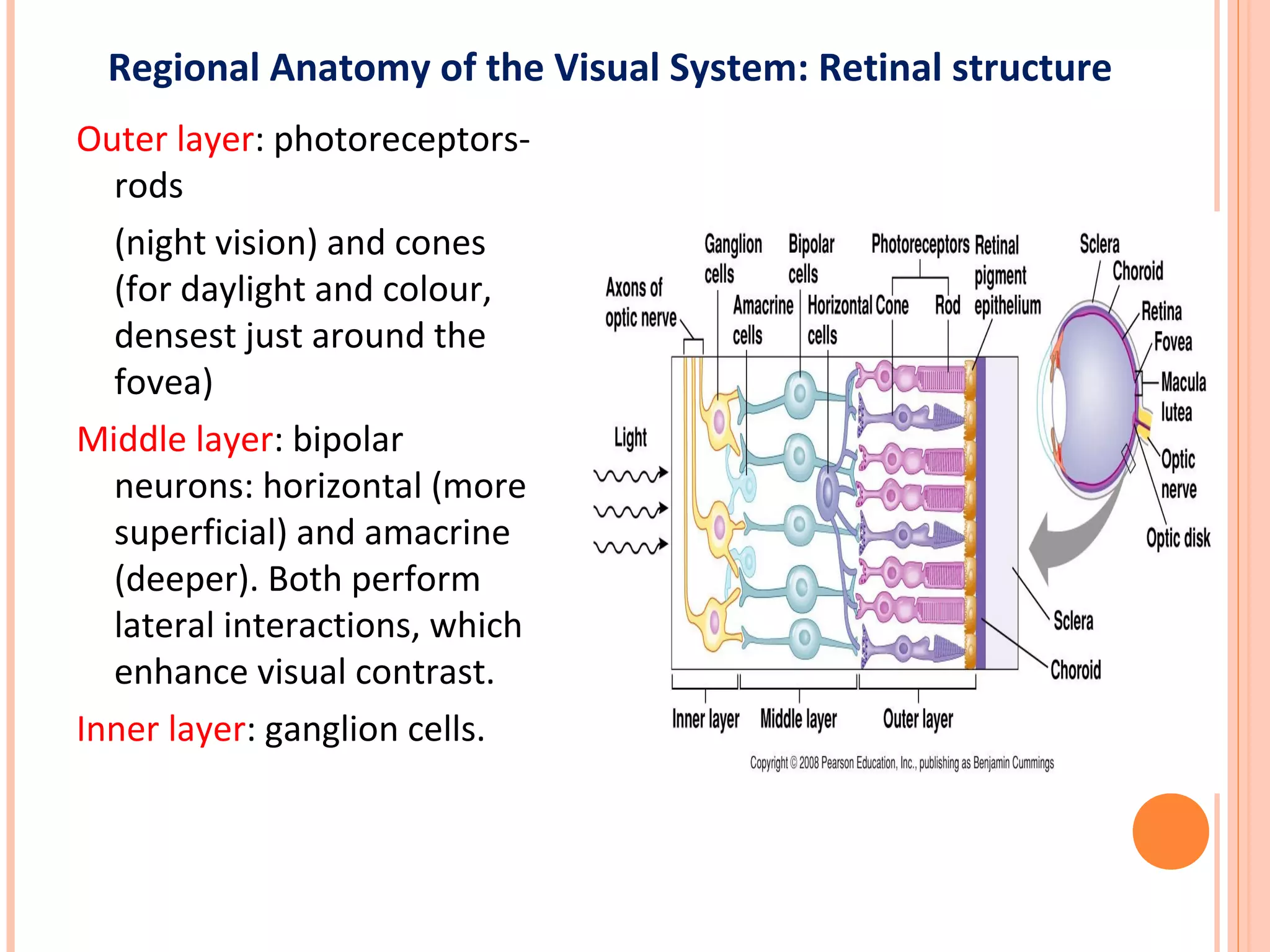
Outer layer: photoreceptors-
rods
(night vision) and cones
(for daylight and colour,
densest just around the
fovea)
Middle layer: bipolar
neurons: horizontal (more
superficial) and amacrine
(deeper). Both perform
lateral interactions, which
enhance visual contrast.
Inner layer: ganglion cells.
Regional Anatomy of the Visual System: Retinal structure
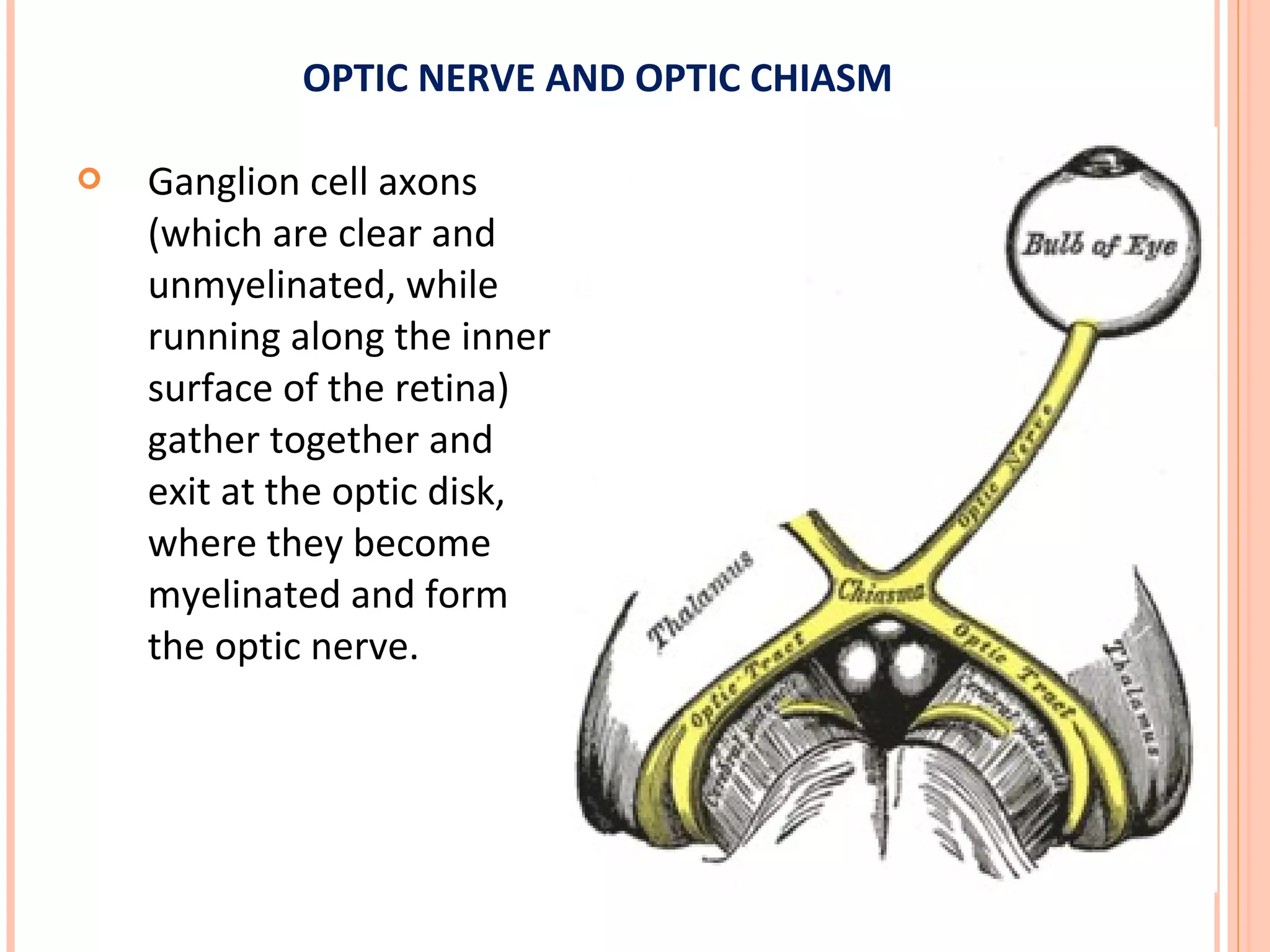
ļ‚¢ Ganglion cell axons
(which are clear and
unmyelinated, while
running along the inner
surface of the retina)
gather together and
exit at the optic disk,
where they become
myelinated and form
the optic nerve.
OPTIC NERVE AND OPTIC CHIASM
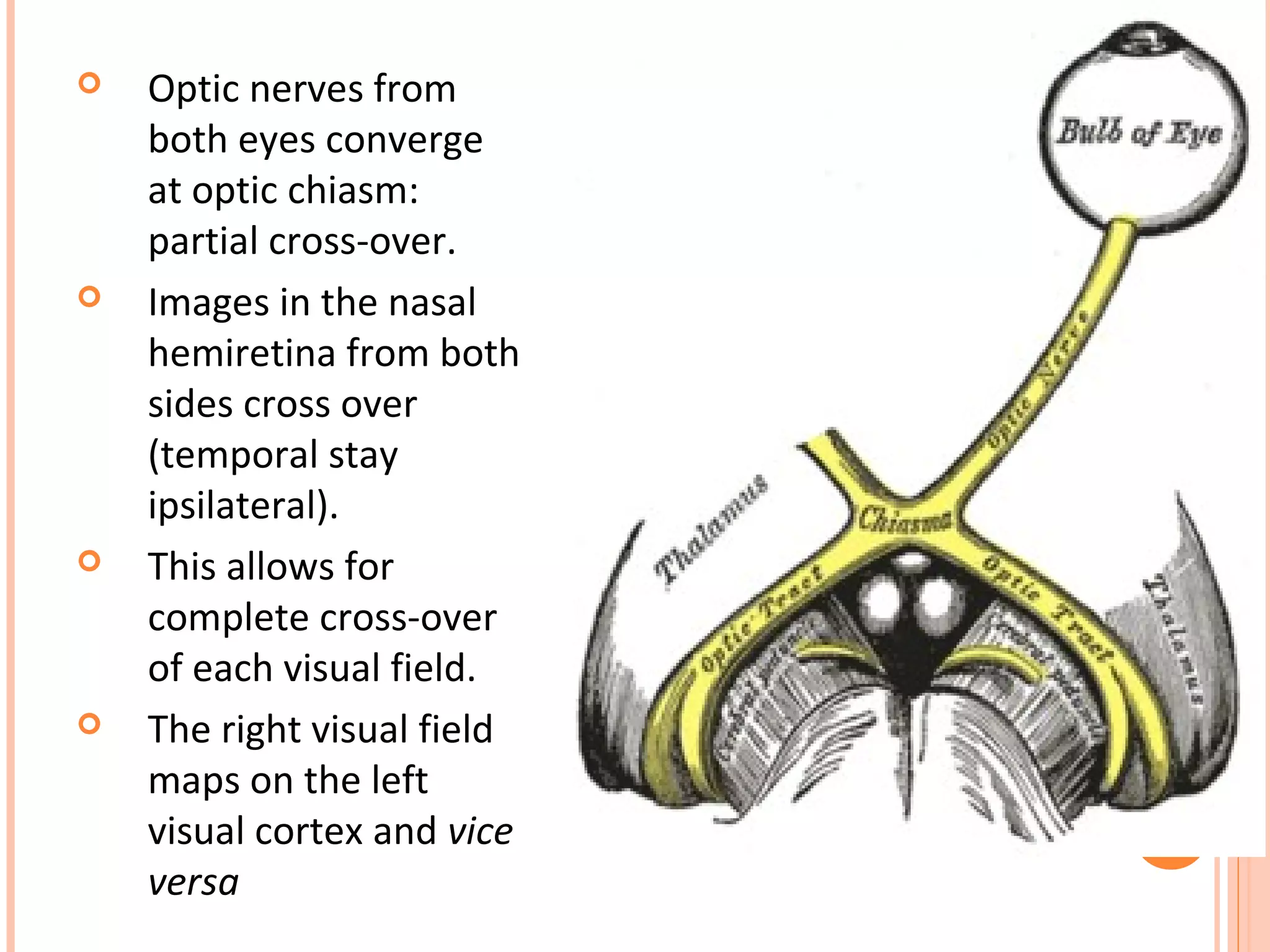
ļ‚¢ Optic nerves from
both eyes converge
at optic chiasm:
partial cross-over.
ļ‚¢ Images in the nasal
hemiretina from both
sides cross over
(temporal stay
ipsilateral).
ļ‚¢ This allows for
complete cross-over
of each visual field.
ļ‚¢ The right visual field
maps on the left
visual cortex and vice
versa
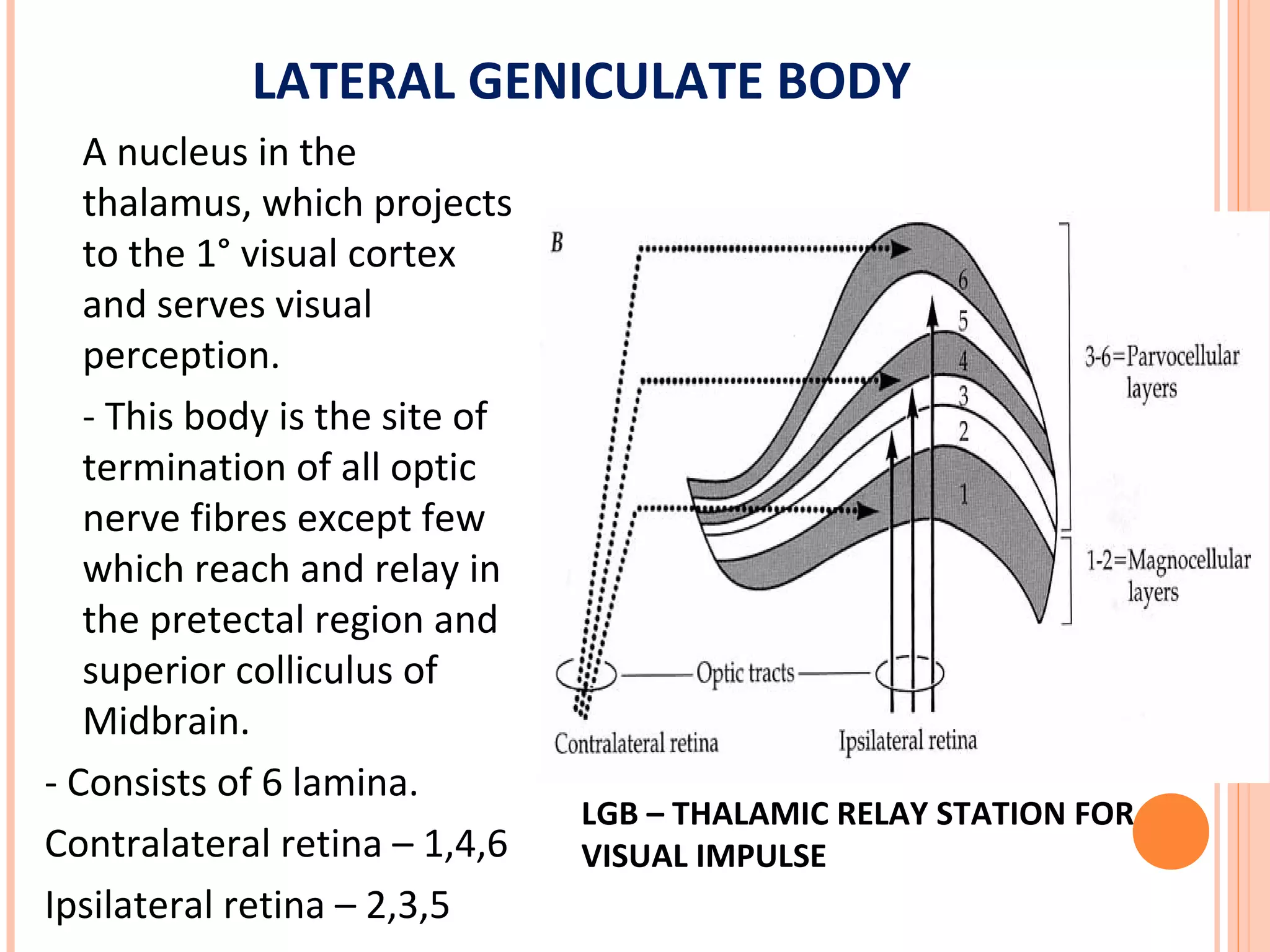
LATERAL GENICULATE BODY
A nucleus in the
thalamus, which projects
to the 1° visual cortex
and serves visual
perception.
- This body is the site of
termination of all optic
nerve fibres except few
which reach and relay in
the pretectal region and
superior colliculus of
Midbrain.
- Consists of 6 lamina.
Contralateral retina – 1,4,6
Ipsilateral retina – 2,3,5
LGB – THALAMIC RELAY STATION FOR
VISUAL IMPULSE
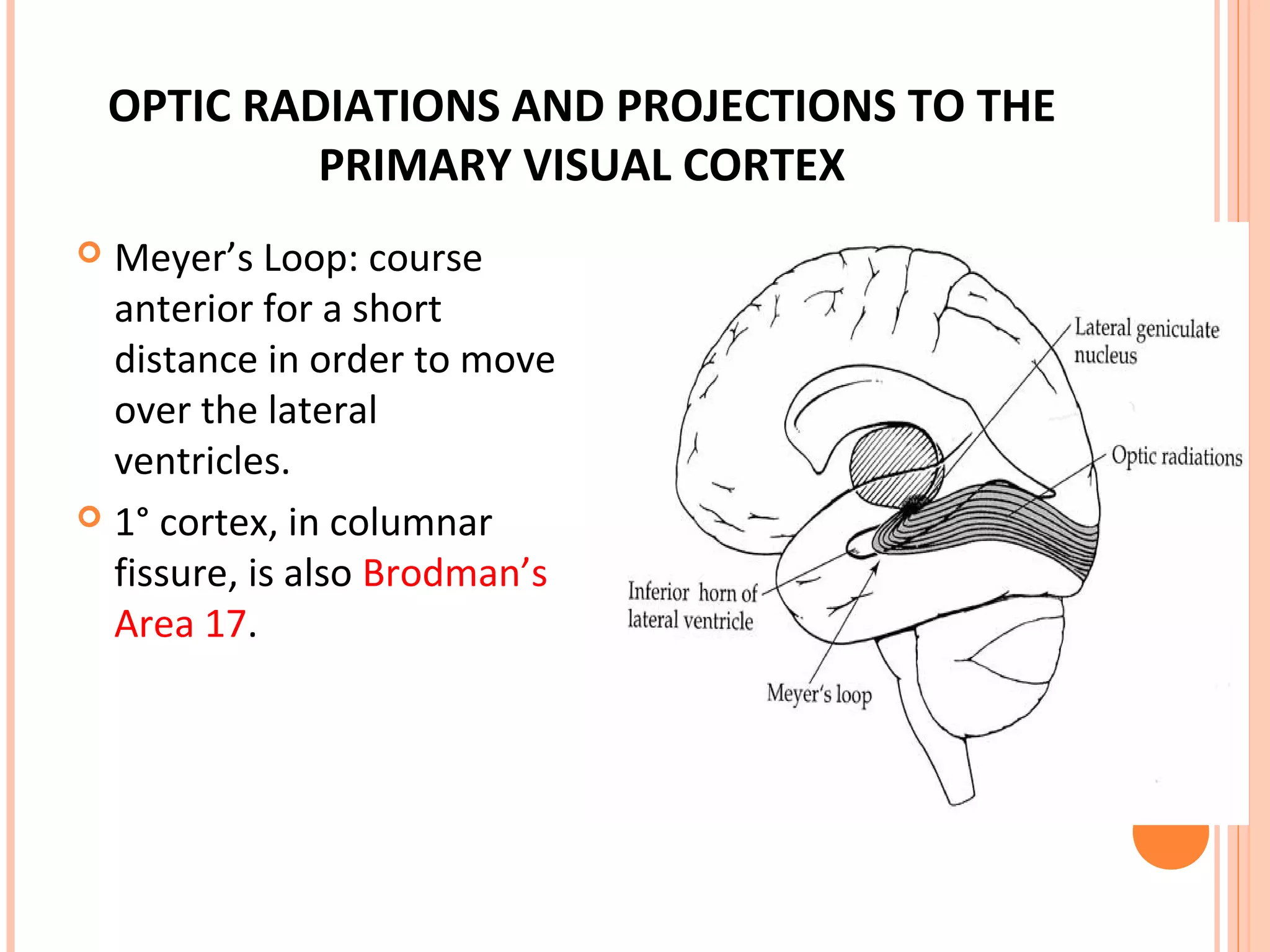
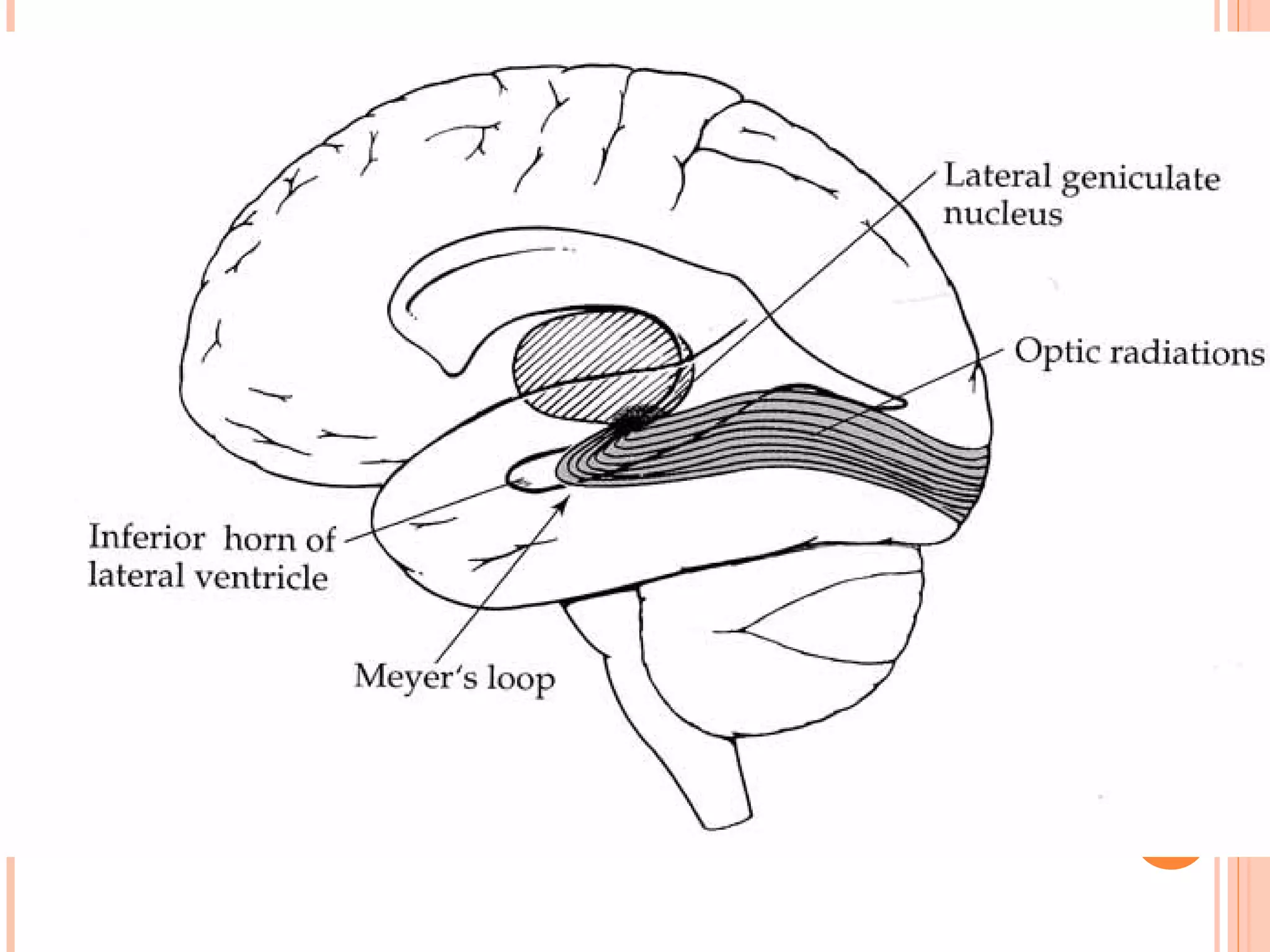
OPTIC RADIATIONS AND PROJECTIONS TO THE
PRIMARY VISUAL CORTEX
ļ‚¢ Meyer’s Loop: course
anterior for a short
distance in order to move
over the lateral
ventricles.
ļ‚¢ 1° cortex, in columnar
fissure, is also Brodman’s
Area 17.
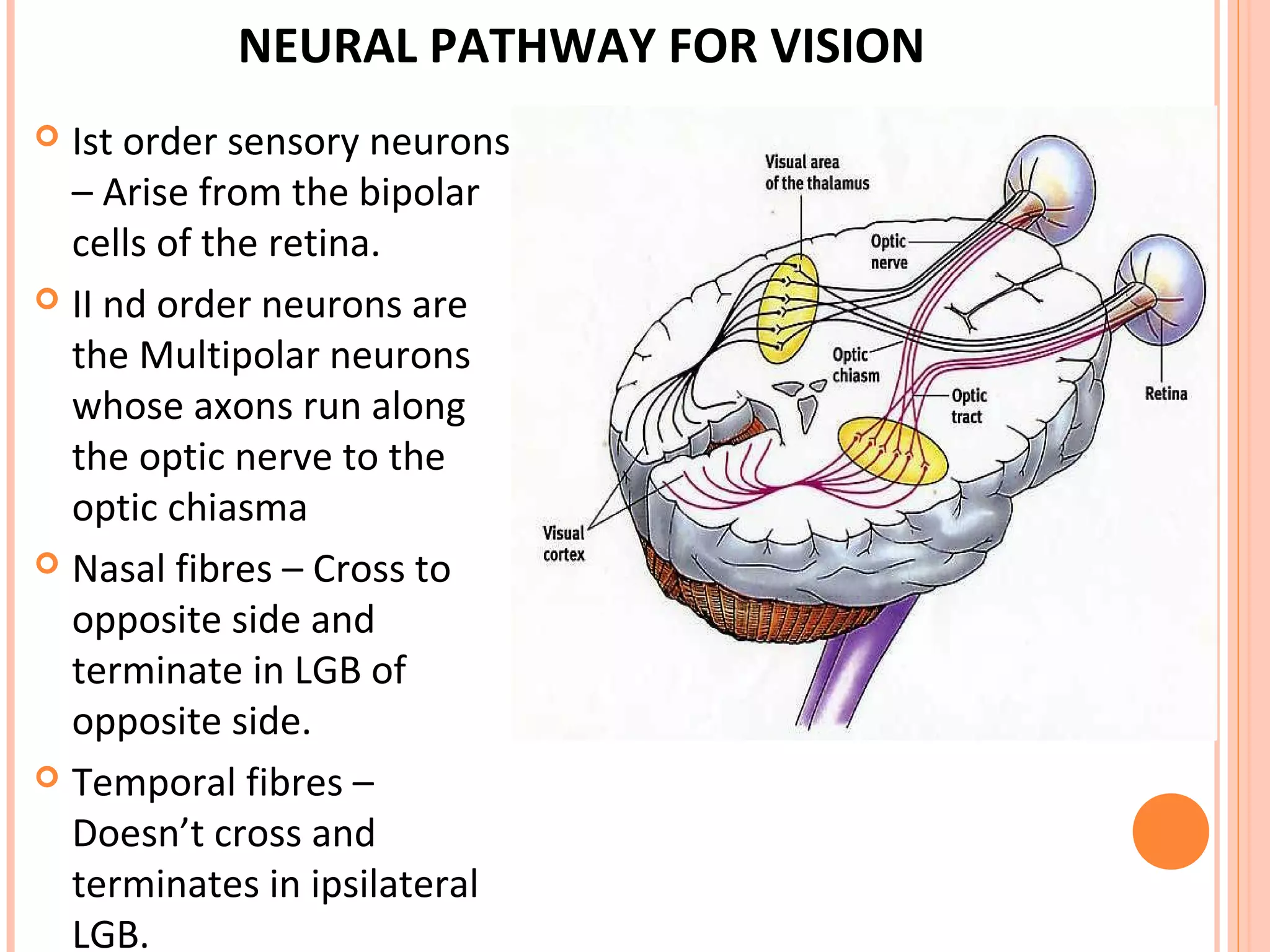
NEURAL PATHWAY FOR VISION
ļ‚¢ Ist order sensory neurons
– Arise from the bipolar
cells of the retina.
ļ‚¢ II nd order neurons are
the Multipolar neurons
whose axons run along
the optic nerve to the
optic chiasma
ļ‚¢ Nasal fibres – Cross to
opposite side and
terminate in LGB of
opposite side.
ļ‚¢ Temporal fibres –
Doesn’t cross and
terminates in ipsilateral
LGB.
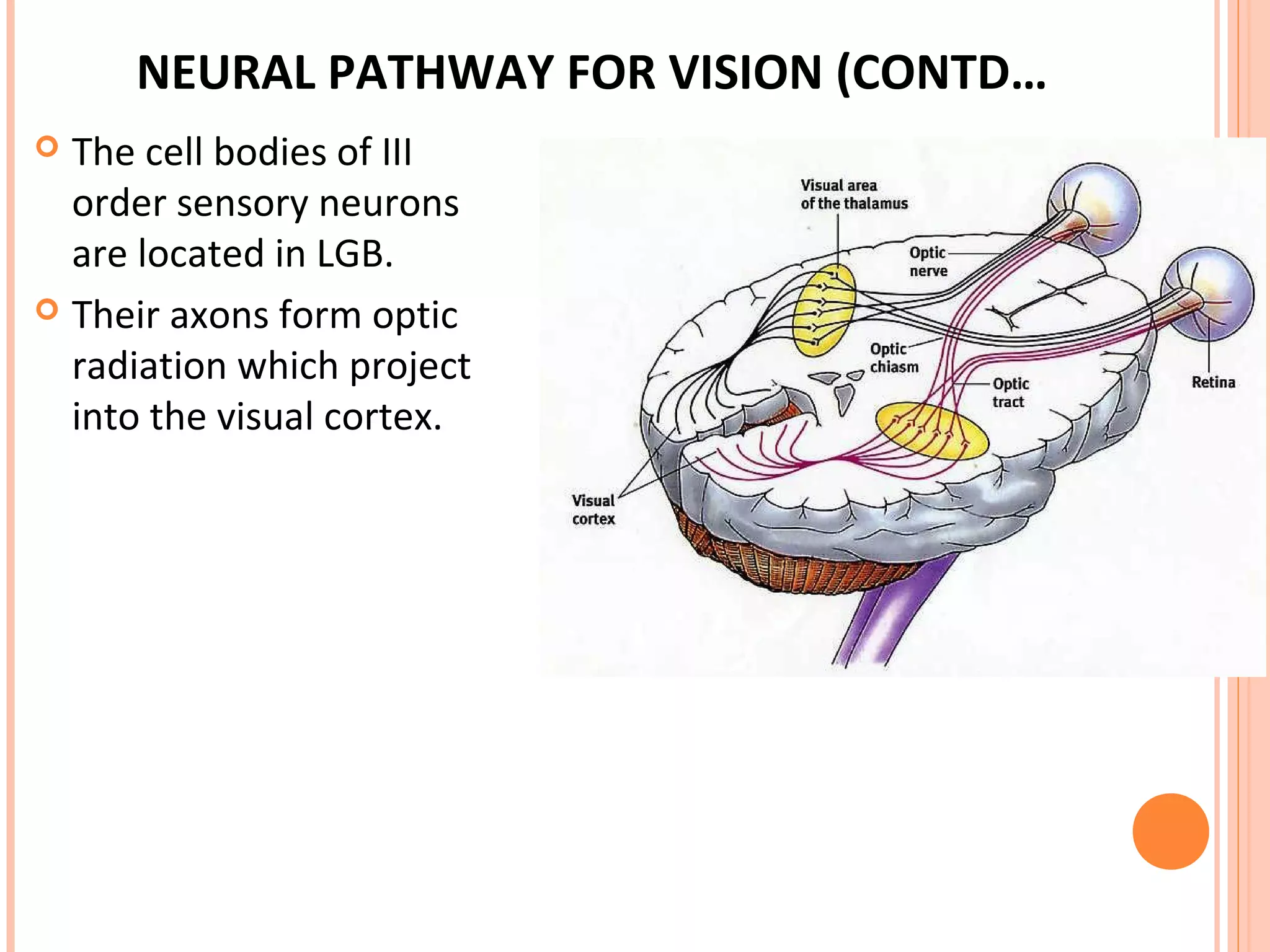
NEURAL PATHWAY FOR VISION (CONTD…
ļ‚¢ The cell bodies of III
order sensory neurons
are located in LGB.
ļ‚¢ Their axons form optic
radiation which project
into the visual cortex.
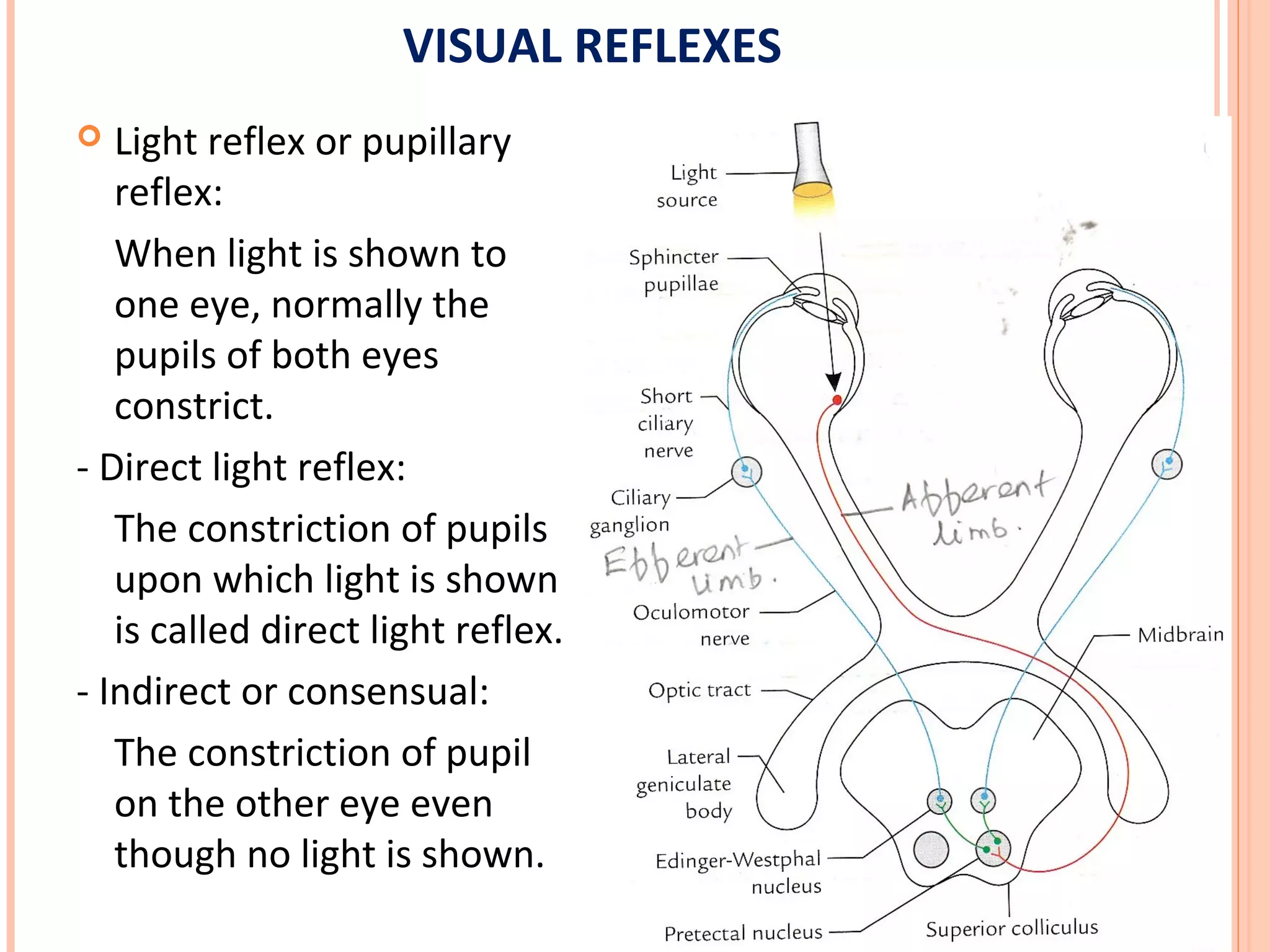
VISUAL REFLEXES
ļ‚¢ Light reflex or pupillary
reflex:
When light is shown to
one eye, normally the
pupils of both eyes
constrict.
- Direct light reflex:
The constriction of pupils
upon which light is shown
is called direct light reflex.
- Indirect or consensual:
The constriction of pupil
on the other eye even
though no light is shown.
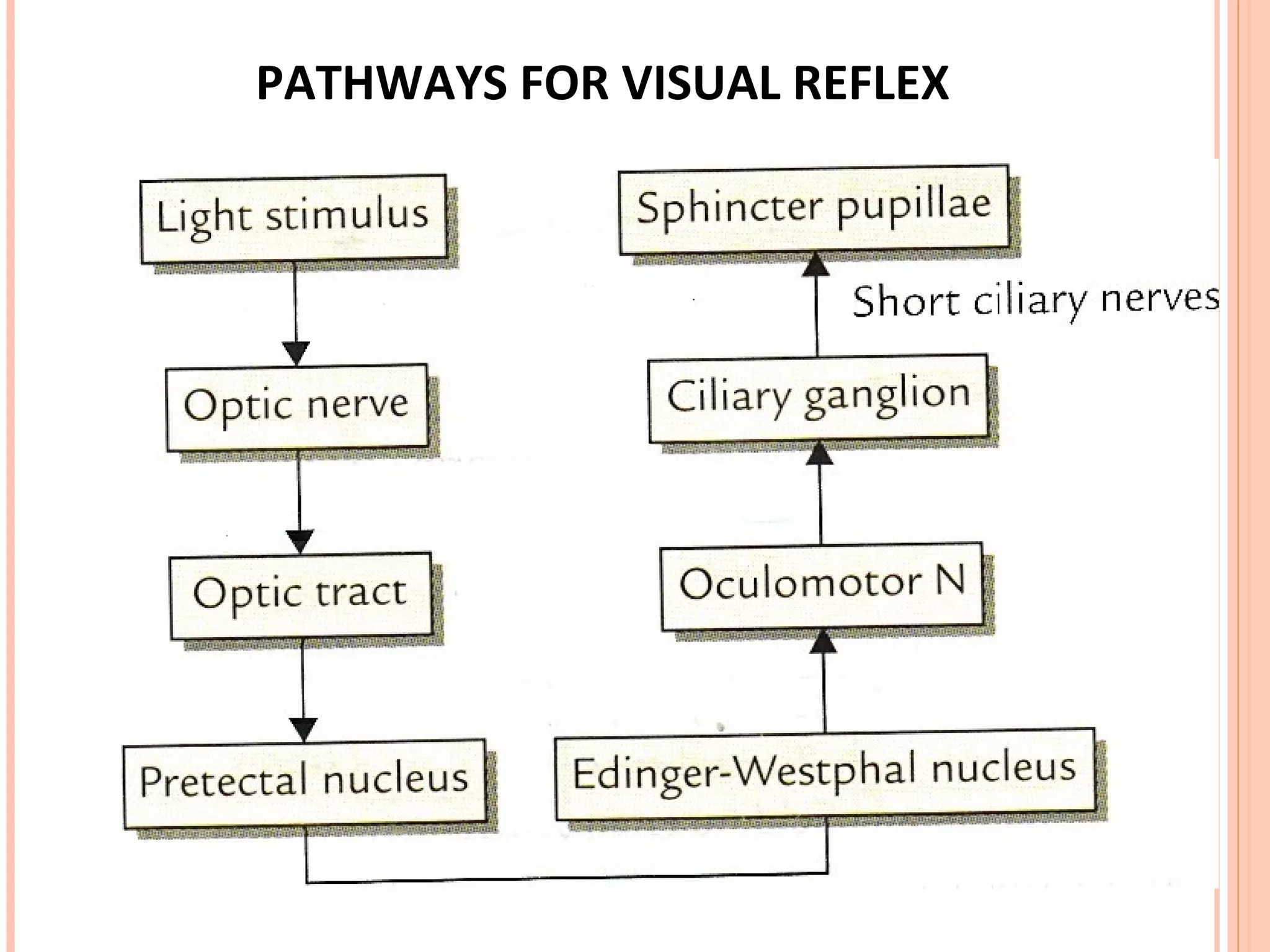
PATHWAYS FOR VISUAL REFLEX
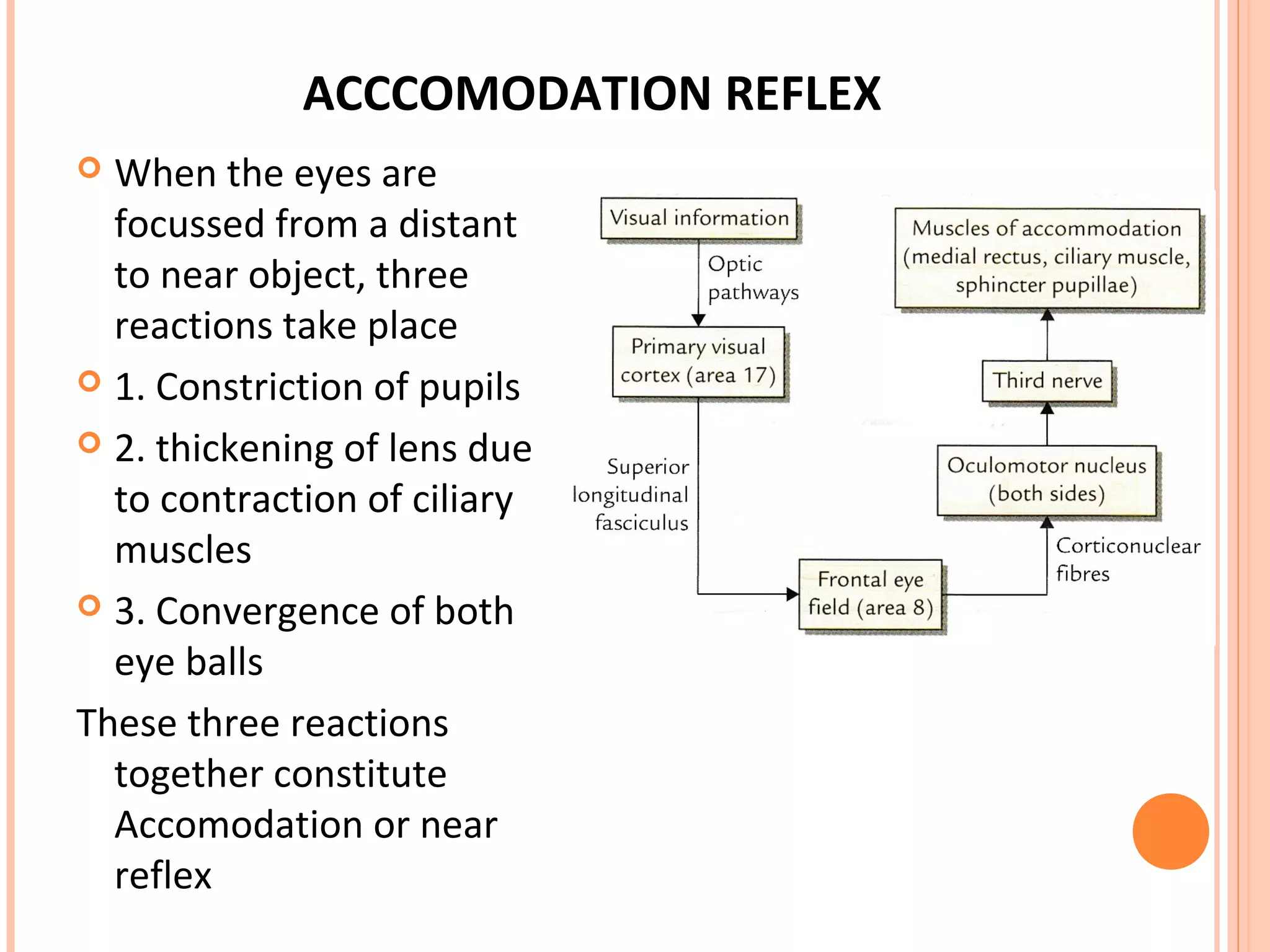
ACCCOMODATION REFLEX
ļ‚¢ When the eyes are
focussed from a distant
to near object, three
reactions take place
ļ‚¢ 1. Constriction of pupils
ļ‚¢ 2. thickening of lens due
to contraction of ciliary
muscles
ļ‚¢ 3. Convergence of both
eye balls
These three reactions
together constitute
Accomodation or near
reflex
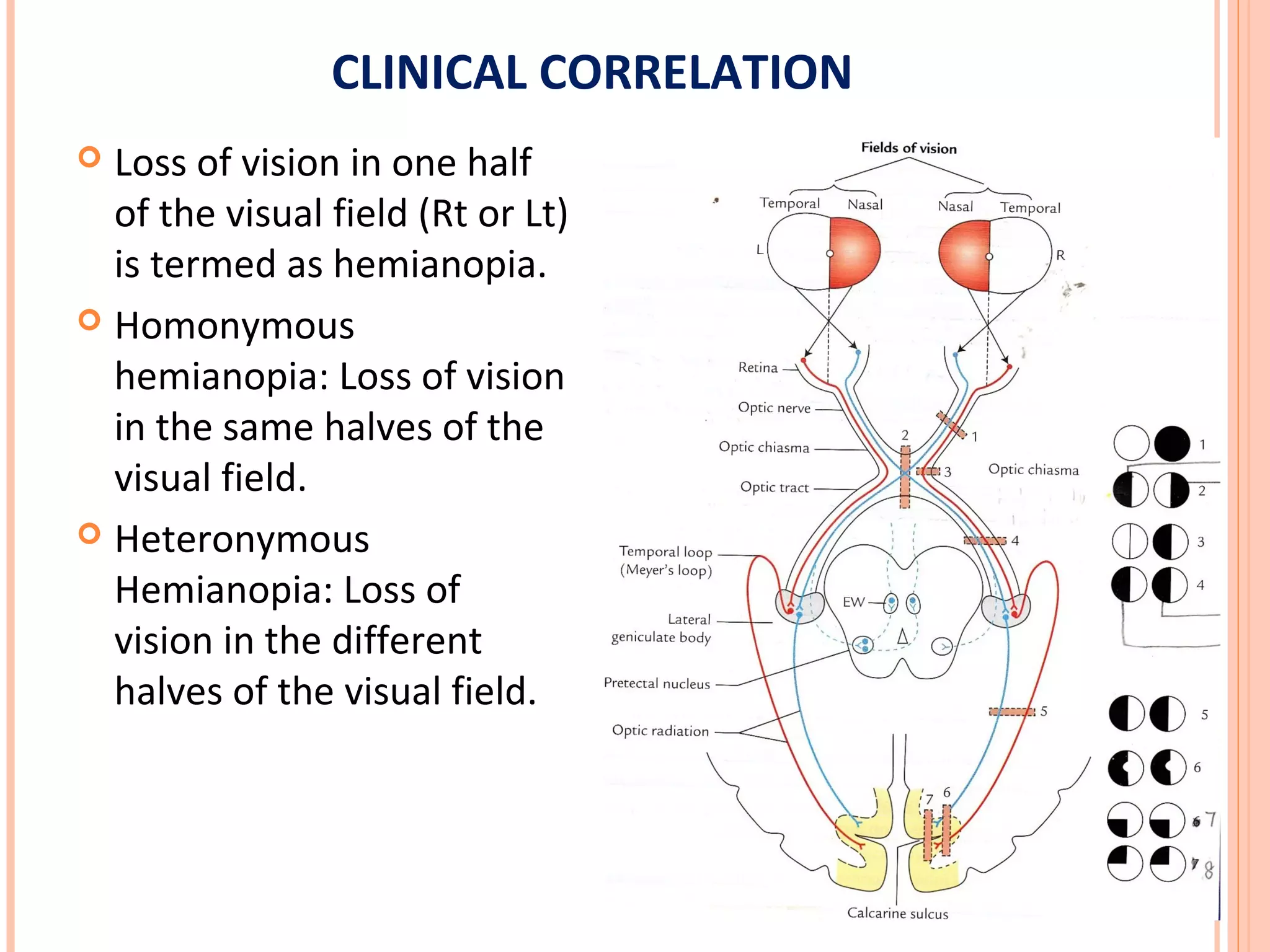
CLINICAL CORRELATION
ļ‚¢ Loss of vision in one half
of the visual field (Rt or Lt)
is termed as hemianopia.
ļ‚¢ Homonymous
hemianopia: Loss of vision
in the same halves of the
visual field.
ļ‚¢ Heteronymous
Hemianopia: Loss of
vision in the different
halves of the visual field.
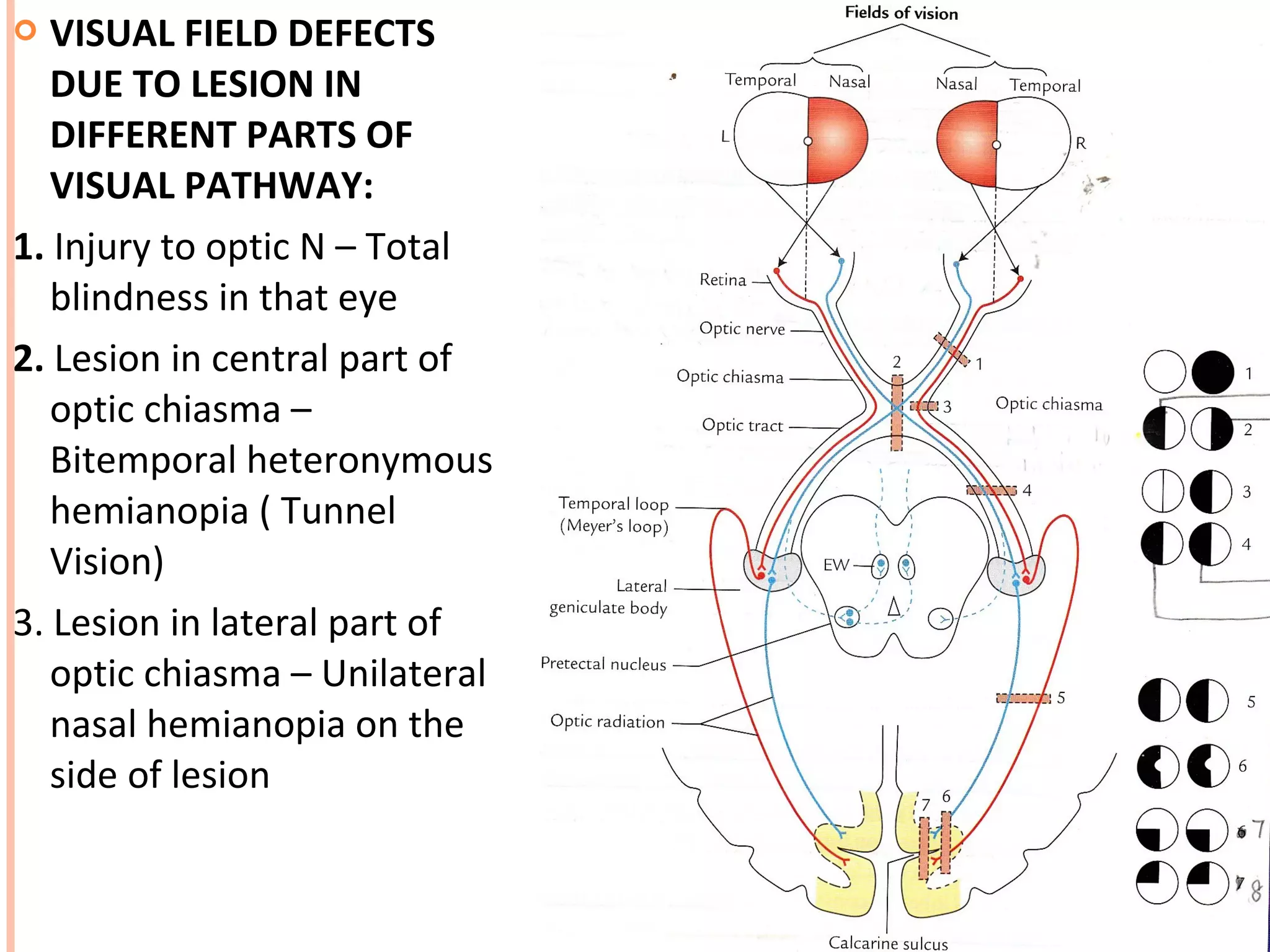
ļ‚¢ VISUAL FIELD DEFECTS
DUE TO LESION IN
DIFFERENT PARTS OF
VISUAL PATHWAY:
1. Injury to optic N – Total
blindness in that eye
2. Lesion in central part of
optic chiasma –
Bitemporal heteronymous
hemianopia ( Tunnel
Vision)
3. Lesion in lateral part of
optic chiasma – Unilateral
nasal hemianopia on the
side of lesion
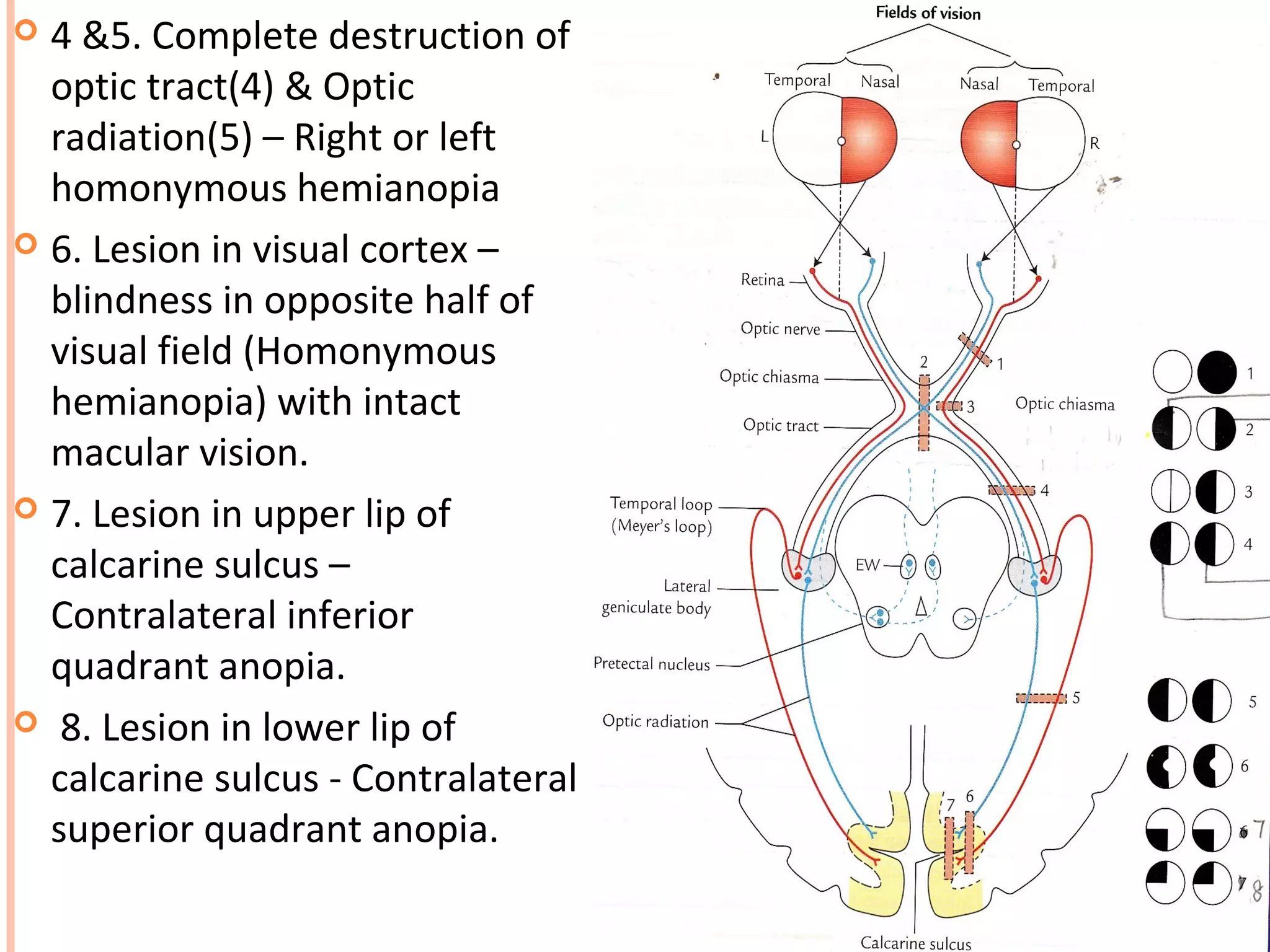
ļ‚¢ 4 &5. Complete destruction of
optic tract(4) & Optic
radiation(5) – Right or left
homonymous hemianopia
ļ‚¢ 6. Lesion in visual cortex –
blindness in opposite half of
visual field (Homonymous
hemianopia) with intact
macular vision.
ļ‚¢ 7. Lesion in upper lip of
calcarine sulcus –
Contralateral inferior
quadrant anopia.
ļ‚¢ 8. Lesion in lower lip of
calcarine sulcus - Contralateral
superior quadrant anopia.
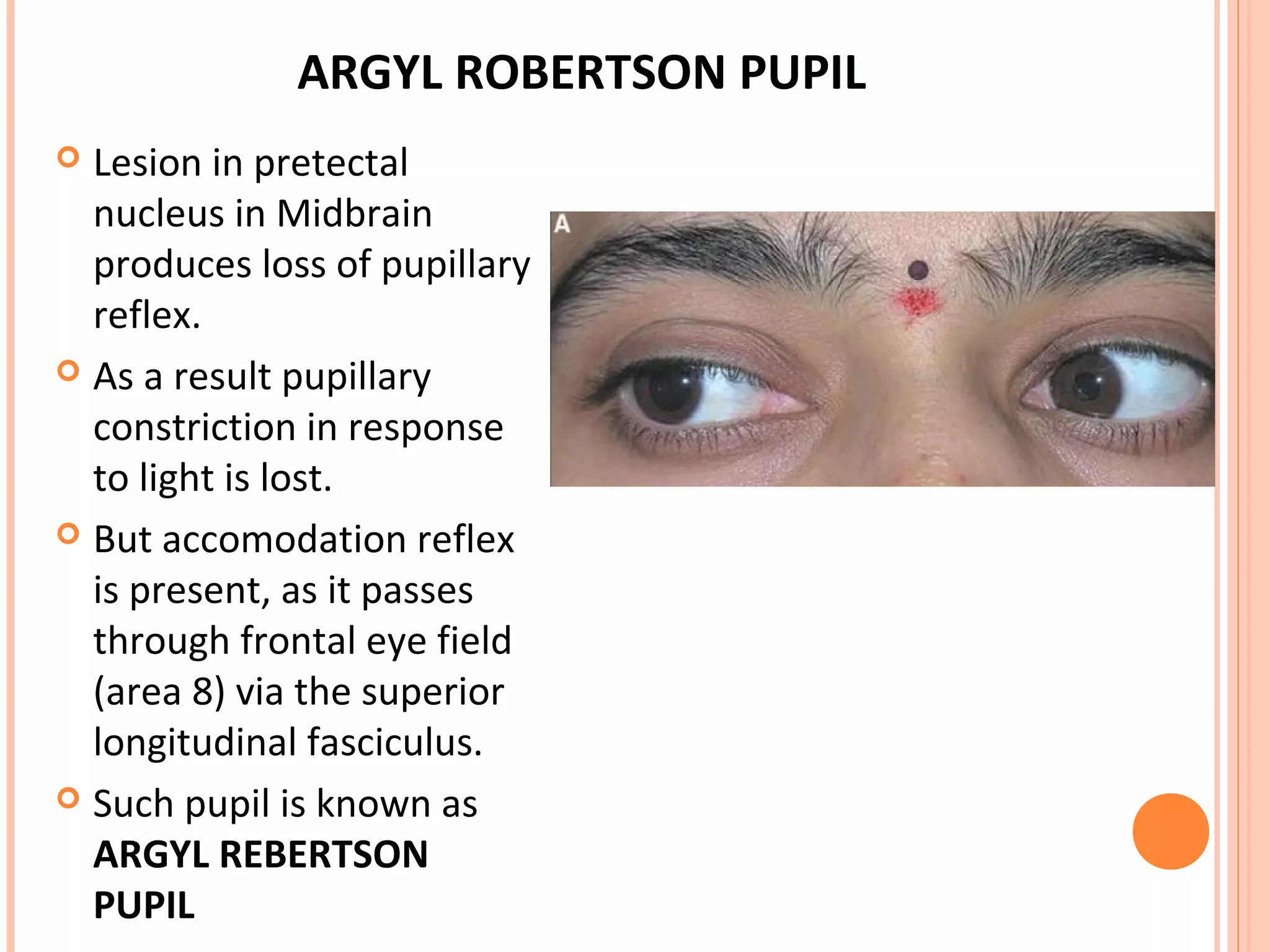
ARGYL ROBERTSON PUPIL
ļ‚¢ Lesion in pretectal
nucleus in Midbrain
produces loss of pupillary
reflex.
ļ‚¢ As a result pupillary
constriction in response
to light is lost.
ļ‚¢ But accomodation reflex
is present, as it passes
through frontal eye field
(area 8) via the superior
longitudinal fasciculus.
ļ‚¢ Such pupil is known as
ARGYL REBERTSON
PUPIL
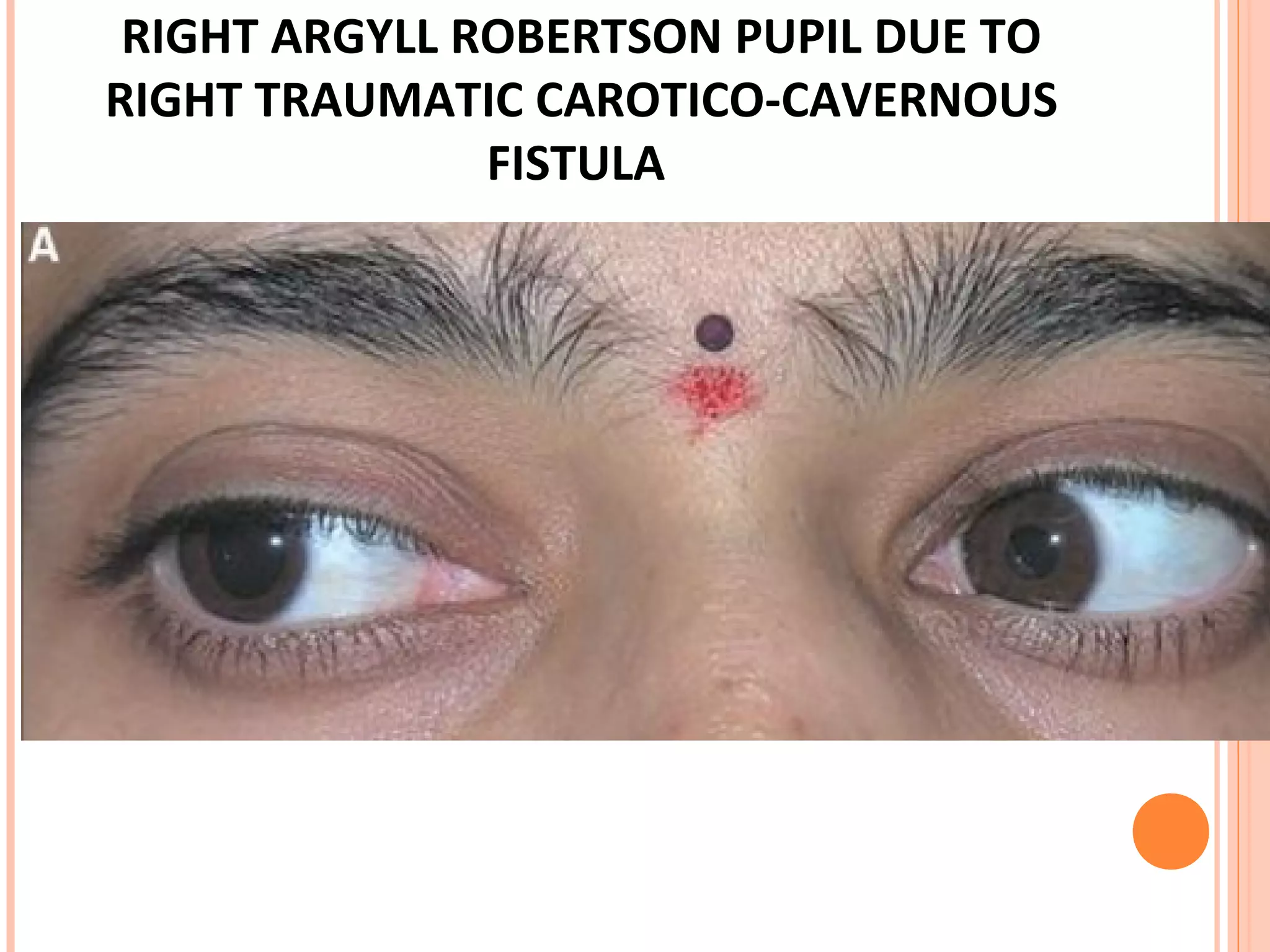
RIGHT ARGYLL ROBERTSON PUPIL DUE TO
RIGHT TRAUMATIC CAROTICO-CAVERNOUS
FISTULA
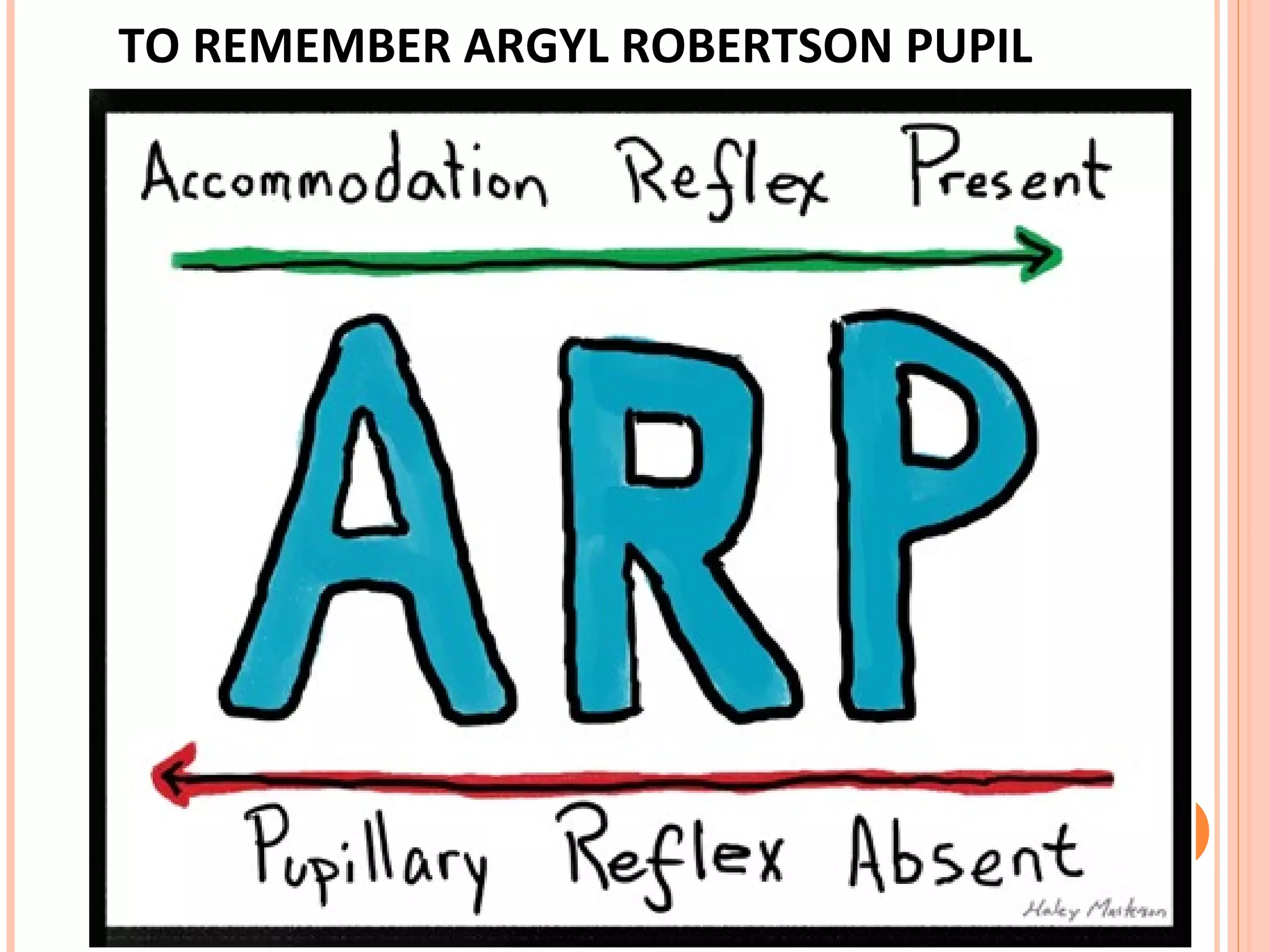
TO REMEMBER ARGYL ROBERTSON PUPIL
Thank you
15 sq.Km of rain forest disappear every minute
- WWF

Visual pathway

  • 1.
  • 2.
    INTRODUCTION - Most importantspecial sense in humans. Components: A. Retina B. Optic nerve and optic chiasm. C. Optic tract D. Lateral geniculate body (of the thalamus). E. Optic radiations F. Visual cortex
  • 3.
    Outer layer: photoreceptors- rods (nightvision) and cones (for daylight and colour, densest just around the fovea) Middle layer: bipolar neurons: horizontal (more superficial) and amacrine (deeper). Both perform lateral interactions, which enhance visual contrast. Inner layer: ganglion cells. Regional Anatomy of the Visual System: Retinal structure
  • 4.
    ļ‚¢ Ganglion cellaxons (which are clear and unmyelinated, while running along the inner surface of the retina) gather together and exit at the optic disk, where they become myelinated and form the optic nerve. OPTIC NERVE AND OPTIC CHIASM
  • 5.
    ļ‚¢ Optic nervesfrom both eyes converge at optic chiasm: partial cross-over. ļ‚¢ Images in the nasal hemiretina from both sides cross over (temporal stay ipsilateral). ļ‚¢ This allows for complete cross-over of each visual field. ļ‚¢ The right visual field maps on the left visual cortex and vice versa
  • 6.
    LATERAL GENICULATE BODY Anucleus in the thalamus, which projects to the 1° visual cortex and serves visual perception. - This body is the site of termination of all optic nerve fibres except few which reach and relay in the pretectal region and superior colliculus of Midbrain. - Consists of 6 lamina. Contralateral retina – 1,4,6 Ipsilateral retina – 2,3,5 LGB – THALAMIC RELAY STATION FOR VISUAL IMPULSE
  • 7.
    OPTIC RADIATIONS ANDPROJECTIONS TO THE PRIMARY VISUAL CORTEX ļ‚¢ Meyer’s Loop: course anterior for a short distance in order to move over the lateral ventricles. ļ‚¢ 1° cortex, in columnar fissure, is also Brodman’s Area 17.
  • 9.
    NEURAL PATHWAY FORVISION ļ‚¢ Ist order sensory neurons – Arise from the bipolar cells of the retina. ļ‚¢ II nd order neurons are the Multipolar neurons whose axons run along the optic nerve to the optic chiasma ļ‚¢ Nasal fibres – Cross to opposite side and terminate in LGB of opposite side. ļ‚¢ Temporal fibres – Doesn’t cross and terminates in ipsilateral LGB.
  • 10.
    NEURAL PATHWAY FORVISION (CONTD… ļ‚¢ The cell bodies of III order sensory neurons are located in LGB. ļ‚¢ Their axons form optic radiation which project into the visual cortex.
  • 11.
    VISUAL REFLEXES ļ‚¢ Lightreflex or pupillary reflex: When light is shown to one eye, normally the pupils of both eyes constrict. - Direct light reflex: The constriction of pupils upon which light is shown is called direct light reflex. - Indirect or consensual: The constriction of pupil on the other eye even though no light is shown.
  • 12.
  • 13.
    ACCCOMODATION REFLEX ļ‚¢ Whenthe eyes are focussed from a distant to near object, three reactions take place ļ‚¢ 1. Constriction of pupils ļ‚¢ 2. thickening of lens due to contraction of ciliary muscles ļ‚¢ 3. Convergence of both eye balls These three reactions together constitute Accomodation or near reflex
  • 14.
    CLINICAL CORRELATION ļ‚¢ Lossof vision in one half of the visual field (Rt or Lt) is termed as hemianopia. ļ‚¢ Homonymous hemianopia: Loss of vision in the same halves of the visual field. ļ‚¢ Heteronymous Hemianopia: Loss of vision in the different halves of the visual field.
  • 15.
    ļ‚¢ VISUAL FIELDDEFECTS DUE TO LESION IN DIFFERENT PARTS OF VISUAL PATHWAY: 1. Injury to optic N – Total blindness in that eye 2. Lesion in central part of optic chiasma – Bitemporal heteronymous hemianopia ( Tunnel Vision) 3. Lesion in lateral part of optic chiasma – Unilateral nasal hemianopia on the side of lesion
  • 16.
    ļ‚¢ 4 &5.Complete destruction of optic tract(4) & Optic radiation(5) – Right or left homonymous hemianopia ļ‚¢ 6. Lesion in visual cortex – blindness in opposite half of visual field (Homonymous hemianopia) with intact macular vision. ļ‚¢ 7. Lesion in upper lip of calcarine sulcus – Contralateral inferior quadrant anopia. ļ‚¢ 8. Lesion in lower lip of calcarine sulcus - Contralateral superior quadrant anopia.
  • 17.
    ARGYL ROBERTSON PUPIL ļ‚¢Lesion in pretectal nucleus in Midbrain produces loss of pupillary reflex. ļ‚¢ As a result pupillary constriction in response to light is lost. ļ‚¢ But accomodation reflex is present, as it passes through frontal eye field (area 8) via the superior longitudinal fasciculus. ļ‚¢ Such pupil is known as ARGYL REBERTSON PUPIL
  • 18.
    RIGHT ARGYLL ROBERTSONPUPIL DUE TO RIGHT TRAUMATIC CAROTICO-CAVERNOUS FISTULA
  • 19.
    TO REMEMBER ARGYLROBERTSON PUPIL
  • 20.
    Thank you 15 sq.Kmof rain forest disappear every minute - WWF