Introduction
Retina is a multilayered sensory tissue that lines the
back of the eye.
It contains millions of light receptors that captures
light rays and convert them into electrical impulses.
These impulses travel along the optic nerve to the
brain where they are turned to images.
Structure of Fovea Centralis
In this area, there are no rods.
Cones are tightly packed and it is the most sensitive
part of retina.
It’s central part is called foveola.
All other retinal layers are absent in this region.
Histological Layers of the Retina
retinal layers of physiological significance
Photoreceptor Layer
Rods and Cones are the end organs of vision and are
also known as photoreceptors.
 Rods(120 million) contain a photosensitive
substance rhodopsin(visual purple) and helps in
peripheral vision and vision of low illumination
(scotopic vision)
 Cones (6.5 million) also contain a photosensitive
substance and helps in highly discriminatory central
vision(photopic vision) and colour vision.
8
Visual Pigments
• Rhodopsin
• Light-sensitive pigment in rods
• Decomposes in presence of light
• Triggers a complex series of
reactions that initiate nerve
impulses
• Impulses travel along optic nerve
• Pigments on cones
• Each set contains different light-
sensitive pigment
• Each set is sensitive to different
wavelengths
• Color perceived depends on which
sets of cones are stimulated
• Erythrolabe – responds to red
• Chlorolabe – responds to green
• Cyanolabe – responds to blue
Rods and Cones
cones
rods
Rods Cones
Number
Distribution
~ 120 millions in
each retina
More in periphery
Non in Fovea
~ 6 millions in
each retina
More in centre
Present
Photosensitive
pigment
Rhodopsin 3 types (iodopsin)
Connection Convergence
(300:1 connection)
No convergence
(1:1; direct private
line)
Function ↑light sensitivity
↓ visual acuity
- colour vision
Night vision
↓ light sensitivity
↑ visual acuity
+ colour vision
Day vision
Why Fovea is the most sensitive spot in retina?
 All layers are shifted aside leaving outer segments of
photosensors to be hit directly by light
 High density of small diameter Cones with long outer
segments
 1:1 convergence (cone-BC-GC)
 Wide presentation in occipital primary visual area
1)- Retinal Pigmented Epithelium
 Absorption of light (due to presence of black pigment
melanin) → reduction of glare (Albinos!!)
 Production of extracellular matrix → keeping outer
segments of photoreceptors straight
 Storage of vitamin A (precursor of 11-cis retinal) for
regeneration of photosensitive pigments
 Phagocytosis of the tips of outer segments after their
shedding off by the photoreceptors → continual renewal of
outer segments
Photochemistry of Vision
What Happens in Retina
The light rays are focused directly onto the retina,
the light sensitive tissue lining the back of the eye.
Light energy is converted into neural signal
Through visual pathway, these signals reach brain.
Action potentials
 excitation of rods causes
 hyperpolarisation rather than depolarisation
 increased negativity of the membrane
 this is due to decreased permeability to Na
 inner segment pumps Na out
 outer segment is very leaky to Na
 normally membrane is -40mV (inside)
 when excited outer segment prevents Na influx
 inner segment continually pumps Na out
 increased negativity inside -> hyperpolarisation
 inside becomes -80mV
Physiology of vision
The main mechanisms are
[ ]Initiation of vision (Phototransduction)
[ ]Processing and transmission of visual sensations
[ ]Visual perception
Phototransduction
(Initiation of Vision)
The whole phenomenon of conversion of light energy
into nerve impulse is known as phototransduction.
Light falling upon retina cause photochemical
changes( ) which trigger a cascade of biochemical
reactions that result in generation of electrical
changes( ).
( )Photochemical Changes
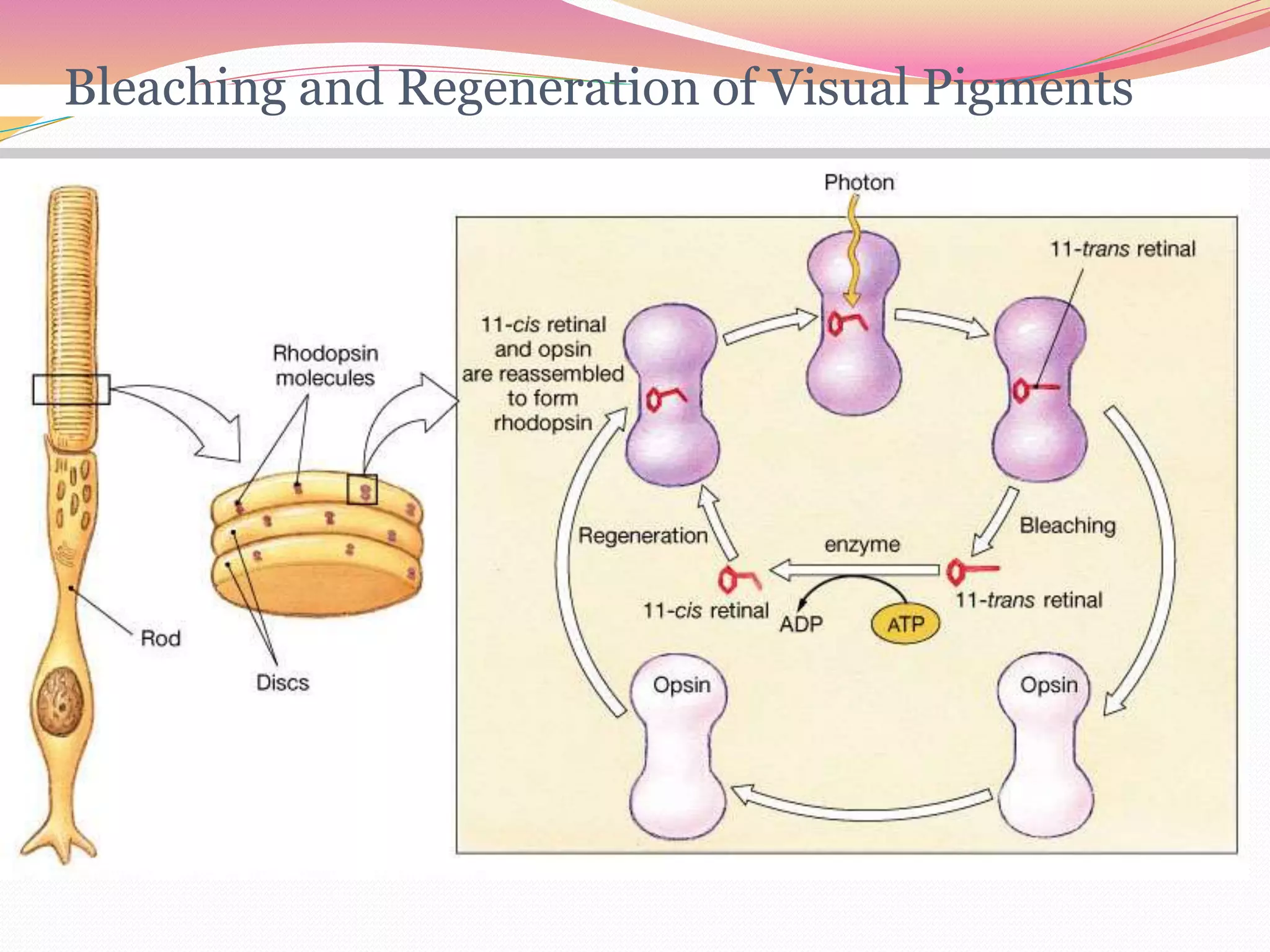
RHODOPSIN BLEACHING
Rhodopsin refers to the visual pigment present in the
rods-the receptors for night(scotopic) vision.
Its maximum absorption spectrum is around 500 nm.
Rhodopsin consists of a colourless protein called opsin
coupled with a carotenoid called retinine(Vit A or 11-cis-
retinal)
Bleaching and Regeneration of Visual Pigments
Visual Cycle
Photoreception - In More Detail
Photoreception
Effect of Light on Retinal Neurons
VISUAL CYCLE
In the retina of living animals , under constant lght
stimulation, a steady state must exist under which
the rate at which the photochemicals are bleached is
equal to the rate at which they are regenerated.
This equilibrium between the photo-decomposition
and regeneration of visual pigments is referred to as
visual cycle.
( )Electrical Changes
 Activated rhodopsin cascade of biochemical
reactions generation of receptor potential
 Thus light energy is converted to electrical energy
Light Adaptation
 retinal sensitivity depends on the amount of chemical pigment
 if a person is in bright light for some time, large amount of
photochemical is reduced to retinal and opsin
 retinal converted to vitamin A
 this reduces the sensitivity of the retina
 this is known as light adaptation
 now if the person goes into a dark room
 he cannot see any object
 reason: severe reduction in retinal sensitivity
Dark Adaptation
Ability of the eye to adapt to decreasing illumination.
When one goes from bright sunshine into a dimly-lit
room, one cannot perceive the objects in the room
until some time has elapsed.
This is called dark adaptation time.
It is the time taken for regeneration of rhodopsin
pigment which was bleached by the bright light.
Night blindness
 vitamin A deficiency
 not enough quantities of
retinal to reform rhodopsin
 but in daytime cones can still
be excited
Autonomic Nervous System
UOB EXAM QUESTIONS

 What is Autonomic nervous system? What are its parts
and their significance?
 Compare and contrast between the sympathetic and
parasympathetic nervous system.
 Compare and contrast between the somatic and
autonomic nervous system.
 Differentiate between the adrenergic and cholinergic
fibers.
 What is the location and significance of the various
receptors of the parasympathetic nervous system.

Retina physiology

  • 2.
    Introduction Retina is amultilayered sensory tissue that lines the back of the eye. It contains millions of light receptors that captures light rays and convert them into electrical impulses. These impulses travel along the optic nerve to the brain where they are turned to images.
  • 3.
    Structure of FoveaCentralis In this area, there are no rods. Cones are tightly packed and it is the most sensitive part of retina. It’s central part is called foveola. All other retinal layers are absent in this region.
  • 4.
  • 5.
    retinal layers ofphysiological significance
  • 7.
    Photoreceptor Layer Rods andCones are the end organs of vision and are also known as photoreceptors.  Rods(120 million) contain a photosensitive substance rhodopsin(visual purple) and helps in peripheral vision and vision of low illumination (scotopic vision)  Cones (6.5 million) also contain a photosensitive substance and helps in highly discriminatory central vision(photopic vision) and colour vision.
  • 8.
    8 Visual Pigments • Rhodopsin •Light-sensitive pigment in rods • Decomposes in presence of light • Triggers a complex series of reactions that initiate nerve impulses • Impulses travel along optic nerve • Pigments on cones • Each set contains different light- sensitive pigment • Each set is sensitive to different wavelengths • Color perceived depends on which sets of cones are stimulated • Erythrolabe – responds to red • Chlorolabe – responds to green • Cyanolabe – responds to blue
  • 9.
  • 10.
    Rods Cones Number Distribution ~ 120millions in each retina More in periphery Non in Fovea ~ 6 millions in each retina More in centre Present Photosensitive pigment Rhodopsin 3 types (iodopsin) Connection Convergence (300:1 connection) No convergence (1:1; direct private line) Function ↑light sensitivity ↓ visual acuity - colour vision Night vision ↓ light sensitivity ↑ visual acuity + colour vision Day vision
  • 11.
    Why Fovea isthe most sensitive spot in retina?
  • 12.
    Why Fovea isthe most sensitive spot in retina?  All layers are shifted aside leaving outer segments of photosensors to be hit directly by light  High density of small diameter Cones with long outer segments  1:1 convergence (cone-BC-GC)  Wide presentation in occipital primary visual area
  • 13.
    1)- Retinal PigmentedEpithelium  Absorption of light (due to presence of black pigment melanin) → reduction of glare (Albinos!!)  Production of extracellular matrix → keeping outer segments of photoreceptors straight  Storage of vitamin A (precursor of 11-cis retinal) for regeneration of photosensitive pigments  Phagocytosis of the tips of outer segments after their shedding off by the photoreceptors → continual renewal of outer segments
  • 14.
  • 15.
    What Happens inRetina The light rays are focused directly onto the retina, the light sensitive tissue lining the back of the eye. Light energy is converted into neural signal Through visual pathway, these signals reach brain.
  • 17.
    Action potentials  excitationof rods causes  hyperpolarisation rather than depolarisation  increased negativity of the membrane  this is due to decreased permeability to Na  inner segment pumps Na out  outer segment is very leaky to Na  normally membrane is -40mV (inside)  when excited outer segment prevents Na influx  inner segment continually pumps Na out  increased negativity inside -> hyperpolarisation  inside becomes -80mV
  • 18.
    Physiology of vision Themain mechanisms are [ ]Initiation of vision (Phototransduction) [ ]Processing and transmission of visual sensations [ ]Visual perception
  • 19.
    Phototransduction (Initiation of Vision) Thewhole phenomenon of conversion of light energy into nerve impulse is known as phototransduction. Light falling upon retina cause photochemical changes( ) which trigger a cascade of biochemical reactions that result in generation of electrical changes( ).
  • 20.
    ( )Photochemical Changes RHODOPSINBLEACHING Rhodopsin refers to the visual pigment present in the rods-the receptors for night(scotopic) vision. Its maximum absorption spectrum is around 500 nm. Rhodopsin consists of a colourless protein called opsin coupled with a carotenoid called retinine(Vit A or 11-cis- retinal)
  • 21.
    Bleaching and Regenerationof Visual Pigments
  • 22.
  • 23.
  • 24.
  • 25.
    Effect of Lighton Retinal Neurons
  • 27.
    VISUAL CYCLE In theretina of living animals , under constant lght stimulation, a steady state must exist under which the rate at which the photochemicals are bleached is equal to the rate at which they are regenerated. This equilibrium between the photo-decomposition and regeneration of visual pigments is referred to as visual cycle.
  • 28.
    ( )Electrical Changes Activated rhodopsin cascade of biochemical reactions generation of receptor potential  Thus light energy is converted to electrical energy
  • 29.
    Light Adaptation  retinalsensitivity depends on the amount of chemical pigment  if a person is in bright light for some time, large amount of photochemical is reduced to retinal and opsin  retinal converted to vitamin A  this reduces the sensitivity of the retina  this is known as light adaptation  now if the person goes into a dark room  he cannot see any object  reason: severe reduction in retinal sensitivity
  • 30.
    Dark Adaptation Ability ofthe eye to adapt to decreasing illumination. When one goes from bright sunshine into a dimly-lit room, one cannot perceive the objects in the room until some time has elapsed. This is called dark adaptation time. It is the time taken for regeneration of rhodopsin pigment which was bleached by the bright light.
  • 31.
    Night blindness  vitaminA deficiency  not enough quantities of retinal to reform rhodopsin  but in daytime cones can still be excited
  • 32.
    Autonomic Nervous System UOBEXAM QUESTIONS   What is Autonomic nervous system? What are its parts and their significance?  Compare and contrast between the sympathetic and parasympathetic nervous system.  Compare and contrast between the somatic and autonomic nervous system.  Differentiate between the adrenergic and cholinergic fibers.  What is the location and significance of the various receptors of the parasympathetic nervous system.