PRESENTED BY:-                              PRESENTED TO:-
             Aman Jain (EC 08)                           Ravitesh Mishra
             Gourav Gupta (EC 38)                        A.P,BCE Mandideep
             Mohit Swarnkar ( EC 53)
             Narendra Singh Rajput (EC 57)
             Piyush Pal (EC66)


28/02/2013        Time taken: 24 mins        AMAN JAIN   Number of Slides : 19   1
Presentation Outline


  What is Phase Locked Loop (PLL)
  Parts of a PLL
  Locked Condition
  Dynamics of Simple PLL
  Transient Respone to PLL
  Application of PLL


28/02/2013                              AMAN JAIN           2
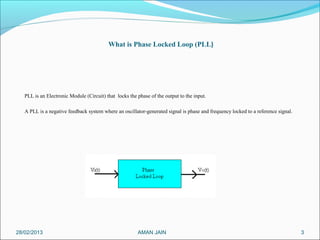
What is Phase Locked Loop (PLL)


   PLL is an Electronic Module (Circuit) that locks the phase of the output to the input.

   A PLL is a negative feedback system where an oscillator-generated signal is phase and frequency locked to a reference signal.


28/02/2013                                              AMAN JAIN                                                                  3
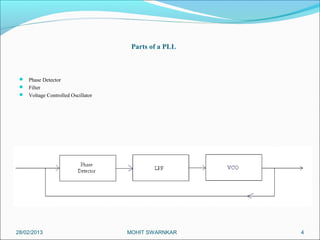
Parts of a PLL


  Phase Detector
  Filter
  Voltage Controlled Oscillator


28/02/2013                         MOHIT SWARNKAR    4
Parts of a PLL


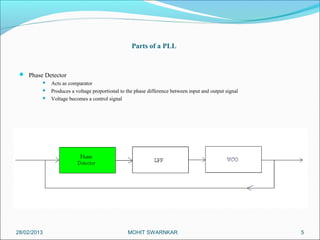
  Phase Detector
            Acts as comparator
            Produces a voltage proportional to the phase difference between input and output signal
            Voltage becomes a control signal


28/02/2013                                      MOHIT SWARNKAR                                         5
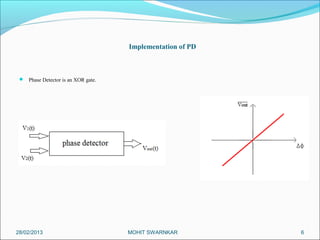
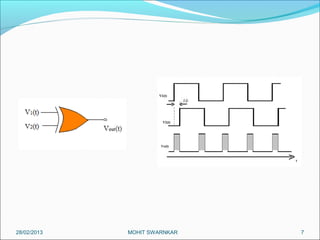
Implementation of PD


  Phase Detector is an XOR gate.


28/02/2013                          MOHIT SWARNKAR         6
28/02/2013   MOHIT SWARNKAR   7
Parts of a PLL


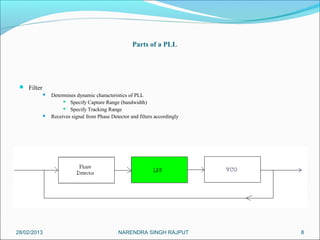
  Filter
               Determines dynamic characteristics of PLL
                      Specify Capture Range (bandwidth)

                      Specify Tracking Range

               Receives signal from Phase Detector and filters accordingly


28/02/2013                                     NARENDRA SINGH RAJPUT          8
Parts of a PLL


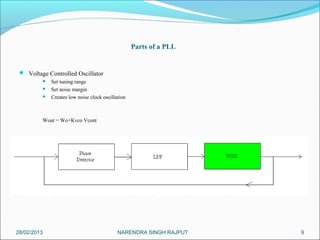
  Voltage Controlled Oscillator
            Set tuning range
            Set noise margin
            Creates low noise clock oscillation


         Wout = Wo+Kvco Vcont


28/02/2013                                  NARENDRA SINGH RAJPUT   9
Locked Condition


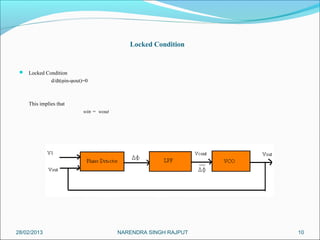
  Locked Condition
              d/dt(φin-φout)=0


    This implies that
                            win = wout


28/02/2013                               NARENDRA SINGH RAJPUT   10
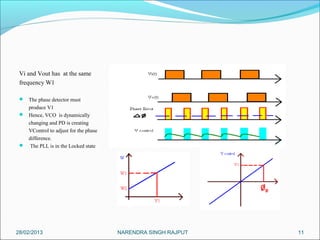
Vi and Vout has at the same
 frequency W1

  The phase detector must
   produce V1
  Hence, VCO is dynamically
   changing and PD is creating
   VControl to adjust for the phase
   difference.
  The PLL is in the Locked state


28/02/2013                            NARENDRA SINGH RAJPUT   11
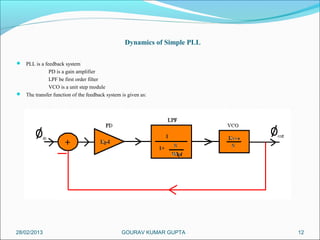
Dynamics of Simple PLL

 PLL is a feedback system
            PD is a gain amplifier
            LPF be first order filter
            VCO is a unit step module
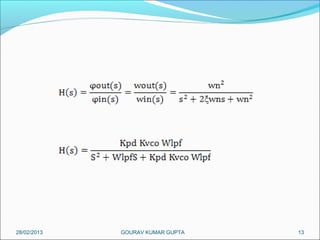
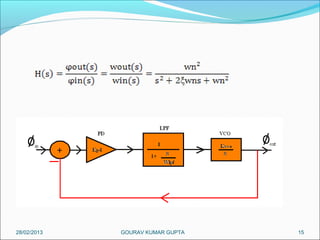
 The transfer function of the feedback system is given as:


28/02/2013                                     GOURAV KUMAR GUPTA         12
28/02/2013   GOURAV KUMAR GUPTA   13
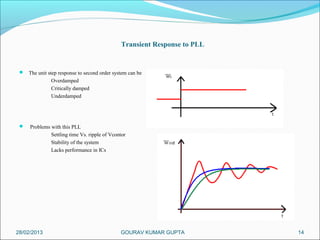
Transient Response to PLL


  The unit step response to second order system can be
               Overdamped
               Critically damped
               Underdamped


    Problems with this PLL
              Settling time Vs. ripple of Vcontor
              Stability of the system
              Lacks performance in ICs


28/02/2013                                    GOURAV KUMAR GUPTA           14
28/02/2013   GOURAV KUMAR GUPTA   15
Application of PLL


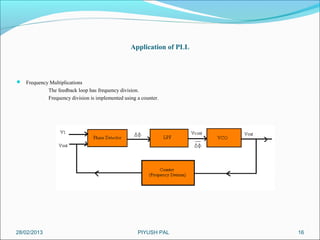
 Frequency Multiplications
             The feedback loop has frequency division.
             Frequency division is implemented using a counter.


28/02/2013                                           PIYUSH PAL        16
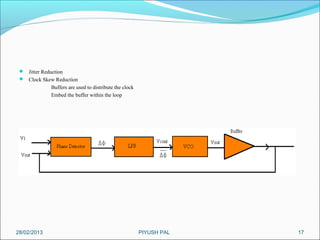
 Jitter Reduction
  Clock Skew Reduction
             Buffers are used to distribute the clock
             Embed the buffer within the loop


28/02/2013                                              PIYUSH PAL   17
Other applications include:


  Demodulation of both FM and AM signals
  Recovery of small signals that otherwise would be lost in noise (lock-in amplifier)
  Recovery of clock timing information from a data stream such as from a disk drive
  Clock multipliers in microprocessors that allow internal processor elements to run faster than external connections, while
   maintaining precise timing relationships
  DTMF decoders, modems, and other tone decoders, for remote control and telecommunications


28/02/2013                                              PIYUSH PAL                                                              18
THANK YOU


28/02/2013   19

PHASE LOCK LOOPs

  • 1.
    PRESENTED BY:- PRESENTED TO:- Aman Jain (EC 08) Ravitesh Mishra Gourav Gupta (EC 38) A.P,BCE Mandideep Mohit Swarnkar ( EC 53) Narendra Singh Rajput (EC 57) Piyush Pal (EC66) 28/02/2013 Time taken: 24 mins AMAN JAIN Number of Slides : 19 1
  • 2.
    Presentation Outline What is Phase Locked Loop (PLL)  Parts of a PLL  Locked Condition  Dynamics of Simple PLL  Transient Respone to PLL  Application of PLL 28/02/2013 AMAN JAIN 2
  • 3.
    What is PhaseLocked Loop (PLL) PLL is an Electronic Module (Circuit) that locks the phase of the output to the input. A PLL is a negative feedback system where an oscillator-generated signal is phase and frequency locked to a reference signal. 28/02/2013 AMAN JAIN 3
  • 4.
    Parts of aPLL  Phase Detector  Filter  Voltage Controlled Oscillator 28/02/2013 MOHIT SWARNKAR 4
  • 5.
    Parts of aPLL  Phase Detector  Acts as comparator  Produces a voltage proportional to the phase difference between input and output signal  Voltage becomes a control signal 28/02/2013 MOHIT SWARNKAR 5
  • 6.
    Implementation of PD  Phase Detector is an XOR gate. 28/02/2013 MOHIT SWARNKAR 6
  • 7.
    28/02/2013 MOHIT SWARNKAR 7
  • 8.
    Parts of aPLL  Filter  Determines dynamic characteristics of PLL  Specify Capture Range (bandwidth)  Specify Tracking Range  Receives signal from Phase Detector and filters accordingly 28/02/2013 NARENDRA SINGH RAJPUT 8
  • 9.
    Parts of aPLL  Voltage Controlled Oscillator  Set tuning range  Set noise margin  Creates low noise clock oscillation Wout = Wo+Kvco Vcont 28/02/2013 NARENDRA SINGH RAJPUT 9
  • 10.
    Locked Condition Locked Condition d/dt(φin-φout)=0 This implies that win = wout 28/02/2013 NARENDRA SINGH RAJPUT 10
  • 11.
    Vi and Vouthas at the same frequency W1  The phase detector must produce V1  Hence, VCO is dynamically changing and PD is creating VControl to adjust for the phase difference.  The PLL is in the Locked state 28/02/2013 NARENDRA SINGH RAJPUT 11
  • 12.
    Dynamics of SimplePLL  PLL is a feedback system PD is a gain amplifier LPF be first order filter VCO is a unit step module  The transfer function of the feedback system is given as: 28/02/2013 GOURAV KUMAR GUPTA 12
  • 13.
    28/02/2013 GOURAV KUMAR GUPTA 13
  • 14.
    Transient Response toPLL  The unit step response to second order system can be Overdamped Critically damped Underdamped  Problems with this PLL Settling time Vs. ripple of Vcontor Stability of the system Lacks performance in ICs 28/02/2013 GOURAV KUMAR GUPTA 14
  • 15.
    28/02/2013 GOURAV KUMAR GUPTA 15
  • 16.
    Application of PLL Frequency Multiplications The feedback loop has frequency division. Frequency division is implemented using a counter. 28/02/2013 PIYUSH PAL 16
  • 17.
     Jitter Reduction  Clock Skew Reduction Buffers are used to distribute the clock Embed the buffer within the loop 28/02/2013 PIYUSH PAL 17
  • 18.
    Other applications include:  Demodulation of both FM and AM signals  Recovery of small signals that otherwise would be lost in noise (lock-in amplifier)  Recovery of clock timing information from a data stream such as from a disk drive  Clock multipliers in microprocessors that allow internal processor elements to run faster than external connections, while maintaining precise timing relationships  DTMF decoders, modems, and other tone decoders, for remote control and telecommunications 28/02/2013 PIYUSH PAL 18
  • 19.