R.M.K. COLLEGE OF ENGINEERING AND TECHNOLOGY
DEPARTMENT OF CSE
EC 8395
COMMUNICATION ENGINEERING
Dr.Kannan Krishnan
Assistant Professor
Department of ECE
AMPLITUDE MODULATION
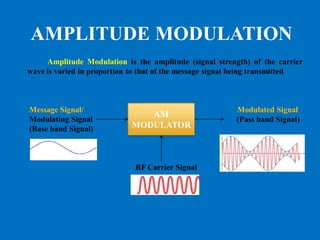
Amplitude Modulation is the amplitude (signal strength) of the carrier
wave is varied in proportion to that of the message signal being transmitted
Message Signal/ Modulated Signal
Modulating Signal (Pass band Signal)
(Base band Signal)
RF Carrier Signal
AM
MODULATOR
AMPLITUDE DEMODULATION
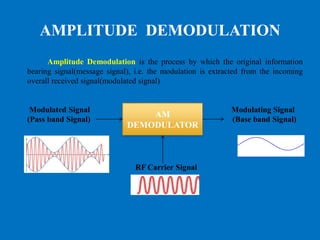
Amplitude Demodulation is the process by which the original information
bearing signal(message signal), i.e. the modulation is extracted from the incoming
overall received signal(modulated signal)
Modulated Signal Modulating Signal
(Pass band Signal) (Base band Signal)
RF Carrier Signal
AM
DEMODULATOR
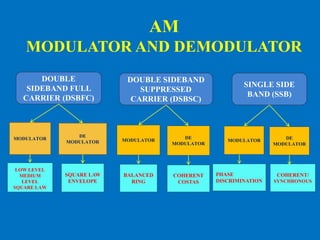
AM
MODULATOR AND DEMODULATOR
DOUBLE
SIDEBAND FULL
CARRIER (DSBFC)
DOUBLE SIDEBAND
SUPPRESSED
CARRIER (DSBSC)
SINGLE SIDE
BAND (SSB)
MODULATOR
DE
MODULATOR MODULATOR DE
MODULATOR
MODULATOR DE
MODULATOR
LOW LEVEL
MEDIUM
LEVEL
SQUARE LAW
SQUARE LAW
ENVELOPE
BALANCED
RING
COHERENT
COSTAS
PHASE
DISCRIMINATION
COHERENT/
SYNCHRONOUS
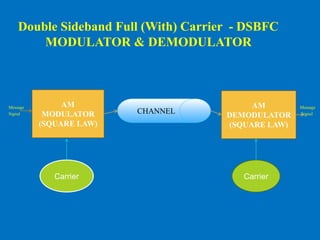
Double Sideband Full (With) Carrier - DSBFC
MODULATOR & DEMODULATOR
Message Message
Signal Signal
AM
MODULATOR
(SQUARE LAW)
CHANNEL
AM
DEMODULATOR
(SQUARE LAW)
Carrier Carrier
DSBFC (Double Sideband Full (With) Carrier)
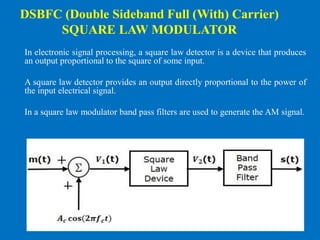
SQUARE LAW MODULATOR
In electronic signal processing, a square law detector is a device that produces
an output proportional to the square of some input.
A square law detector provides an output directly proportional to the power of
the input electrical signal.
In a square law modulator band pass filters are used to generate the AM signal.
DSBFC (Double Sideband Full Carrier)
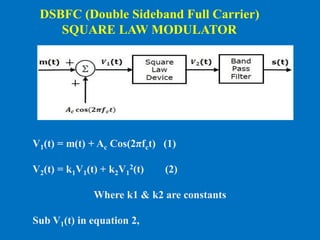
SQUARE LAW MODULATOR
V1(t) = m(t) + Ac Cos(2πfct) (1)
V2(t) = k1V1(t) + k2V1
2(t) (2)
Where k1 & k2 are constants
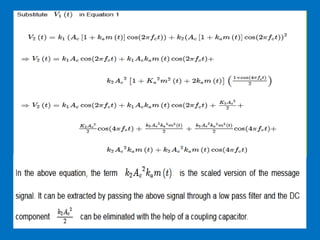
Sub V1(t) in equation 2,
SQUARE LAW - DEMODULATOR
The process of extracting an original message signal from the modulated
wave is known as detection or demodulation. The circuit, which demodulates the
modulated wave is known as the demodulator
The Standard form of AM wave is
V1(t) = Ac[1+kam(t)]Cos(2πfct)
V2(t) = k1V1(t)+k2V1
2(t) (1)
Where, V1(t) is the input of the square law device, which is nothing but the
AM wave
V2(t) is the output of the square law device
k1 and k2 are constants
BALANCED MODULATOR
Balanced Modulator consists of two identical AM modulators.
These two modulators are arranged in a balanced configuration in
order to suppress the carrier signal. Hence, it is called as Balanced
modulator.
Double Side Band Suppressed
Carrier (DSBSC) - MODULATOR
The same carrier signal
C(t) = Ac Cos (2πfct) is applied as one of
the inputs to these two AM modulators.
Output of the upper AM modulator is
S1(t) = Ac[1+kam(t)]Cos(2πfct)
Output of the lower AM modulator is
S2(t) = Ac[1−kam(t)]Cos(2πfct)
s1(t) with positive sign and s2(t) with negative sign are applied as inputs to
summer block.
Thus, the summer block produces an output s(t) which is the difference of s1(t)
and s2(t).
s(t) = Ac[1+kam(t)]cos(2πfct) − Ac [1−kam(t)]cos(2πfct)
s(t) = Accos(2πfct)+ Ac kam(t)cos(2πfct)− Ac cos(2πfct)+ Ac kam(t)cos(2πfct)
s(t) = 2 Ac ka m(t)cos(2πfct)
We know the standard equation of DSBSC wave is
S(t)= Ac m(t)cos(2πfct)
By comparing the output of summer block with the standard equation of
DSBSC wave, we will get the scaling factor as 2ka
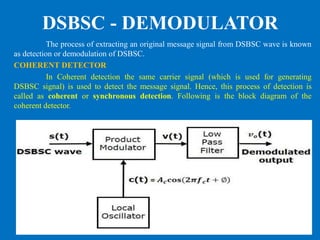
The process of extracting an original message signal from DSBSC wave is known
as detection or demodulation of DSBSC.
COHERENT DETECTOR
In Coherent detection the same carrier signal (which is used for generating
DSBSC signal) is used to detect the message signal. Hence, this process of detection is
called as coherent or synchronous detection. Following is the block diagram of the
coherent detector.
DSBSC - DEMODULATOR
Let the DSBSC wave be s(t) = Ac Cos(2πfct) m(t)
The output of the local oscillator is c(t) = Ac Cos(2πfct+ϕ)
From the figure, Output of product modulator as v(t) = s(t) c(t)
v(t) = Ac Cos(2πfct) m(t) Ac Cos(2πfct + ϕ)
= Ac2 Cos(2πfct) Cos (2πfct + ϕ) m(t)
= Ac2 /2[Cos(4πfct + ϕ) + Cosϕ ]m(t)
v(t) = Ac2 /2 Cosϕm(t) + Ac2/2Cos (4πfct + ϕ)m(t)
Here the first term is the scaled version of the message signal. It can be extracted by
passing the above signal through a low pass filter.
Therefore, the output of low pass filter is V0t = Ac2 /2Cosϕm(t)
 The demodulated signal amplitude will be maximum, when ϕ = 00
 That’s why the local oscillator signal and the carrier signal should be in phase, i.e.,
there should not be any phase difference between these two signals.
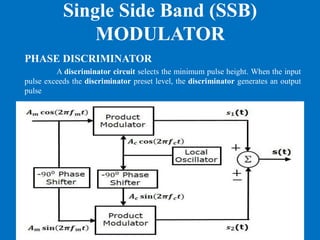
PHASE DISCRIMINATOR
A discriminator circuit selects the minimum pulse height. When the input
pulse exceeds the discriminator preset level, the discriminator generates an output
pulse
Single Side Band (SSB)
MODULATOR
The modulating signal = Am cos (2πfmt)
The carrier signal = Ac cos (2πfct)
The output of upper product modulator is
S1(t) = Am cos (2πfmt) Ac cos (2πfct)
= Am Ac /2{cos[2π(fc+fm)t]+cos[2π(fc−fm)t]}
The output of lower product modulator is
S2(t) = Am Ac cos(2πfmt −900)cos(2πfct −900)
= Am Ac sin(2πfmt)sin(2πfct)
= Am Ac/ 2{cos[2π(fc−fm)t] − cos[2𝜋(fc+fm)t]}
At the Summer S(t) = S1(t) + S2(t)
S(t) = Am Ac /2{cos[2π(fc+fm)t]+cos[2π(fc−fm)t]} +
Am Ac/ 2{cos[2π(fc−fm)t] − cos[2𝜋(fc+fm)t]}
S(t) = Am Ac cos2π(fc−fm)t
Subtract S2(t) from S1(t) to get S(t)
S(t) = Am Ac /2{cos[2π(fc+fm)t]+cos[2π(fc−fm)t]} -
Am Ac/ 2{cos[2π(fc−fm)t] − cos[2𝜋(fc+fm)t]}
S(t) = Am Ac cos2π(fc+fm)t
Hence, by properly choosing the polarities of inputs at
summer block, we will get SSBSC wave having a upper
sideband or a lower sideband.
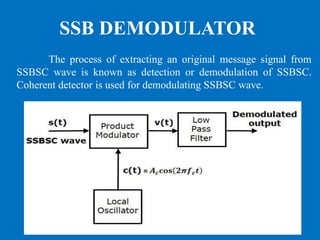
The process of extracting an original message signal from
SSBSC wave is known as detection or demodulation of SSBSC.
Coherent detector is used for demodulating SSBSC wave.
SSB DEMODULATOR
Consider the following SSBSC wave having a LOWER SIDEBAND
S(t) = Am Ac / 2 Cos[2π(fc−fm)t]
The output of the local oscillator is
C(t) = Ac Cos(2πfct)
From the figure, we can write the output of product modulator as v(t) = s(t)c(t)
v(t) = Am Ac /2 Cos[2π(fc−fm)t] AcCos(2πfct)
= Am Ac
2 /2 Cos[2π(fc−fm)t] Cos(2πfct)
= Am Ac
2 /4{Cos2π(2fc−fm)t + Cos(2πfm)t}
In the above equation, the Second term is the scaled version of the message
signal. It can be extracted by passing the above signal through a low pass filter.
The output of low pass filter is
V0(t)=Am Ac
2 /4 Cos(2πfmt)
Here, the scaling factor is Ac2/4
Methods of SSB Generation
- Filter Method
- Phase shift Method
- Weaver’s Method or Third Method
SSB GENERATION
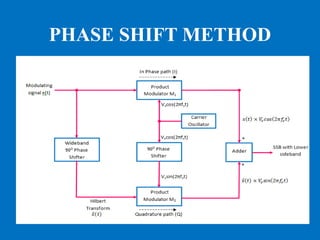
PHASE SHIFT METHOD
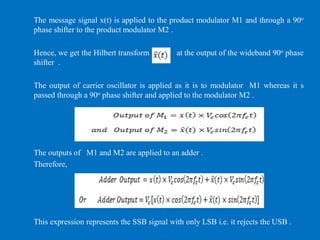
The message signal x(t) is applied to the product modulator M1 and through a 90o
phase shifter to the product modulator M2 .
Hence, we get the Hilbert transform at the output of the wideband 90o phase
shifter .
The output of carrier oscillator is applied as it is to modulator M1 whereas it s
passed through a 90o phase shifter and applied to the modulator M2 .
The outputs of M1 and M2 are applied to an adder .
Therefore,
This expression represents the SSB signal with only LSB i.e. it rejects the USB .
AM
TRANSMITTER AND
RECEIVER
Transmitter
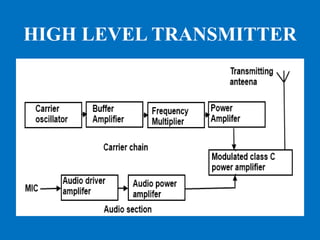
(i) Low level transmitter
(ii) High level transmitter
Receiver
(i) Tuned Radio Frequency receiver
(ii) Super heterodyne receiver
HIGH LEVEL TRANSMITTER
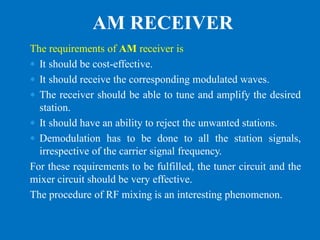
The requirements of AM receiver is
 It should be cost-effective.
 It should receive the corresponding modulated waves.
 The receiver should be able to tune and amplify the desired
station.
 It should have an ability to reject the unwanted stations.
 Demodulation has to be done to all the station signals,
irrespective of the carrier signal frequency.
For these requirements to be fulfilled, the tuner circuit and the
mixer circuit should be very effective.
The procedure of RF mixing is an interesting phenomenon.
AM RECEIVER
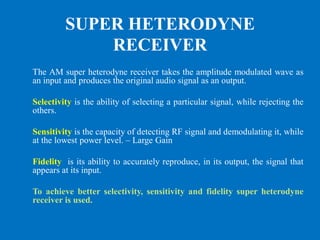
The AM super heterodyne receiver takes the amplitude modulated wave as
an input and produces the original audio signal as an output.
Selectivity is the ability of selecting a particular signal, while rejecting the
others.
Sensitivity is the capacity of detecting RF signal and demodulating it, while
at the lowest power level. – Large Gain
Fidelity is its ability to accurately reproduce, in its output, the signal that
appears at its input.
To achieve better selectivity, sensitivity and fidelity super heterodyne
receiver is used.
SUPER HETERODYNE
RECEIVER
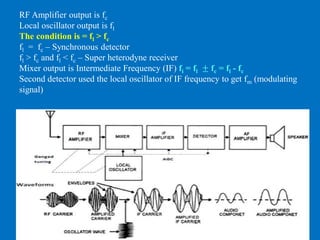
RF Amplifier output is fc
Local oscillator output is fl
The condition is = fl > fc
fl = fc – Synchronous detector
fl > fc and fl < fc – Super heterodyne receiver
Mixer output is Intermediate Frequency (IF) fi = fl ± fc = fl - fc
Second detector used the local oscillator of IF frequency to get fm (modulating
signal)
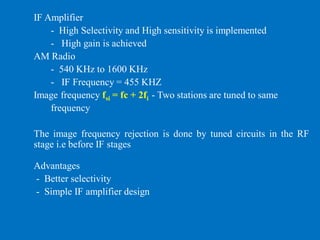
IF Amplifier
- High Selectivity and High sensitivity is implemented
- High gain is achieved
AM Radio
- 540 KHz to 1600 KHz
- IF Frequency = 455 KHZ
Image frequency fsi = fc + 2fi - Two stations are tuned to same
frequency
The image frequency rejection is done by tuned circuits in the RF
stage i.e before IF stages
Advantages
- Better selectivity
- Simple IF amplifier design
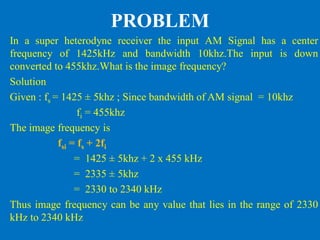
In a super heterodyne receiver the input AM Signal has a center
frequency of 1425kHz and bandwidth 10khz.The input is down
converted to 455khz.What is the image frequency?
Solution
Given : fs = 1425 ± 5khz ; Since bandwidth of AM signal = 10khz
fi = 455khz
The image frequency is
fsi = fs + 2fi
= 1425 ± 5khz + 2 x 455 kHz
= 2335 ± 5khz
= 2330 to 2340 kHz
Thus image frequency can be any value that lies in the range of 2330
kHz to 2340 kHz
PROBLEM
THANK YOU

AM - Modulator and Demodulator

  • 1.
    R.M.K. COLLEGE OFENGINEERING AND TECHNOLOGY DEPARTMENT OF CSE EC 8395 COMMUNICATION ENGINEERING Dr.Kannan Krishnan Assistant Professor Department of ECE
  • 2.
    AMPLITUDE MODULATION Amplitude Modulationis the amplitude (signal strength) of the carrier wave is varied in proportion to that of the message signal being transmitted Message Signal/ Modulated Signal Modulating Signal (Pass band Signal) (Base band Signal) RF Carrier Signal AM MODULATOR
  • 3.
    AMPLITUDE DEMODULATION Amplitude Demodulationis the process by which the original information bearing signal(message signal), i.e. the modulation is extracted from the incoming overall received signal(modulated signal) Modulated Signal Modulating Signal (Pass band Signal) (Base band Signal) RF Carrier Signal AM DEMODULATOR
  • 5.
    AM MODULATOR AND DEMODULATOR DOUBLE SIDEBANDFULL CARRIER (DSBFC) DOUBLE SIDEBAND SUPPRESSED CARRIER (DSBSC) SINGLE SIDE BAND (SSB) MODULATOR DE MODULATOR MODULATOR DE MODULATOR MODULATOR DE MODULATOR LOW LEVEL MEDIUM LEVEL SQUARE LAW SQUARE LAW ENVELOPE BALANCED RING COHERENT COSTAS PHASE DISCRIMINATION COHERENT/ SYNCHRONOUS
  • 6.
    Double Sideband Full(With) Carrier - DSBFC MODULATOR & DEMODULATOR Message Message Signal Signal AM MODULATOR (SQUARE LAW) CHANNEL AM DEMODULATOR (SQUARE LAW) Carrier Carrier
  • 7.
    DSBFC (Double SidebandFull (With) Carrier) SQUARE LAW MODULATOR In electronic signal processing, a square law detector is a device that produces an output proportional to the square of some input. A square law detector provides an output directly proportional to the power of the input electrical signal. In a square law modulator band pass filters are used to generate the AM signal.
  • 8.
    DSBFC (Double SidebandFull Carrier) SQUARE LAW MODULATOR V1(t) = m(t) + Ac Cos(2πfct) (1) V2(t) = k1V1(t) + k2V1 2(t) (2) Where k1 & k2 are constants Sub V1(t) in equation 2,
  • 10.
    SQUARE LAW -DEMODULATOR The process of extracting an original message signal from the modulated wave is known as detection or demodulation. The circuit, which demodulates the modulated wave is known as the demodulator The Standard form of AM wave is V1(t) = Ac[1+kam(t)]Cos(2πfct) V2(t) = k1V1(t)+k2V1 2(t) (1) Where, V1(t) is the input of the square law device, which is nothing but the AM wave V2(t) is the output of the square law device k1 and k2 are constants
  • 12.
    BALANCED MODULATOR Balanced Modulatorconsists of two identical AM modulators. These two modulators are arranged in a balanced configuration in order to suppress the carrier signal. Hence, it is called as Balanced modulator. Double Side Band Suppressed Carrier (DSBSC) - MODULATOR The same carrier signal C(t) = Ac Cos (2πfct) is applied as one of the inputs to these two AM modulators. Output of the upper AM modulator is S1(t) = Ac[1+kam(t)]Cos(2πfct) Output of the lower AM modulator is S2(t) = Ac[1−kam(t)]Cos(2πfct)
  • 13.
    s1(t) with positivesign and s2(t) with negative sign are applied as inputs to summer block. Thus, the summer block produces an output s(t) which is the difference of s1(t) and s2(t). s(t) = Ac[1+kam(t)]cos(2πfct) − Ac [1−kam(t)]cos(2πfct) s(t) = Accos(2πfct)+ Ac kam(t)cos(2πfct)− Ac cos(2πfct)+ Ac kam(t)cos(2πfct) s(t) = 2 Ac ka m(t)cos(2πfct) We know the standard equation of DSBSC wave is S(t)= Ac m(t)cos(2πfct) By comparing the output of summer block with the standard equation of DSBSC wave, we will get the scaling factor as 2ka
  • 14.
    The process ofextracting an original message signal from DSBSC wave is known as detection or demodulation of DSBSC. COHERENT DETECTOR In Coherent detection the same carrier signal (which is used for generating DSBSC signal) is used to detect the message signal. Hence, this process of detection is called as coherent or synchronous detection. Following is the block diagram of the coherent detector. DSBSC - DEMODULATOR
  • 15.
    Let the DSBSCwave be s(t) = Ac Cos(2πfct) m(t) The output of the local oscillator is c(t) = Ac Cos(2πfct+ϕ) From the figure, Output of product modulator as v(t) = s(t) c(t) v(t) = Ac Cos(2πfct) m(t) Ac Cos(2πfct + ϕ) = Ac2 Cos(2πfct) Cos (2πfct + ϕ) m(t) = Ac2 /2[Cos(4πfct + ϕ) + Cosϕ ]m(t) v(t) = Ac2 /2 Cosϕm(t) + Ac2/2Cos (4πfct + ϕ)m(t) Here the first term is the scaled version of the message signal. It can be extracted by passing the above signal through a low pass filter. Therefore, the output of low pass filter is V0t = Ac2 /2Cosϕm(t)  The demodulated signal amplitude will be maximum, when ϕ = 00  That’s why the local oscillator signal and the carrier signal should be in phase, i.e., there should not be any phase difference between these two signals.
  • 16.
    PHASE DISCRIMINATOR A discriminatorcircuit selects the minimum pulse height. When the input pulse exceeds the discriminator preset level, the discriminator generates an output pulse Single Side Band (SSB) MODULATOR
  • 17.
    The modulating signal= Am cos (2πfmt) The carrier signal = Ac cos (2πfct) The output of upper product modulator is S1(t) = Am cos (2πfmt) Ac cos (2πfct) = Am Ac /2{cos[2π(fc+fm)t]+cos[2π(fc−fm)t]} The output of lower product modulator is S2(t) = Am Ac cos(2πfmt −900)cos(2πfct −900) = Am Ac sin(2πfmt)sin(2πfct) = Am Ac/ 2{cos[2π(fc−fm)t] − cos[2𝜋(fc+fm)t]} At the Summer S(t) = S1(t) + S2(t)
  • 18.
    S(t) = AmAc /2{cos[2π(fc+fm)t]+cos[2π(fc−fm)t]} + Am Ac/ 2{cos[2π(fc−fm)t] − cos[2𝜋(fc+fm)t]} S(t) = Am Ac cos2π(fc−fm)t Subtract S2(t) from S1(t) to get S(t) S(t) = Am Ac /2{cos[2π(fc+fm)t]+cos[2π(fc−fm)t]} - Am Ac/ 2{cos[2π(fc−fm)t] − cos[2𝜋(fc+fm)t]} S(t) = Am Ac cos2π(fc+fm)t Hence, by properly choosing the polarities of inputs at summer block, we will get SSBSC wave having a upper sideband or a lower sideband.
  • 19.
    The process ofextracting an original message signal from SSBSC wave is known as detection or demodulation of SSBSC. Coherent detector is used for demodulating SSBSC wave. SSB DEMODULATOR
  • 20.
    Consider the followingSSBSC wave having a LOWER SIDEBAND S(t) = Am Ac / 2 Cos[2π(fc−fm)t] The output of the local oscillator is C(t) = Ac Cos(2πfct) From the figure, we can write the output of product modulator as v(t) = s(t)c(t) v(t) = Am Ac /2 Cos[2π(fc−fm)t] AcCos(2πfct) = Am Ac 2 /2 Cos[2π(fc−fm)t] Cos(2πfct) = Am Ac 2 /4{Cos2π(2fc−fm)t + Cos(2πfm)t} In the above equation, the Second term is the scaled version of the message signal. It can be extracted by passing the above signal through a low pass filter. The output of low pass filter is V0(t)=Am Ac 2 /4 Cos(2πfmt) Here, the scaling factor is Ac2/4
  • 21.
    Methods of SSBGeneration - Filter Method - Phase shift Method - Weaver’s Method or Third Method SSB GENERATION
  • 22.
  • 23.
    The message signalx(t) is applied to the product modulator M1 and through a 90o phase shifter to the product modulator M2 . Hence, we get the Hilbert transform at the output of the wideband 90o phase shifter . The output of carrier oscillator is applied as it is to modulator M1 whereas it s passed through a 90o phase shifter and applied to the modulator M2 . The outputs of M1 and M2 are applied to an adder . Therefore, This expression represents the SSB signal with only LSB i.e. it rejects the USB .
  • 24.
    AM TRANSMITTER AND RECEIVER Transmitter (i) Lowlevel transmitter (ii) High level transmitter Receiver (i) Tuned Radio Frequency receiver (ii) Super heterodyne receiver
  • 25.
  • 26.
    The requirements ofAM receiver is  It should be cost-effective.  It should receive the corresponding modulated waves.  The receiver should be able to tune and amplify the desired station.  It should have an ability to reject the unwanted stations.  Demodulation has to be done to all the station signals, irrespective of the carrier signal frequency. For these requirements to be fulfilled, the tuner circuit and the mixer circuit should be very effective. The procedure of RF mixing is an interesting phenomenon. AM RECEIVER
  • 27.
    The AM superheterodyne receiver takes the amplitude modulated wave as an input and produces the original audio signal as an output. Selectivity is the ability of selecting a particular signal, while rejecting the others. Sensitivity is the capacity of detecting RF signal and demodulating it, while at the lowest power level. – Large Gain Fidelity is its ability to accurately reproduce, in its output, the signal that appears at its input. To achieve better selectivity, sensitivity and fidelity super heterodyne receiver is used. SUPER HETERODYNE RECEIVER
  • 28.
    RF Amplifier outputis fc Local oscillator output is fl The condition is = fl > fc fl = fc – Synchronous detector fl > fc and fl < fc – Super heterodyne receiver Mixer output is Intermediate Frequency (IF) fi = fl ± fc = fl - fc Second detector used the local oscillator of IF frequency to get fm (modulating signal)
  • 29.
    IF Amplifier - HighSelectivity and High sensitivity is implemented - High gain is achieved AM Radio - 540 KHz to 1600 KHz - IF Frequency = 455 KHZ Image frequency fsi = fc + 2fi - Two stations are tuned to same frequency The image frequency rejection is done by tuned circuits in the RF stage i.e before IF stages Advantages - Better selectivity - Simple IF amplifier design
  • 30.
    In a superheterodyne receiver the input AM Signal has a center frequency of 1425kHz and bandwidth 10khz.The input is down converted to 455khz.What is the image frequency? Solution Given : fs = 1425 ± 5khz ; Since bandwidth of AM signal = 10khz fi = 455khz The image frequency is fsi = fs + 2fi = 1425 ± 5khz + 2 x 455 kHz = 2335 ± 5khz = 2330 to 2340 kHz Thus image frequency can be any value that lies in the range of 2330 kHz to 2340 kHz PROBLEM
  • 32.