Roboticists develop man-made mechanical
devices that can move by
themselves, whose motion must be
modelled, planned, sensed, actuated and
controlled, and whose motion behaviour
can be influenced by “programming”.
Robots are called “intelligent” if they
succeed in moving in safe interaction with
an unstructured environment, while
autonomously achieving their specified
Definition of a 'Robot'
An automatic device that
performs functions normally
ascribed to humans or a
machine in the form of a
human."
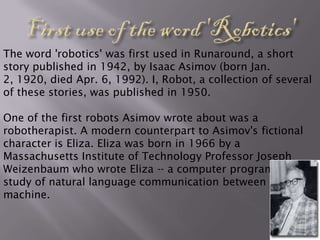
The word 'robotics' was first used in Runaround, a short
story published in 1942, by Isaac Asimov (born Jan.
2, 1920, died Apr. 6, 1992). I, Robot, a collection of several
of these stories, was published in 1950.

One of the first robots Asimov wrote about was a
robotherapist. A modern counterpart to Asimov's fictional
character is Eliza. Eliza was born in 1966 by a
Massachusetts Institute of Technology Professor Joseph
Weizenbaum who wrote Eliza -- a computer program for the
study of natural language communication between man and
machine.
Law      Zero:    A   robot      may    not   injure
humanity, or, through inaction, allow humanity to
come                      to                 harm.
Law One: A robot may not injure a human
being, or, through inaction, allow a human being to
come to harm, unless this would violate a higher
order                                           law.
Law Two: A robot must obey orders given it by
human beings, except where such orders would
conflict     with    a      higher     order    law.
Law Three: A robot must protect its own existence
as long as such protection does not conflict with a
higher order law.
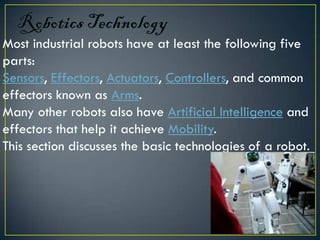
Most industrial robots have at least the following five
parts:
Sensors, Effectors, Actuators, Controllers, and common
effectors known as Arms.
Many other robots also have Artificial Intelligence and
effectors that help it achieve Mobility.
This section discusses the basic technologies of a robot.
TYPES OF ROBOS
•   Mobile robots
•   Rolling robots
•   Walking robots
•   Stationary Robots
•   Autonomous Robots
•   Remote-control Robots
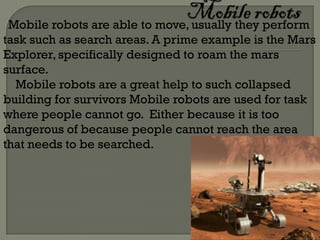
Mobile robots are able to move, usually they perform
task such as search areas. A prime example is the Mars
Explorer, specifically designed to roam the mars
surface.
  Mobile robots are a great help to such collapsed
building for survivors Mobile robots are used for task
where people cannot go. Either because it is too
dangerous of because people cannot reach the area
that needs to be searched.
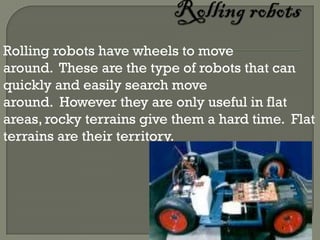
Rolling robots have wheels to move
around. These are the type of robots that can
quickly and easily search move
around. However they are only useful in flat
areas, rocky terrains give them a hard time. Flat
terrains are their territory.
Robots on legs are usually brought in when the terrain
is rocky and difficult to enter with wheels. Robots have
a hard time shifting balance and keep them from
tumbling. That’s why most robots with have at least 4 of
them, usually they have 6 legs or more. Even when
they lift one or more legs they still keep their
balance. Development of legged robots is often
modeled after insects or crawfish..
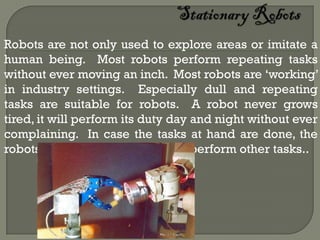
Robots are not only used to explore areas or imitate a
human being. Most robots perform repeating tasks
without ever moving an inch. Most robots are ‘working’
in industry settings. Especially dull and repeating
tasks are suitable for robots. A robot never grows
tired, it will perform its duty day and night without ever
complaining. In case the tasks at hand are done, the
robots will be reprogrammed to perform other tasks..
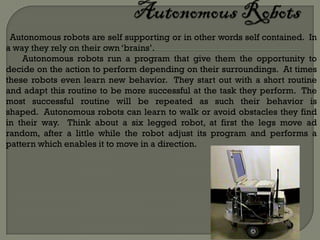
Autonomous robots are self supporting or in other words self contained. In
a way they rely on their own ‘brains’.
    Autonomous robots run a program that give them the opportunity to
decide on the action to perform depending on their surroundings. At times
these robots even learn new behavior. They start out with a short routine
and adapt this routine to be more successful at the task they perform. The
most successful routine will be repeated as such their behavior is
shaped. Autonomous robots can learn to walk or avoid obstacles they find
in their way. Think about a six legged robot, at first the legs move ad
random, after a little while the robot adjust its program and performs a
pattern which enables it to move in a direction.
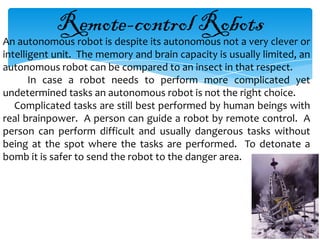
Remote-control Robots
An autonomous robot is despite its autonomous not a very clever or
intelligent unit. The memory and brain capacity is usually limited, an
autonomous robot can be compared to an insect in that respect.
       In case a robot needs to perform more complicated yet
undetermined tasks an autonomous robot is not the right choice.
   Complicated tasks are still best performed by human beings with
real brainpower. A person can guide a robot by remote control. A
person can perform difficult and usually dangerous tasks without
being at the spot where the tasks are performed. To detonate a
bomb it is safer to send the robot to the danger area.
Benefits
Robots offer specific benefits to workers, industries and countries. If introduced
correctly, industrial robots can improve the quality of life by freeing workers from
dirty, boring, dangerous and heavy labor. it is true that robots can cause
unemployment by replacing human workers but robots also create jobs: robot
technicians,      salesmen,     engineers,    programmers        and     supervisors.

The benefits of robots to industry include improved management control and
productivity and consistently high quality products. Industrial robots can work
tirelessly night and day on an assembly line without an loss in performance.

Consequently, they can greatly reduce the costs of manufactured goods. As a result of
these industrial benefits, countries that effectively use robots in their industries will
have an economic advantage on world market.
PRESENTATION DONE
       BY


 SRI SIVA SAI REDDY.G
      IX CLASS
      RJD-ONCS

robotics ppt

  • 2.
    Roboticists develop man-mademechanical devices that can move by themselves, whose motion must be modelled, planned, sensed, actuated and controlled, and whose motion behaviour can be influenced by “programming”. Robots are called “intelligent” if they succeed in moving in safe interaction with an unstructured environment, while autonomously achieving their specified
  • 3.
    Definition of a'Robot' An automatic device that performs functions normally ascribed to humans or a machine in the form of a human."
  • 4.
    The word 'robotics'was first used in Runaround, a short story published in 1942, by Isaac Asimov (born Jan. 2, 1920, died Apr. 6, 1992). I, Robot, a collection of several of these stories, was published in 1950. One of the first robots Asimov wrote about was a robotherapist. A modern counterpart to Asimov's fictional character is Eliza. Eliza was born in 1966 by a Massachusetts Institute of Technology Professor Joseph Weizenbaum who wrote Eliza -- a computer program for the study of natural language communication between man and machine.
  • 5.
    Law Zero: A robot may not injure humanity, or, through inaction, allow humanity to come to harm. Law One: A robot may not injure a human being, or, through inaction, allow a human being to come to harm, unless this would violate a higher order law. Law Two: A robot must obey orders given it by human beings, except where such orders would conflict with a higher order law. Law Three: A robot must protect its own existence as long as such protection does not conflict with a higher order law.
  • 6.
    Most industrial robotshave at least the following five parts: Sensors, Effectors, Actuators, Controllers, and common effectors known as Arms. Many other robots also have Artificial Intelligence and effectors that help it achieve Mobility. This section discusses the basic technologies of a robot.
  • 7.
    TYPES OF ROBOS • Mobile robots • Rolling robots • Walking robots • Stationary Robots • Autonomous Robots • Remote-control Robots
  • 8.
    Mobile robots areable to move, usually they perform task such as search areas. A prime example is the Mars Explorer, specifically designed to roam the mars surface. Mobile robots are a great help to such collapsed building for survivors Mobile robots are used for task where people cannot go. Either because it is too dangerous of because people cannot reach the area that needs to be searched.
  • 9.
    Rolling robots havewheels to move around. These are the type of robots that can quickly and easily search move around. However they are only useful in flat areas, rocky terrains give them a hard time. Flat terrains are their territory.
  • 10.
    Robots on legsare usually brought in when the terrain is rocky and difficult to enter with wheels. Robots have a hard time shifting balance and keep them from tumbling. That’s why most robots with have at least 4 of them, usually they have 6 legs or more. Even when they lift one or more legs they still keep their balance. Development of legged robots is often modeled after insects or crawfish..
  • 11.
    Robots are notonly used to explore areas or imitate a human being. Most robots perform repeating tasks without ever moving an inch. Most robots are ‘working’ in industry settings. Especially dull and repeating tasks are suitable for robots. A robot never grows tired, it will perform its duty day and night without ever complaining. In case the tasks at hand are done, the robots will be reprogrammed to perform other tasks..
  • 12.
    Autonomous robots areself supporting or in other words self contained. In a way they rely on their own ‘brains’. Autonomous robots run a program that give them the opportunity to decide on the action to perform depending on their surroundings. At times these robots even learn new behavior. They start out with a short routine and adapt this routine to be more successful at the task they perform. The most successful routine will be repeated as such their behavior is shaped. Autonomous robots can learn to walk or avoid obstacles they find in their way. Think about a six legged robot, at first the legs move ad random, after a little while the robot adjust its program and performs a pattern which enables it to move in a direction.
  • 13.
    Remote-control Robots An autonomousrobot is despite its autonomous not a very clever or intelligent unit. The memory and brain capacity is usually limited, an autonomous robot can be compared to an insect in that respect. In case a robot needs to perform more complicated yet undetermined tasks an autonomous robot is not the right choice. Complicated tasks are still best performed by human beings with real brainpower. A person can guide a robot by remote control. A person can perform difficult and usually dangerous tasks without being at the spot where the tasks are performed. To detonate a bomb it is safer to send the robot to the danger area.
  • 14.
    Benefits Robots offer specificbenefits to workers, industries and countries. If introduced correctly, industrial robots can improve the quality of life by freeing workers from dirty, boring, dangerous and heavy labor. it is true that robots can cause unemployment by replacing human workers but robots also create jobs: robot technicians, salesmen, engineers, programmers and supervisors. The benefits of robots to industry include improved management control and productivity and consistently high quality products. Industrial robots can work tirelessly night and day on an assembly line without an loss in performance. Consequently, they can greatly reduce the costs of manufactured goods. As a result of these industrial benefits, countries that effectively use robots in their industries will have an economic advantage on world market.
  • 16.
    PRESENTATION DONE BY SRI SIVA SAI REDDY.G IX CLASS RJD-ONCS