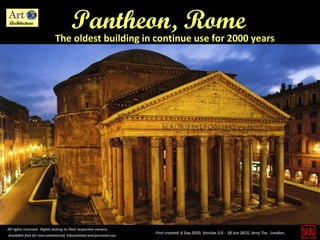
Pantheon, RomeThe oldest building in continue use for 2000 years
First created 6 Sep 2010. Version 3.0 - 26 Jun 2015. Jerry Tse. London.
All rights reserved. Rights belong to their respective owners.
Available free for non-commercial, Educational and personal use.
Pantheon
Pantheon, Rome
It was built in 118-125 AD, nearly 2000 years
ago. The poet Shelley called it “The
unmeasured dome of Heaven.”
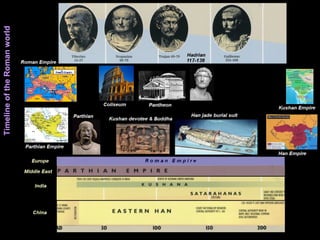
TimelineoftheRomanworld
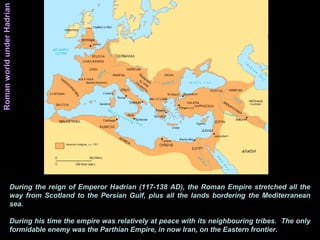
During the reign of Emperor Hadrian (117-138 AD), the Roman Empire stretched all the
way from Scotland to the Persian Gulf, plus all the lands bordering the Mediterranean
sea.
During his time the empire was relatively at peace with its neighbouring tribes. The only
formidable enemy was the Parthian Empire, in now Iran, on the Eastern frontier.
RomanworldunderHadrian
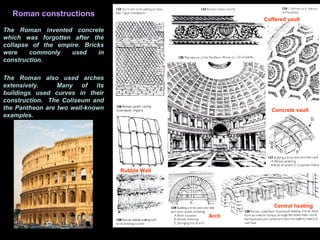
The Roman invented concrete
which was forgotten after the
collapse of the empire. Bricks
were commonly used in
construction.
The Roman also used arches
extensively. Many of its
buildings used curves in their
construction. The Coliseum and
the Pantheon are two well-known
examples.
Rubble Wall
Arch
Central heating
Concrete vault
Coffered vault
Roman constructions
Interior
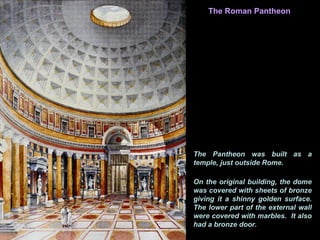
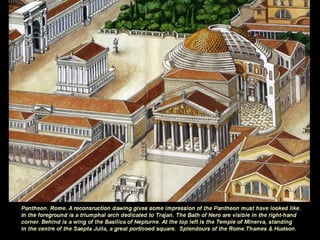
The Pantheon was built as a
temple, just outside Rome.
The Roman Pantheon
On the original building, the dome
was covered with sheets of bronze
giving it a shinny golden surface.
The lower part of the external wall
were covered with marbles. It also
had a bronze door.
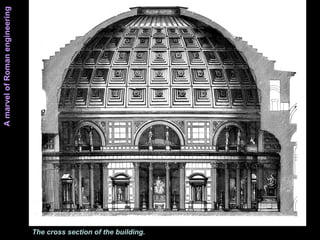
AmarvelofRomanengineering
The cross section of the building.
Pantheon
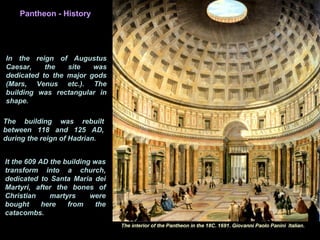
It the 609 AD the building was
transform into a church,
dedicated to Santa Maria dei
Martyri, after the bones of
Christian martyrs were
bought here from the
catacombs.
Pantheon - History
In the reign of Augustus
Caesar, the site was
dedicated to the major gods
(Mars, Venus etc.). The
building was rectangular in
shape.
The building was rebuilt
between 118 and 125 AD,
during the reign of Hadrian.
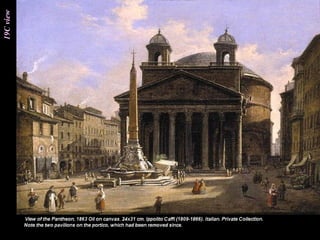
19Cview
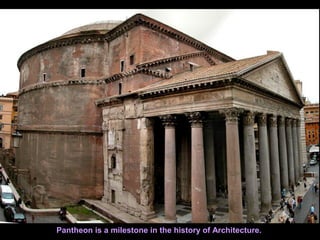
Pantheon is a milestone in the history of Architecture.
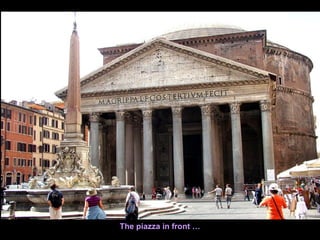
The piazza in front …
The external brick wall
map
Pantheon
Plaza Navona
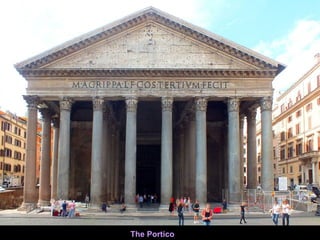
The Portico
map
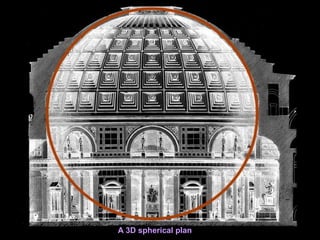
A 3D spherical plan
The main components of
the building – the portico,
the rotunda and the dome.
A brilliant composition
of geometric forms.
map
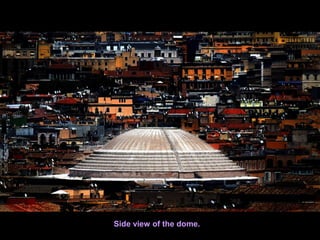
Side view of the dome.
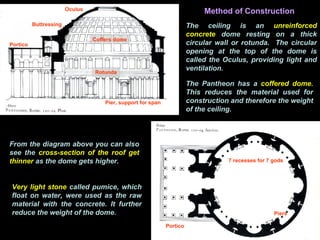
The ceiling is an unreinforced
concrete dome resting on a thick
circular wall or rotunda. The circular
opening at the top of the dome is
called the Oculus, providing light and
ventilation.
The Pantheon has a coffered dome.
This reduces the material used for
construction and therefore the weight
of the ceiling.
From the diagram above you can also
see the cross-section of the roof get
thinner as the dome gets higher.
Method of Construction
Very light stone called pumice, which
float on water, were used as the raw
material with the concrete. It further
reduce the weight of the dome.
Coffers dome
Oculus
Buttressing
Piers
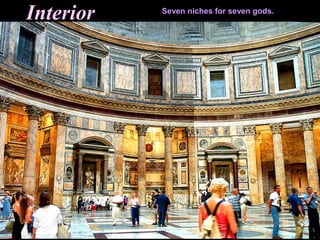
7 recesses for 7 gods
Pier, support for span
Portico
Portico
Rotunda
map
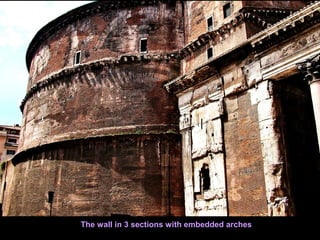
The wall in 3 sections with embedded arches
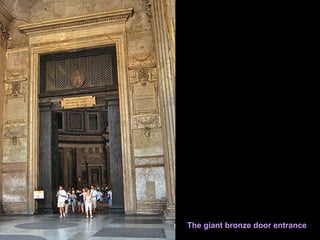
The giant bronze door entrance
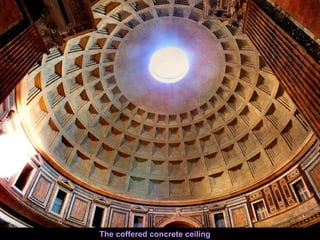
The coffered concrete ceiling
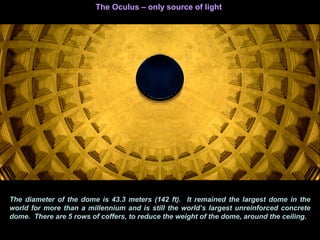
The diameter of the dome is 43.3 meters (142 ft). It remained the largest dome in the
world for more than a millennium and is still the world’s largest unreinforced concrete
dome. There are 5 rows of coffers, to reduce the weight of the dome, around the ceiling.
The Oculus – only source of light
Tomb
The statue of St Rasius.
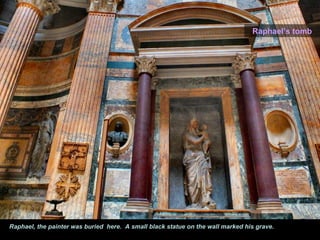
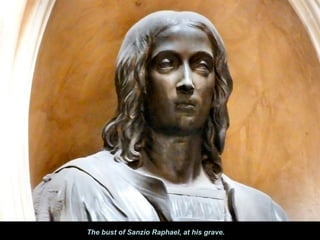
Raphael, the painter was buried here. A small black statue on the wall marked his grave.
Raphael’s tomb
The bust of Sanzio Raphael, at his grave.
map
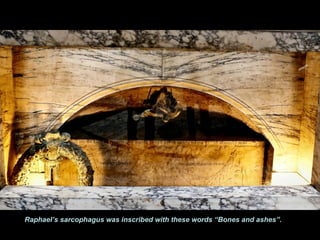
Raphael’s sarcophagus was inscribed with these words “Bones and ashes”.
Seven niches for seven gods.
Interior
Interior
It is the best preserved
building of ancient Rome.
The oldest building in
the world, still in use
today.
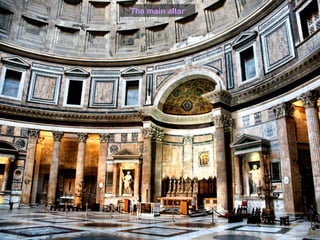
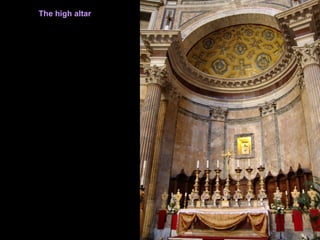
The main altar
Altar
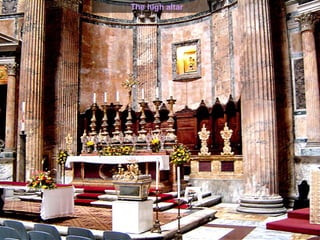
The high altar
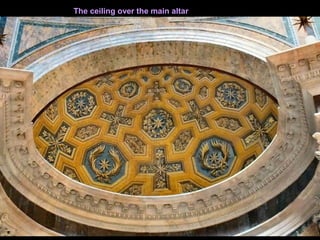
The ceiling over the main altar
The high altar
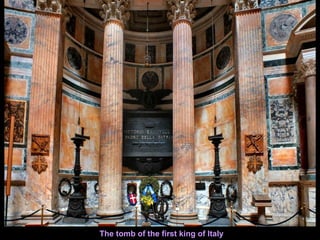
The tomb of the first king of Italy
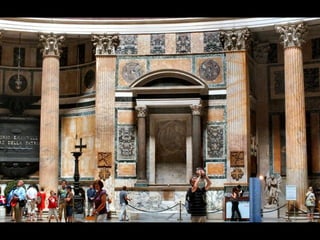
The entire interior is covered with marbles.
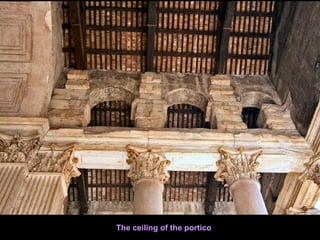
The ceiling of the portico
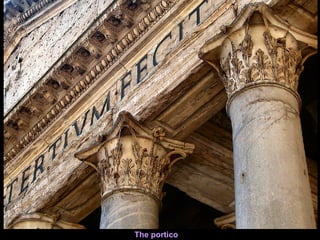
The portico
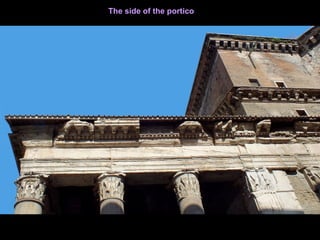
The side of the portico
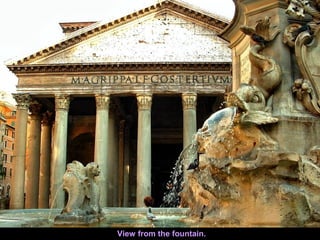
View from the fountain.
Evolution of styles …
The End
Music - Albinoni’s oboe concerto in C Major, op 9 no 57 -
1st
movement. Allegro
All rights reserved. Rights belong to their respective owners. Available
free for non-commercial and personal use.
Related Powerpoints …

Pantheon, Rome v 3

  • 1.
    Pantheon, RomeThe oldestbuilding in continue use for 2000 years First created 6 Sep 2010. Version 3.0 - 26 Jun 2015. Jerry Tse. London. All rights reserved. Rights belong to their respective owners. Available free for non-commercial, Educational and personal use.
  • 2.
    Pantheon Pantheon, Rome It wasbuilt in 118-125 AD, nearly 2000 years ago. The poet Shelley called it “The unmeasured dome of Heaven.”
  • 3.
  • 4.
    During the reignof Emperor Hadrian (117-138 AD), the Roman Empire stretched all the way from Scotland to the Persian Gulf, plus all the lands bordering the Mediterranean sea. During his time the empire was relatively at peace with its neighbouring tribes. The only formidable enemy was the Parthian Empire, in now Iran, on the Eastern frontier. RomanworldunderHadrian
  • 5.
    The Roman inventedconcrete which was forgotten after the collapse of the empire. Bricks were commonly used in construction. The Roman also used arches extensively. Many of its buildings used curves in their construction. The Coliseum and the Pantheon are two well-known examples. Rubble Wall Arch Central heating Concrete vault Coffered vault Roman constructions
  • 6.
    Interior The Pantheon wasbuilt as a temple, just outside Rome. The Roman Pantheon On the original building, the dome was covered with sheets of bronze giving it a shinny golden surface. The lower part of the external wall were covered with marbles. It also had a bronze door.
  • 7.
  • 8.
  • 9.
    It the 609AD the building was transform into a church, dedicated to Santa Maria dei Martyri, after the bones of Christian martyrs were bought here from the catacombs. Pantheon - History In the reign of Augustus Caesar, the site was dedicated to the major gods (Mars, Venus etc.). The building was rectangular in shape. The building was rebuilt between 118 and 125 AD, during the reign of Hadrian.
  • 10.
  • 11.
    Pantheon is amilestone in the history of Architecture.
  • 12.
    The piazza infront …
  • 13.
  • 14.
  • 15.
  • 16.
  • 17.
    The main componentsof the building – the portico, the rotunda and the dome. A brilliant composition of geometric forms.
  • 18.
  • 19.
    The ceiling isan unreinforced concrete dome resting on a thick circular wall or rotunda. The circular opening at the top of the dome is called the Oculus, providing light and ventilation. The Pantheon has a coffered dome. This reduces the material used for construction and therefore the weight of the ceiling. From the diagram above you can also see the cross-section of the roof get thinner as the dome gets higher. Method of Construction Very light stone called pumice, which float on water, were used as the raw material with the concrete. It further reduce the weight of the dome. Coffers dome Oculus Buttressing Piers 7 recesses for 7 gods Pier, support for span Portico Portico Rotunda
  • 20.
    map The wall in3 sections with embedded arches
  • 21.
    The giant bronzedoor entrance
  • 22.
  • 23.
    The diameter ofthe dome is 43.3 meters (142 ft). It remained the largest dome in the world for more than a millennium and is still the world’s largest unreinforced concrete dome. There are 5 rows of coffers, to reduce the weight of the dome, around the ceiling. The Oculus – only source of light
  • 24.
  • 25.
    Raphael, the painterwas buried here. A small black statue on the wall marked his grave. Raphael’s tomb
  • 26.
    The bust ofSanzio Raphael, at his grave.
  • 27.
    map Raphael’s sarcophagus wasinscribed with these words “Bones and ashes”.
  • 28.
    Seven niches forseven gods. Interior
  • 29.
    Interior It is thebest preserved building of ancient Rome. The oldest building in the world, still in use today.
  • 30.
  • 31.
  • 32.
    The ceiling overthe main altar
  • 33.
  • 34.
    The tomb ofthe first king of Italy
  • 36.
    The entire interioris covered with marbles.
  • 37.
    The ceiling ofthe portico
  • 38.
  • 39.
    The side ofthe portico
  • 40.
    View from thefountain.
  • 43.
  • 44.
    The End Music -Albinoni’s oboe concerto in C Major, op 9 no 57 - 1st movement. Allegro All rights reserved. Rights belong to their respective owners. Available free for non-commercial and personal use.
  • 45.

Editor's Notes

  • #3 Built more than 1800 years ago, the magnificent Pantheon building still stands as a reminder of the great Roman empire. Pantheon, with its thick brick walls and large marble columns, the Pantheon makes an immediate impression on visitors. But for its time the most remarkable part of the building is the more than 43 meter high some. It was the largest dome in the world until 1436 when the Florence Cathedral was constructed. At the top of the dome is a large opening, the oculus, which was the only source of light. The front portico has three rows of 8 columns, each one with a diameter of 1.5m. A huge bronze door gives access to the cylindrical building. Its Originally a temple for all pagan gods, the temple was converted into a church in 609. The Pantheon now contains the tombs of the famous artist Raphael and of several Italian Kings. Its ecclesiastic interior design contrast with the temple's structural design, but the marble floor - which features a design consisting of a series of geometric patterns - is still the ancient Roman original.
  • #21 The photo shows the circular wall supporting the dome was build up in 3 sections. Within each section there were a number of embedded arches which beared the weight of the dome, leaving the remainder of the wall relatively stress free.
  • #29 The most famous Roman dome, and the largest, is in the Pantheon, a building in Rome originally built as a temple. Dating from the 2nd century, it is an unreinforced concrete dome resting on a thick circular wall, or rotunda. The circular opening at the top of the dome is called the Oculus, and it provides light and ventilation for the interior. The height to the oculus and the diameter of the interior walls are the same, 43.3 meters (142 ft). It remained the largest dome in the world for more than a millennium and is still the world's largest unreinforced concrete dome Wikipedia on Dome.