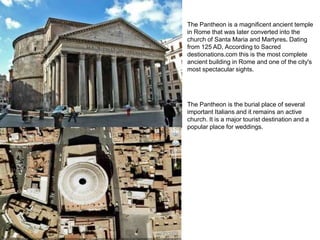
The Pantheon is a magnificent ancient temple
in Rome that was later converted into the
church of Santa Maria and Martyres. Dating
from 125 AD, According to Sacred
destionations.com this is the most complete
ancient building in Rome and one of the city's
most spectacular sights.
The Pantheon is the burial place of several
important Italians and it remains an active
church. It is a major tourist destination and a
popular place for weddings.
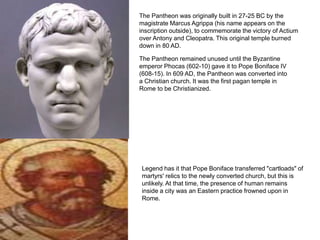
The Pantheon was originally built in 27-25 BC by the
magistrate Marcus Agrippa (his name appears on the
inscription outside), to commemorate the victory of Actium
over Antony and Cleopatra. This original temple burned
down in 80 AD.
The Pantheon remained unused until the Byzantine
emperor Phocas (602-10) gave it to Pope Boniface IV
(608-15). In 609 AD, the Pantheon was converted into
a Christian church. It was the first pagan temple in
Rome to be Christianized.
Legend has it that Pope Boniface transferred "cartloads" of
martyrs' relics to the newly converted church, but this is
unlikely. At that time, the presence of human remains
inside a city was an Eastern practice frowned upon in
Rome.
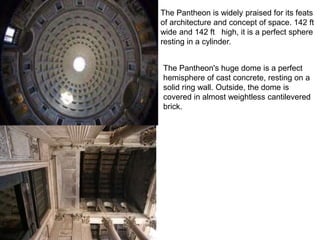
The Pantheon is widely praised for its feats
of architecture and concept of space. 142 ft
wide and 142 ft high, it is a perfect sphere
resting in a cylinder.
The Pantheon's huge dome is a perfect
hemisphere of cast concrete, resting on a
solid ring wall. Outside, the dome is
covered in almost weightless cantilevered
brick.
The bronze doors leading into the building
(which are original and were once covered
in gold) weigh 20 tons each. The walls of
the Pantheon are 25 ft. thick.
According to sacred-destinations. Com
The Pantheon stands as the most
complete Roman structure on earth,
having survived 20 centuries of plunder,
pillage and invasion.
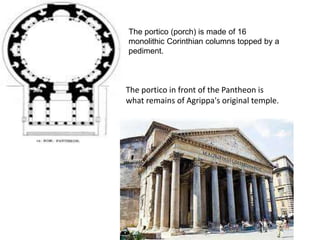
The portico (porch) is made of 16
monolithic Corinthian columns topped by a
pediment.
The portico in front of the Pantheon is
what remains of Agrippa's original temple.
The inscription M·AGRIPPA·L·F·COS·TERTIUM·FECIT
means: "Marcus Agrippa, son of Lucius, during his third
consulate, built this."
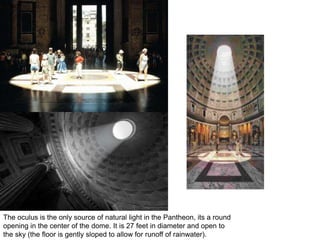
The oculus is the only source of natural light in the Pantheon, its a round
opening in the center of the dome. It is 27 feet in diameter and open to
the sky (the floor is gently sloped to allow for runoff of rainwater).
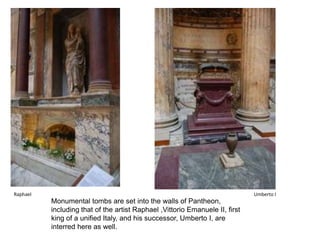
Monumental tombs are set into the walls of Pantheon,
including that of the artist Raphael ,Vittorio Emanuele II, first
king of a unified Italy, and his successor, Umberto I, are
interred here as well.
Raphael Umberto I
Vittorio Emanuele II
The Pantheon is open from 8:30 a.m.
to 7:30 p.m. Monday to Saturday, from
9 a.m. to 6 p.m. on Sunday, and 9
a.m. to 1 p.m. on holidays that fall on
weekdays except for Christmas Day,
New Year's Day and May 1, when it is
closed. Admission is free.

Pantheon

  • 1.
    The Pantheon isa magnificent ancient temple in Rome that was later converted into the church of Santa Maria and Martyres. Dating from 125 AD, According to Sacred destionations.com this is the most complete ancient building in Rome and one of the city's most spectacular sights. The Pantheon is the burial place of several important Italians and it remains an active church. It is a major tourist destination and a popular place for weddings.
  • 2.
    The Pantheon wasoriginally built in 27-25 BC by the magistrate Marcus Agrippa (his name appears on the inscription outside), to commemorate the victory of Actium over Antony and Cleopatra. This original temple burned down in 80 AD. The Pantheon remained unused until the Byzantine emperor Phocas (602-10) gave it to Pope Boniface IV (608-15). In 609 AD, the Pantheon was converted into a Christian church. It was the first pagan temple in Rome to be Christianized. Legend has it that Pope Boniface transferred "cartloads" of martyrs' relics to the newly converted church, but this is unlikely. At that time, the presence of human remains inside a city was an Eastern practice frowned upon in Rome.
  • 3.
    The Pantheon iswidely praised for its feats of architecture and concept of space. 142 ft wide and 142 ft high, it is a perfect sphere resting in a cylinder. The Pantheon's huge dome is a perfect hemisphere of cast concrete, resting on a solid ring wall. Outside, the dome is covered in almost weightless cantilevered brick.
  • 4.
    The bronze doorsleading into the building (which are original and were once covered in gold) weigh 20 tons each. The walls of the Pantheon are 25 ft. thick. According to sacred-destinations. Com The Pantheon stands as the most complete Roman structure on earth, having survived 20 centuries of plunder, pillage and invasion.
  • 5.
    The portico (porch)is made of 16 monolithic Corinthian columns topped by a pediment. The portico in front of the Pantheon is what remains of Agrippa's original temple.
  • 6.
    The inscription M·AGRIPPA·L·F·COS·TERTIUM·FECIT means:"Marcus Agrippa, son of Lucius, during his third consulate, built this."
  • 7.
    The oculus isthe only source of natural light in the Pantheon, its a round opening in the center of the dome. It is 27 feet in diameter and open to the sky (the floor is gently sloped to allow for runoff of rainwater).
  • 9.
    Monumental tombs areset into the walls of Pantheon, including that of the artist Raphael ,Vittorio Emanuele II, first king of a unified Italy, and his successor, Umberto I, are interred here as well. Raphael Umberto I
  • 10.
    Vittorio Emanuele II ThePantheon is open from 8:30 a.m. to 7:30 p.m. Monday to Saturday, from 9 a.m. to 6 p.m. on Sunday, and 9 a.m. to 1 p.m. on holidays that fall on weekdays except for Christmas Day, New Year's Day and May 1, when it is closed. Admission is free.