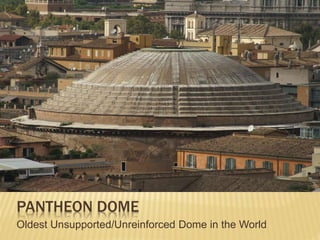
PANTHEON DOME
Oldest Unsupported/Unreinforced Dome in the World
ORIGIN
 Commissioned by Emperor Hadrian
 The word “Pantheon” loosely translates to
“all of the gods”… the Pantheon serves as a
temple to the Roman gods, the dome being
the divine feature
 Built between 118-128 A.D.
 1,887 years old (still in use today)
DOME
 Depth from dome’s apex to floor is exactly equal
to the width of the dome (142.4 ft)
 Meaning: the rotunda (round floor beneath
dome) and dome are configured in accordance
with a perfect sphere
 Because of no reinforcement to keep the dome
from trying to “push” or “flatten” out, Romans
built 20 ft thick walls to serve as buttresses for
the dome
 Based on the “arch” concept
WEIGHT OF DOME
 The most critical issue Roman engineers
faced was the dome’s own dead weight
 Roman engineers needed a material with a
larger strength to weight ratio than traditional
stone. Answer: concrete
 Strength was not a central issue in the
design, but rather the weight and stresses
associated with the material used
ROMAN CONCRETE
 Very strong by modern standards
 For the Roman engineers, the concrete was
still too heavy, so they needed to develop
ways to reduce the amount used
 Roman engineers conducted a stress
analysis of the dome and determined that the
compression stresses were smaller towards
the top. Solution: pour a progressively
thinner layer of concrete
ROMAN CONCRETE (CONTINUED)
 Romans relied on the chemical reactions that
took place between the lime and pozzolans they
added into the mix to strengthen their concrete
 Pozzolans – volcanic ash found in and around
Puzzuoli Bay near Naples (varies in dome)
 Roman engineers used small hollow jars called
amphra as aggregate… used to displace
concrete to make mix lighter
ROMAN CONCRETE (CONTINUED)
 Coffers – ingenious Roman innovation which
removed an array of concrete sections…
made the dome lighter and more appealing,
all while maintaining thick sections to serve
as reinforcement
 Oculus – used to distribute the stresses
acting on the dome’s weakest point along a
rounded perimeter… also serves as an
aesthetic feature
REFERENCES
 Rome: Engineering an Empire
 https://www.youtube.com/watch?v=C5obOUDy
Q5s
 The Secrets of Ancient Roman Concrete
 http://www.history.com/news/the-secrets-of-
ancient-roman-concrete
 The Pantheon
 http://www.romanconcrete.com/docs/chapt01/ch
apt01.htm

Pantheon dome

  • 1.
  • 2.
    ORIGIN  Commissioned byEmperor Hadrian  The word “Pantheon” loosely translates to “all of the gods”… the Pantheon serves as a temple to the Roman gods, the dome being the divine feature  Built between 118-128 A.D.  1,887 years old (still in use today)
  • 4.
    DOME  Depth fromdome’s apex to floor is exactly equal to the width of the dome (142.4 ft)  Meaning: the rotunda (round floor beneath dome) and dome are configured in accordance with a perfect sphere  Because of no reinforcement to keep the dome from trying to “push” or “flatten” out, Romans built 20 ft thick walls to serve as buttresses for the dome  Based on the “arch” concept
  • 6.
    WEIGHT OF DOME The most critical issue Roman engineers faced was the dome’s own dead weight  Roman engineers needed a material with a larger strength to weight ratio than traditional stone. Answer: concrete  Strength was not a central issue in the design, but rather the weight and stresses associated with the material used
  • 7.
    ROMAN CONCRETE  Verystrong by modern standards  For the Roman engineers, the concrete was still too heavy, so they needed to develop ways to reduce the amount used  Roman engineers conducted a stress analysis of the dome and determined that the compression stresses were smaller towards the top. Solution: pour a progressively thinner layer of concrete
  • 8.
    ROMAN CONCRETE (CONTINUED) Romans relied on the chemical reactions that took place between the lime and pozzolans they added into the mix to strengthen their concrete  Pozzolans – volcanic ash found in and around Puzzuoli Bay near Naples (varies in dome)  Roman engineers used small hollow jars called amphra as aggregate… used to displace concrete to make mix lighter
  • 9.
    ROMAN CONCRETE (CONTINUED) Coffers – ingenious Roman innovation which removed an array of concrete sections… made the dome lighter and more appealing, all while maintaining thick sections to serve as reinforcement  Oculus – used to distribute the stresses acting on the dome’s weakest point along a rounded perimeter… also serves as an aesthetic feature
  • 11.
    REFERENCES  Rome: Engineeringan Empire  https://www.youtube.com/watch?v=C5obOUDy Q5s  The Secrets of Ancient Roman Concrete  http://www.history.com/news/the-secrets-of- ancient-roman-concrete  The Pantheon  http://www.romanconcrete.com/docs/chapt01/ch apt01.htm