Romanesque Architecture
800 AD to 1100 AD
• The term Romanesque ("Roman-like") was first used to designate a
style of architecture that used Roman arches and vaults and had
thick, heavy walls, based upon the basilica plan type.
• Church buildings, art, and sculpture, were all used for the purpose
to spread the Christian Gospel.
• The style prevailed all throughout Europe.
• Due to the rise of feudalism there began to be some stability in the
European governments and economies during the 11th Century.
• Art and architecture from this period is church-centered because the
central "ruling" body was the Pope and the unifying element was the
Christianity.
• Latin cross plan
• Use of local stone
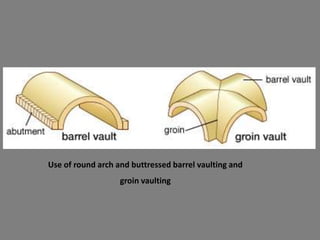
• Use of round arches, buttressed barrel vaulting and groin vaulting
• Towers engaged to façade and large transept towers
• Dome often over apse
• Recessed doorways ornamented with sculpture
• Harmonious proportions
MAJOR ELEMENTS WERE
• Thick and heavy walls and pillars
• Small windows
• Sculptured decoration on portals, capitals and other surfaces
• Painted decoration throughout the interior
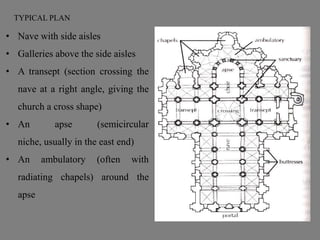
• Nave with side aisles
• Galleries above the side aisles
• A transept (section crossing the
nave at a right angle, giving the
church a cross shape)
• An apse (semicircular
niche, usually in the east end)
• An ambulatory (often with
radiating chapels) around the
apse
TYPICAL PLAN
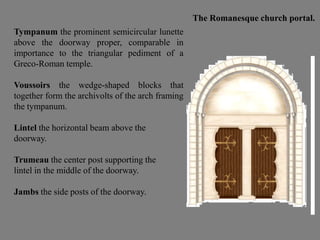
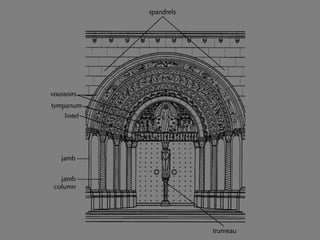
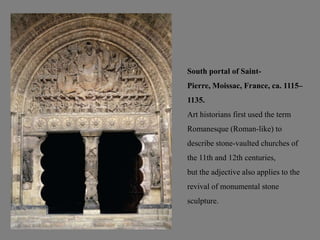
Tympanum the prominent semicircular lunette
above the doorway proper, comparable in
importance to the triangular pediment of a
Greco-Roman temple.
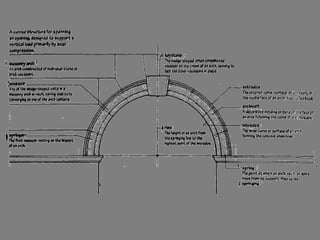
Voussoirs the wedge-shaped blocks that
together form the archivolts of the arch framing
the tympanum.
Lintel the horizontal beam above the
doorway.
Trumeau the center post supporting the
lintel in the middle of the doorway.
Jambs the side posts of the doorway.
The Romanesque church portal.
South portal of Saint-
Pierre, Moissac, France, ca. 1115–
1135.
Art historians first used the term
Romanesque (Roman-like) to
describe stone-vaulted churches of
the 11th and 12th centuries,
but the adjective also applies to the
revival of monumental stone
sculpture.
Use of round arch and buttressed barrel vaulting and
groin vaulting
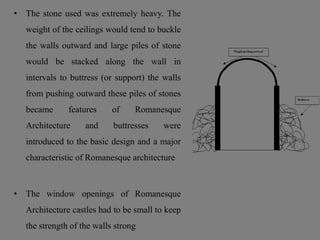
• The stone used was extremely heavy. The
weight of the ceilings would tend to buckle
the walls outward and large piles of stone
would be stacked along the wall in
intervals to buttress (or support) the walls
from pushing outward these piles of stones
became features of Romanesque
Architecture and buttresses were
introduced to the basic design and a major
characteristic of Romanesque architecture
• The window openings of Romanesque
Architecture castles had to be small to keep
the strength of the walls strong
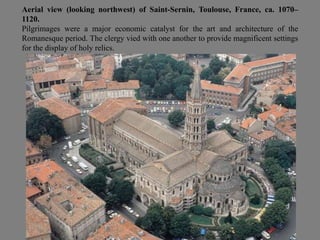
Aerial view (looking northwest) of Saint-Sernin, Toulouse, France, ca. 1070–
1120.
Pilgrimages were a major economic catalyst for the art and architecture of the
Romanesque period. The clergy vied with one another to provide magnificent settings
for the display of holy relics.
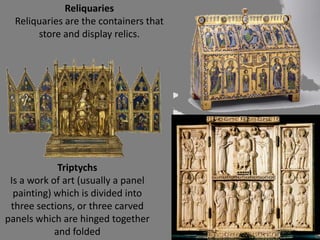
Reliquaries
Reliquaries are the containers that
store and display relics.
Triptychs
Is a work of art (usually a panel
painting) which is divided into
three sections, or three carved
panels which are hinged together
and folded
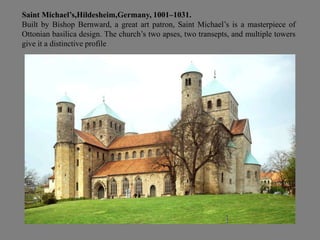
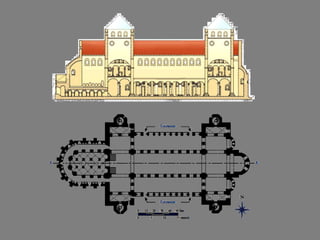
Saint Michael’s,Hildesheim,Germany, 1001–1031.
Built by Bishop Bernward, a great art patron, Saint Michael’s is a masterpiece of
Ottonian basilica design. The church’s two apses, two transepts, and multiple towers
give it a distinctive profile
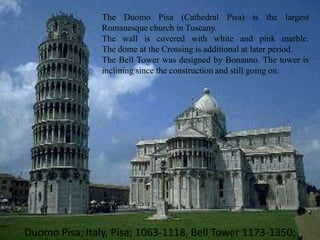
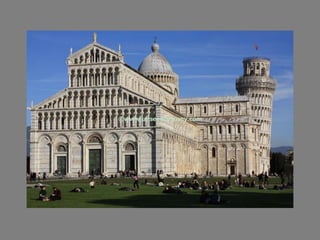
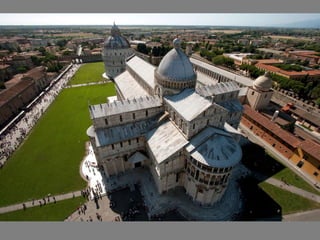
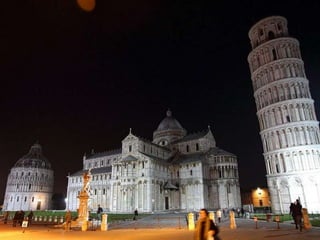
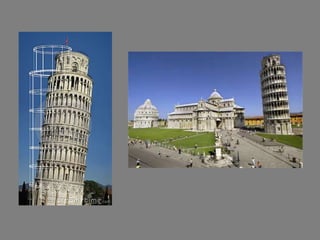
Duomo Pisa, Italy, Pisa; 1063-1118, Bell Tower 1173-1350;
The Duomo Pisa (Cathedral Pisa) is the largest
Romanesque church in Tuscany.
The wall is covered with white and pink marble.
The dome at the Crossing is additional at later period.
The Bell Tower was designed by Bonanno. The tower is
inclining since the construction and still going on.
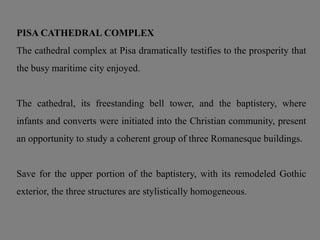
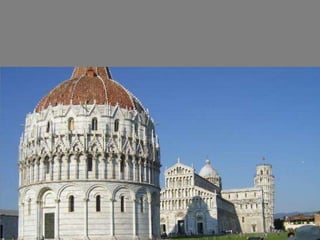
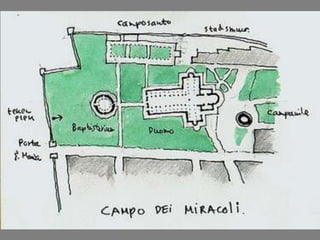
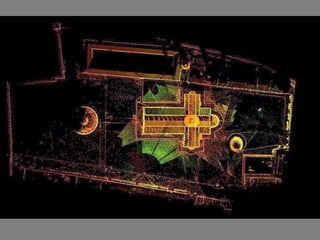
PISA CATHEDRAL COMPLEX
The cathedral complex at Pisa dramatically testifies to the prosperity that
the busy maritime city enjoyed.
The cathedral, its freestanding bell tower, and the baptistery, where
infants and converts were initiated into the Christian community, present
an opportunity to study a coherent group of three Romanesque buildings.
Save for the upper portion of the baptistery, with its remodeled Gothic
exterior, the three structures are stylistically homogeneous.
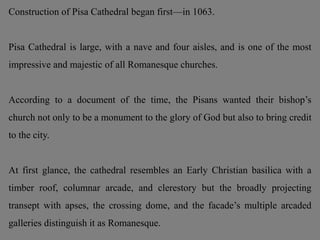
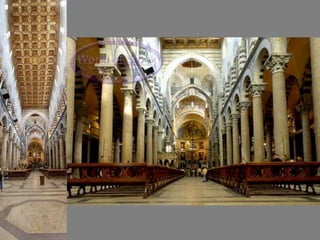
Construction of Pisa Cathedral began first—in 1063.
Pisa Cathedral is large, with a nave and four aisles, and is one of the most
impressive and majestic of all Romanesque churches.
According to a document of the time, the Pisans wanted their bishop’s
church not only to be a monument to the glory of God but also to bring credit
to the city.
At first glance, the cathedral resembles an Early Christian basilica with a
timber roof, columnar arcade, and clerestory but the broadly projecting
transept with apses, the crossing dome, and the facade’s multiple arcaded
galleries distinguish it as Romanesque.
The cathedral’s campanile, detached in the standard Italian fashion, is
Pisa’s famous Leaning tower.
Graceful arcaded galleries mark the tower’s stages and repeat the
cathedral’s facade motif, effectively relating the round campanile to its
mother building.
The tilted vertical axis of the tower is the result of a settling foundation.
The tower began to “lean” even while under construction and by the
late 20th century had inclined some 5.5 degrees (about 15 feet) out
of plumb at the top.
In 1999 an international team of scientists began a daring project to
remove soil from beneath the north side of the tower. The soil extraction
has already moved the tower more than an inch closer to vertical and
ensured the stability of the structure for at least 300 years.
Romanesque Architecture

Romanesque Architecture

  • 1.
  • 2.
    • The termRomanesque ("Roman-like") was first used to designate a style of architecture that used Roman arches and vaults and had thick, heavy walls, based upon the basilica plan type. • Church buildings, art, and sculpture, were all used for the purpose to spread the Christian Gospel. • The style prevailed all throughout Europe. • Due to the rise of feudalism there began to be some stability in the European governments and economies during the 11th Century. • Art and architecture from this period is church-centered because the central "ruling" body was the Pope and the unifying element was the Christianity.
  • 3.
    • Latin crossplan • Use of local stone • Use of round arches, buttressed barrel vaulting and groin vaulting • Towers engaged to façade and large transept towers • Dome often over apse • Recessed doorways ornamented with sculpture • Harmonious proportions MAJOR ELEMENTS WERE
  • 4.
    • Thick andheavy walls and pillars • Small windows • Sculptured decoration on portals, capitals and other surfaces • Painted decoration throughout the interior
  • 5.
    • Nave withside aisles • Galleries above the side aisles • A transept (section crossing the nave at a right angle, giving the church a cross shape) • An apse (semicircular niche, usually in the east end) • An ambulatory (often with radiating chapels) around the apse TYPICAL PLAN
  • 6.
    Tympanum the prominentsemicircular lunette above the doorway proper, comparable in importance to the triangular pediment of a Greco-Roman temple. Voussoirs the wedge-shaped blocks that together form the archivolts of the arch framing the tympanum. Lintel the horizontal beam above the doorway. Trumeau the center post supporting the lintel in the middle of the doorway. Jambs the side posts of the doorway. The Romanesque church portal.
  • 9.
    South portal ofSaint- Pierre, Moissac, France, ca. 1115– 1135. Art historians first used the term Romanesque (Roman-like) to describe stone-vaulted churches of the 11th and 12th centuries, but the adjective also applies to the revival of monumental stone sculpture.
  • 10.
    Use of roundarch and buttressed barrel vaulting and groin vaulting
  • 11.
    • The stoneused was extremely heavy. The weight of the ceilings would tend to buckle the walls outward and large piles of stone would be stacked along the wall in intervals to buttress (or support) the walls from pushing outward these piles of stones became features of Romanesque Architecture and buttresses were introduced to the basic design and a major characteristic of Romanesque architecture • The window openings of Romanesque Architecture castles had to be small to keep the strength of the walls strong
  • 14.
    Aerial view (lookingnorthwest) of Saint-Sernin, Toulouse, France, ca. 1070– 1120. Pilgrimages were a major economic catalyst for the art and architecture of the Romanesque period. The clergy vied with one another to provide magnificent settings for the display of holy relics.
  • 15.
    Reliquaries Reliquaries are thecontainers that store and display relics. Triptychs Is a work of art (usually a panel painting) which is divided into three sections, or three carved panels which are hinged together and folded
  • 16.
    Saint Michael’s,Hildesheim,Germany, 1001–1031. Builtby Bishop Bernward, a great art patron, Saint Michael’s is a masterpiece of Ottonian basilica design. The church’s two apses, two transepts, and multiple towers give it a distinctive profile
  • 18.
    Duomo Pisa, Italy,Pisa; 1063-1118, Bell Tower 1173-1350; The Duomo Pisa (Cathedral Pisa) is the largest Romanesque church in Tuscany. The wall is covered with white and pink marble. The dome at the Crossing is additional at later period. The Bell Tower was designed by Bonanno. The tower is inclining since the construction and still going on.
  • 19.
    PISA CATHEDRAL COMPLEX Thecathedral complex at Pisa dramatically testifies to the prosperity that the busy maritime city enjoyed. The cathedral, its freestanding bell tower, and the baptistery, where infants and converts were initiated into the Christian community, present an opportunity to study a coherent group of three Romanesque buildings. Save for the upper portion of the baptistery, with its remodeled Gothic exterior, the three structures are stylistically homogeneous.
  • 20.
    Construction of PisaCathedral began first—in 1063. Pisa Cathedral is large, with a nave and four aisles, and is one of the most impressive and majestic of all Romanesque churches. According to a document of the time, the Pisans wanted their bishop’s church not only to be a monument to the glory of God but also to bring credit to the city. At first glance, the cathedral resembles an Early Christian basilica with a timber roof, columnar arcade, and clerestory but the broadly projecting transept with apses, the crossing dome, and the facade’s multiple arcaded galleries distinguish it as Romanesque.
  • 21.
    The cathedral’s campanile,detached in the standard Italian fashion, is Pisa’s famous Leaning tower. Graceful arcaded galleries mark the tower’s stages and repeat the cathedral’s facade motif, effectively relating the round campanile to its mother building. The tilted vertical axis of the tower is the result of a settling foundation. The tower began to “lean” even while under construction and by the late 20th century had inclined some 5.5 degrees (about 15 feet) out of plumb at the top. In 1999 an international team of scientists began a daring project to remove soil from beneath the north side of the tower. The soil extraction has already moved the tower more than an inch closer to vertical and ensured the stability of the structure for at least 300 years.