P R E S E N T E D B Y A A Y I S H A M . , V . S . S A F V A N A S U L A I M A N
• The architecture of the Byzantine Empire.
• The Byzantines were an outstanding culture that
revolutionized the world of architecture.
• Characterized especially by massive domes with square bases and
rounded arches and spires and extensive use of glass mosaics.
• Early Byzantine architecture was built as a continuation of Roman
architecture.
• Byzantine structures featured soaring spaces and sumptuous
decoration: marble columns and inlay, mosaics on the vaults,
inlaid-stone pavements, and sometimes gold coffered ceiling
• Buildings increased in geometric complexity, brick and plaster
were used in addition to stone in the decoration of important
public structures, classical orders were used more freely,
mosaics replaced carved decoration, complex domes rested
upon massive piers, and windows filtered light through thin
sheets of alabaster to softly illuminate interiors.
• Christian denomination affected Byzantine architecture.
• Byzantine urban areas were characterised by strong evidence
of town planning, large open spaces for commercial and
public use, wide regular streets
• The use of public monuments such as statues of important
figures and monumental arches and city gates.
.
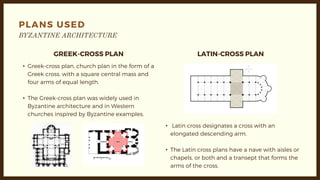
PLANS USED
GREEK-CROSS PLAN LATIN-CROSS PLAN
• Greek-cross plan, church plan in the form of a
Greek cross, with a square central mass and
four arms of equal length.
• The Greek-cross plan was widely used in
Byzantine architecture and in Western
churches inspired by Byzantine examples.
• Latin cross designates a cross with an
elongated descending arm.
• The Latin cross plans have a nave with aisles or
chapels, or both and a transept that forms the
arms of the cross.
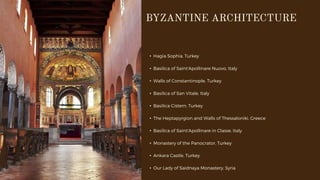
• Hagia Sophia, Turkey
• Basilica of Saint'Apollinare Nuovo, Italy
• Walls of Constantinople, Turkey
• Basilica of San Vitale, Italy
• Basilica Cistern, Turkey
• The Heptapyrgion and Walls of Thessaloniki, Greece
• Basilica of Saint'Apollinare in Classe, Italy
• Monastery of the Panocrator, Turkey
• Ankara Castle, Turkey
• Our Lady of Saidnaya Monastery, Syria
INTRODUCTION
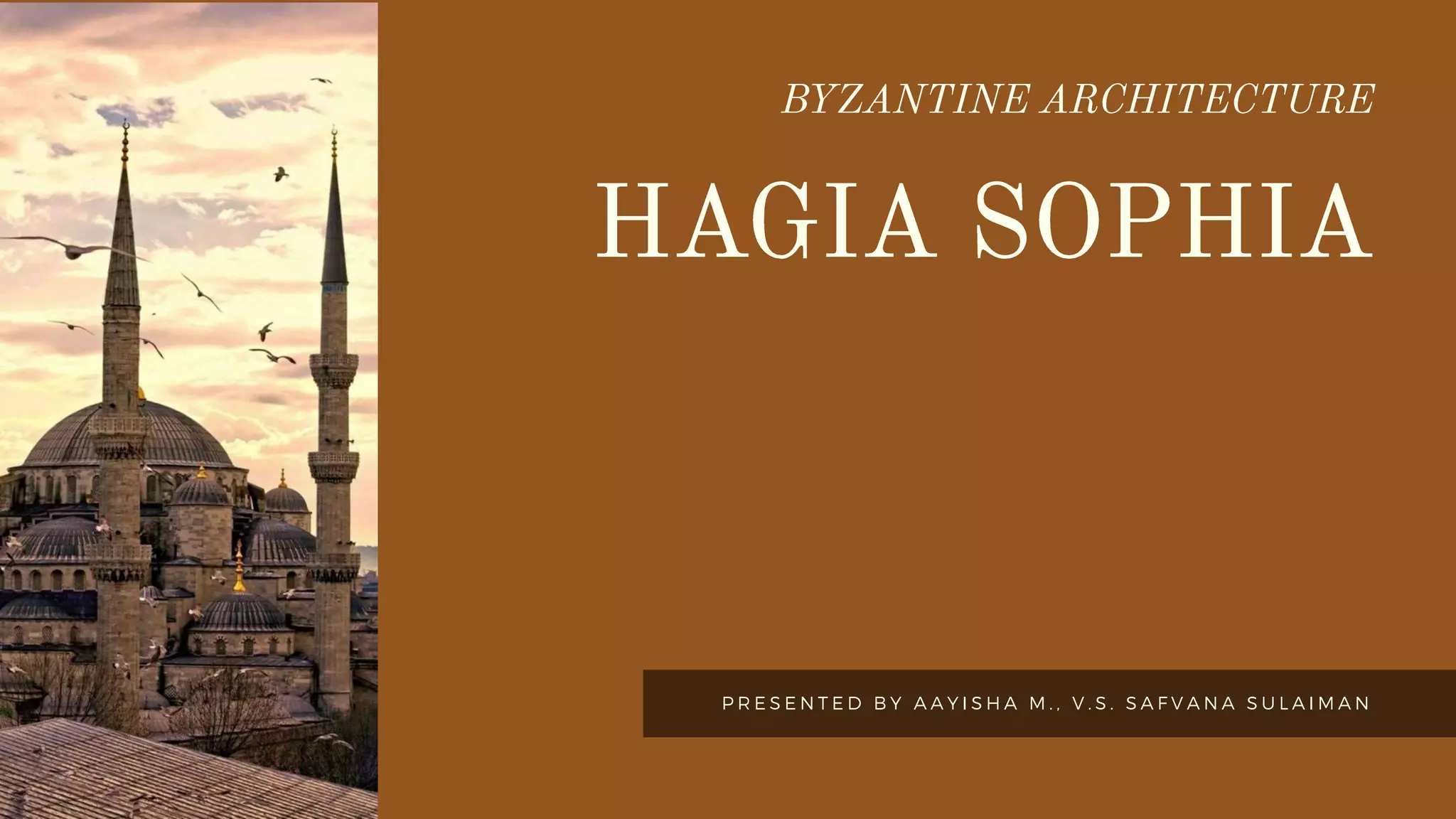
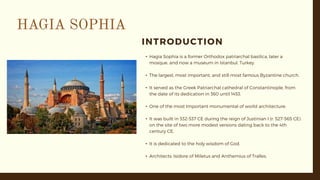
• Hagia Sophia is a former Orthodox patriarchal basilica, later a
mosque, and now a museum in Istanbul, Turkey.
• The largest, most important, and still most famous Byzantine church.
• It served as the Greek Patriarchal cathedral of Constantinople, from
the date of its dedication in 360 until 1453.
• One of the most Important monumental of world architecture.
• It was built in 532-537 CE during the reign of Justinian I (r. 527-565 CE)
on the site of two more modest versions dating back to the 4th
century CE.
• It is dedicated to the holy wisdom of God.
• Architects: Isidore of Miletus and Anthemius of Tralles.
HAGIA SOPHIA
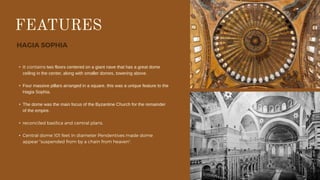
• It contains two floors centered on a giant nave that has a great dome
ceiling in the center, along with smaller domes, towering above.
• Four massive pillars arranged in a square. this was a unique feature to the
Hagia Sophia.
• The dome was the main focus of the Byzantine Church for the remainder
of the empire.
• reconciled basilica and central plans.
• Central dome 101 feet in diameter Pendentives made dome
appear "suspended from by a chain from heaven".
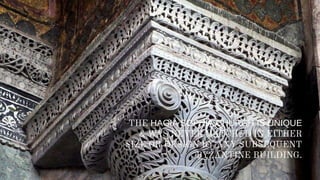
HAGIA SOPHIA CHURCH IS UNIQUE
&
USE OF BRICK AND MORTAR
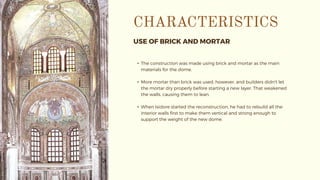
• The construction was made using brick and mortar as the main
materials for the dome.
• More mortar than brick was used, however, and builders didn't let
the mortar dry properly before starting a new layer. That weakened
the walls, causing them to lean.
• When Isidore started the reconstruction, he had to rebuild all the
interior walls first to make them vertical and strong enough to
support the weight of the new dome.
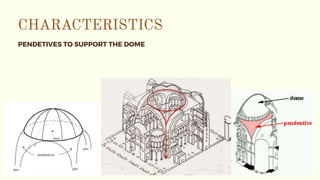
PENDETIVES TO SUPPORT THE DOME
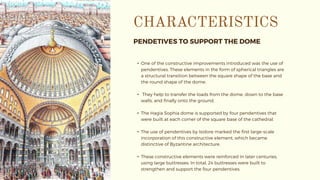
• One of the constructive improvements introduced was the use of
pendentives. These elements in the form of spherical triangles are
a structural transition between the square shape of the base and
the round shape of the dome.
• They help to transfer the loads from the dome, down to the base
walls, and finally onto the ground.
• The Hagia Sophia dome is supported by four pendentives that
were built at each corner of the square base of the cathedral.
• The use of pendentives by Isidore marked the first large-scale
incorporation of this constructive element, which became
distinctive of Byzantine architecture.
• These constructive elements were reinforced in later centuries,
using large buttresses. In total, 24 buttresses were built to
strengthen and support the four pendentives.
PENDETIVES TO SUPPORT THE DOME
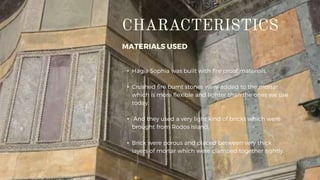
MATERIALS USED
• Hagia Sophia was built with fire proof materials.
• Crushed fire burnt stones were added to the mortar
which is more flexible and lighter than the ones we use
today.
• And they used a very light kind of bricks which were
brought from Rodos Island.
• Brick were porous and placed between very thick
layers of mortar which were clamped together tightly.
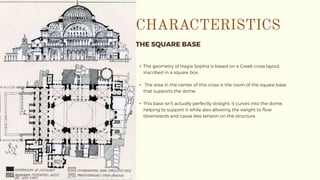
THE SQUARE BASE
• The geometry of Hagia Sophia is based on a Greek cross layout,
inscribed in a square box.
• The area in the center of this cross is the room of the square base
that supports the dome.
• This base isn't actually perfectly straight; it curves into the dome,
helping to support it while also allowing the weight to flow
downwards and cause less tension on the structure.
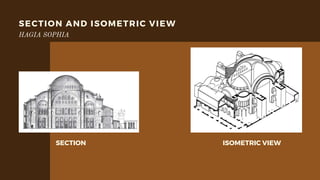
SECTION AND ISOMETRIC VIEW
SECTION ISOMETRIC VIEW
Hagia Sophia.pptx

Hagia Sophia.pptx

  • 1.
    P R ES E N T E D B Y A A Y I S H A M . , V . S . S A F V A N A S U L A I M A N
  • 2.
    • The architectureof the Byzantine Empire. • The Byzantines were an outstanding culture that revolutionized the world of architecture. • Characterized especially by massive domes with square bases and rounded arches and spires and extensive use of glass mosaics. • Early Byzantine architecture was built as a continuation of Roman architecture. • Byzantine structures featured soaring spaces and sumptuous decoration: marble columns and inlay, mosaics on the vaults, inlaid-stone pavements, and sometimes gold coffered ceiling
  • 3.
    • Buildings increasedin geometric complexity, brick and plaster were used in addition to stone in the decoration of important public structures, classical orders were used more freely, mosaics replaced carved decoration, complex domes rested upon massive piers, and windows filtered light through thin sheets of alabaster to softly illuminate interiors. • Christian denomination affected Byzantine architecture. • Byzantine urban areas were characterised by strong evidence of town planning, large open spaces for commercial and public use, wide regular streets • The use of public monuments such as statues of important figures and monumental arches and city gates. .
  • 4.
    PLANS USED GREEK-CROSS PLANLATIN-CROSS PLAN • Greek-cross plan, church plan in the form of a Greek cross, with a square central mass and four arms of equal length. • The Greek-cross plan was widely used in Byzantine architecture and in Western churches inspired by Byzantine examples. • Latin cross designates a cross with an elongated descending arm. • The Latin cross plans have a nave with aisles or chapels, or both and a transept that forms the arms of the cross.
  • 5.
    • Hagia Sophia,Turkey • Basilica of Saint'Apollinare Nuovo, Italy • Walls of Constantinople, Turkey • Basilica of San Vitale, Italy • Basilica Cistern, Turkey • The Heptapyrgion and Walls of Thessaloniki, Greece • Basilica of Saint'Apollinare in Classe, Italy • Monastery of the Panocrator, Turkey • Ankara Castle, Turkey • Our Lady of Saidnaya Monastery, Syria
  • 6.
    INTRODUCTION • Hagia Sophiais a former Orthodox patriarchal basilica, later a mosque, and now a museum in Istanbul, Turkey. • The largest, most important, and still most famous Byzantine church. • It served as the Greek Patriarchal cathedral of Constantinople, from the date of its dedication in 360 until 1453. • One of the most Important monumental of world architecture. • It was built in 532-537 CE during the reign of Justinian I (r. 527-565 CE) on the site of two more modest versions dating back to the 4th century CE. • It is dedicated to the holy wisdom of God. • Architects: Isidore of Miletus and Anthemius of Tralles.
  • 7.
    HAGIA SOPHIA • Itcontains two floors centered on a giant nave that has a great dome ceiling in the center, along with smaller domes, towering above. • Four massive pillars arranged in a square. this was a unique feature to the Hagia Sophia. • The dome was the main focus of the Byzantine Church for the remainder of the empire. • reconciled basilica and central plans. • Central dome 101 feet in diameter Pendentives made dome appear "suspended from by a chain from heaven".
  • 8.
  • 9.
    USE OF BRICKAND MORTAR • The construction was made using brick and mortar as the main materials for the dome. • More mortar than brick was used, however, and builders didn't let the mortar dry properly before starting a new layer. That weakened the walls, causing them to lean. • When Isidore started the reconstruction, he had to rebuild all the interior walls first to make them vertical and strong enough to support the weight of the new dome.
  • 10.
    PENDETIVES TO SUPPORTTHE DOME • One of the constructive improvements introduced was the use of pendentives. These elements in the form of spherical triangles are a structural transition between the square shape of the base and the round shape of the dome. • They help to transfer the loads from the dome, down to the base walls, and finally onto the ground. • The Hagia Sophia dome is supported by four pendentives that were built at each corner of the square base of the cathedral. • The use of pendentives by Isidore marked the first large-scale incorporation of this constructive element, which became distinctive of Byzantine architecture. • These constructive elements were reinforced in later centuries, using large buttresses. In total, 24 buttresses were built to strengthen and support the four pendentives.
  • 11.
  • 12.
    MATERIALS USED • HagiaSophia was built with fire proof materials. • Crushed fire burnt stones were added to the mortar which is more flexible and lighter than the ones we use today. • And they used a very light kind of bricks which were brought from Rodos Island. • Brick were porous and placed between very thick layers of mortar which were clamped together tightly.
  • 13.
    THE SQUARE BASE •The geometry of Hagia Sophia is based on a Greek cross layout, inscribed in a square box. • The area in the center of this cross is the room of the square base that supports the dome. • This base isn't actually perfectly straight; it curves into the dome, helping to support it while also allowing the weight to flow downwards and cause less tension on the structure.
  • 14.
    SECTION AND ISOMETRICVIEW SECTION ISOMETRIC VIEW