GEODESIC DOMES
PANTHEON, ROME
SUBMITTED BY
ANJALI
(75176004)
HISTORY
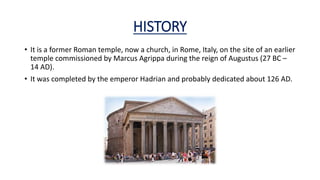
• It is a former Roman temple, now a church, in Rome, Italy, on the site of an earlier
temple commissioned by Marcus Agrippa during the reign of Augustus (27 BC –
14 AD).
• It was completed by the emperor Hadrian and probably dedicated about 126 AD.
ABOUT PANTHEON
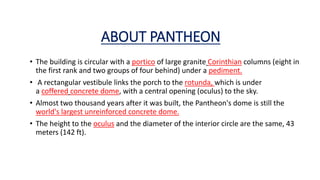
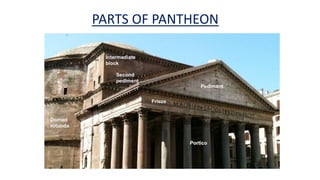
• The building is circular with a portico of large granite Corinthian columns (eight in
the first rank and two groups of four behind) under a pediment.
• A rectangular vestibule links the porch to the rotunda, which is under
a coffered concrete dome, with a central opening (oculus) to the sky.
• Almost two thousand years after it was built, the Pantheon's dome is still the
world's largest unreinforced concrete dome.
• The height to the oculus and the diameter of the interior circle are the same, 43
meters (142 ft).
PARTS OF PANTHEON
Pantheon's Worlds Largest Circular Domed CELLA
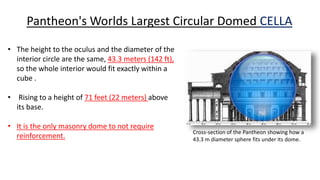
Cross-section of the Pantheon showing how a
43.3 m diameter sphere fits under its dome.
• The height to the oculus and the diameter of the
interior circle are the same, 43.3 meters (142 ft),
so the whole interior would fit exactly within a
cube .
• Rising to a height of 71 feet (22 meters) above
its base.
• It is the only masonry dome to not require
reinforcement.
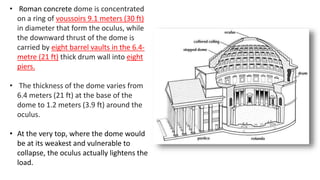
• Roman concrete dome is concentrated
on a ring of voussoirs 9.1 meters (30 ft)
in diameter that form the oculus, while
the downward thrust of the dome is
carried by eight barrel vaults in the 6.4-
metre (21 ft) thick drum wall into eight
piers.
• The thickness of the dome varies from
6.4 meters (21 ft) at the base of the
dome to 1.2 meters (3.9 ft) around the
oculus.
• At the very top, where the dome would
be at its weakest and vulnerable to
collapse, the oculus actually lightens the
load.
MATERIAL
• The materials used in the concrete of the dome also varies.
• At its thickest point, the aggregate is travertine, then terracotta tiles, then at the
very top, tufa and pumice, both porous light stones.
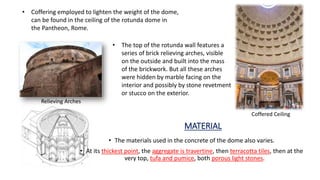
• Coffering employed to lighten the weight of the dome,
can be found in the ceiling of the rotunda dome in
the Pantheon, Rome.
• The top of the rotunda wall features a
series of brick relieving arches, visible
on the outside and built into the mass
of the brickwork. But all these arches
were hidden by marble facing on the
interior and possibly by stone revetment
or stucco on the exterior.
Relieving Arches
Coffered Ceiling
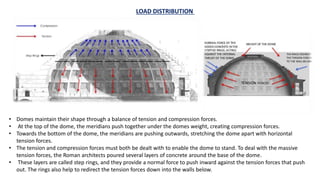
• Domes maintain their shape through a balance of tension and compression forces.
• At the top of the dome, the meridians push together under the domes weight, creating compression forces.
• Towards the bottom of the dome, the meridians are pushing outwards, stretching the dome apart with horizontal
tension forces.
• The tension and compression forces must both be dealt with to enable the dome to stand. To deal with the massive
tension forces, the Roman architects poured several layers of concrete around the base of the dome.
• These layers are called step rings, and they provide a normal force to push inward against the tension forces that push
out. The rings also help to redirect the tension forces down into the walls below.
LOAD DISTRIBUTION
COFFER DESIGN
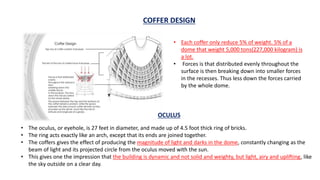
• Each coffer only reduce 5% of weight. 5% of a
dome that weight 5,000 tons(227,000 kilogram) is
a lot.
• Forces is that distributed evenly throughout the
surface is then breaking down into smaller forces
in the recesses. Thus less down the forces carried
by the whole dome.
OCULUS
• The oculus, or eyehole, is 27 feet in diameter, and made up of 4.5 foot thick ring of bricks.
• The ring acts exactly like an arch, except that its ends are joined together.
• The coffers gives the effect of producing the magnitude of light and darks in the dome, constantly changing as the
beam of light and its projected circle from the oculus moved with the sun.
• This gives one the impression that the building is dynamic and not solid and weighty, but light, airy and uplifting, like
the sky outside on a clear day.
THANK YOU

Pantheon

  • 1.
  • 2.
    HISTORY • It isa former Roman temple, now a church, in Rome, Italy, on the site of an earlier temple commissioned by Marcus Agrippa during the reign of Augustus (27 BC – 14 AD). • It was completed by the emperor Hadrian and probably dedicated about 126 AD.
  • 3.
    ABOUT PANTHEON • Thebuilding is circular with a portico of large granite Corinthian columns (eight in the first rank and two groups of four behind) under a pediment. • A rectangular vestibule links the porch to the rotunda, which is under a coffered concrete dome, with a central opening (oculus) to the sky. • Almost two thousand years after it was built, the Pantheon's dome is still the world's largest unreinforced concrete dome. • The height to the oculus and the diameter of the interior circle are the same, 43 meters (142 ft).
  • 4.
  • 5.
    Pantheon's Worlds LargestCircular Domed CELLA Cross-section of the Pantheon showing how a 43.3 m diameter sphere fits under its dome. • The height to the oculus and the diameter of the interior circle are the same, 43.3 meters (142 ft), so the whole interior would fit exactly within a cube . • Rising to a height of 71 feet (22 meters) above its base. • It is the only masonry dome to not require reinforcement.
  • 6.
    • Roman concretedome is concentrated on a ring of voussoirs 9.1 meters (30 ft) in diameter that form the oculus, while the downward thrust of the dome is carried by eight barrel vaults in the 6.4- metre (21 ft) thick drum wall into eight piers. • The thickness of the dome varies from 6.4 meters (21 ft) at the base of the dome to 1.2 meters (3.9 ft) around the oculus. • At the very top, where the dome would be at its weakest and vulnerable to collapse, the oculus actually lightens the load.
  • 7.
    MATERIAL • The materialsused in the concrete of the dome also varies. • At its thickest point, the aggregate is travertine, then terracotta tiles, then at the very top, tufa and pumice, both porous light stones. • Coffering employed to lighten the weight of the dome, can be found in the ceiling of the rotunda dome in the Pantheon, Rome. • The top of the rotunda wall features a series of brick relieving arches, visible on the outside and built into the mass of the brickwork. But all these arches were hidden by marble facing on the interior and possibly by stone revetment or stucco on the exterior. Relieving Arches Coffered Ceiling
  • 8.
    • Domes maintaintheir shape through a balance of tension and compression forces. • At the top of the dome, the meridians push together under the domes weight, creating compression forces. • Towards the bottom of the dome, the meridians are pushing outwards, stretching the dome apart with horizontal tension forces. • The tension and compression forces must both be dealt with to enable the dome to stand. To deal with the massive tension forces, the Roman architects poured several layers of concrete around the base of the dome. • These layers are called step rings, and they provide a normal force to push inward against the tension forces that push out. The rings also help to redirect the tension forces down into the walls below. LOAD DISTRIBUTION
  • 9.
    COFFER DESIGN • Eachcoffer only reduce 5% of weight. 5% of a dome that weight 5,000 tons(227,000 kilogram) is a lot. • Forces is that distributed evenly throughout the surface is then breaking down into smaller forces in the recesses. Thus less down the forces carried by the whole dome. OCULUS • The oculus, or eyehole, is 27 feet in diameter, and made up of 4.5 foot thick ring of bricks. • The ring acts exactly like an arch, except that its ends are joined together. • The coffers gives the effect of producing the magnitude of light and darks in the dome, constantly changing as the beam of light and its projected circle from the oculus moved with the sun. • This gives one the impression that the building is dynamic and not solid and weighty, but light, airy and uplifting, like the sky outside on a clear day.
  • 10.