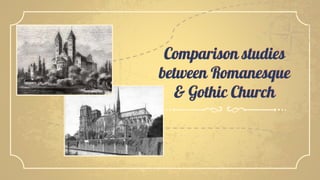
Comparison studies
between Romanesque
& Gothic Church
Introduction for Romanesque
Architecture
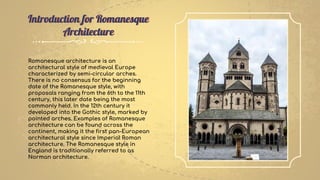
Romanesque architecture is an
architectural style of medieval Europe
characterized by semi-circular arches.
There is no consensus for the beginning
date of the Romanesque style, with
proposals ranging from the 6th to the 11th
century, this later date being the most
commonly held. In the 12th century it
developed into the Gothic style, marked by
pointed arches. Examples of Romanesque
architecture can be found across the
continent, making it the first pan-European
architectural style since Imperial Roman
architecture. The Romanesque style in
England is traditionally referred to as
Norman architecture.
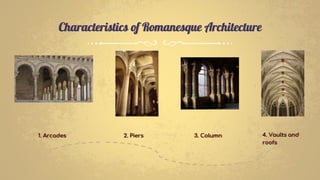
Characteristics of Romanesque Architecture
1. Arcades 2. Piers 3. Column 4. Vaults and
roofs
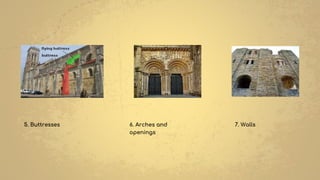
5. Buttresses 6. Arches and
openings
7. Walls
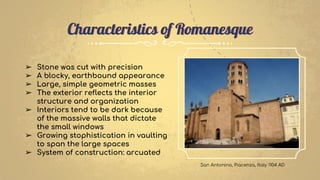
➢ Stone was cut with precision
➢ A blocky, earthbound appearance
➢ Large, simple geometric masses
➢ The exterior reflects the interior
structure and organization
➢ Interiors tend to be dark because
of the massive walls that dictate
the small windows
➢ Growing stophistication in vaulting
to span the large spaces
➢ System of construction: arcuated
Characteristics of Romanesque
San Antonino, Piacenza, Italy 1104 AD
Other Romanesque features :
● Ecclesiastical and secular buildings, is one of massive solidity and strength in
which the load bearing structural members are columns, pilasters and arches
not the walls or sections of walls
● The walls of Romanesque buildings are often of massive thickness with few
and comparatively small openings. They are often double shells, filled with
rubble.
● Buttresses are not a highly significant feature as in Gothic architecture.
because of the massive nature of Romanesque walls
● The arches used in Romanesque architecture are nearly always semicircular,
for openings such as doors and windows, for vaults and for arcades. Wide
doorways are usually surmounted by a semicircular arch
● Arcades separates the nave from the aisles, and in large secular interiors
spaces, such as the great hall of a castle, supporting the timbers of a roof or
upper floor. Arcades also occur in cloisters and atriums, enclosing an open
space. the arcades that separate large interior spaces of castles, is the
alternation of piers and columns.
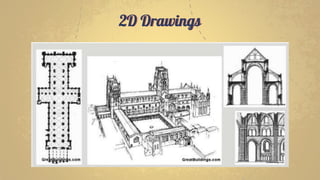
2D Drawings
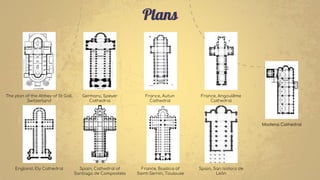
Plans
The plan of the Abbey of St Gall,
Switzerland
Germany, Speyer
Cathedral
France, Autun
Cathedral
France, Angoulême
Cathedral
England, Ely Cathedral Spain, Cathedral of
Santiago de Compostela
France, Basilica of
Saint-Sernin, Toulouse
Spain, San Isidoro de
León
Modena Cathedral
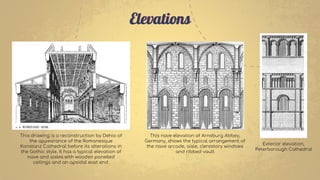
Elevations
This drawing is a reconstruction by Dehio of
the appearance of the Romanesque
Konstanz Cathedral before its alterations in
the Gothic style. It has a typical elevation of
nave and aisles with wooden panelled
ceilings and an apsidal east end.
This nave elevation of Arnsburg Abbey,
Germany, shows the typical arrangement of
the nave arcade, aisle, clerestory windows
and ribbed vault
Exterior elevation,
Peterborough Cathedral
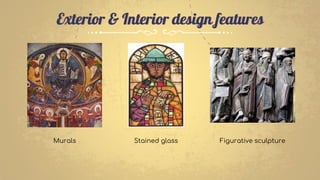
Exterior & Interior design features
Murals Stained glass Figurative sculpture
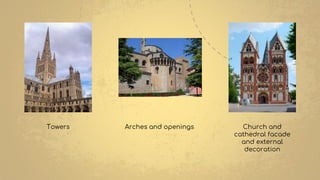
Towers Church and
cathedral facade
and external
decoration
Arches and openings
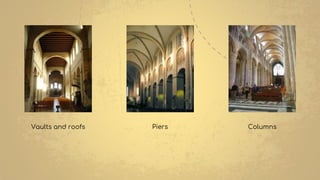
Vaults and roofs Columns
Piers
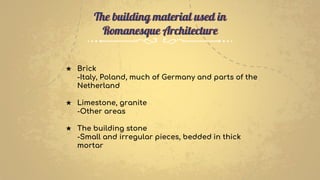
★ Brick
-Italy, Poland, much of Germany and parts of the
Netherland
★ Limestone, granite
-Other areas
★ The building stone
-Small and irregular pieces, bedded in thick
mortar
The building material used in
Romanesque Architecture
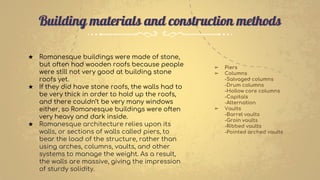
★ Romanesque buildings were made of stone,
but often had wooden roofs because people
were still not very good at building stone
roofs yet.
★ If they did have stone roofs, the walls had to
be very thick in order to hold up the roofs,
and there couldn’t be very many windows
either, so Romanesque buildings were often
very heavy and dark inside.
★ Romanesque architecture relies upon its
walls, or sections of walls called piers, to
bear the load of the structure, rather than
using arches, columns, vaults, and other
systems to manage the weight. As a result,
the walls are massive, giving the impression
of sturdy solidity.
Building materials and construction methods
➢ Piers
➢ Columns
-Salvaged columns
-Drum columns
-Hollow core columns
-Capitals
-Alternation
➢ Vaults
-Barrel vaults
-Groin vaults
-Ribbed vaults
-Pointed arched vaults
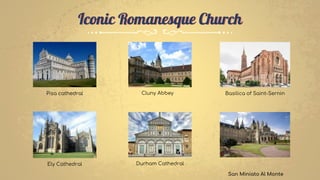
Iconic Romanesque Church
Pisa cathedral Cluny Abbey Basilica of Saint-Sernin
Ely Cathedral Durham Cathedral
San Miniato Al Monte
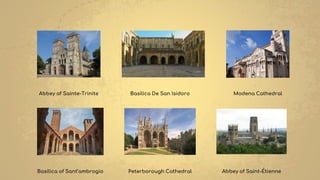
Abbey of Sainte-Trinite Basilica De San Isidoro Modena Cathedral
Basilica of Sant’ambrogio Peterborough Cathedral Abbey of Saint-Étienne
Introduction for Gothic
Architecture
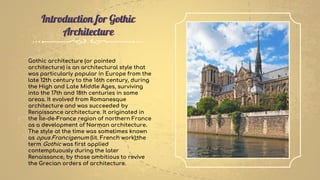
Gothic architecture (or pointed
architecture) is an architectural style that
was particularly popular in Europe from the
late 12th century to the 16th century, during
the High and Late Middle Ages, surviving
into the 17th and 18th centuries in some
areas. It evolved from Romanesque
architecture and was succeeded by
Renaissance architecture. It originated in
the Île-de-France region of northern France
as a development of Norman architecture.
The style at the time was sometimes known
as opus Francigenum (lit. French work);the
term Gothic was first applied
contemptuously during the later
Renaissance, by those ambitious to revive
the Grecian orders of architecture.
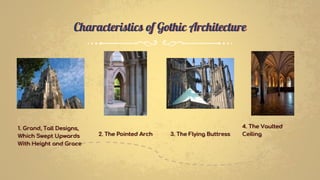
Characteristics of Gothic Architecture
1. Grand, Tall Designs,
Which Swept Upwards
With Height and Grace
2. The Pointed Arch 3. The Flying Buttress
4. The Vaulted
Ceiling
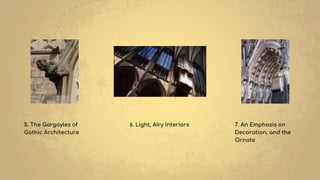
5. The Gargoyles of
Gothic Architecture
6. Light, Airy Interiors 7. An Emphasis on
Decoration, and the
Ornate
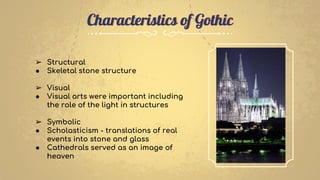
➢ Structural
● Skeletal stone structure
➢ Visual
● Visual arts were important including
the role of the light in structures
➢ Symbolic
● Scholasticism - translations of real
events into stone and glass
● Cathedrals served as an image of
heaven
Characteristics of Gothic
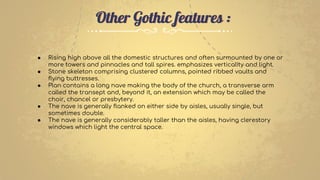
Other Gothic features :
● Rising high above all the domestic structures and often surmounted by one or
more towers and pinnacles and tall spires. emphasizes verticality and light.
● Stone skeleton comprising clustered columns, pointed ribbed vaults and
flying buttresses.
● Plan contains a long nave making the body of the church, a transverse arm
called the transept and, beyond it, an extension which may be called the
choir, chancel or presbytery.
● The nave is generally flanked on either side by aisles, usually single, but
sometimes double.
● The nave is generally considerably taller than the aisles, having clerestory
windows which light the central space.
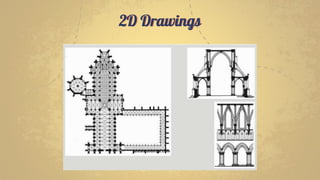
2D Drawings
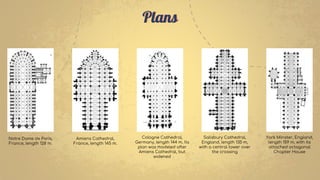
Plans
Notre Dame de Paris,
France, length 128 m.
Amiens Cathedral,
France, length 145 m.
Cologne Cathedral,
Germany, length 144 m, Its
plan was modeled after
Amiens Cathedral, but
widened
Salisbury Cathedral,
England, length 135 m,
with a central tower over
the crossing
York Minster, England,
length 159 m, with its
attached octagonal
Chapter House
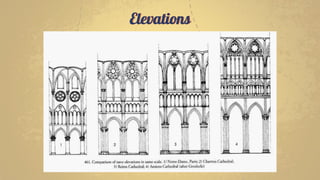
Elevations
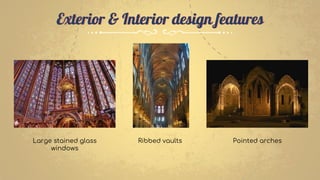
Exterior & Interior design features
Large stained glass
windows
Ribbed vaults Pointed arches
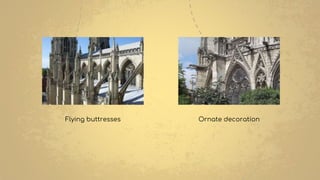
Flying buttresses Ornate decoration
★ Brick and tiles
-Netherland, Denmark, Baltic countries and
Northern Poland
★ Limestone
-France
★ Sandstone and purbeck marble
-England
★ Stone
-Italy
The building material used in Gothic
Architecture
★ Ribbed vaults: arched ceilings made of stone. In the
Gothic style they were held up by stone ribs. A
skeleton of stonework with great big glass windows in
between. Flying buttresses: buttresses that help to
hold the vault up.
★ While the Gothic style can vary according to location,
age, and type of building, it is often characterized by
5 key architectural elements: large stained glass
windows, pointed arches, ribbed vaults, flying
buttresses, and ornate decoration.
★ The walls and pillars, timber scaffolding and roof
were built first. Once the roof was in place, and the
walls were reinforced with buttresses, the
construction of the vaults could begin. One of the
most complex steps was the construction of the rib
vaults, which covered the nave and choir.
Building materials and construction methods
Iconic Gothic Church
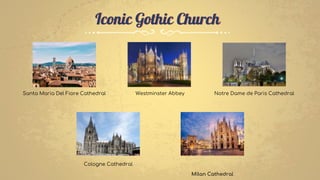
Santa Maria Del Fiore Cathedral Westminster Abbey Notre Dame de Paris Cathedral
Cologne Cathedral
Milan Cathedral
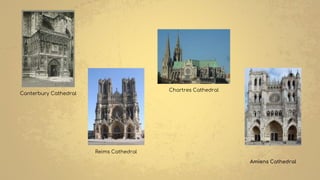
Canterbury Cathedral
Chartres Cathedral
Reims Cathedral
Amiens Cathedral
I would prefer Gothic architectural style because it can be recognized with
seven main featured elements; flying buttresses, vaulted ceilings, pointed
arches, gargoyles, light and airy interiors, height, and Christian features. The
form of Gothic architecture is recognized as light and freedom. Found in
various areas of Europe, Gothic architecture is no longer constructed after
the 1800’s and its style can be referenced as medieval era. Its architecture is
priceless and are set as monuments that can be visited by all people around
the world. The significance of Gothic architecture has made some beautiful
buildings. Its history has brought on the importance of how its elements
influenced other styles to evolve as well. The innovation of religion also lays in
the structure and monumental buildings for centuries beyond our times. The
development is unique to its own and is not found in every corner of the world.
Gothic Styles are part of history and will remain as history, like all other art
generations.
Conclusion
Thank you

Comparison studies between Romanesque and Gothic architecture

  • 1.
  • 2.
    Introduction for Romanesque Architecture Romanesquearchitecture is an architectural style of medieval Europe characterized by semi-circular arches. There is no consensus for the beginning date of the Romanesque style, with proposals ranging from the 6th to the 11th century, this later date being the most commonly held. In the 12th century it developed into the Gothic style, marked by pointed arches. Examples of Romanesque architecture can be found across the continent, making it the first pan-European architectural style since Imperial Roman architecture. The Romanesque style in England is traditionally referred to as Norman architecture.
  • 3.
    Characteristics of RomanesqueArchitecture 1. Arcades 2. Piers 3. Column 4. Vaults and roofs
  • 4.
    5. Buttresses 6.Arches and openings 7. Walls
  • 5.
    ➢ Stone wascut with precision ➢ A blocky, earthbound appearance ➢ Large, simple geometric masses ➢ The exterior reflects the interior structure and organization ➢ Interiors tend to be dark because of the massive walls that dictate the small windows ➢ Growing stophistication in vaulting to span the large spaces ➢ System of construction: arcuated Characteristics of Romanesque San Antonino, Piacenza, Italy 1104 AD
  • 6.
    Other Romanesque features: ● Ecclesiastical and secular buildings, is one of massive solidity and strength in which the load bearing structural members are columns, pilasters and arches not the walls or sections of walls ● The walls of Romanesque buildings are often of massive thickness with few and comparatively small openings. They are often double shells, filled with rubble. ● Buttresses are not a highly significant feature as in Gothic architecture. because of the massive nature of Romanesque walls ● The arches used in Romanesque architecture are nearly always semicircular, for openings such as doors and windows, for vaults and for arcades. Wide doorways are usually surmounted by a semicircular arch ● Arcades separates the nave from the aisles, and in large secular interiors spaces, such as the great hall of a castle, supporting the timbers of a roof or upper floor. Arcades also occur in cloisters and atriums, enclosing an open space. the arcades that separate large interior spaces of castles, is the alternation of piers and columns.
  • 7.
  • 8.
    Plans The plan ofthe Abbey of St Gall, Switzerland Germany, Speyer Cathedral France, Autun Cathedral France, Angoulême Cathedral England, Ely Cathedral Spain, Cathedral of Santiago de Compostela France, Basilica of Saint-Sernin, Toulouse Spain, San Isidoro de León Modena Cathedral
  • 9.
    Elevations This drawing isa reconstruction by Dehio of the appearance of the Romanesque Konstanz Cathedral before its alterations in the Gothic style. It has a typical elevation of nave and aisles with wooden panelled ceilings and an apsidal east end. This nave elevation of Arnsburg Abbey, Germany, shows the typical arrangement of the nave arcade, aisle, clerestory windows and ribbed vault Exterior elevation, Peterborough Cathedral
  • 10.
    Exterior & Interiordesign features Murals Stained glass Figurative sculpture
  • 11.
    Towers Church and cathedralfacade and external decoration Arches and openings
  • 12.
    Vaults and roofsColumns Piers
  • 13.
    ★ Brick -Italy, Poland,much of Germany and parts of the Netherland ★ Limestone, granite -Other areas ★ The building stone -Small and irregular pieces, bedded in thick mortar The building material used in Romanesque Architecture
  • 14.
    ★ Romanesque buildingswere made of stone, but often had wooden roofs because people were still not very good at building stone roofs yet. ★ If they did have stone roofs, the walls had to be very thick in order to hold up the roofs, and there couldn’t be very many windows either, so Romanesque buildings were often very heavy and dark inside. ★ Romanesque architecture relies upon its walls, or sections of walls called piers, to bear the load of the structure, rather than using arches, columns, vaults, and other systems to manage the weight. As a result, the walls are massive, giving the impression of sturdy solidity. Building materials and construction methods ➢ Piers ➢ Columns -Salvaged columns -Drum columns -Hollow core columns -Capitals -Alternation ➢ Vaults -Barrel vaults -Groin vaults -Ribbed vaults -Pointed arched vaults
  • 15.
    Iconic Romanesque Church Pisacathedral Cluny Abbey Basilica of Saint-Sernin Ely Cathedral Durham Cathedral San Miniato Al Monte
  • 16.
    Abbey of Sainte-TriniteBasilica De San Isidoro Modena Cathedral Basilica of Sant’ambrogio Peterborough Cathedral Abbey of Saint-Étienne
  • 17.
    Introduction for Gothic Architecture Gothicarchitecture (or pointed architecture) is an architectural style that was particularly popular in Europe from the late 12th century to the 16th century, during the High and Late Middle Ages, surviving into the 17th and 18th centuries in some areas. It evolved from Romanesque architecture and was succeeded by Renaissance architecture. It originated in the Île-de-France region of northern France as a development of Norman architecture. The style at the time was sometimes known as opus Francigenum (lit. French work);the term Gothic was first applied contemptuously during the later Renaissance, by those ambitious to revive the Grecian orders of architecture.
  • 18.
    Characteristics of GothicArchitecture 1. Grand, Tall Designs, Which Swept Upwards With Height and Grace 2. The Pointed Arch 3. The Flying Buttress 4. The Vaulted Ceiling
  • 19.
    5. The Gargoylesof Gothic Architecture 6. Light, Airy Interiors 7. An Emphasis on Decoration, and the Ornate
  • 20.
    ➢ Structural ● Skeletalstone structure ➢ Visual ● Visual arts were important including the role of the light in structures ➢ Symbolic ● Scholasticism - translations of real events into stone and glass ● Cathedrals served as an image of heaven Characteristics of Gothic
  • 21.
    Other Gothic features: ● Rising high above all the domestic structures and often surmounted by one or more towers and pinnacles and tall spires. emphasizes verticality and light. ● Stone skeleton comprising clustered columns, pointed ribbed vaults and flying buttresses. ● Plan contains a long nave making the body of the church, a transverse arm called the transept and, beyond it, an extension which may be called the choir, chancel or presbytery. ● The nave is generally flanked on either side by aisles, usually single, but sometimes double. ● The nave is generally considerably taller than the aisles, having clerestory windows which light the central space.
  • 22.
  • 23.
    Plans Notre Dame deParis, France, length 128 m. Amiens Cathedral, France, length 145 m. Cologne Cathedral, Germany, length 144 m, Its plan was modeled after Amiens Cathedral, but widened Salisbury Cathedral, England, length 135 m, with a central tower over the crossing York Minster, England, length 159 m, with its attached octagonal Chapter House
  • 24.
  • 25.
    Exterior & Interiordesign features Large stained glass windows Ribbed vaults Pointed arches
  • 26.
  • 27.
    ★ Brick andtiles -Netherland, Denmark, Baltic countries and Northern Poland ★ Limestone -France ★ Sandstone and purbeck marble -England ★ Stone -Italy The building material used in Gothic Architecture
  • 28.
    ★ Ribbed vaults:arched ceilings made of stone. In the Gothic style they were held up by stone ribs. A skeleton of stonework with great big glass windows in between. Flying buttresses: buttresses that help to hold the vault up. ★ While the Gothic style can vary according to location, age, and type of building, it is often characterized by 5 key architectural elements: large stained glass windows, pointed arches, ribbed vaults, flying buttresses, and ornate decoration. ★ The walls and pillars, timber scaffolding and roof were built first. Once the roof was in place, and the walls were reinforced with buttresses, the construction of the vaults could begin. One of the most complex steps was the construction of the rib vaults, which covered the nave and choir. Building materials and construction methods
  • 29.
    Iconic Gothic Church SantaMaria Del Fiore Cathedral Westminster Abbey Notre Dame de Paris Cathedral Cologne Cathedral Milan Cathedral
  • 30.
  • 31.
    I would preferGothic architectural style because it can be recognized with seven main featured elements; flying buttresses, vaulted ceilings, pointed arches, gargoyles, light and airy interiors, height, and Christian features. The form of Gothic architecture is recognized as light and freedom. Found in various areas of Europe, Gothic architecture is no longer constructed after the 1800’s and its style can be referenced as medieval era. Its architecture is priceless and are set as monuments that can be visited by all people around the world. The significance of Gothic architecture has made some beautiful buildings. Its history has brought on the importance of how its elements influenced other styles to evolve as well. The innovation of religion also lays in the structure and monumental buildings for centuries beyond our times. The development is unique to its own and is not found in every corner of the world. Gothic Styles are part of history and will remain as history, like all other art generations. Conclusion
  • 32.