The Pantheon  Rome, Italy Drew Matthews and Cassi Lau
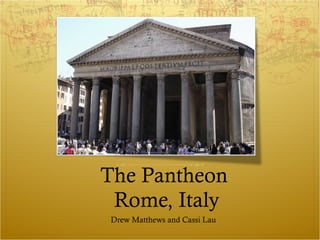
The Pantheon One of the wonders of the ancient world and one of Rome’s most popular tourist attractions It was once used as a temple to honor all gods and now used as a Roman Catholic church Pantheon in Greek means “to honor all gods” The inscription on the Pantheon reads: " M·AGRIPPA·L·F·COS·TERTIVM·FECIT ” which translates to "'Marcus Agrippa, son of Lucius, Consul for the third time, built this”
The Pantheon sits on the southern edge of the Piazza Della Rotonda, one of the city's most famous plazas  At the center of the plaza is a towering obelisk, which Pope Clement XI placed in the early 1700s
The Piazza della Rotonda with its beautiful fountain designed by Giacomo Della Porta. The Piazza della Rotonda is a lively square filled with cafes, bars, and restaurants.
History Pantheon was first built by Augustus’s general Marcus Agrippa in 27 BC and later reconstructed by Emperor Hadrian in 125 AD In 608 AD the Byzantine Emperor Phocas gave the building to Pope Boniface IV, who converted it to a Christian church, that was dedicated to “St. Mary and the Martyrs” In the early 17 th  Century, Pope Urban VIII removed the bronze beams of the portico, using the bronze to construct the canopy that covers the altar at St. Peter’s Basilica
History Since the Renaissance the Pantheon has been used as a tomb  The building houses the tombs of two 19 th  Century kings Victor Emmanuel II and Umberto I  And also serves as the burial place of the painter Raphael
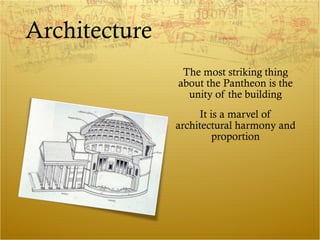
The most striking thing about the Pantheon is the unity of the building It is a marvel of architectural harmony and proportion Architecture
Beneath the light and between the granite Corinthian columns, seven sculptures stand  These Roman gods correspond to each of the seven planets (at the time) and remain in their original spots Architecture
Columns The ranks of columns consist of eight in the first row, and two groups of four behind The massive columns supporting the portico weigh 60 tons. Each is 39 feet tall and 5 feet in diameter They were made from stone quarried in Egypt
Oculus The opening at the top of the Pantheon, the oculus, is nearly 30 feet in diameter and was the temples only source of light The oculus also serves as a cooling and ventilation method
Rotunda The concrete dome is 4,535 metric tons  The top of the rotunda wall features a series of brick relieving arches, visible on the outside and built into the mass of the brickwork
Portico A rectangular structure links the portico with the rotunda. In the walls at the back of the portico were niches for statues of Caesar, Augustus and Agrippa
The pediment was decorated with a sculpture in bronze showing the Battle of the Titans The building was originally approached by a flight of steps. The ground level in the surrounding area has risen considerably since antiquity
Interior The interior of the Pantheon was painted by Giovanni Paolo Panini in the 18th century Each zone of the interior, from floor to ceiling, is subdivided according to a different scheme. As a result, the interior decorative zones do not line up.
Circles and squares form the unifying theme of the interior design. The checkerboard floor pattern contrasts with the concentric circles of square coffers in the dome
Religion It’s possible that the Pantheon had an impact on Western religion  the Pantheon appears to be the first temple built with general public access in mind  Temples of the ancient world were generally limited only to specific priests  The Pantheon existed for all the people
The Pantheon is still used as a church today Masses are celebrated there on important Catholic days of obligation and weddings
Getting  there…

Pantheon

  • 1.
    The Pantheon Rome, Italy Drew Matthews and Cassi Lau
  • 2.
    The Pantheon Oneof the wonders of the ancient world and one of Rome’s most popular tourist attractions It was once used as a temple to honor all gods and now used as a Roman Catholic church Pantheon in Greek means “to honor all gods” The inscription on the Pantheon reads: " M·AGRIPPA·L·F·COS·TERTIVM·FECIT ” which translates to "'Marcus Agrippa, son of Lucius, Consul for the third time, built this”
  • 3.
    The Pantheon sitson the southern edge of the Piazza Della Rotonda, one of the city's most famous plazas At the center of the plaza is a towering obelisk, which Pope Clement XI placed in the early 1700s
  • 4.
    The Piazza dellaRotonda with its beautiful fountain designed by Giacomo Della Porta. The Piazza della Rotonda is a lively square filled with cafes, bars, and restaurants.
  • 5.
    History Pantheon wasfirst built by Augustus’s general Marcus Agrippa in 27 BC and later reconstructed by Emperor Hadrian in 125 AD In 608 AD the Byzantine Emperor Phocas gave the building to Pope Boniface IV, who converted it to a Christian church, that was dedicated to “St. Mary and the Martyrs” In the early 17 th Century, Pope Urban VIII removed the bronze beams of the portico, using the bronze to construct the canopy that covers the altar at St. Peter’s Basilica
  • 6.
    History Since theRenaissance the Pantheon has been used as a tomb The building houses the tombs of two 19 th Century kings Victor Emmanuel II and Umberto I And also serves as the burial place of the painter Raphael
  • 7.
    The most strikingthing about the Pantheon is the unity of the building It is a marvel of architectural harmony and proportion Architecture
  • 8.
    Beneath the lightand between the granite Corinthian columns, seven sculptures stand These Roman gods correspond to each of the seven planets (at the time) and remain in their original spots Architecture
  • 9.
    Columns The ranksof columns consist of eight in the first row, and two groups of four behind The massive columns supporting the portico weigh 60 tons. Each is 39 feet tall and 5 feet in diameter They were made from stone quarried in Egypt
  • 10.
    Oculus The openingat the top of the Pantheon, the oculus, is nearly 30 feet in diameter and was the temples only source of light The oculus also serves as a cooling and ventilation method
  • 11.
    Rotunda The concretedome is 4,535 metric tons The top of the rotunda wall features a series of brick relieving arches, visible on the outside and built into the mass of the brickwork
  • 12.
    Portico A rectangularstructure links the portico with the rotunda. In the walls at the back of the portico were niches for statues of Caesar, Augustus and Agrippa
  • 13.
    The pediment wasdecorated with a sculpture in bronze showing the Battle of the Titans The building was originally approached by a flight of steps. The ground level in the surrounding area has risen considerably since antiquity
  • 14.
    Interior The interiorof the Pantheon was painted by Giovanni Paolo Panini in the 18th century Each zone of the interior, from floor to ceiling, is subdivided according to a different scheme. As a result, the interior decorative zones do not line up.
  • 15.
    Circles and squaresform the unifying theme of the interior design. The checkerboard floor pattern contrasts with the concentric circles of square coffers in the dome
  • 16.
    Religion It’s possiblethat the Pantheon had an impact on Western religion the Pantheon appears to be the first temple built with general public access in mind Temples of the ancient world were generally limited only to specific priests The Pantheon existed for all the people
  • 17.
    The Pantheon isstill used as a church today Masses are celebrated there on important Catholic days of obligation and weddings
  • 18.

Editor's Notes

  • #9 - Placed in seven splendid niches between two Corinthian columns the used to be the seven gods linked to the worship of planets, or considered to be such: the Sun, the Moon, Venus, Saturn, Jupiter, Mercury and Mars. With the advent of Christianity, some of them were used for small altars dedicated to Christian Martyrs.
  • #10 - The columns were transported by wooden sledges to the Nile, barged to Alexandria, and put on vessels for a trip across the Mediterranean to the port of Ostia. From there the columns came up the Tiber by barge.
  • #12 - The base was mostly built with basalt, top pumice
  • #13 Holes may still be seen where the clamps which held the sculpture in place were fixed.
  • #17 -The Roman Pantheon seems to exist independent of religious rule - more a tribute to the past than any specific spiritual figures.