First created. Feb 2010. London. Jerry Daperro. Version 4.0. 26 Feb 2022.
Pieter Bruegel the
Elder
Epic of Every day Life
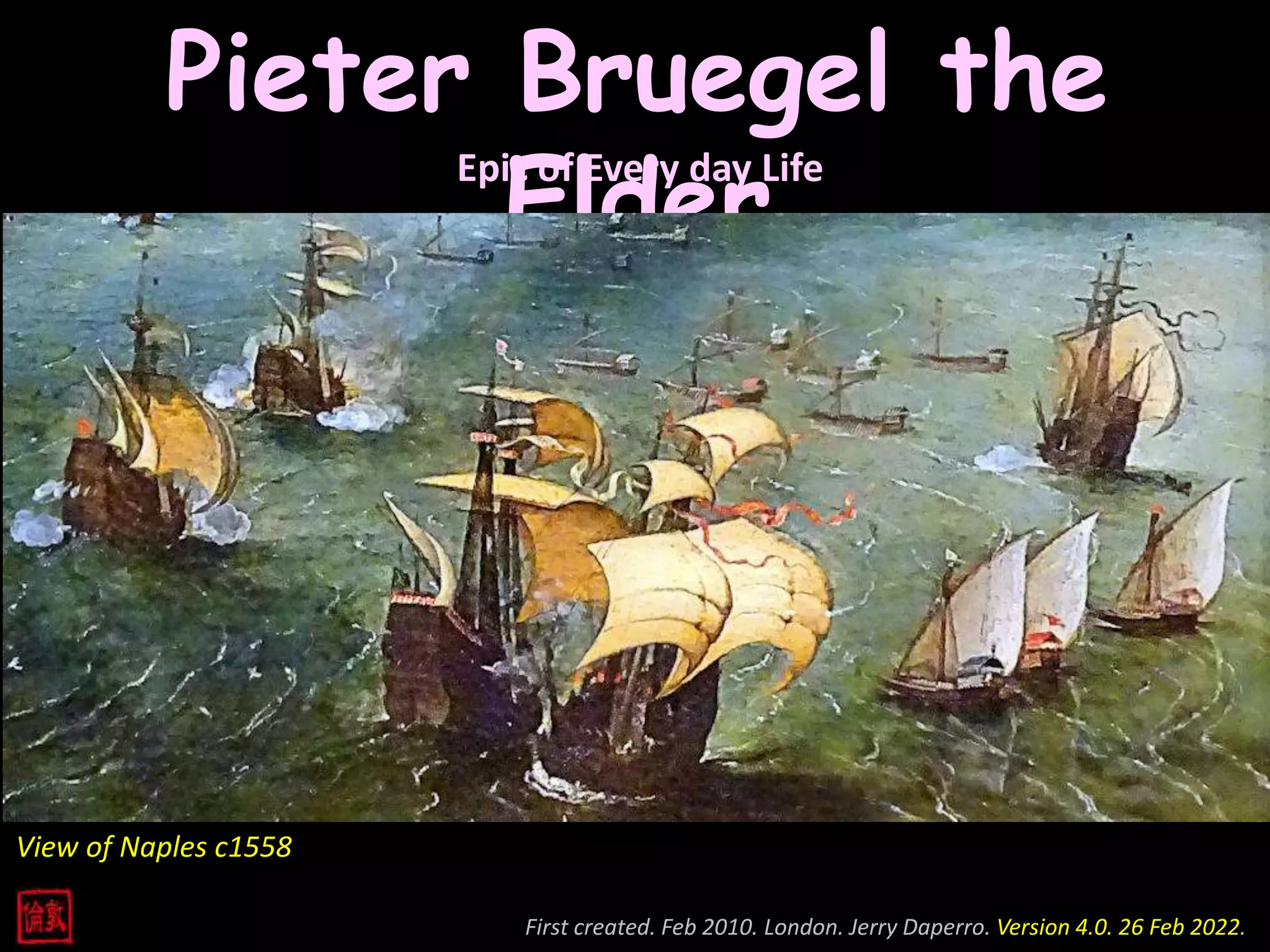
View of Naples c1558
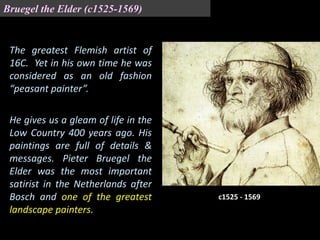
The greatest Flemish artist of
16C. Yet in his own time he was
considered as an old fashion
“peasant painter”.
c1525 - 1569
Bruegel the Elder (c1525-1569)
He gives us a gleam of life in the
Low Country 400 years ago. His
paintings are full of details &
messages. Pieter Bruegel the
Elder was the most important
satirist in the Netherlands after
Bosch and one of the greatest
landscape painters.
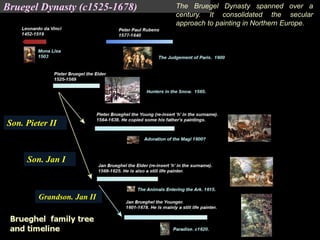
Son. Pieter II
Son. Jan I
Grandson. Jan II
Bruegel Dynasty (c1525-1678) The Bruegel Dynasty spanned over a
century. It consolidated the secular
approach to painting in Northern Europe.
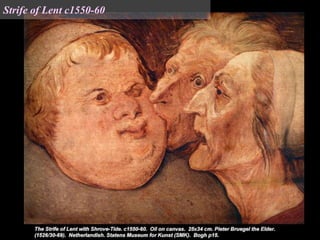
Strife of Lent c1550-60
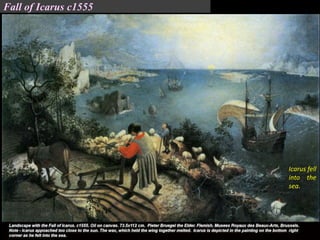
Fall of Icarus c1555
Icarus fell
into the
sea.
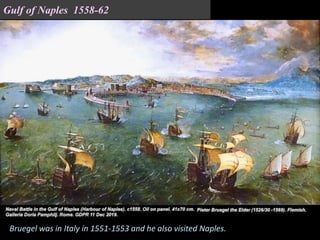
Gulf of Naples 1558-62
Bruegel was in Italy in 1551-1553 and he also visited Naples.
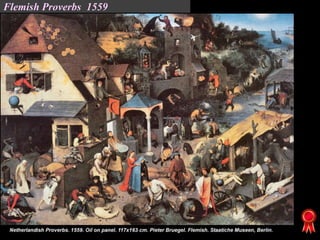
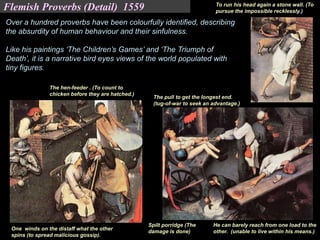
Flemish Proverbs 1559
He can barely reach from one load to the
other. (unable to live within his means.)
To run his head again a stone wall. (To
pursue the impossible recklessly.)
The hen-feeder . (To count to
chicken before they are hatched.)
One winds on the distaff what the other
spins (to spread malicious gossip).
The pull to get the longest end.
(tug-of-war to seek an advantage.)
Spilt porridge (The
damage is done)
Over a hundred proverbs have been colourfully identified, describing
the absurdity of human behaviour and their sinfulness.
Like his paintings ‘The Children’s Games’ and ‘The Triumph of
Death’, it is a narrative bird eyes views of the world populated with
tiny figures.
Flemish Proverbs (Detail) 1559
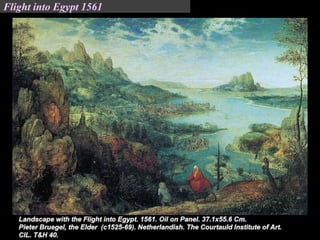
Flight into Egypt 1561
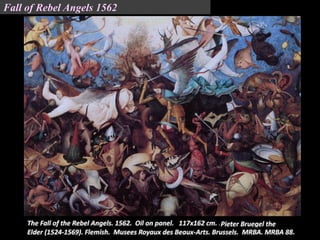
Fall of Rebel Angels 1562
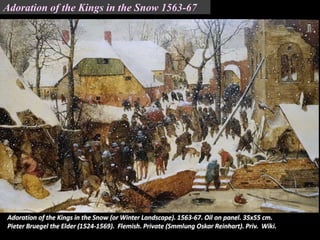
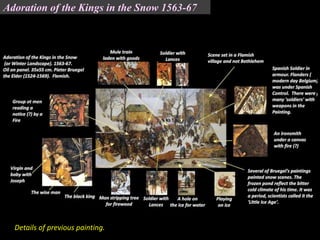
Adoration of the Kings in the Snow 1563-67
Details of previous painting.
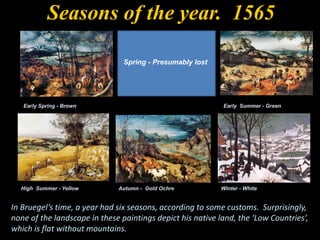
Early Spring - Brown
Spring - Presumably lost
Early Summer - Green
High Summer - Yellow Autumn - Gold Ochre Winter - White
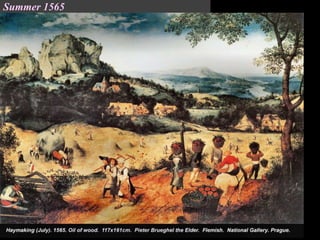
In Bruegel‘s time, a year had six seasons, according to some customs. Surprisingly,
none of the landscape in these paintings depict his native land, the ‘Low Countries’,
which is flat without mountains.
Seasons of the year. 1565
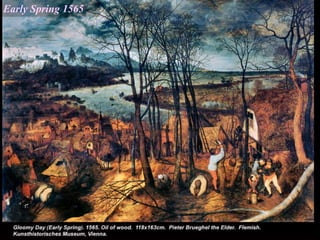
Early Spring 1565
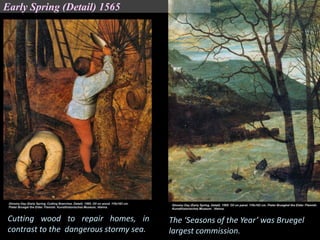
The ‘Seasons of the Year’ was Bruegel
largest commission.
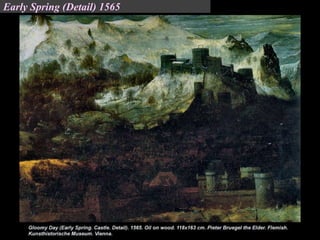
Cutting wood to repair homes, in
contrast to the dangerous stormy sea.
Early Spring (Detail) 1565
Summer 1565
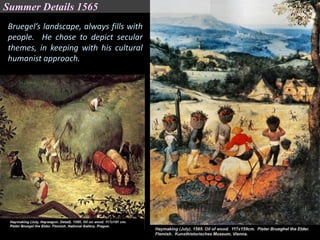
Bruegel’s landscape, always fills with
people. He chose to depict secular
themes, in keeping with his cultural
humanist approach.
Summer Details 1565
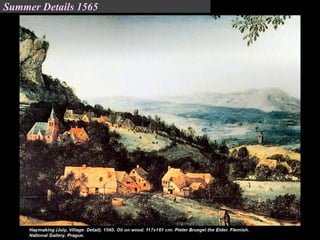
Summer Details 1565
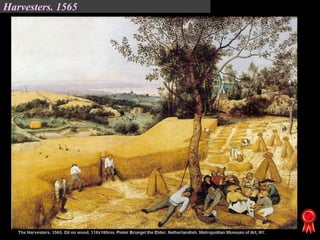
Harvesters. 1565
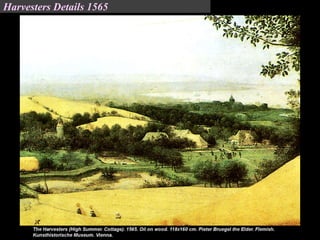
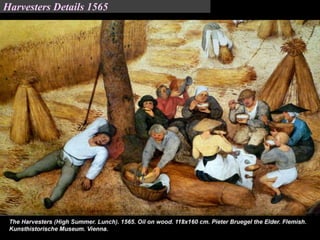
Harvesters Details 1565
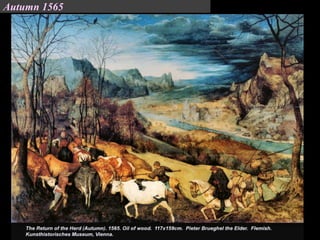
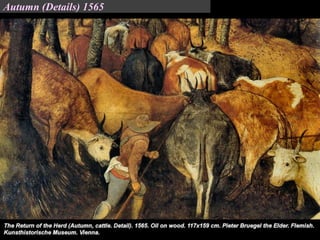
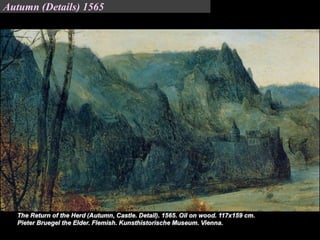
Autumn 1565
Autumn (Details) 1565
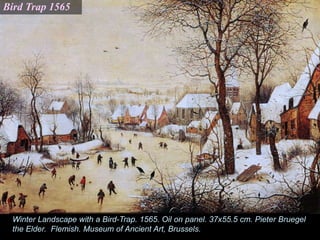
Winter Landscape with a Bird-Trap. 1565. Oil on panel. 37x55.5 cm. Pieter Bruegel
the Elder. Flemish. Museum of Ancient Art, Brussels.
Bird Trap 1565
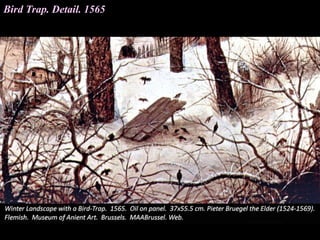
Bird Trap. Detail. 1565
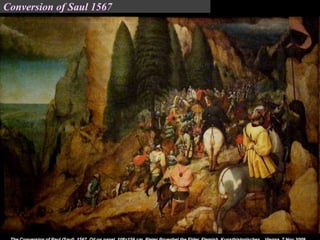
Conversion of Saul 1567
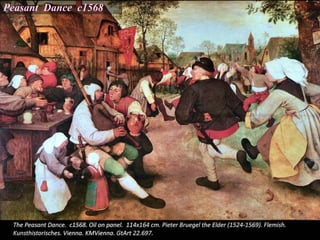
Peasant Dance c1568
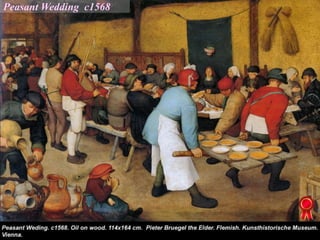
Peasant Wedding c1568
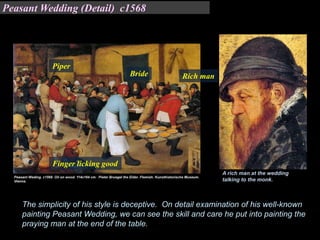
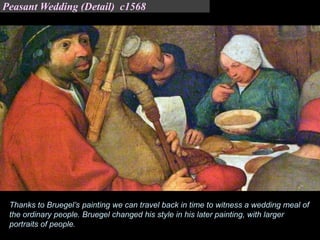
The simplicity of his style is deceptive. On detail examination of his well-known
painting Peasant Wedding, we can see the skill and care he put into painting the
praying man at the end of the table.
A rich man at the wedding
talking to the monk.
Bride Rich man
Piper
Finger licking good
Peasant Wedding (Detail) c1568
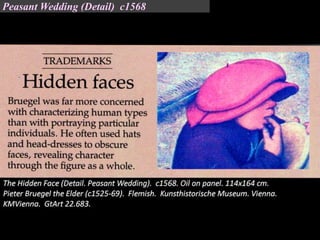
Thanks to Bruegel’s painting we can travel back in time to witness a wedding meal of
the ordinary people. Bruegel changed his style in his later painting, with larger
portraits of people.
Peasant Wedding (Detail) c1568
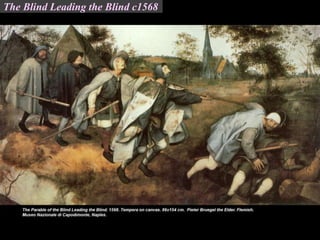
The Blind Leading the Blind c1568
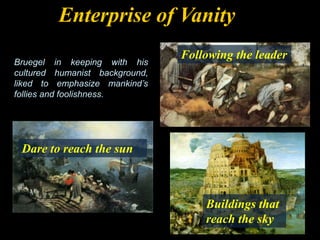
Enterprise of Vanity
Bruegel in keeping with his
cultured humanist background,
liked to emphasize mankind’s
follies and foolishness.
Buildings that
reach the sky
Following the leader
Dare to reach the sun
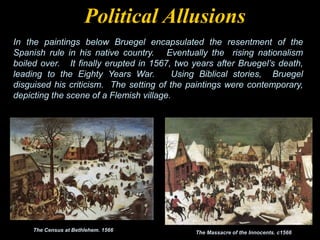
The Census at Bethlehem. 1566 The Massacre of the Innocents. c1566
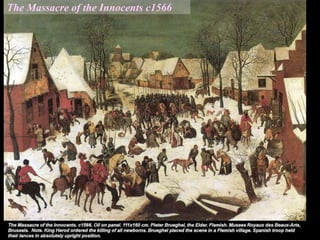
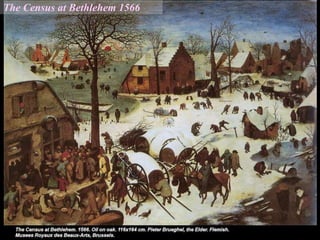
In the paintings below Bruegel encapsulated the resentment of the
Spanish rule in his native country. Eventually the rising nationalism
boiled over. It finally erupted in 1567, two years after Bruegel’s death,
leading to the Eighty Years War. Using Biblical stories, Bruegel
disguised his criticism. The setting of the paintings were contemporary,
depicting the scene of a Flemish village.
Political Allusions
The Massacre of the Innocents c1566
The Census at Bethlehem 1566
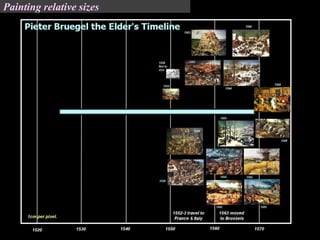
Painting relative sizes
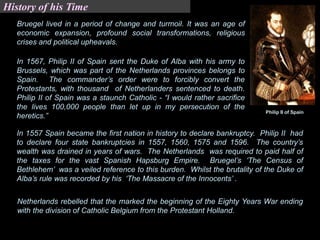
Bruegel lived in a period of change and turmoil. It was an age of
economic expansion, profound social transformations, religious
crises and political upheavals.
In 1567, Philip II of Spain sent the Duke of Alba with his army to
Brussels, which was part of the Netherlands provinces belongs to
Spain. The commander’s order were to forcibly convert the
Protestants, with thousand of Netherlanders sentenced to death.
Philip II of Spain was a staunch Catholic - “I would rather sacrifice
the lives 100,000 people than let up in my persecution of the
heretics.”
Philip II of Spain
In 1557 Spain became the first nation in history to declare bankruptcy. Philip II had
to declare four state bankruptcies in 1557, 1560, 1575 and 1596. The country’s
wealth was drained in years of wars. The Netherlands was required to paid half of
the taxes for the vast Spanish Hapsburg Empire. Bruegel’s ‘The Census of
Bethlehem’ was a veiled reference to this burden. Whilst the brutality of the Duke of
Alba’s rule was recorded by his ‘The Massacre of the Innocents’ .
Netherlands rebelled that the marked the beginning of the Eighty Years War ending
with the division of Catholic Belgium from the Protestant Holland.
History of his Time
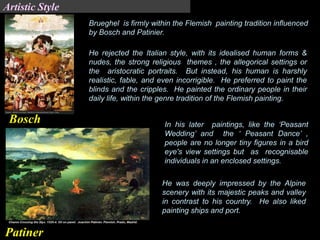
Brueghel is firmly within the Flemish painting tradition influenced
by Bosch and Patinier.
He rejected the Italian style, with its idealised human forms &
nudes, the strong religious themes , the allegorical settings or
the aristocratic portraits. But instead, his human is harshly
realistic, fable, and even incorrigible. He preferred to paint the
blinds and the cripples. He painted the ordinary people in their
daily life, within the genre tradition of the Flemish painting.
In his later paintings, like the ‘Peasant
Wedding’ and the ‘ Peasant Dance’ ,
people are no longer tiny figures in a bird
eye's view settings but as recognisable
individuals in an enclosed settings.
He was deeply impressed by the Alpine
scenery with its majestic peaks and valley
in contrast to his country. He also liked
painting ships and port.
Bosch
Patiner
Artistic Style
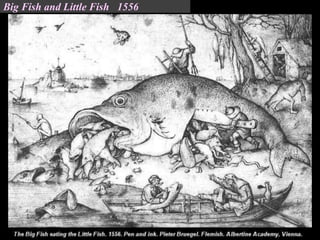
Big Fish and Little Fish 1556
See the above paintings in Pieter Bruegel in Details
slideshow
The End
Music from the ballet Sylvia (1876), act III, Divertissment No 20
(Pizzicati). Composed by Leo Delibes (1836-1891).
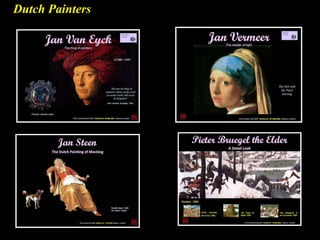
Dutch Painters
Pieter Bruegel 4.0
Pieter Bruegel 4.0

Pieter Bruegel 4.0

  • 1.
    First created. Feb2010. London. Jerry Daperro. Version 4.0. 26 Feb 2022. Pieter Bruegel the Elder Epic of Every day Life View of Naples c1558
  • 2.
    The greatest Flemishartist of 16C. Yet in his own time he was considered as an old fashion “peasant painter”. c1525 - 1569 Bruegel the Elder (c1525-1569) He gives us a gleam of life in the Low Country 400 years ago. His paintings are full of details & messages. Pieter Bruegel the Elder was the most important satirist in the Netherlands after Bosch and one of the greatest landscape painters.
  • 3.
    Son. Pieter II Son.Jan I Grandson. Jan II Bruegel Dynasty (c1525-1678) The Bruegel Dynasty spanned over a century. It consolidated the secular approach to painting in Northern Europe.
  • 4.
  • 5.
    Fall of Icarusc1555 Icarus fell into the sea.
  • 6.
    Gulf of Naples1558-62 Bruegel was in Italy in 1551-1553 and he also visited Naples.
  • 7.
  • 8.
    He can barelyreach from one load to the other. (unable to live within his means.) To run his head again a stone wall. (To pursue the impossible recklessly.) The hen-feeder . (To count to chicken before they are hatched.) One winds on the distaff what the other spins (to spread malicious gossip). The pull to get the longest end. (tug-of-war to seek an advantage.) Spilt porridge (The damage is done) Over a hundred proverbs have been colourfully identified, describing the absurdity of human behaviour and their sinfulness. Like his paintings ‘The Children’s Games’ and ‘The Triumph of Death’, it is a narrative bird eyes views of the world populated with tiny figures. Flemish Proverbs (Detail) 1559
  • 9.
  • 10.
    Fall of RebelAngels 1562
  • 11.
    Adoration of theKings in the Snow 1563-67
  • 12.
    Adoration of theKings in the Snow 1563-67 Details of previous painting.
  • 13.
    Early Spring -Brown Spring - Presumably lost Early Summer - Green High Summer - Yellow Autumn - Gold Ochre Winter - White In Bruegel‘s time, a year had six seasons, according to some customs. Surprisingly, none of the landscape in these paintings depict his native land, the ‘Low Countries’, which is flat without mountains. Seasons of the year. 1565
  • 14.
  • 15.
    The ‘Seasons ofthe Year’ was Bruegel largest commission. Cutting wood to repair homes, in contrast to the dangerous stormy sea. Early Spring (Detail) 1565
  • 16.
  • 17.
  • 18.
    Bruegel’s landscape, alwaysfills with people. He chose to depict secular themes, in keeping with his cultural humanist approach. Summer Details 1565
  • 19.
  • 20.
  • 21.
  • 22.
  • 23.
  • 24.
  • 25.
  • 26.
    Winter Landscape witha Bird-Trap. 1565. Oil on panel. 37x55.5 cm. Pieter Bruegel the Elder. Flemish. Museum of Ancient Art, Brussels. Bird Trap 1565
  • 27.
  • 28.
  • 29.
  • 30.
  • 31.
    The simplicity ofhis style is deceptive. On detail examination of his well-known painting Peasant Wedding, we can see the skill and care he put into painting the praying man at the end of the table. A rich man at the wedding talking to the monk. Bride Rich man Piper Finger licking good Peasant Wedding (Detail) c1568
  • 32.
    Thanks to Bruegel’spainting we can travel back in time to witness a wedding meal of the ordinary people. Bruegel changed his style in his later painting, with larger portraits of people. Peasant Wedding (Detail) c1568
  • 33.
  • 34.
    The Blind Leadingthe Blind c1568
  • 35.
    Enterprise of Vanity Bruegelin keeping with his cultured humanist background, liked to emphasize mankind’s follies and foolishness. Buildings that reach the sky Following the leader Dare to reach the sun
  • 36.
    The Census atBethlehem. 1566 The Massacre of the Innocents. c1566 In the paintings below Bruegel encapsulated the resentment of the Spanish rule in his native country. Eventually the rising nationalism boiled over. It finally erupted in 1567, two years after Bruegel’s death, leading to the Eighty Years War. Using Biblical stories, Bruegel disguised his criticism. The setting of the paintings were contemporary, depicting the scene of a Flemish village. Political Allusions
  • 37.
    The Massacre ofthe Innocents c1566
  • 38.
    The Census atBethlehem 1566
  • 39.
  • 40.
    Bruegel lived ina period of change and turmoil. It was an age of economic expansion, profound social transformations, religious crises and political upheavals. In 1567, Philip II of Spain sent the Duke of Alba with his army to Brussels, which was part of the Netherlands provinces belongs to Spain. The commander’s order were to forcibly convert the Protestants, with thousand of Netherlanders sentenced to death. Philip II of Spain was a staunch Catholic - “I would rather sacrifice the lives 100,000 people than let up in my persecution of the heretics.” Philip II of Spain In 1557 Spain became the first nation in history to declare bankruptcy. Philip II had to declare four state bankruptcies in 1557, 1560, 1575 and 1596. The country’s wealth was drained in years of wars. The Netherlands was required to paid half of the taxes for the vast Spanish Hapsburg Empire. Bruegel’s ‘The Census of Bethlehem’ was a veiled reference to this burden. Whilst the brutality of the Duke of Alba’s rule was recorded by his ‘The Massacre of the Innocents’ . Netherlands rebelled that the marked the beginning of the Eighty Years War ending with the division of Catholic Belgium from the Protestant Holland. History of his Time
  • 41.
    Brueghel is firmlywithin the Flemish painting tradition influenced by Bosch and Patinier. He rejected the Italian style, with its idealised human forms & nudes, the strong religious themes , the allegorical settings or the aristocratic portraits. But instead, his human is harshly realistic, fable, and even incorrigible. He preferred to paint the blinds and the cripples. He painted the ordinary people in their daily life, within the genre tradition of the Flemish painting. In his later paintings, like the ‘Peasant Wedding’ and the ‘ Peasant Dance’ , people are no longer tiny figures in a bird eye's view settings but as recognisable individuals in an enclosed settings. He was deeply impressed by the Alpine scenery with its majestic peaks and valley in contrast to his country. He also liked painting ships and port. Bosch Patiner Artistic Style
  • 42.
    Big Fish andLittle Fish 1556
  • 43.
    See the abovepaintings in Pieter Bruegel in Details slideshow The End Music from the ballet Sylvia (1876), act III, Divertissment No 20 (Pizzicati). Composed by Leo Delibes (1836-1891).
  • 44.

Editor's Notes

  • #2 The greatest Flemish artist of 16th century. This realistic and landscape painter, gives us a gleam of life in the Low Country 400 years ago. His paintings are full of details & messages and so interesting to look at. Pieter Bruegel the Elder (c1525/30-69), nicknamed ‘Peasant Bruegel’, was the most important satirist in the Netherlands after Bosch and one of the greatest landscape painters. After he became Master in the Antwerp Guild in 1551, he went to France and Italy, travelling as far south as Sicily. He was impressed by the landscape of Italy but not so on the Italian paintings. From his painting, he gave us insights to the peasant life and their relationship with nature of 16C in the Low Countries. He was an educated man, well able to associate with his distinguished clients and sophisticated enough disguised his political opinions as a biblical story.
  • #44 Ver 1.0 Released Feb 2010 Ver 2.0 Released 30 May 2017 Ver 3.0 Released c July 2021 added notes slide of Babel, add Adoration in snow, notes etc.. Change Music. Remove Animation Ver 4.0 26 Feb 2022 - version 3 splited into two version. A new version on detail looks of a few of his paintings.